⚠ Evidence warning: Clinical trials or other evidence do not support the claim that glutathione and the integrative nutraceutical protocol (N-acetylcysteine, glycine, alpha-lipoic acid, coenzyme Q10, curcumin, sulforaphane and others) slow Parkinson's progression or protect the brain's dopamine neurons. This page keeps it as a report of what people, websites or other media say.
Glutathione for Parkinson's Disease & Dopaminergic Neuroprotection
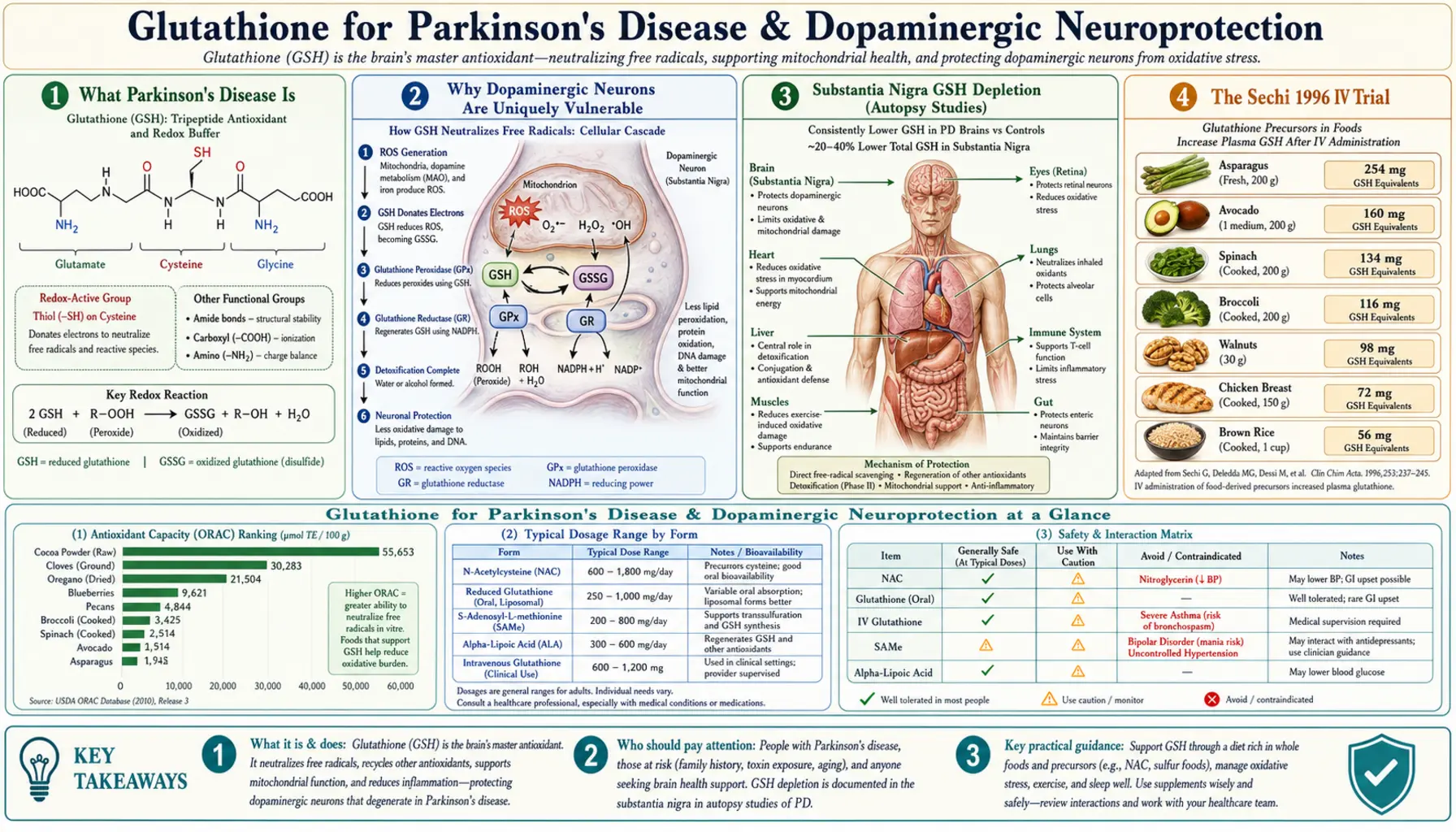
Parkinson's disease involves the selective oxidative destruction of dopaminergic neurons in the substantia nigra pars compacta. Glutathione levels in the substantia nigra are reduced by 40-50% in Parkinson's patients at autopsy, and this depletion is detectable even in early-stage disease — suggesting it may be a causal contributor rather than merely a consequence of neurodegeneration. The Sechi 1996 open-label intravenous glutathione study of 9 patients reported a 42% decline in disability over 30 days at 600 mg twice daily, launching widespread off-label use of intravenous (IV) glutathione in integrative neurology. Two small placebo-controlled trials (Hauser 2009, Mischley 2017) found no significant difference from placebo. This deep-dive walks through the dopaminergic-neuron oxidative vulnerability mechanism, the pivotal trials, the practical intravenous and intranasal protocols, and the integrative neurology framework that combines glutathione with N-acetylcysteine (NAC), lipoic acid, glycine, selenium, and coenzyme Q10 (CoQ10) for neuroprotective effect in early-stage disease.
Interactive Visualization Free Radicals & Your Antioxidant Network Follow one superoxide radical down the whole relay — superoxide dismutase (SOD), catalase, glutathione, vitamin E, vitamin C, reduced nicotinamide adenine dinucleotide phosphate (NADPH) — then release free iron and watch a membrane tear itself apart. Launch →
Table of Contents
- What Parkinson's Disease Is
- Why Dopaminergic Neurons Are Uniquely Vulnerable
- Substantia Nigra Reduced Glutathione Depletion (Autopsy Studies)
- The Sechi 1996 Intravenous Trial
- The Hauser 2009 Controlled Trial
- The Mischley Intranasal Trials
- N-Acetylcysteine Trials & the Monti DaT Imaging Data
- Alpha-Synuclein, Iron, and Oxidative Modification
- Integrative Neurology Protocol (Mischley, Perlmutter)
- Protocols Used in Integrative Practice
- Patient FAQ
- Cautions Specific to Parkinson's Patients
- Key Research Papers
- Connections
- Featured Videos
What Parkinson's Disease Is
Parkinson's disease (PD) is a progressive neurodegenerative disorder characterized by the selective death of dopaminergic neurons in the substantia nigra pars compacta — the midbrain region that projects dopamine to the striatum (basal ganglia). The dopamine signal from the substantia nigra is essential for smooth, coordinated voluntary movement. As nigral neurons die, dopamine output falls; once roughly 60-80% of substantia nigra neurons have been lost, the clinical syndrome of bradykinesia, rigidity, resting tremor, and postural instability emerges.
Beyond the cardinal motor features, PD includes a constellation of non-motor manifestations: REM sleep behavior disorder (often preceding motor symptoms by 10-20 years), constipation, hyposmia (loss of smell), autonomic dysfunction, cognitive decline, depression, anxiety, and visual hallucinations. The pathological hallmark is alpha-synuclein aggregation into Lewy bodies and Lewy neurites within affected neurons.
Conventional pharmacological treatment focuses on dopamine replacement (levodopa/carbidopa) and dopamine receptor agonists (pramipexole, ropinirole, rotigotine), with adjuncts (MAO-B inhibitors selegiline and rasagiline, COMT inhibitors entacapone, the N-methyl-D-aspartate (NMDA) antagonist amantadine). These provide symptomatic relief but do not slow the underlying neurodegeneration. Deep brain stimulation (DBS) is reserved for advanced motor fluctuations and dyskinesias.
The fundamental therapeutic gap in PD is the absence of any approved disease-modifying intervention — nothing that actually slows the progressive loss of nigral neurons. This is the gap that glutathione, N-acetylcysteine, and the broader integrative neurology approach attempts to fill, particularly in early-stage disease where some neuronal rescue may still be possible. For the full clinical picture, see our Parkinson's Disease page.
Why Dopaminergic Neurons Are Uniquely Vulnerable
The substantia nigra dopaminergic neurons are among the most metabolically and oxidatively stressed neurons in the brain. Several converging factors explain their unique vulnerability:
- Dopamine itself is oxidatively unstable — dopamine spontaneously auto-oxidizes to dopamine quinones, semiquinones, and aminochrome, generating superoxide and hydrogen peroxide in the process. MAO-B metabolism of dopamine also generates hydrogen peroxide. Dopaminergic neurons therefore live with chronic intracellular reactive oxygen species (ROS) production simply by virtue of containing dopamine.
- Neuromelanin and iron accumulation — nigral neurons accumulate neuromelanin (a polymerized derivative of dopamine and dopa-quinone) over decades. Neuromelanin binds iron, and the substantia nigra has the highest iron concentration of any brain region. Free iron catalyzes the Fenton reaction (H2O2 + Fe2+ → OH• + OH− + Fe3+), generating extremely damaging hydroxyl radicals.
- Very high mitochondrial density and energy demand — these neurons have unusually long, unmyelinated axons with thousands of synaptic boutons, each requiring continuous mitochondrial adenosine triphosphate (ATP) production. The high mitochondrial density means high baseline electron transport chain leak and high superoxide production.
- Calcium channel-driven autonomous firing — nigral dopaminergic neurons use Cav1.3 L-type calcium channels to drive their pacemaker firing, which produces continuous intracellular calcium oscillations. Calcium-driven mitochondrial uncoupling adds to oxidative stress.
- Reduced antioxidant capacity — nigral neurons have relatively low baseline glutathione compared to other brain regions, and lower expression of catalase, superoxide dismutase, and glutathione peroxidase. They are positioned at the edge of their antioxidant reserve under normal conditions.
- Mitochondrial complex I deficiency in PD — the iconic biochemical finding in Parkinson's substantia nigra is a 25-40% reduction in mitochondrial complex I activity, which both impairs adenosine triphosphate production and increases superoxide leak. This is the basis of the MPTP/MPP+ model of PD — MPTP is converted by MAO-B to MPP+, which inhibits complex I and produces a Parkinson's-like syndrome.
The combination — high baseline reactive oxygen species production, high iron load, mitochondrial complex I dysfunction, and low baseline antioxidant capacity — explains why these specific neurons are uniquely vulnerable to oxidative damage and why glutathione supplementation has a particularly compelling theoretical rationale in PD. The biology is exactly the kind of setting where restoring antioxidant capacity might rescue surviving neurons and slow further loss.
Substantia Nigra Reduced Glutathione Depletion (Autopsy Studies)
The Sian, Dexter, Marsden group at King's College London (1990s landmark papers) and the Perry group's Vancouver autopsy series both documented dramatic and selective reductions in substantia nigra glutathione in Parkinson's patients at autopsy:
- 40-50% reduction in total substantia nigra reduced glutathione (GSH) compared to age-matched non-PD controls
- Selectivity — the reduction was confined to the substantia nigra; in the Sian 1994 study the other brain areas measured (putamen, caudate nucleus, globus pallidus and cerebral cortex) showed no change
- Early disease finding — reduced nigral reduced glutathione was present in patients with incidental Lewy body disease (preclinical PD identified at autopsy in patients who died of other causes), suggesting reduced glutathione depletion precedes clinical symptoms
- Not explained by drug treatment alone — patients with multiple-system atrophy, who were also treated with levodopa, did not show the nigral reduction, so Sian 1994 concluded the change is not entirely explained by drug therapy
- Parallel reductions in glutathione synthesis enzymes (GCL subunits) and increased markers of oxidative damage (4-hydroxynonenal, malondialdehyde, 8-OHdG)
The temporal sequence is critical. If reduced glutathione depletion were merely a consequence of neuronal death, it would correlate with disease severity and be absent in incidental Lewy body disease. The fact that it appears in pre-symptomatic disease and precedes overt neuronal loss is consistent with a causal contribution — reduced glutathione depletion may be one of the early biochemical events that creates the oxidative milieu permitting dopaminergic degeneration to progress.
This is the clinical and biochemical foundation for considering glutathione replacement as potentially disease-modifying rather than merely symptomatic. The mechanism is plausible; the question is whether exogenous glutathione (or its precursors) can actually raise intra-nigral glutathione to therapeutic levels.
The Sechi 1996 Intravenous Trial
Giovanni Sechi and colleagues at the University of Sassari (Sardinia) published the landmark 1996 paper in Progress in Neuropsychopharmacology & Biological Psychiatry that essentially launched intravenous glutathione as an off-label PD therapy in integrative neurology. The trial design was simple:
- Patients: 9 untreated, newly diagnosed Parkinson's patients (no prior levodopa or dopamine agonists)
- Intervention: Reduced glutathione 600 mg intravenous twice daily for 30 days
- Design: Open-label, single-arm, with patients serving as their own pre/post controls
- Outcome measure: clinical disability, assessed with two rating scales and the Webster Step-Second Test
Results
- 42% decline in disability at the end of the 30-day treatment course; all 9 patients improved significantly
- Clinical improvement persisted for 2-4 months after the intravenous glutathione was discontinued before gradually declining
- Improvement was apparent in bradykinesia, rigidity, and resting tremor
- No significant adverse events; the intravenous infusions were well-tolerated
Limitations
The trial design has important weaknesses that subsequent commentary has emphasized:
- Small sample size (n=9)
- Open-label, no placebo control — placebo response in PD is substantial (15-25% UPDRS improvement is typical in placebo arms)
- Single center, single investigator
- Patients served as their own controls, but spontaneous early-disease variability could contribute
Impact
Despite the methodological limitations, the magnitude of effect (42% decline in disability, larger than most pharmaceutical trials) and the persistence of benefit after discontinuation captured clinical attention. The study spawned widespread off-label use of intravenous glutathione in integrative neurology practices in Europe and the US. Many of the surviving patients of the Sechi study reportedly continued periodic intravenous glutathione courses with reported sustained benefit, though no formal long-term follow-up was published.
The replication record since 1996 has been mixed, but the Sechi study remains the founding clinical observation that motivates continued exploration of glutathione-based PD interventions.
The Hauser 2009 Controlled Trial
Robert Hauser and colleagues at the University of South Florida ran a small randomized, double-blind, placebo-controlled trial of intravenous glutathione published in Movement Disorders in 2009:
- Patients: 21 Parkinson's patients with moderate disease (Hoehn-Yahr stage 2-3) whose motor symptoms were not adequately controlled on their current medicines; 11 were randomised to glutathione and 10 to placebo
- Intervention: intravenous glutathione 1400 mg three times weekly versus intravenous saline placebo for 4 weeks (total 12 infusions)
- Outcome measures: UPDRS motor score, global clinical impression, quality of life measures
Results
- There were no significant differences in changes in UPDRS scores. Over the 4 weeks of infusions, the combined daily-living + motor UPDRS score improved by a mean of 2.8 units more in the glutathione group than on placebo (P = 0.32), a difference that could be chance
- Over the 8 weeks after the infusions stopped, the same score worsened by a mean of 3.5 units more in the glutathione group (P = 0.54)
- Quality of life measures showed numerical but non-significant improvement
- The placebo group also showed some improvement (typical placebo response in PD trials)
- No significant adverse events; intravenous glutathione was well-tolerated
Interpretation
The Hauser trial is often cited as "negative" because it did not reach statistical significance, but the magnitude and direction of effect were consistent with a smaller version of the Sechi finding. Several factors likely contributed to the failure to demonstrate clear benefit:
- Underpowered — with n=21 split across two arms, the trial had limited power to detect modest effects against placebo response
- Short duration — 4 weeks vs Sechi's 30 days at twice the daily dose
- More advanced disease — Sechi enrolled untreated newly-diagnosed patients where neuronal rescue might be most feasible; Hauser enrolled patients with moderate established disease
- Less frequent dosing — three times weekly vs daily, possibly producing less sustained intracellular elevation
The Hauser trial does not refute the Sechi finding, but it tempers enthusiasm: if there is a real effect of intravenous glutathione on PD progression, the effect size in moderate-stage disease with intermittent dosing may be too small to detect in 21 patients over 4 weeks.
The Mischley Intranasal Trials
Laurie Mischley (ND, MPH, PhD) at Bastyr University has run the most systematic clinical program on intranasal glutathione delivery in PD. The intranasal route is appealing because it potentially delivers glutathione directly to the brain via olfactory and trigeminal nerve pathways, bypassing the blood-brain barrier limitations of oral or systemic intravenous administration.
Phase IIb trial (Mischley et al., 2017, Journal of Parkinson's Disease)
- Design: Randomized, double-blind, placebo-controlled, three-arm trial
- Patients: 45 Parkinson's patients (Hoehn & Yahr stage 1-3)
- Interventions: Intranasal placebo (saline), 100 mg reduced glutathione, or 200 mg reduced glutathione per dose, three times daily for 3 months, followed by a one-month washout
- Outcome: UPDRS, quality of life, and biomarker measures
Results
- All groups improved, including placebo. The high-dose (200 mg) group improved over its own baseline in total UPDRS (−4.6 points, P = 0.0025) and UPDRS motor subscore (−2.2 points, P = 0.0485), but neither glutathione group did better than placebo
- The placebo group showed substantial improvement — the authors note it was more robust than in previous PD studies
- One participant in the high-dose glutathione group developed cardiomyopathy (a disease of the heart muscle)
- Subgroup analyses suggested possible greater benefit in patients with higher baseline oxidative stress markers
Interpretation
Like the Hauser trial, the Mischley study illustrates the fundamental challenge of PD neuroprotection trials: placebo response is large, the disease progresses slowly, sample sizes are typically small, and demonstrating that an intervention slows progression requires long-duration trials with careful biomarker selection.
The Mischley group has continued to develop intranasal glutathione protocols in clinical practice, where the outcomes appear (anecdotally) more favorable than the formal trial data would suggest. The intranasal route remains an active area of investigation.
Brain uptake study (Mischley et al., 2016)
An earlier brain-scan study (magnetic resonance spectroscopy) in 15 people with mid-stage Parkinson's measured brain glutathione before and after a single 200 mg intranasal dose taken inside the scanner. Brain glutathione rose above baseline overall (P<0.001): there was no rise at 8 minutes, but levels were significantly higher at every later time point (P<0.01) and stayed higher for at least an hour. This showed that the nasal route reaches the brain; the study did not test symptoms, and the authors state that dose-response studies are still needed.
N-Acetylcysteine Trials & the Monti DaT Imaging Data
Daniel Monti and colleagues at Thomas Jefferson University Hospital have run trials of intravenous and oral N-acetylcysteine in Parkinson's disease with imaging biomarkers, providing some of the most provocative data in this area.
Monti 2016, 2019 trials
The Monti group's 2019 publication in Clinical Pharmacology & Therapeutics reported a randomized trial in 42 Parkinson's patients of intravenous N-acetylcysteine (50 mg/kg intravenous weekly) plus oral N-acetylcysteine (500 mg twice daily) for 3 months versus standard care alone, with DaT-SPECT imaging before and after. The comparison group received their usual care, not a placebo, so patients knew whether they were getting N-acetylcysteine (an open-label design):
- DaT-SPECT imaging measures dopamine transporter density in the striatum, an objective biomarker of presynaptic dopaminergic neuron integrity
- The N-acetylcysteine group showed measurable increased DaT binding in the caudate and putamen compared to standard-care controls (mean increases of 3.4% to 8.3%, P < 0.05)
- UPDRS motor scores improved more in the N-acetylcysteine group; the abstract reports significantly improved PD symptoms (P < 0.0001)
- The authors conclude that "Larger scale studies are warranted."
- The imaging finding is potentially the first objective evidence of dopaminergic neuron rescue or restoration in human PD trials
Interpretation
The Monti DaT imaging data are the strongest objective evidence in this entire area that antioxidant intervention can favorably affect dopaminergic neuron integrity in PD. The result has been replicated by some groups and not by others; the methodological community has debated whether the DaT changes reflect actual neuron rescue, surviving-neuron upregulation, or technical artifact.
Integrative practitioners cite the Monti trials in support of N-acetylcysteine (oral 600 mg twice daily or more; intravenous N-acetylcysteine weekly to monthly in some integrative protocols) as a foundational PD nutraceutical, complementing or potentially substituting for direct glutathione administration.
2026 systematic review of N-acetylcysteine and glutathione
A 2026 systematic review (Mohammed and colleagues, Amino Acids) found 9 studies, carried out between 2009 and 2019, with 196 participants in total. N-acetylcysteine improved both motor and non-motor symptoms and significantly raised the reduced-to-oxidised glutathione ratio (GSH/GSSG), glutathione in the fluid around the brain and spinal cord (cerebrospinal fluid, CSF) and DAT binding. Intranasal glutathione gave only modest rises in brain levels, without significant improvement in symptoms or oxidative stress markers. The authors list small sample sizes, short treatment periods and inconsistent doses and routes as limitations, and call the evidence for both N-acetylcysteine and glutathione preliminary; they describe the findings for glutathione as inconclusive.
Alpha-Synuclein, Iron, and Oxidative Modification
Alpha-synuclein is the protein whose abnormal aggregation forms the Lewy bodies pathognomonic of Parkinson's disease. Recent biochemistry has clarified that alpha-synuclein aggregation is dramatically accelerated by oxidative modification of specific cysteine and tyrosine residues, and that glutathione status modulates this process.
- Methionine oxidation at alpha-synuclein methionine residues (Met1, Met5, Met116, Met127) shifts the protein conformation toward aggregation-prone forms
- Nitration of tyrosine residues by peroxynitrite (formed when nitric oxide reacts with superoxide) stabilizes alpha-synuclein oligomers and accelerates fibril formation
- Glutathione covalent adducts on alpha-synuclein can either accelerate or slow aggregation depending on the modification context
- Iron binding at the C-terminus of alpha-synuclein promotes aggregation; the substantia nigra's high iron load is a key contributor
- Dopamine quinone adducts on alpha-synuclein stabilize a particularly toxic oligomeric form
The convergence is striking: every modification that promotes alpha-synuclein toxicity involves an oxidative reaction that glutathione is positioned to prevent or reverse. This provides an additional mechanistic rationale for glutathione-targeted intervention — not just protecting neurons from generic oxidative damage, but specifically preventing the pathognomonic alpha-synuclein aggregation cascade.
The integrative neurology framework therefore typically pairs glutathione/N-acetylcysteine with iron chelators (in patients with elevated serum iron or ferritin — sometimes deferiprone is used in trial settings), reduced dietary iron (vegetable-heavy diets), and avoidance of unnecessary iron supplementation.
Integrative Neurology Protocol (Mischley, Perlmutter)
The integrative neurology approach to early-stage Parkinson's disease — pioneered by clinicians including Laurie Mischley, David Perlmutter, Roger Murphree, and others — goes beyond glutathione monotherapy to a multi-component nutraceutical protocol targeting the broader oxidative-mitochondrial-inflammatory cascade. Typical components:
- Glutathione precursors — N-acetylcysteine 600-1800 mg/day, glycine 5-10 g/day (GlyNAC approach)
- Direct glutathione — liposomal glutathione 500-1000 mg/day OR intravenous glutathione 600-2000 mg weekly to monthly OR intranasal glutathione 100-200 mg three times daily
- Alpha lipoic acid 300-600 mg/day — regenerates oxidized glutathione; crosses blood-brain barrier; addresses mitochondrial complex I dysfunction (see Alpha-Lipoic Acid for Neuroprotection)
- Coenzyme Q10 (ubiquinol form) 200-1200 mg/day — addresses mitochondrial complex I-III deficiency; the phase III QE3 trial of 1200 or 2400 mg/day found no benefit and was stopped for futility
- Selenium 200 mcg/day — essential cofactor for glutathione peroxidase
- Vitamin D 5000 international units (IU)/day to target serum 25-OH-D 50-80 ng/mL — PD patients commonly deficient; deficiency associated with faster progression
- Omega-3 fatty acids (eicosapentaenoic acid (EPA) + docosahexaenoic acid (DHA)) 2-4 g/day — anti-inflammatory; supports neuronal membrane integrity
- B-complex with methylated B12, methylfolate, P5P — supports methylation, transsulfuration to cysteine, and homocysteine clearance
- Vitamin K2 (menaquinone-7, MK-7) 100-200 mcg/day — some early evidence of motor benefit in PD
- Curcumin 500-1000 mg twice daily — Nrf2 activator; anti-inflammatory; some evidence of alpha-synuclein modulation
- Sulforaphane 30 mg/day from broccoli sprout extract — potent Nrf2 activator, upregulates endogenous antioxidant gene expression
- Mucuna pruriens — standardized to 15-30% L-dopa, sometimes used as adjunctive natural levodopa source; its L-dopa adds to the dose from pharmaceutical levodopa
This combination targets multiple mechanisms simultaneously — glutathione precursors + direct reduced glutathione for antioxidant defense, alpha-lipoic acid (ALA) + coenzyme Q10 for mitochondrial function, omega-3 + curcumin + sulforaphane for inflammation and Nrf2 activation, B-complex for methylation. The integrative position is that the disease has multiple pathophysiological drivers and that addressing one in isolation (the conventional pharmaceutical approach) misses the converging biology.
Outcomes data on this comprehensive approach are largely anecdotal and observational (Mischley's practice registry data, clinical observation), with limited randomized trial evidence for the full combination. The components individually have varying degrees of evidence as outlined above. In practice this approach is delivered by integrative neurology clinicians familiar with PD management.
One component, coenzyme Q10, was tested on its own in the phase III QE3 trial (Parkinson Study Group, 2014). It gave 600 people with early Parkinson's coenzyme Q10 at 1200 or 2400 mg/day, or placebo; everyone also received vitamin E 1200 IU/day. The trial was stopped early when a pre-set futility rule was met, and at that point both coenzyme Q10 groups showed slight adverse trends compared with placebo.
Protocols Used in Integrative Practice
The doses below are those described in integrative neurology practice (Mischley- and Perlmutter-style protocols). They come from practitioners' experience, not from trials of the full combination.
Early-stage Parkinson's disease (Hoehn-Yahr 1-2)
- N-acetylcysteine 600 mg twice daily as a minimum; some practitioners increase it to 1200 mg twice daily
- Glycine 5-10 g/day at bedtime
- Selenium 200 mcg/day from selenomethionine
- Alpha lipoic acid 300-600 mg/day on empty stomach
- Coenzyme Q10 (ubiquinol) 200-600 mg/day
- Vitamin D 5000 international units/day to target 25-OH-D 50-80 ng/mL
- Omega-3 (eicosapentaenoic acid + docosahexaenoic acid) 2-4 g/day
- Methylated B-complex
- In some protocols, liposomal glutathione 500-1000 mg/day OR periodic intravenous glutathione 1500-2000 mg weekly to monthly
- In some protocols, intranasal glutathione 100-200 mg three times daily
- Exercise — vigorous aerobic exercise has the strongest evidence base of any intervention for slowing PD progression
Moderate Parkinson's disease (Hoehn-Yahr 3)
Same foundation as early-stage with these additions:
- Monthly to weekly intravenous glutathione 1500-2000 mg, which practitioners call a Sechi-style protocol
- Curcumin 500-1000 mg twice daily added
- Sulforaphane 30 mg/day added
- Attention to sleep (REM sleep behavior disorder is common; practitioners use melatonin 3-9 mg at bedtime)
- Conventional dopamine replacement continues, adjusted by the neurologist
Advanced Parkinson's disease (Hoehn-Yahr 4-5)
The integrative interventions become more about quality of life, swallowing safety, and reducing complications than disease modification. N-acetylcysteine and glycine often continued; intravenous glutathione less commonly used given limited evidence of meaningful effect at this stage.
Intravenous glutathione protocol details
- Reduced glutathione 1500-2000 mg in 100-250 mL normal saline
- Infusion over 15-30 minutes
- Schedule: weekly × 4-8 weeks initially, then every 2-4 weeks for maintenance
- Reassessment after 12 weeks, with continuation when the patient reports benefit
- Performed by integrative medicine clinic or intravenous nutrient therapy clinic
- Cost typically $100-300 per infusion (rarely insurance-covered)
Patient FAQ
Q: Will glutathione cure my Parkinson's?
No. No intervention currently cures Parkinson's. The realistic hope with glutathione and integrative protocols is to slow progression and improve quality of life, particularly in early-stage disease.
Q: How quickly will I notice benefit?
Most patients who respond report subjective improvement within 2-6 weeks of starting comprehensive protocol. Objective UPDRS improvement, if it occurs, is typically apparent at 8-12 weeks. Some patients report no detectable benefit despite consistent use.
Q: What is known about intravenous glutathione?
The evidence for intravenous glutathione is mixed but the safety profile is excellent and many integrative neurologists use it routinely in early-stage disease. Practitioners who use it describe a 4-8 week trial of weekly infusions, stopped when no benefit is perceived and continued when the patient reports clear improvement.
Q: Will glutathione replace my levodopa?
No. Glutathione and integrative protocols are complementary to conventional dopamine replacement, not substitutes. Stopping levodopa or dopamine agonists without neurology supervision can cause severe motor decline or a neuroleptic malignant-like syndrome (see Cautions below).
Q: Are there any interactions with my Parkinson's medications?
No significant interactions are documented between glutathione/N-acetylcysteine and levodopa, dopamine agonists, MAO-B inhibitors, or COMT inhibitors. The combination is well-tolerated in clinical practice.
Q: Is DaT-SPECT imaging used to track progression?
Routine serial DaT-SPECT imaging is not standard of care. It can be useful in unclear diagnostic situations or research protocols. The Monti trial used it as an outcome measure, but for individual patients it adds cost without clear benefit beyond what clinical UPDRS assessment provides.
Q: What about exercise?
Vigorous aerobic exercise has the strongest disease-modifying evidence of any PD intervention — stronger than any medication or supplement. Practitioners describe a target of 150+ minutes per week of moderate-to-vigorous activity. Boxing, dance, and cycling protocols (e.g., non-contact boxing programmes and large-amplitude movement therapy) are particularly effective.
Cautions Specific to Parkinson's Patients
- Not a substitute for prescribed medications — glutathione, N-acetylcysteine, and integrative protocols complement conventional dopamine replacement; they do not replace it. Discontinuing levodopa or dopamine agonists without neurology supervision can cause severe motor decline or neuroleptic malignant-like syndrome.
- Many medicines at once — PD management increasingly involves multiple medications with complex titration, adjusted by the primary neurologist; integrative additions are added on top of that regimen.
- L-dopa absorption interactions — levodopa is absorbed by the same intestinal transporter as large neutral amino acids (including some used in glutathione precursor protocols). Because of this competition, L-dopa is commonly timed 30-60 minutes before high-protein meals or amino acid supplements (N-acetylcysteine, glycine) to protect its absorption.
- Pyridoxine (B6) caveat — high-dose pyridoxine (>25 mg/day) can increase peripheral L-dopa decarboxylation, reducing brain bioavailability. Modern carbidopa/levodopa combinations include carbidopa to prevent this, so the interaction is now less clinically significant than historically.
- Iron supplementation — given the iron-alpha-synuclein interaction, integrative practitioners limit iron supplements to people with documented iron deficiency. Iron supplements also reduce levodopa absorption; when both are taken, the doses are usually separated by 2+ hours.
- Sleep medication interactions — glycine has mild sedative properties, which can add to the effect of prescription sleep medications.
- Intravenous glutathione safety — safe when performed by trained clinicians in clinical settings. Cosmetic intravenous glutathione protocols are pharmacologically different and have documented serious adverse events.
- Sulfur sensitivity — rare patients with CBS pathway polymorphisms tolerate sulfur-containing supplements poorly; practitioners start them on low doses.
- Sulfurous breath / body odor — common with high-dose N-acetylcysteine; a lower dose, taking it with food, or breath fresheners are the usual responses.
- Orthostatic hypotension — PD patients often have autonomic dysfunction with orthostatic hypotension. N-acetylcysteine and glutathione don't typically affect this.
Key Research Papers
- Sechi G, Deledda MG, Bua G, Satta WM, Deiana GA, Pes GM, Rosati G (1996). Reduced intravenous glutathione in the treatment of early Parkinson's disease. Progress in Neuropsychopharmacology & Biological Psychiatry. — PubMed PMID: 8938817
- Hauser RA, Lyons KE, McClain T, Carter S, Perlmutter D (2009). Randomized, double-blind, pilot evaluation of intravenous glutathione in Parkinson's disease. Movement Disorders. — PubMed PMID: 19230029
- Mischley LK, Lau RC, Shankland EG, Wilbur TK, Padowski JM (2017). Phase IIb study of intranasal glutathione in Parkinson's disease. Journal of Parkinson's Disease. — PubMed PMID: 28436395
- Monti DA, Zabrecky G, Kremens D, Liang TW, Wintering NA, Bazzan AJ, Zhong L, Bowens BK, Chervoneva I, Intenzo C, Newberg AB (2019). N-acetyl cysteine is associated with dopaminergic improvement in Parkinson's disease. Clinical Pharmacology & Therapeutics. — PubMed PMID: 31206613
- Sian J, Dexter DT, Lees AJ, Daniel S, Agid Y, Javoy-Agid F, Jenner P, Marsden CD (1994). Alterations in glutathione levels in Parkinson's disease and other neurodegenerative disorders affecting basal ganglia. Annals of Neurology. — PubMed PMID: 8080242
- Perry TL, Godin DV, Hansen S (1982). Parkinson's disease: a disorder due to nigral glutathione deficiency? Neuroscience Letters. — PubMed PMID: 7162692
- Schapira AH, Cooper JM, Dexter D, Clark JB, Jenner P, Marsden CD (1990). Mitochondrial complex I deficiency in Parkinson's disease. Journal of Neurochemistry. — PubMed PMID: 2154550
- Bharath S, Hsu M, Kaur D, Rajagopalan S, Andersen JK (2002). Glutathione, iron, and Parkinson's disease. Biochemical Pharmacology. — PubMed PMID: 12213603
- Mischley LK, Standish LJ, Weiss NS, Padowski JM, Kavanagh TJ, White CC, Rosenfeld ME (2016). Glutathione as a biomarker in Parkinson's disease: associations with aging and disease severity. Oxidative Medicine and Cellular Longevity. — PubMed PMID: 27446510
- Smeyne M, Smeyne RJ (2013). Glutathione metabolism and Parkinson's disease. Free Radical Biology & Medicine. — PubMed PMID: 23665395
- Surmeier DJ, Schumacker PT, Guzman JD, Ilijic E, Yang B, Zampese E (2017). Calcium and Parkinson's disease. Biochemical and Biophysical Research Communications. — PubMed PMID: 27590583
- Olanow CW, Schapira AHV (2013). Therapeutic prospects for Parkinson disease. Annals of Neurology. — PubMed PMID: 24038341
- Mischley LK, Conley KE, Shankland EG, Kavanagh TJ, Rosenfeld ME, Duda JE, White CC, Wilbur TK, De La Torre PU, Padowski JM (2016). Central nervous system uptake of intranasal glutathione in Parkinson's disease. NPJ Parkinson's Disease. — PubMed PMID: 28725693
- Mohammed I, Nankya Y, Hong UT, Kan A, Abdelhafid AM, Latunde-Dada GO (2026). The role of N-acetylcysteine and glutathione in the management of Parkinson's disease: a systematic review of oxidative biomarkers and clinical outcomes. Amino Acids. — PubMed PMID: 41874704
- Parkinson Study Group QE3 Investigators; Beal MF, Oakes D, Shoulson I, et al. (2014). A randomized clinical trial of high-dosage coenzyme Q10 in early Parkinson disease: no evidence of benefit. JAMA Neurology. — PubMed PMID: 24664227
PubMed Topic Searches
Connections
- Free Radicals & Your Antioxidant Network — interactive animation
- Glutathione Overview
- Reduced Glutathione Benefits Hub
- Reduced Glutathione for Liver Detoxification
- Reduced Glutathione for Aging (GlyNAC)
- Reduced Glutathione for Lung Disease
- N-Acetylcysteine (Primary Precursor)
- Alpha Lipoic Acid
- Alpha-Lipoic Acid for Neuroprotection
- Coenzyme Q10
- Nicotinamide Adenine Dinucleotide & Nicotinamide Mononucleotide
- Cysteine
- Glycine
- Tyrosine (Dopamine Precursor)
- Selenium
- Magnesium
- Vitamin D
- Vitamin B12
- Parkinson's Disease
- Mucuna Pruriens (Natural L-Dopa)
- Turmeric (Curcumin)
- Broccoli (Sulforaphane)
- Oxidative Stress
- Longevity Protocols
- Homocysteine
- Inflammatory Markers
- All Antioxidants
- History