Alpha Lipoic Acid for Diabetic Peripheral Neuropathy
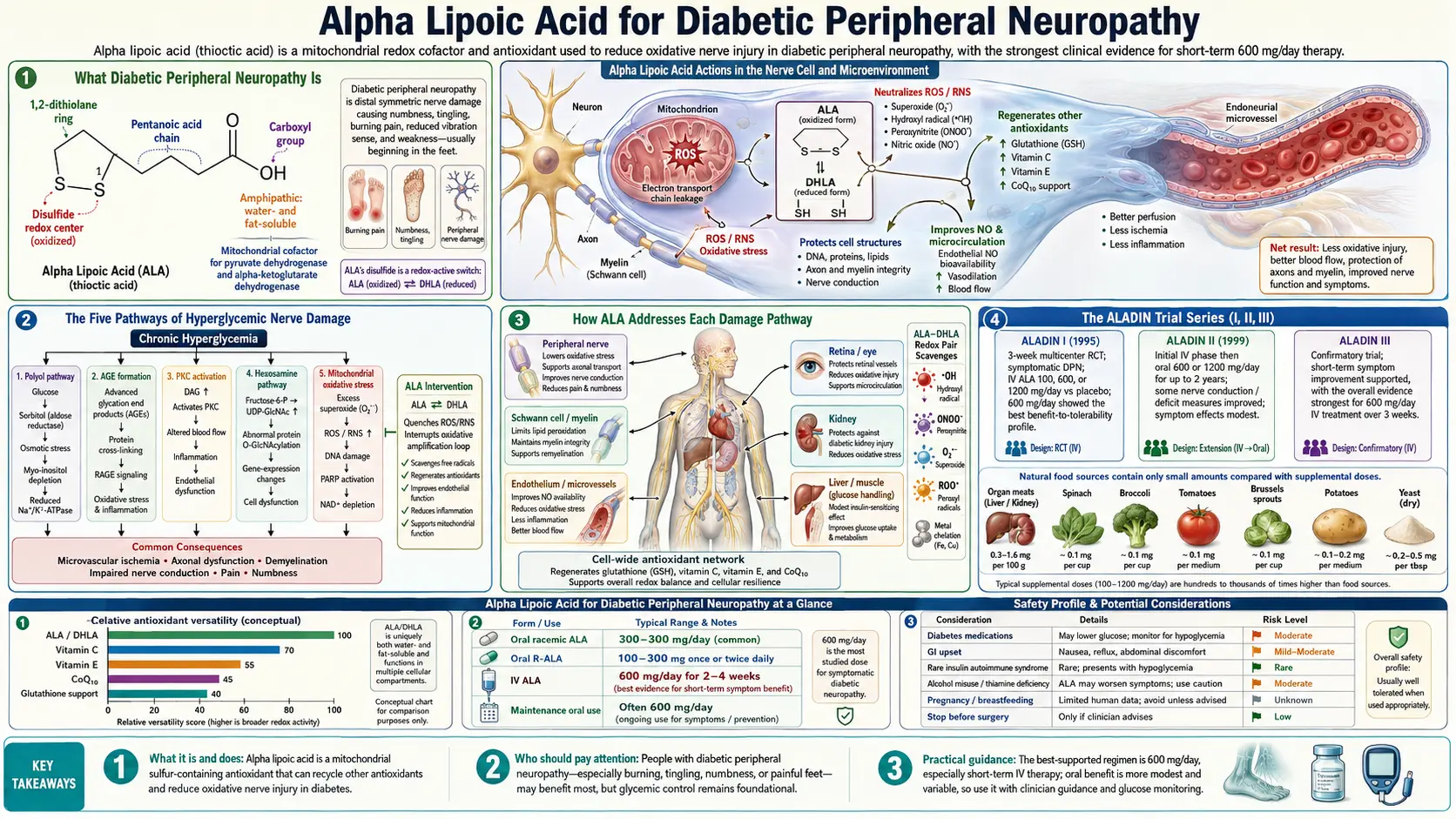
Diabetic peripheral neuropathy is the condition in which alpha lipoic acid (ALA, also called thioctic acid) has been studied most. In Germany, lipoic acid is approved for diabetic neuropathies and available by prescription (Linus Pauling Institute). The main randomized trials — ALADIN I–III, SYDNEY 1 and 2, ORPIL, DEKAN and the 4-year NATHAN 1 — were run largely by European and Russian research groups. Short courses of intravenous ALA 600 mg/day, and oral doses of 600 mg/day or more over several weeks, reduced symptom scores compared with placebo; NATHAN 1, the one 4-year oral trial, did not meet its primary endpoint, and serious adverse events were more frequent with ALA. This page walks through each trial, the meta-analyses, the doses and schedules the studies used, and the cautions the research raises.
Interactive Visualization Free Radicals & Your Antioxidant Network Follow one superoxide radical down the whole relay — SOD, catalase, glutathione, vitamin E, vitamin C, NADPH — then release free iron and watch a membrane tear itself apart. Launch →
Table of Contents
- What Diabetic Peripheral Neuropathy Is
- The Five Proposed Pathways of Hyperglycemic Nerve Damage
- What Laboratory Studies Show About ALA and Nerves
- The ALADIN Trial Series (I, II, III)
- The SYDNEY Trial Series (1 and 2)
- NATHAN 1 — The 4-Year Oral Trial
- DEKAN and ORPIL Trials
- Meta-Analyses (Ziegler, Mijnhout, Han, Hsieh)
- Intravenous and Oral Trials Compared
- Doses and Schedules Used in the Trials
- ALA Alongside Other Treatments: What Was Studied
- Common Questions and What the Trials Found
- Cautions the Research Raises
- Key Research Papers
- Connections
- Featured Videos
What Diabetic Peripheral Neuropathy Is
Diabetic peripheral neuropathy (DPN) is damage to the sensory and motor nerves that develops in people with diabetes, type 1 or type 2, and becomes more common the longer diabetes lasts. It is one of the common long-term complications of diabetes (Pop-Busui 2017).
The classic presentation is a "stocking-glove" distribution: burning, tingling, electric-shock pain, pins-and-needles and numbness, starting in the toes and feet and gradually ascending. As nerve damage progresses, sensation is lost, which raises the risk of unnoticed foot injuries, ulcers and amputations.
The American Diabetes Association's 2017 position statement describes glucose control as the way to prevent or slow neuropathy, and lists drug treatments for neuropathic pain such as pregabalin, duloxetine, gabapentin and tricyclic antidepressants (Pop-Busui 2017). The ALA trials below measured symptom scores and, in several of them, nerve conduction and examination findings.
For the broader clinical picture of peripheral neuropathy, see the Peripheral Neuropathy page. For neuropathy alongside retinopathy and nephropathy, see Diabetic Complications.
The Five Proposed Pathways of Hyperglycemic Nerve Damage
Laboratory and animal research describes several overlapping ways in which chronically high blood sugar damages nerves and their small blood vessels. Brownlee (2001) proposed that four of them reflect a single process — overproduction of superoxide by the mitochondrial electron transport chain.
- The polyol (aldose reductase) pathway — excess glucose inside cells is converted by aldose reductase to sorbitol. Increased flux through this pathway is linked to sorbitol accumulation, a fall in nerve myo-inositol and reduced Na+/K+-ATPase activity (Vallianou 2009).
- Advanced glycation end-product (AGE) formation — glucose attaches non-enzymatically to proteins, forming cross-linked AGE structures that can disrupt function and trigger inflammatory signaling through the RAGE receptor.
- Protein kinase C (PKC) activation — high glucose increases diacylglycerol, activating PKC isoforms linked to vascular dysfunction and reduced nerve blood flow.
- Hexosamine pathway flux — excess fructose-6-phosphate enters the hexosamine pathway, producing UDP-N-acetylglucosamine, which modifies proteins including transcription factors.
- Mitochondrial superoxide overproduction — the proposed unifying step: excess electron flow through the mitochondrial electron transport chain generates superoxide, which in this model drives the other four pathways (Brownlee 2001).
Vallianou (2009) also describes damage to the small vessels inside the nerve, with hypoxia when oxygen free radicals inactivate nitric oxide. Oxidative stress is therefore one of several proposed ways high blood sugar harms nerves, and it is the rationale for testing an antioxidant such as ALA.
What Laboratory Studies Show About ALA and Nerves
The evidence on how ALA might act on diabetic nerves comes mainly from experimental diabetes:
- Nerve function and blood flow — the SYDNEY investigators cite work in which ALA prevented or improved nerve conduction, blood flow inside the nerve (endoneurial blood flow) and nerve Na+/K+-ATPase activity in experimental diabetes (Ametov 2003).
- Antioxidant actions — laboratory reviews describe ALA and its reduced form, dihydrolipoic acid (DHLA), reacting with several reactive oxygen species (Packer 1995).
- Glutathione — Vallianou (2009) reviews findings that ALA treatment increases reduced glutathione, and discusses ALA in relation to glycation and nerve hypoxia.
Whether these mechanisms operate at the doses used in people has not been established. The trials below measured symptoms, nerve conduction and neurological examination findings directly.
The ALADIN Trial Series (I, II, III)
ALADIN stands for "Alpha-Lipoic Acid in Diabetic Neuropathy", a series of randomized, placebo-controlled trials published in the 1990s.
ALADIN I (Ziegler et al., 1995, Diabetologia)
328 patients with type 2 diabetes and symptomatic peripheral neuropathy received intravenous ALA at 1,200, 600 or 100 mg/day, or placebo, for 3 weeks. Symptoms (pain, burning, paresthesias and numbness in the feet) were combined in the Total Symptom Score (TSS).
- By day 19 the TSS fell 63.5% with 600 mg and 58.6% with 1,200 mg, versus 38.4% with placebo (both significant); it fell 43.2% with 100 mg.
- The total score of the Hamburg Pain Adjective List also fell more with 1,200 and 600 mg than with placebo.
- Adverse events were 32.6% with 1,200 mg, 18.2% with 600 mg, 13.6% with 100 mg and 20.7% with placebo.
The authors concluded that 600 mg/day intravenously over 3 weeks was superior to placebo in reducing symptoms.
ALADIN II (Reljanovic et al., 1999, Free Radical Research)
A 2-year trial in type 1 and type 2 diabetes: 5 days of intravenous ALA, then oral 1,200 or 600 mg/day or placebo. After independent reviewers excluded patients with highly variable test data, 65 patients were analyzed. Sural sensory nerve conduction velocity improved with both doses compared with placebo; the Neuropathy Disability Score did not differ.
ALADIN III (Ziegler et al., 1999, Diabetes Care)
509 patients with type 2 diabetes received intravenous ALA 600 mg/day for 3 weeks, then oral 600 mg three times daily (1,800 mg/day) for 6 months, or placebo. The TSS did not differ significantly from placebo after 3 weeks or after 7 months; the Neuropathy Impairment Score (NIS) improved at 19 days (P = 0.02) with a trend at 7 months (P = 0.09). The authors concluded there was no clinically meaningful effect on symptoms but a favorable effect on neuropathic deficits.
The SYDNEY Trial Series (1 and 2)
SYDNEY 1 (Ametov et al., 2003, Diabetes Care)
SYDNEY stands for "Symptomatic Diabetic Neuropathy". 120 patients received intravenous ALA 600 mg or placebo 5 days a week for 14 treatments.
- The TSS improved by 5.7 points with ALA versus 1.8 with placebo (P < 0.001).
- Each symptom in the score (stabbing and burning pain, numbness and prickling) improved more with ALA, as did the NIS, one nerve-conduction measure and the global assessment of efficacy.
- The ALA infused was racemic (a 50/50 mix of the R and S forms).
SYDNEY 2 (Ziegler et al., 2006, Diabetes Care)
181 patients in Russia and Israel took oral ALA 600, 1,200 or 1,800 mg once daily, or placebo, for 5 weeks after a 1-week placebo run-in.
- The TSS fell 4.9 points (51%), 4.5 points (48%) and 4.7 points (52%) with the three doses, versus 2.9 points (32%) with placebo (all P < 0.05).
- At least a 50% reduction in TSS occurred in 62%, 50% and 56% of patients, versus 26% with placebo.
- Nausea, vomiting and vertigo rose with dose.
The authors concluded that 600 mg once daily appeared to give the best risk-to-benefit ratio; the higher doses did not reduce symptoms further.
NATHAN 1 — The 4-Year Oral Trial
NATHAN 1 (Ziegler et al., 2011, Diabetes Care) randomized 460 patients with mild-to-moderate diabetic distal symmetric polyneuropathy to oral ALA 600 mg once daily or placebo for 4 years.
- Primary endpoint not met — the primary composite score (NIS of the lower limbs plus seven neurophysiological tests) did not differ significantly between the groups (P = 0.105). The authors note that it did not worsen significantly in the placebo group either, so the trial could not show prevention of its progression.
- Secondary measures — the NIS (P = 0.028), NIS of the lower limbs (P = 0.05) and its muscle-weakness subscore (P = 0.045) changed more favorably with ALA, and more patients improved and fewer progressed on the NIS and NIS of the lower limbs.
- Nerve conduction and sensory tests — did not worsen significantly with placebo.
- Safety — tolerability and discontinuations for poor tolerability were similar, but serious adverse events were more frequent with ALA (38.1%) than with placebo (28.0%).
The authors concluded that 4 years of ALA did not influence the primary endpoint but produced a clinically meaningful improvement and less progression of neuropathic impairment. NATHAN 1 did not test what happens after ALA is stopped.
DEKAN and ORPIL Trials
DEKAN (Ziegler et al., 1997, Diabetes Care)
The "Deutsche Kardiale Autonome Neuropathie" trial studied cardiac autonomic neuropathy, in which diabetes damages the nerves that regulate the heart. 73 patients with type 2 diabetes and reduced heart-rate variability took oral ALA 800 mg/day or placebo for 4 months; 17 dropped out.
Two heart-rate-variability measures (RMSSD and low-frequency spectral power) improved compared with placebo, with trends for two others; cardiovascular autonomic symptoms did not differ, and adverse-event rates were similar. The authors concluded that ALA "may slightly improve" cardiac autonomic neuropathy.
ORPIL (Ruhnau et al., 1999, Diabetic Medicine)
ORPIL, the "Oral Pilot" trial (the name used in Ziegler's 2004 review of the trial series), randomized 24 patients with type 2 diabetes to oral ALA 600 mg three times daily (1,800 mg/day) or placebo for 3 weeks. The TSS fell 47% versus 24% with placebo (P = 0.021), and the Neuropathy Disability Score also favored ALA; adverse-event rates did not differ. The authors called the findings preliminary.
Meta-Analyses (Ziegler, Mijnhout, Han, Hsieh)
Ziegler et al. (2004)
Pooled four intravenous trials (ALADIN, ALADIN III, SYDNEY and NATHAN II; 1,258 patients) drawn from the drug manufacturer's trial database. After 3 weeks of 600 mg/day the TSS was 24.1% better with ALA than with placebo, and responder rates (at least 50% improvement) were 52.7% versus 36.9%; the difference first appeared after 8 days of treatment. Adverse-event rates did not differ.
Mijnhout et al. (2012)
An independent meta-analysis of randomized trials that used the TSS found a pooled reduction favoring ALA (standardized mean difference −2.26), with both oral (−1.78) and intravenous (−2.81) subgroups favoring ALA. The authors concluded that intravenous ALA 600 mg/day for 3 weeks gives a significant and clinically relevant reduction in neuropathic pain, and that it is unclear whether the improvements after 3–5 weeks of oral treatment are clinically relevant.
Han et al. (2012)
Pooled 15 randomized trials of intravenous ALA 300–600 mg/day for 2–4 weeks. Nerve conduction velocities increased with ALA (for example, by 4.63 m/s in median motor nerve conduction), and the odds ratio for treatment efficacy was 4.03; no serious adverse events were reported during treatment. The authors cautioned that the evidence may not be strong because most included studies had poor methodological quality.
Hsieh et al. (2023)
A meta-analysis of oral ALA (10 randomized trials, 1,242 patients) found favorable results for the TSS, with a dose-related trend, and for the Neuropathy Disability Score and global satisfaction, but not for pain on a visual analogue scale, vibration perception, NIS of the lower limbs or nerve conduction.
In short: short courses of intravenous ALA, and oral doses of 600 mg/day or more over several weeks, reduced symptom scores in these analyses; how clinically relevant the oral effect is remains debated, and the one 4-year oral trial did not meet its primary endpoint. In the United States, ALA is sold as a dietary supplement rather than approved as a drug.
Intravenous and Oral Trials Compared
| Aspect | Intravenous trials | Oral trials |
|---|---|---|
| Doses studied | 600 mg/day (ALADIN also 100 and 1,200 mg) | 600–1,800 mg/day |
| Length of treatment | 14 infusions to 3 weeks | 3 weeks (ORPIL), 5 weeks (SYDNEY 2), 6 months (ALADIN III), 2 years (ALADIN II), 4 years (NATHAN 1) |
| Symptom score (TSS) results | Improved versus placebo in ALADIN and SYDNEY; not after 3 weeks in ALADIN III | Improved versus placebo in ORPIL and SYDNEY 2; not at 7 months in ALADIN III |
| Meta-analysis view | Clinically relevant pain reduction with 600 mg/day for 3 weeks (Mijnhout 2012) | Unclear clinical relevance after 3–5 weeks (Mijnhout 2012); favorable TSS, not pain or nerve conduction (Hsieh 2023) |
| Longest trial | — | NATHAN 1, 4 years: primary endpoint not met; more serious adverse events with ALA |
| Availability | Prescription medicine in Germany | Sold as a dietary supplement in many countries |
Several trials combined the two routes: ALADIN II gave 5 days of intravenous ALA before 2 years of oral treatment, and ALADIN III gave 3 weeks of intravenous ALA before 6 months of oral treatment. No trial in this series directly compared an intravenous course with oral treatment alone.
Doses and Schedules Used in the Trials
These are the doses and schedules the cited studies used, not instructions.
- Intravenous — 600 mg/day for about 3 weeks (ALADIN, ALADIN III); 600 mg 5 days a week for 14 treatments (SYDNEY). The 1,200 mg/day arm of ALADIN had more adverse events (32.6%) than 600 mg (18.2%).
- Oral, short term — 600, 1,200 or 1,800 mg once daily for 5 weeks (SYDNEY 2, whose authors judged 600 mg the best risk-to-benefit ratio); 600 mg three times daily for 3 weeks (ORPIL).
- Oral, longer term — 600 mg three times daily for 6 months (ALADIN III); 600 or 1,200 mg/day for 2 years (ALADIN II); 600 mg once daily for 4 years (NATHAN 1).
- Cardiac autonomic neuropathy — 800 mg/day orally for 4 months (DEKAN).
Form. SYDNEY describes the ALA it infused as racemic. In a small crossover trial in progressive multiple sclerosis, 600 mg of R-ALA gave R-ALA blood levels bioequivalent to 1,200 mg of the racemic mixture, with fewer gastrointestinal complaints (Cameron 2020); the neuropathy trials above did not test R-ALA.
Food. The Linus Pauling Institute summarizes that taking lipoic acid with food decreased peak plasma concentrations by about 30% and total plasma concentrations by about 20%.
Timing of response. In the pooled intravenous trials, the TSS difference from placebo first appeared after 8 days of infusions (Ziegler 2004). The oral trials assessed symptoms at 3 weeks (ORPIL) and 5 weeks (SYDNEY 2).
ALA Alongside Other Treatments: What Was Studied
- Diabetes medicines — a single-dose study in 24 healthy volunteers found no drug interaction between ALA and glibenclamide (glyburide) or acarbose, in blood levels or in insulin and glucose (Gleiter 1999); longer combined use was not examined there. Meta-analyses found that ALA modestly lowered fasting glucose (see the blood sugar page).
- Pain medicines — the trials on this page compared ALA with placebo; none of them tested ALA against, or in planned combination with, pregabalin, gabapentin, duloxetine or tricyclic antidepressants.
- Benfotiamine — combinations of ALA with benfotiamine, a form of vitamin B1, have been studied; the trials on this page tested ALA alone. A PubMed search is listed under Key Research Papers.
Common Questions and What the Trials Found
Q: How quickly did symptoms change in the trials?
In the pooled intravenous trials, the difference from placebo first appeared after 8 days of infusions (Ziegler 2004). The oral trials measured symptoms after 3 weeks (ORPIL) and 5 weeks (SYDNEY 2).
Q: Did the trials include people with long-standing neuropathy?
The trials enrolled people with established symptomatic neuropathy; NATHAN 1 enrolled people with mild-to-moderate disease. The trials did not report separate results by how long neuropathy had lasted.
Q: What happens when ALA is stopped?
None of the trials on this page studied what happens after ALA is stopped.
Q: Did ALA replace pain medicines in the trials?
No trial on this page tested whether people taking ALA could reduce or stop pregabalin, gabapentin, duloxetine or other pain medicines.
Q: What side effects were reported?
Nausea, vomiting and vertigo rose with dose in SYDNEY 2, and the 1,200 mg/day intravenous arm of ALADIN had more adverse events than 600 mg. The Linus Pauling Institute lists allergic skin reactions (rashes, hives, itching) as the most frequently reported side effects of oral ALA. In NATHAN 1, serious adverse events were more frequent with ALA than with placebo (38.1% versus 28.0%).
Q: Has long-term use been studied?
NATHAN 1 gave 600 mg/day for 4 years; tolerability was similar to placebo, but serious adverse events were more frequent with ALA. ALADIN II gave ALA for 2 years.
Cautions the Research Raises
- Blood sugar and diabetes medicines — ALA modestly lowered fasting glucose in meta-analyses. A single-dose study found no interaction with glibenclamide or acarbose (Gleiter 1999); longer combined use was not examined there.
- Insulin autoimmune syndrome (IAS, Hirata disease) — a rare, immune-mediated cause of hypoglycemia with insulin autoantibodies. In Japanese people it is associated with the HLA-DRB1*04:06 allele and often follows exposure to sulfhydryl-containing compounds, including lipoic acid. It is not limited to East Asian people: a 2014 series described six white European patients taking ALA 600 mg/day whose hypoglycemia began 30–120 days after starting it; five carried HLA-DRB1*04:03 and one HLA-DRB1*04:06 (Gullo 2014). The European Food Safety Authority's 2021 opinion reviewed 49 case reports, in all of which IAS resolved within weeks to months after ALA was stopped, and could not set a dose below which IAS is not expected (EFSA 2021).
- Serious adverse events — more frequent with ALA than placebo over 4 years in NATHAN 1 (38.1% versus 28.0%).
- Kidney — investigators described biopsy-proven NELL1-associated membranous nephropathy after ALA supplementation, remitting after ALA was stopped (Spain 2021); a 2026 multiple sclerosis trial found more proteinuria with ALA.
- Biotin — in rats given lipoic acid injections for 28 days, liver activities of two biotin-dependent carboxylases were 28–36% lower, and normal when biotin was given as well (Zempleni 1997). That study did not measure effects in people.
- Thiamine (vitamin B1) — the enzymes that use lipoic acid also need thiamine pyrophosphate. A 1965 study in thiamine-deficient rats reported a toxicity of (−)-alpha-lipoic acid that thiamine reversed (Gal 1965); the concern for people with thiamine deficiency, such as heavy drinkers, rests on this animal finding.
- Foot care and glucose control — reduced sensation raises the risk of unnoticed foot injuries, and the American Diabetes Association's position statement describes glucose control as the way to prevent or slow neuropathy (Pop-Busui 2017); see HbA1c.
Decisions about medicines and supplements belong with a clinician.
Key Research Papers
- Ziegler D, Hanefeld M, Ruhnau KJ, Meissner HP, Lobisch M, Schütte K, Gries FA (1995). Treatment of symptomatic diabetic peripheral neuropathy with the anti-oxidant alpha-lipoic acid. A 3-week multicentre randomized controlled trial (ALADIN Study). Diabetologia 38(12):1425-33. — PubMed PMID: 8786016
- Reljanovic M, Reichel G, Rett K, Lobisch M, Schuette K, Möller W, Tritschler HJ, Mehnert H (1999). Treatment of diabetic polyneuropathy with the antioxidant thioctic acid (alpha-lipoic acid): a two year multicenter randomized double-blind placebo-controlled trial (ALADIN II). Alpha Lipoic Acid in Diabetic Neuropathy. Free Radical Research 31(3):171-9. — PubMed PMID: 10499773
- Ziegler D, Hanefeld M, Ruhnau KJ, Hasche H, Lobisch M, Schütte K, Kerum G, Malessa R (1999). Treatment of symptomatic diabetic polyneuropathy with the antioxidant alpha-lipoic acid: a 7-month multicenter randomized controlled trial (ALADIN III Study). ALADIN III Study Group. Alpha-Lipoic Acid in Diabetic Neuropathy. Diabetes Care 22(8):1296-301. — PubMed PMID: 10480774
- Ametov AS, Barinov A, Dyck PJ, Hermann R, Kozlova N, Litchy WJ, et al. (2003). The sensory symptoms of diabetic polyneuropathy are improved with alpha-lipoic acid: the SYDNEY trial. Diabetes Care 26(3):770-6. — PubMed PMID: 12610036
- Ziegler D, Ametov A, Barinov A, Dyck PJ, Gurieva I, Low PA, et al. (2006). Oral treatment with alpha-lipoic acid improves symptomatic diabetic polyneuropathy: the SYDNEY 2 trial. Diabetes Care 29(11):2365-70. — PubMed PMID: 17065669
- Ruhnau KJ, Meissner HP, Finn JR, Reljanovic M, Lobisch M, Schütte K, et al. (1999). Effects of 3-week oral treatment with the antioxidant thioctic acid (alpha-lipoic acid) in symptomatic diabetic polyneuropathy. Diabetic Medicine 16(12):1040-3. — PubMed PMID: 10656234
- Ziegler D, Low PA, Litchy WJ, Boulton AJ, Vinik AI, Freeman R, et al. (2011). Efficacy and safety of antioxidant treatment with α-lipoic acid over 4 years in diabetic polyneuropathy: the NATHAN 1 trial. Diabetes Care 34(9):2054-60. — PubMed PMID: 21775755
- Ziegler D, Schatz H, Conrad F, Gries FA, Ulrich H, Reichel G (1997). Effects of treatment with the antioxidant alpha-lipoic acid on cardiac autonomic neuropathy in NIDDM patients. A 4-month randomized controlled multicenter trial (DEKAN Study). Deutsche Kardiale Autonome Neuropathie. Diabetes Care 20(3):369-73. — PubMed PMID: 9051389
- Ziegler D, Nowak H, Kempler P, Vargha P, Low PA (2004). Treatment of symptomatic diabetic polyneuropathy with the antioxidant alpha-lipoic acid: a meta-analysis. Diabetic Medicine 21(2):114-21. — PubMed PMID: 14984445
- Ziegler D (2004). Thioctic acid for patients with symptomatic diabetic polyneuropathy: a critical review. Treatments in Endocrinology 3(3):173-89. — PubMed PMID: 16026113
- Mijnhout GS, Kollen BJ, Alkhalaf A, Kleefstra N, Bilo HJ (2012). Alpha lipoic Acid for symptomatic peripheral neuropathy in patients with diabetes: a meta-analysis of randomized controlled trials. International Journal of Endocrinology 2012:456279. — PubMed PMID: 22331979
- Han T, Bai J, Liu W, Hu Y (2012). A systematic review and meta-analysis of α-lipoic acid in the treatment of diabetic peripheral neuropathy. European Journal of Endocrinology 167(4):465-71. — PubMed PMID: 22837391
- Hsieh RY, Huang IC, Chen C, Sung JY (2023). Effects of Oral Alpha-Lipoic Acid Treatment on Diabetic Polyneuropathy: A Meta-Analysis and Systematic Review. Nutrients 15(16):3634. — PubMed PMID: 37630823
- Vallianou N, Evangelopoulos A, Koutalas P (2009). Alpha-lipoic Acid and diabetic neuropathy. Review of Diabetic Studies 6(4):230-6. — PubMed PMID: 20043035
- Pop-Busui R, Boulton AJ, Feldman EL, Bril V, Freeman R, Malik RA, et al. (2017). Diabetic Neuropathy: A Position Statement by the American Diabetes Association. Diabetes Care 40(1):136-154. — PubMed PMID: 27999003
- Brownlee M (2001). Biochemistry and molecular cell biology of diabetic complications. Nature 414(6865):813-20. — PubMed PMID: 11742414
- Packer L, Witt EH, Tritschler HJ (1995). alpha-Lipoic acid as a biological antioxidant. Free Radical Biology & Medicine 19(2):227-50. — PubMed PMID: 7649494
- Gleiter CH, Schreeb KH, Freudenthaler S, Thomas M, Elze M, Fieger-Büschges H, et al. (1999). Lack of interaction between thioctic acid, glibenclamide and acarbose. British Journal of Clinical Pharmacology 48(6):819-25. — PubMed PMID: 10594485
- Gullo D, Evans JL, Sortino G, Goldfine ID, Vigneri R (2014). Insulin autoimmune syndrome (Hirata Disease) in European Caucasians taking α-lipoic acid. Clinical Endocrinology 81(2):204-9. — PubMed PMID: 24111525
- EFSA Panel on Nutrition, Novel Foods and Food Allergens (NDA); Turck D, Castenmiller J, de Henauw S, Hirsch-Ernst KI, Kearney J, Knutsen HK, et al. (2021). Scientific opinion on the relationship between intake of alpha-lipoic acid (thioctic acid) and the risk of insulin autoimmune syndrome. EFSA Journal 19(6):e06577. — PubMed PMID: 34122657
- Spain RI, Andeen NK, Gibson PC, Samuels MH, Morris CD, Solomon AJ, et al. (2021). Lipoic acid supplementation associated with neural epidermal growth factor-like 1 (NELL1)-associated membranous nephropathy. Kidney International 100(6):1208-1213. — PubMed PMID: 34662650
- Zempleni J, Trusty TA, Mock DM (1997). Lipoic acid reduces the activities of biotin-dependent carboxylases in rat liver. Journal of Nutrition 127(9):1776-81. — PubMed PMID: 9278559
- Gal EM (1965). Reversal of selective toxicity of (-)-alpha-lipoic acid by thiamine in thiamine-deficient rats. Nature 207(996):535. — PubMed PMID: 5328673
- Cameron M, Taylor C, Lapidus J, Ramsey K, Koop D, Spain R (2020). Gastrointestinal Tolerability and Absorption of R- Versus R,S-Lipoic Acid in Progressive Multiple Sclerosis: A Randomized Crossover Trial. Journal of Clinical Pharmacology 60(8):1099-1106. — PubMed PMID: 32212340
PubMed Topic Searches
Connections
- Free Radicals & Your Antioxidant Network — interactive animation
- Alpha Lipoic Acid Overview
- ALA Benefits Hub
- ALA for Mitochondria
- ALA for Blood Sugar
- ALA for Neuroprotection
- Peripheral Neuropathy
- Diabetic Complications
- Diabetes
- Hemoglobin A1c
- Fasting Insulin
- Vitamin B1 (Thiamine / Benfotiamine)
- Vitamin B7 (Biotin)
- Vitamin B12
- Numbness & Tingling
- Chronic Pain
- All Antioxidants
- Oxidative Stress
- History