NAD+ and NMN: History and Discovery
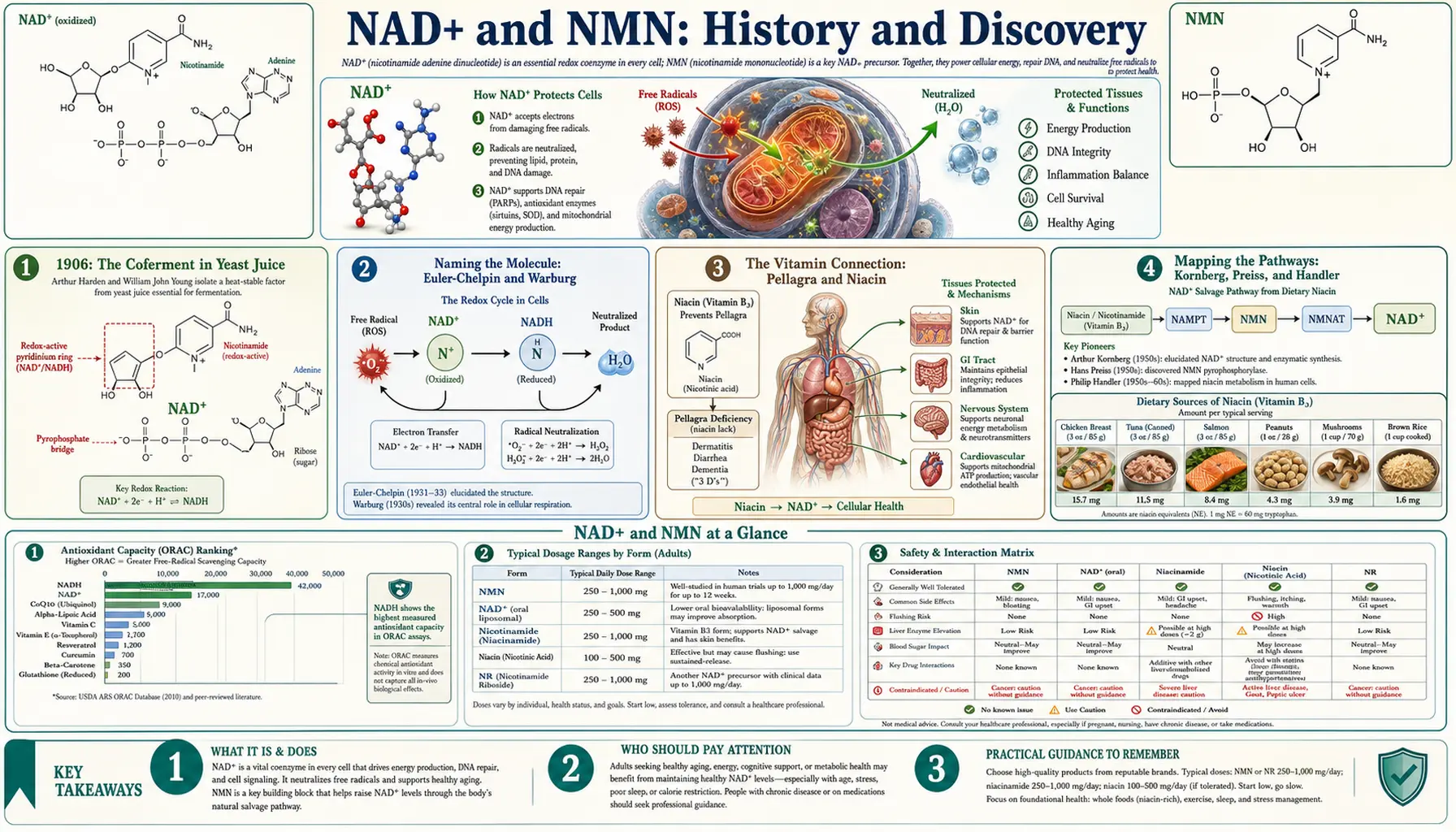
The story of NAD+ is, unusually, a story we can date almost year by year. Unlike a herb whose use fades back into prehistory, nicotinamide adenine dinucleotide (NAD+) was discovered in a laboratory through a documented series of experiments, and named, weighed, and mapped by named scientists across the twentieth century. It begins in 1906 with two British chemists puzzling over why yeast juice loses its fizz, runs through a Nobel Prize, the conquest of a deadly vitamin-deficiency disease, the patient charting of how the body builds the molecule, and arrives in our own time at the discovery that NAD+ falls as we age — the finding that turned an old coenzyme into one of the most talked-about molecules in longevity science and put its small precursor, nicotinamide mononucleotide (NMN), on supplement shelves worldwide. This article traces what the historical record actually supports. Where a date or a discoverer is firmly documented, we name them; where a claim is still argued or uncertain, we say so.
Table of Contents
- 1906: The Coferment in Yeast Juice
- Naming the Molecule: Euler-Chelpin and Warburg
- The Vitamin Connection: Pellagra and Niacin
- Mapping the Pathways: Kornberg, Preiss, and Handler
- Where NMN Fits: An Intermediate, Not a Newcomer
- 2000: NAD+ Joins the Science of Aging
- NR, NMN, and the Modern Precursor Era
- From Bench to Bottle: NMN Becomes a Supplement
- Research Papers and References
- Connections
- Featured Videos
1906: The Coferment in Yeast Juice
NAD+ was discovered while two scientists were trying to understand fermentation — how yeast turns sugar into alcohol. In 1906, the British biochemists Arthur Harden and William John Young, working in London, made a simple but revealing observation. When they passed yeast juice through a fine filter, the filtered liquid lost much of its ability to ferment sugar. Yet if they took the small molecules that had passed through the filter and added them back, fermentation sped up again. They had shown that fermentation needed two kinds of ingredient: a large, heat-sensitive part (the enzymes) and a small, heat-stable part that could be removed and added back at will.
That small, heat-stable helper they called a coferment, or in the older literature a cozymase. They did not know its chemical structure, and the name simply meant "the thing that works alongside the ferment." What Harden and Young had unknowingly demonstrated — though not yet isolated in pure form or chemically identified — was the molecule we now call NAD+. Their paper, "The alcoholic ferment of yeast-juice," appeared in the Proceedings of the Royal Society of London in 1906 and is the documented starting point of NAD+'s history.
It is worth pausing on how indirect this discovery was. Nobody set out to find NAD+; it announced itself only as a missing factor — a fizz that disappeared and could be restored. For nearly a quarter of a century after 1906, the coferment remained a known effect without a known formula, a ghost in the chemistry of every living cell.
Naming the Molecule: Euler-Chelpin and Warburg
The work of turning Harden and Young's mysterious coferment into a defined chemical fell largely to the Swedish-German biochemist Hans von Euler-Chelpin. Through the 1920s he and his collaborators established that the cozymase molecule contained an adenine base, a sugar, and phosphate — the building blocks of what we now recognise as a dinucleotide. This was the first real glimpse of the molecule's architecture.
The contribution was significant enough that in 1929 the Royal Swedish Academy of Sciences awarded the Nobel Prize in Chemistry jointly to Arthur Harden and Hans von Euler-Chelpin, with the official citation reading "for their investigations on the fermentation of sugar and fermentative enzymes." The prize honoured the whole line of work that had begun with the 1906 yeast-juice experiments and continued through the chemical characterisation of the coferment.
The final piece of the early picture — how the molecule actually works — came from the German biochemist Otto Heinrich Warburg. In 1936, Warburg and his colleague Walter Christian showed that the nicotinamide (pyridine) portion of the coenzyme is the business end of the molecule: the site where hydrogen, and with it electrons, is accepted and handed on. This identified NAD+'s central job as a carrier in the cell's energy-handling reactions, the role for which it is still best known. By the late 1930s, then, the once-anonymous coferment had a structure and a function: it was a dinucleotide built around nicotinamide, and it moved hydrogen.
The Vitamin Connection: Pellagra and Niacin
One of the most human chapters in NAD+'s history runs in parallel with the laboratory chemistry, and for a long time nobody realised the two stories were the same story. That chapter is the conquest of pellagra, a devastating disease — marked by the "four Ds" of dermatitis, diarrhoea, dementia, and, untreated, death — that afflicted poor populations living on a corn-based diet across the American South and parts of Europe in the early twentieth century.
The turning point came in 1937, when the American biochemist Conrad A. Elvehjem and his colleagues at the University of Wisconsin showed that nicotinic acid (niacin) cured "black tongue" in dogs — the canine equivalent of pellagra — and human trials soon confirmed that nicotinic acid prevented and cured pellagra in people. A deadly disease was, it turned out, a vitamin-deficiency disease; the missing vitamin was niacin, a member of the vitamin B3 family.
The deep connection is this: niacin and the related nicotinamide are the dietary raw materials the body uses to build NAD+. The reason a niacin-poor diet was lethal is that, without it, cells could not make enough of the coenzyme that Harden, Euler-Chelpin, and Warburg had been studying. Two threads — a clinical mystery about a wasting disease and a biochemical mystery about a yeast coferment — turned out to lead to the same molecule. NAD+ is, in the plainest terms, what your body makes vitamin B3 into. (For the vitamin's own story, see the Vitamin B3 (Niacin) page.)
Mapping the Pathways: Kornberg, Preiss, and Handler
Knowing that the body builds NAD+ from vitamin B3 is one thing; knowing the exact chemical steps is another, and that map was drawn over the following two decades. In 1948, the American biochemist Arthur Kornberg — later a Nobel laureate for his work on DNA — described the enzymatic synthesis of NAD+, demonstrating one of the reactions cells use to assemble the coenzyme from its immediate building blocks. Kornberg's experiments were among the first to show, step by step, the chemistry of NAD+ construction rather than just its existence.
The fuller route from dietary niacin to finished NAD+ was charted by Jack Preiss and Philip Handler, who in 1958 published a pair of papers in the Journal of Biological Chemistry identifying the intermediates and enzymes of the pathway. That route — nicotinic acid being converted, in three enzymatic steps, into NAD+ — is still known today as the Preiss–Handler pathway, named for the two researchers who worked it out.
Alongside this came the recognition of a second, recycling route. Cells constantly consume NAD+ and release nicotinamide as a by-product, and a salvage pathway reclaims that nicotinamide and rebuilds it back into NAD+ rather than wasting it. This recycling system, rather than fresh dietary intake, supplies most of the NAD+ a cell uses moment to moment — a detail that becomes central to the modern aging story, because the enzymes of the salvage pathway are exactly the ones that falter with age.
Where NMN Fits: An Intermediate, Not a Newcomer
Today NMN is marketed as a cutting-edge longevity supplement, which can give the impression it is a recently invented molecule. Historically, that is misleading. Nicotinamide mononucleotide (NMN) is one of the natural intermediates the body passes through on its way to making NAD+, and it has been part of the known NAD+ biochemistry since the mid-twentieth-century mapping of these pathways. In the salvage route, the enzyme NAMPT joins nicotinamide to a sugar-phosphate to form NMN; another enzyme, NMNAT, then adds the adenine half to turn NMN into NAD+. NMN is, in other words, the molecule one chemical step away from NAD+.
What is genuinely new is not the molecule but the idea of swallowing it. For most of its history NMN was a fleeting internal intermediate of interest only to biochemists studying how cells build their coenzymes. The notion that taking NMN by mouth might raise the body's NAD+ — and that doing so might matter for health and aging — belongs to the twenty-first century and depends entirely on a discovery made around the year 2000: that NAD+ is not just an energy-handling coenzyme but a fuel for the machinery of aging itself.
2000: NAD+ Joins the Science of Aging
For most of the twentieth century, NAD+ was filed under "metabolism" — a hard-working but unglamorous coenzyme that ferried hydrogen around the cell's energy pathways. The moment that transformed its reputation came in 2000, in the laboratory of Leonard Guarente at the Massachusetts Institute of Technology.
That year, Shin-ichiro Imai, Christopher Armstrong, Matt Kaeberlein, and Leonard Guarente published a paper in Nature showing that a protein called Sir2 — already linked to longevity in yeast — is an NAD+-dependent enzyme. Sir2 (and its mammalian relatives, the sirtuins) can only do its work of switching genes on and off, and helping maintain the genome, if NAD+ is present to power the reaction. In the same year, a companion study from the Guarente lab by Su-Ju Lin, Pierre-Antoine Defossez, and Leonard Guarente, published in Science, showed that the life-extending effect of calorie restriction in yeast required both NAD+ and the SIR2 gene.
The implication was electrifying. If the enzymes that influence longevity run on NAD+, then the amount of NAD+ in a cell could help set the pace of aging. NAD+ was no longer just about energy; it was a possible lever on lifespan itself. This is the discovery that connected an old metabolic molecule to the modern field of aging biology, and it is the reason every NMN bottle on a shelf today exists. It is worth being careful, though: this foundational work was done in yeast and other laboratory organisms. It established a profound biological link — not a proven anti-aging treatment for humans, a distinction the later clinical chapters of the story take up.
NR, NMN, and the Modern Precursor Era
Once researchers suspected that raising NAD+ might be beneficial, the obvious question became how — which building block could be fed to cells to lift their NAD+ levels most effectively. This launched the modern era of NAD+ precursors.
A key step came in 2004, when Charles Brenner and his colleague Pawel Bieganowski, then at Dartmouth, published a paper in Cell identifying nicotinamide riboside (NR) — a form found naturally in milk — as a genuine NAD+ precursor, taken up through a previously unrecognised, dedicated route involving enzymes they called nicotinamide riboside kinases. NR became the first of the new-generation precursors to move toward human study.
NMN's rise as a supplement candidate is bound up with the work of Shin-ichiro Imai (by then at Washington University in St. Louis) and others who argued that NMN sits at a strategic point in NAD+ metabolism. In a much-cited 2011 review in FEBS Letters, Imai set out what he called the "NAD World" — a framework placing the salvage enzyme NAMPT and its product NMN at the centre of how the whole body coordinates metabolism and aging. The experimental landmark followed in 2016, when Imai's team reported in Cell Metabolism that giving NMN in drinking water for a full year to normally aging mice blunted age-related decline — improving energy metabolism, insulin sensitivity, eye function, and physical activity, without obvious toxicity. This long-term mouse study is the work most often credited with turning NMN from a biochemical curiosity into a sought-after supplement.
From Bench to Bottle: NMN Becomes a Supplement
The leap from a mouse drinking NMN-laced water to a human swallowing an NMN capsule happened with remarkable speed. Buoyed by the animal results and by the popular advocacy of researchers such as Harvard's David Sinclair, NMN and NR became among the best-selling longevity supplements of the late 2010s and early 2020s, marketed on the promise of restoring "youthful" NAD+ levels. Human clinical trials — the proper test of whether any of this translates to people — began appearing in the same period, generally confirming that oral NMN and NR can safely raise blood NAD+ levels, while showing more modest and variable functional benefits than the dramatic mouse data might suggest.
The commercial story has also been legally turbulent, especially in the United States, where NMN's status as a permissible dietary supplement ingredient swung back and forth with FDA determinations between 2022 and 2025. Those regulatory details, the current human-trial evidence, dosing, and safety are covered on the main NAD+ and NMN page and in the companion Benefits articles; this history is concerned with how the molecule and the idea came to be.
Two honest notes belong at the close of any history like this. First, the documented milestones are about the molecule — its discovery in 1906, its structure, its pathways, and the 2000 finding that linked it to aging biology. The much-publicised claim that supplementing NMN slows human aging is a hypothesis under active test, not an established historical fact, and the strongest results to date remain in animals. Second, the thread running through this whole story — from a fizz that vanished from yeast juice, to a vitamin that cured a deadly disease, to a coenzyme that may pace our cells' aging — is one of the more elegant in modern biochemistry: again and again, a small molecule that seemed minor turned out to sit at the centre of how life keeps itself running.
Research Papers and References
The list below gathers the key documented milestones in the history of NAD+ and NMN, followed by curated PubMed topic-search links into the historical and biochemical literature. Author names, titles, and journals are given as plain text; only the stable DOI, PMID, or archive link is hyperlinked, and each opens in a new tab. The 1929 Nobel Prize award is referenced from the official Nobel Foundation record.
- Harden A, Young WJ. The alcoholic ferment of yeast-juice. Proceedings of the Royal Society of London. Series B. 1906;77(519):405–420. — doi:10.1098/rspb.1906.0029
- The Nobel Prize in Chemistry 1929 — Arthur Harden and Hans von Euler-Chelpin, "for their investigations on the fermentation of sugar and fermentative enzymes." The Nobel Foundation. — nobelprize.org: Chemistry 1929
- Kornberg A. The participation of inorganic pyrophosphate in the reversible enzymatic synthesis of diphosphopyridine nucleotide. Journal of Biological Chemistry. 1948;176(3):1475–1476. — doi:10.1016/S0021-9258(18)57167-2
- Preiss J, Handler P. Biosynthesis of diphosphopyridine nucleotide. I. Identification of intermediates. Journal of Biological Chemistry. 1958;233(2):488–492. — PMID: 13563526
- Preiss J, Handler P. Biosynthesis of diphosphopyridine nucleotide. II. Enzymatic aspects. Journal of Biological Chemistry. 1958;233(2):493–500. — PMID: 13563527
- Imai S, Armstrong CM, Kaeberlein M, Guarente L. Transcriptional silencing and longevity protein Sir2 is an NAD-dependent histone deacetylase. Nature. 2000;403(6771):795–800. — doi:10.1038/35001622
- Lin SJ, Defossez PA, Guarente L. Requirement of NAD and SIR2 for life-span extension by calorie restriction in Saccharomyces cerevisiae. Science. 2000;289(5487):2126–2128. — doi:10.1126/science.289.5487.2126
- Bieganowski P, Brenner C. Discoveries of nicotinamide riboside as a nutrient and conserved NRK genes establish a Preiss-Handler independent route to NAD+ in fungi and humans. Cell. 2004;117(4):495–502. — doi:10.1016/S0092-8674(04)00416-7
- Imai S. Dissecting systemic control of metabolism and aging in the NAD World: the importance of SIRT1 and NAMPT-mediated NAD biosynthesis. FEBS Letters. 2011;585(11):1657–1662. — doi:10.1016/j.febslet.2011.04.060
- Mills KF, Yoshida S, Stein LR, et al. Long-term administration of nicotinamide mononucleotide mitigates age-associated physiological decline in mice. Cell Metabolism. 2016;24(6):795–806. — PMID: 28068222
- NAD+ discovery and history — PubMed: NAD+ history and discovery
- NAD+ biosynthesis pathways and NMN — PubMed: NAD+ biosynthesis and NMN
External Authoritative Resources
- Nobel Foundation — The Nobel Prize in Chemistry 1929
- NCCIH — Nicotinamide Riboside and Nicotinamide Mononucleotide
- PubMed — NAD+ and aging research
Connections
- NAD+ and NMN
- NAD+ and NMN Benefits
- All Antioxidants
- Vitamin B3 (Niacin)
- Resveratrol
- CoQ10
- PQQ
- Spermidine