Lutein for Brain and Cognitive Health
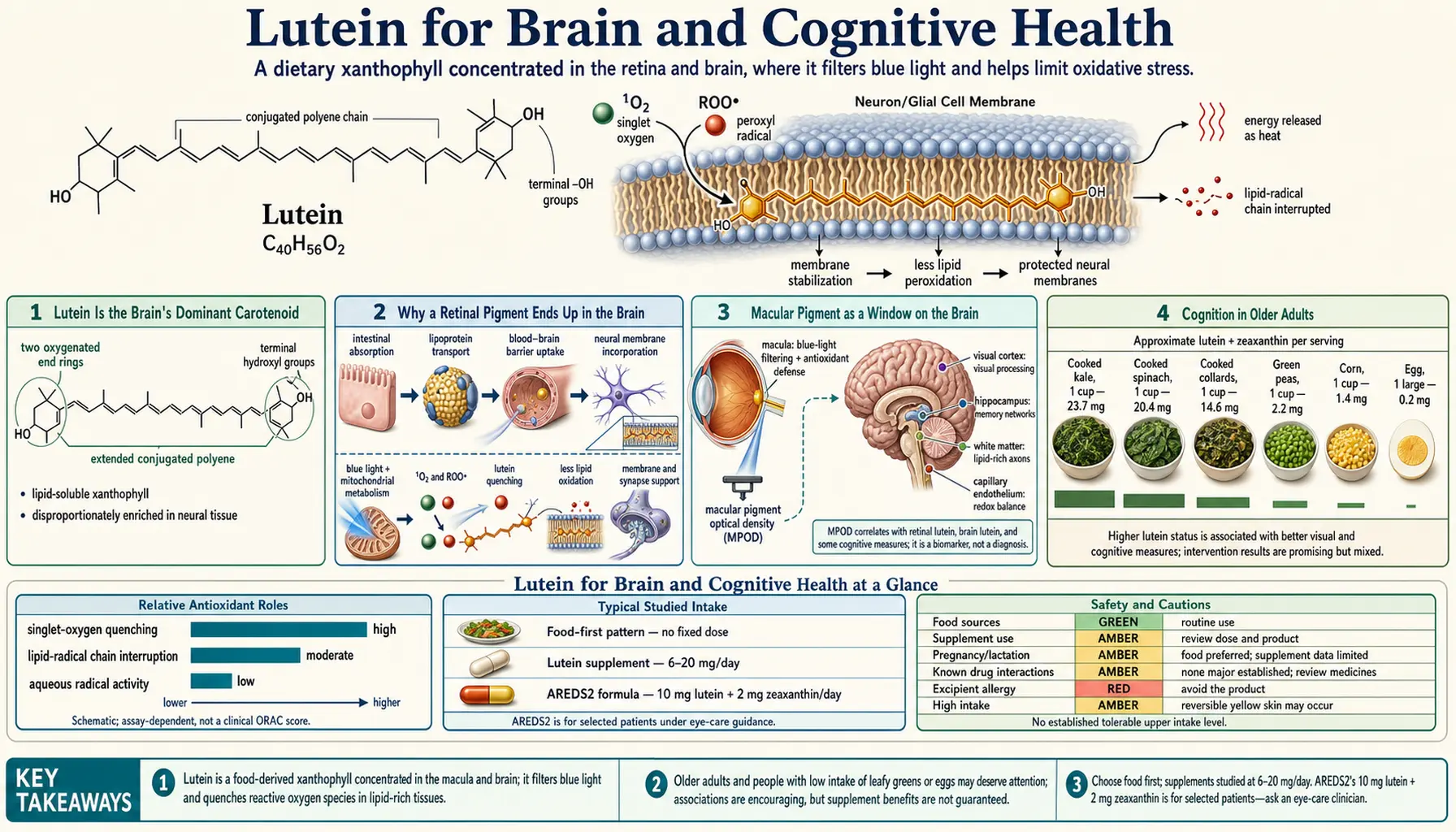
One of the more surprising discoveries about lutein is that it does not stop at the eye. When researchers analyzed human brain tissue, lutein turned out to be the single most abundant carotenoid there — even though it is not the most abundant one in the blood. The brain, like the retina, appears to select and concentrate it. That finding launched a genuinely interesting line of research into whether lutein supports cognition across the lifespan. This page reports that research honestly, and the honesty is the point: this is an emerging and still-preliminary field. There are provocative associations and a handful of small trials, but there is no proof that lutein prevents dementia or reliably makes anyone smarter.
Table of Contents
- Lutein Is the Brain's Dominant Carotenoid
- Why a Retinal Pigment Ends Up in the Brain
- Macular Pigment as a Window on the Brain
- Cognition in Older Adults
- Brain Imaging and Functional Connectivity
- Infant and Early-Life Development
- Plausible Mechanisms
- Honest Limits: What "Emerging" Means
- A Practical Perspective
- Key Research Papers
- Connections
- Featured Videos
Lutein Is the Brain's Dominant Carotenoid
In the bloodstream, several carotenoids circulate together — lutein, zeaxanthin, beta-carotene, lycopene, and others. But when investigators measured carotenoids in human brain tissue, the proportions shifted dramatically: lutein made up a strikingly large share of the total, far more than its share in blood. This selective enrichment mirrors what happens in the retina, and it strongly suggests the brain is not passively soaking up whatever floats by but actively favoring lutein for some purpose. That single observation is the seed of the entire brain-and-lutein research program.
Why a Retinal Pigment Ends Up in the Brain
The retina is, developmentally and anatomically, an outgrowth of the brain — it is central nervous tissue that happens to sit at the back of the eye. So it is perhaps less surprising than it first seems that a pigment the retina prizes would also be prized by the rest of the brain. Both tissues share the same basic vulnerabilities: high oxygen use, abundant easily-oxidized fats in their membranes, and intense metabolic activity. A molecule that is good at protecting delicate neural membranes from oxidative damage in the retina could plausibly do the same job in the cortex.
Crucially, Vishwanathan and colleagues showed in 2016 that the concentration of macular carotenoids in the retina and in the occipital cortex are related in humans — the pigment you can measure in the eye tracks, at least roughly, the lutein in the brain. That is the finding that makes the eye a potential non-invasive window into brain carotenoid status.
Macular Pigment as a Window on the Brain
Because macular pigment optical density (MPOD) can be measured painlessly in a clinic, and because it correlates with brain lutein, researchers have used it as a convenient proxy in cognition studies. The logic is: if brain lutein matters for thinking, then people with denser macular pigment should, on average, perform better on cognitive tests. Vishwanathan and colleagues (2014) reported exactly such an association in older people — higher MPOD went with better cognitive function. Ajana and colleagues (2018) similarly linked plasma lutein/zeaxanthin and MPOD to cognitive performance in older adults.
These are important clues, but they are associations, and associations cannot prove cause. People with denser macular pigment also tend to eat more vegetables, exercise more, and have healthier lifestyles overall — any of which could independently explain better cognition. The only way past this problem is randomized trials, which is where the field has been slowly moving.
Cognition in Older Adults
Several small randomized controlled trials have supplemented older adults with lutein and zeaxanthin and measured cognition. Lopresti and colleagues (2022) tested supplementation in adults with self-reported mild cognitive complaints and reported some benefit on cognitive measures. Verma and colleagues (2025) reported that lutein appeared to moderate the negative influence of arterial stiffness on cognitive function, hinting at a vascular angle to the story. A systematic review by García-Romera and colleagues examined the broader question of whether macular pigment carotenoids affect cognitive function.
The overall picture from these trials is genuinely mixed and modest. Some measures improve, others do not; effect sizes are small; the studies are short and enroll relatively few people. This is not the profile of a proven cognitive treatment. It is the profile of a plausible idea that needs larger, longer, independent trials before anyone should rely on it.
Brain Imaging and Functional Connectivity
Some of the most intriguing work uses functional MRI to look at what supplementation does to brain activity rather than just to test scores. Lindbergh and colleagues (2020) reported that lutein and zeaxanthin supplementation altered resting-state functional connectivity in older adults in a randomized controlled trial. Ceravolo and colleagues (2019) found that the same carotenoids changed patterns of brain activation during cognitive tasks. Oliver and colleagues (2019) reported that neural activation during visual attention differed between people with high versus low macular pigment density.
These imaging findings are mechanistically fascinating — they suggest carotenoids can measurably change how the aging brain works, sometimes appearing to let it accomplish tasks more efficiently. But a change on a brain scan is not the same as a change you would notice in daily life, and translating these signals into meaningful, durable cognitive benefit remains an open question.
Infant and Early-Life Development
The other end of the lifespan has drawn attention too. Lutein is present in breast milk and is deposited in the infant brain; Jeon and colleagues (2018) showed in an infant primate model that lutein is differentially deposited across brain regions depending on whether infants are formula-fed or breastfed. Mahmassani and colleagues (2022), analyzing the Project Viva cohort, found that early-childhood lutein and zeaxanthin intake was positively associated with early receptive vocabulary and mid-childhood executive function — though, tellingly and honestly, not with most other cognitive or behavioral outcomes they examined.
In the vulnerable preterm population, a 2025 Cochrane review by Choo and colleagues evaluated lutein and zeaxanthin for reducing morbidity and mortality in preterm infants. As with much of this field, the careful systematic-review conclusion is that the current evidence is limited — a reminder that even biologically reasonable interventions have to earn their claims through trials.
Plausible Mechanisms
If lutein does help the brain, several mechanisms could plausibly explain it, and they overlap with its retinal roles:
- Antioxidant protection of neural membranes. Brain membranes are rich in fragile polyunsaturated fats; lutein embeds in membranes and can blunt lipid oxidation.
- Anti-inflammatory signaling. Carotenoids can modulate inflammatory pathways, and chronic low-grade neuroinflammation is a feature of cognitive aging.
- Membrane and gap-junction effects. Lutein influences the physical properties of cell membranes and intercellular communication, which could affect neural efficiency.
- Vascular effects. The Verma finding on arterial stiffness hints that some benefit may run through the brain's blood supply rather than through neurons directly.
These are reasonable hypotheses, not established facts, and they are exactly the kind of mechanism that sounds convincing in a review article yet still has to prove itself in living people.
Honest Limits: What "Emerging" Means
It is worth being blunt, because this is a heavily marketed area. As of now:
- There is no evidence that lutein prevents Alzheimer's disease or any dementia.
- The human trials are small, short, and inconsistent; several are funded by supplement makers.
- Much of the supporting data is observational and cannot separate lutein from a generally healthy, vegetable-rich lifestyle.
- Brain-imaging changes are interesting but not proof of real-world cognitive benefit.
None of this means the idea is wrong — the biology is genuinely intriguing and the pigment really is enriched in the brain. It means the honest label is "promising and unproven," and anyone selling lutein as a memory pill is far ahead of the science.
A Practical Perspective
The sensible takeaway is the same one that runs through this entire hub: get lutein from a vegetable-rich diet. Eating the leafy greens and eggs that supply lutein is supported by overwhelming evidence for brain health in general — not because of lutein alone, but because that dietary pattern (think Mediterranean or MIND-style eating) is one of the best-established ways to support cognitive aging. Whether the lutein in those foods is doing something specific for your brain is an open and fascinating question; that you should eat the foods is not. For the best sources and how to absorb them, see the Sources and Absorption page, and for the related condition, see Alzheimer's Disease.
Key Research Papers
- Vishwanathan R et al. (2014). Macular pigment optical density is related to cognitive function in older people. Age Ageing. — PubMed
- Vishwanathan R et al. (2016). Macular pigment carotenoids in the retina and occipital cortex are related in humans. Nutr Neurosci. — PubMed
- Lindbergh CA et al. (2020). The effects of lutein and zeaxanthin on resting-state functional connectivity in older adults: a randomized controlled trial. Brain Imaging Behav. — PubMed
- Ceravolo SA et al. (2019). Dietary carotenoids lutein and zeaxanthin change brain activation in older adult participants: a randomized, double-masked, placebo-controlled trial. Mol Nutr Food Res. — PubMed
- Oliver W et al. (2019). Neural activation during visual attention differs in individuals with high versus low macular pigment density. Mol Nutr Food Res. — PubMed
- Lopresti AL et al. (2022). The effects of lutein and zeaxanthin supplementation on cognitive function in adults with self-reported mild cognitive complaints: a randomized, double-blind, placebo-controlled study. Front Nutr. — PubMed
- Ajana S et al. (2018). Plasma concentrations of lutein and zeaxanthin, macular pigment optical density, and their associations with cognitive performances among older adults. Invest Ophthalmol Vis Sci. — PubMed
- Mahmassani HA et al. (2022). Early childhood lutein and zeaxanthin intake is positively associated with early childhood receptive vocabulary and mid-childhood executive function but no other cognitive or behavioral outcomes in Project Viva. J Nutr. — PubMed
- Jeon S et al. (2018). Lutein is differentially deposited across brain regions following formula or breast feeding of infant rhesus macaques. J Nutr. — PubMed
- Hammond BR et al. (2023). The influence of the macular carotenoids on women's eye and brain health. Nutr Neurosci. — PubMed
- Choo YM et al. (2025). Lutein and zeaxanthin for reducing morbidity and mortality in preterm infants. Cochrane Database Syst Rev. — PubMed
- Verma S et al. (2025). Vascular roads to a healthier brain: lutein moderates the influence of arterial stiffness on cognitive function. J Nutr. — PubMed
PubMed Topic Searches
- PubMed: Lutein, brain, and cognition in older adults
- PubMed: Macular pigment optical density and cognition
- PubMed: Lutein and infant brain development
- PubMed: Lutein/zeaxanthin neuroprotection mechanisms
External Resources
Connections
- Lutein (Main Page)
- Lutein Benefits Hub
- Lutein for Eye & Macular Health
- Lutein Sources & Absorption
- Zeaxanthin
- Astaxanthin
- Lycopene
- All Antioxidants
- Alzheimer's Disease
- Neurology
- Vitamin E
- Kale
- Spinach
- Eggs