Quercetin as Zinc Ionophore and Antiviral
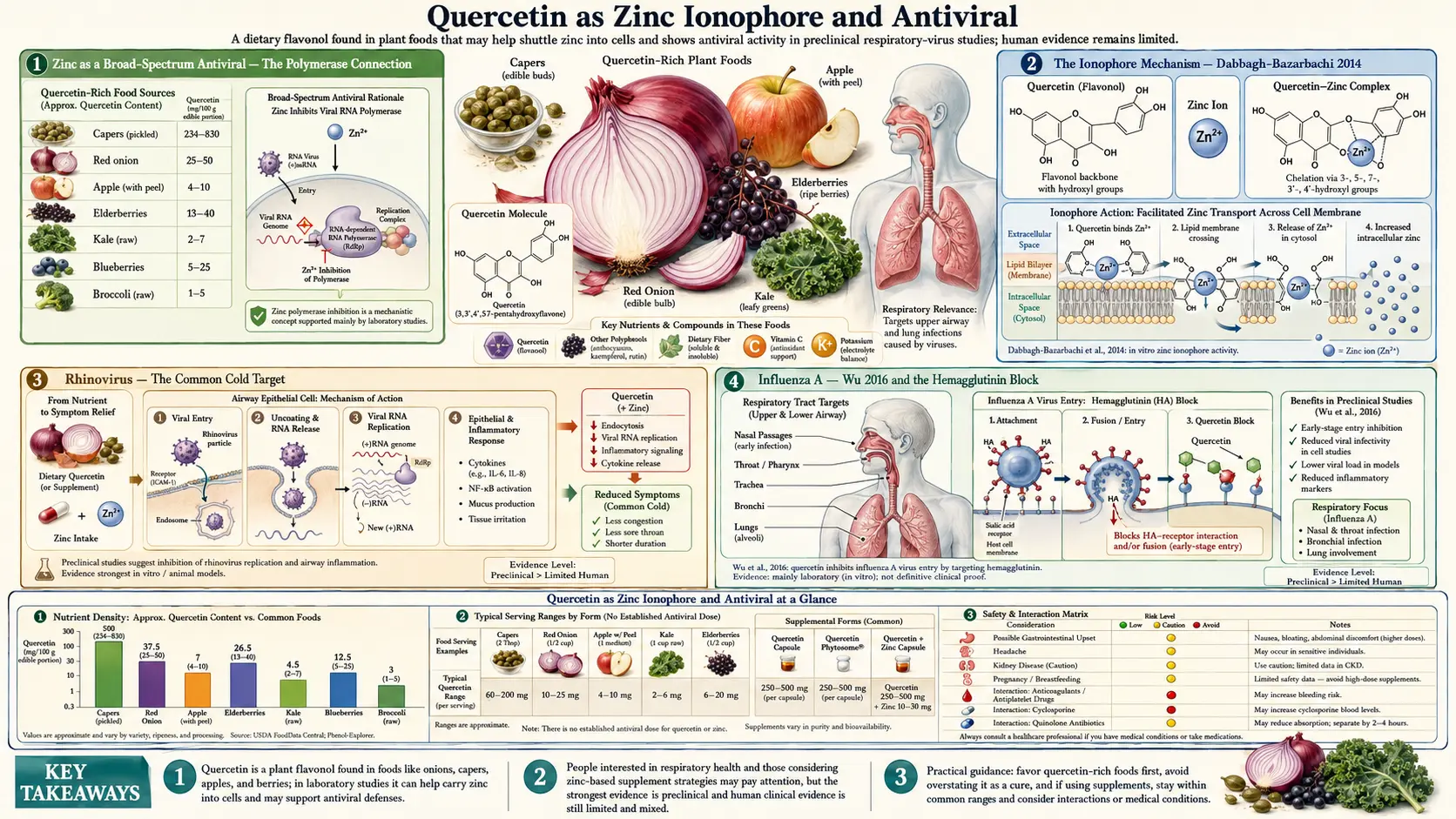
Two laboratory findings sit behind the idea of quercetin as a “zinc ionophore.” In 2010, te Velthuis and colleagues found that zinc inhibits the RNA polymerase of SARS-coronavirus and equine arteritis virus in vitro, and that zinc combined with the ionophore pyrithione blocked the replication of both viruses in cell culture; quercetin was not part of that study. In 2014, Dabbagh-Bazarbachi and colleagues showed that quercetin and epigallocatechin gallate (EGCG), like the drug clioquinol, carried zinc into mouse liver-cancer (Hepa 1-6) cells and across the membrane of artificial liposomes. Separately, cell-culture and mouse studies report activity of quercetin against rhinovirus, influenza A, Epstein-Barr virus, herpes simplex and hepatitis C virus. None of these papers tested quercetin's zinc-carrying action in people. The human evidence is limited: two upper-respiratory trials with differing results, a phase I trial in hepatitis C, and three open-label COVID-19 trials. This page reports what each study found, the doses the studies used, how different forms of quercetin are absorbed, and the safety and drug-interaction findings.
Table of Contents
- Zinc and Viral RNA Polymerases — te Velthuis 2010
- The Ionophore Mechanism — Dabbagh-Bazarbachi 2014
- Rhinovirus and Upper-Respiratory Infection Trials
- Influenza A — Wu 2015 and Virus Entry
- COVID-19 — Three Open-Label Trials
- Epstein-Barr Virus — Cell and Mouse Studies
- Herpes Simplex Virus (HSV-1 and HSV-2) In Vitro
- Hepatitis C — Heat-Shock Proteins and a Phase I Trial
- Doses Used in the Studies
- Bioavailability — How Different Forms Are Absorbed
- Safety and Drug-Interaction Findings
- Key Research Papers
- Connections
- Featured Videos
Zinc and Viral RNA Polymerases — te Velthuis 2010
Zinc lozenges have been tested against the common cold in randomized trials. A 2017 meta-analysis by Hemilä pooled seven placebo-controlled trials with 575 participants that used zinc doses above 75 mg/day; colds were on average 33% shorter in the zinc groups (95% CI 21–45%). Colds were shortened by 40% in the three zinc acetate trials and by 28% in the four zinc gluconate trials, a difference that was not statistically significant, and trials using 192–207 mg/day did not find a larger effect than those using 80–92 mg/day. Quercetin was not part of these trials.
te Velthuis and colleagues at Leiden University Medical Center (2010) start from earlier findings that raising the zinc concentration inside cells with zinc ionophores such as pyrithione can impair the replication of several RNA viruses, including poliovirus and influenza virus. In their study, zinc combined with pyrithione at low concentrations (2 µM each) inhibited the replication of SARS-coronavirus and equine arteritis virus in cell culture. Using replication complexes isolated from infected cells, and then purified recombinant polymerases, they found that zinc directly inhibited the RNA-synthesizing activity of both viruses' RNA-dependent RNA polymerases — blocking the initiation step for equine arteritis virus and inhibiting elongation and template binding for SARS-coronavirus. The effect was reversed by chelating the zinc. Pyrithione is not a flavonoid, and quercetin was not tested in this study.
The Ionophore Mechanism — Dabbagh-Bazarbachi 2014
Dabbagh-Bazarbachi and colleagues at the Universitat Rovira i Virgili in Tarragona, Spain (published in the Journal of Agricultural and Food Chemistry) start from the observation that labile zinc — a tiny, loosely bound fraction of the total zinc inside cells — modulates many signaling and metabolic pathways, and from their own earlier finding that quercetin and EGCG chelate zinc. They showed that both polyphenols rapidly raised labile zinc in mouse hepatocarcinoma (Hepa 1-6) cells. To test whether this happened independently of the cell's own zinc transporters, they added quercetin, EGCG or the drug clioquinol, alone or with zinc, to artificial liposomes loaded with the zinc-sensitive dye FluoZin-3, which cannot cross membranes. Only the combinations of each chelator with zinc produced a rapid rise in fluorescence inside the liposomes — the behaviour of a zinc ionophore. The authors suggest that this ionophore activity may underlie the rise in labile zinc that polyphenols trigger in cells.
These findings come from cultured mouse cells and artificial liposomes. The study did not measure antiviral activity, and none of the papers on this page tested quercetin's zinc-carrying action in people. For comparison, in healthy volunteers taking 150 mg/day of quercetin, the median peak plasma quercetin concentration was 431 nmol/L, with high variation between people (Egert 2008).
Rhinovirus and Upper-Respiratory Infection Trials
Rhinovirus causes the majority of common colds and also triggers exacerbations of asthma and chronic obstructive pulmonary disease (Ganesan 2012). Ganesan and colleagues at the University of Michigan (2012, Antiviral Research) found that pretreating airway epithelial cells with quercetin reduced Akt phosphorylation, viral endocytosis and IL-8 responses; adding quercetin 6 hours after infection reduced viral load, IL-8 and interferon responses, viral RNA and capsid protein. In mice infected with rhinovirus, quercetin treatment decreased viral replication and the expression of chemokines and cytokines, and attenuated rhinovirus-induced airway cholinergic hyperresponsiveness. The authors concluded that further studies of quercetin in the prevention and treatment of rhinovirus infection are warranted.
Two randomized, double-blind, placebo-controlled trials have measured upper-respiratory tract infections (URTI) in people; neither identified which viruses caused the infections:
- Nieman 2007 — 40 trained male cyclists took quercetin 1000 mg/day or placebo for 3 weeks before, during and for 2 weeks after a 3-day period of cycling 3 hours a day. URTI incidence in the 2 weeks after the exercise period was 1 of 20 with quercetin versus 9 of 20 with placebo (P=0.004). Exercise-induced changes in the immune measures studied (natural killer cell activity, lymphocyte proliferation, polymorphonuclear oxidative burst, salivary IgA) did not differ between the groups.
- Heinz 2010 — 1,002 community adults aged 18–85 took 500 mg/day, 1000 mg/day or placebo for 12 weeks. There were no significant group differences in URTI outcomes for all subjects combined, or by gender, body mass index or age category. In a separate analysis of 325 subjects aged 40 and older who rated themselves in the top half of the group for fitness, the 1000 mg group had 36% lower URTI severity (P=0.020) and 31% fewer URTI sick days (P=0.048) than placebo. This separate analysis followed a regression analysis showing that self-reported fitness had the strongest interaction with group status.
Neither trial tested quercetin combined with zinc or vitamin C.
Influenza A — Wu 2015 and Virus Entry
Wu and colleagues at Southern Medical University in Guangzhou (published in Viruses, dated December 2015, volume 8) found that quercetin inhibited infection with several influenza A strains in cell culture, with half-maximal inhibitory concentrations of 7.756, 6.225 and 2.738 µg/mL against A/Puerto Rico/8/34 (H1N1), A/FM-1/47/1 (H1N1) and A/Aichi/2/68 (H3N2). Mechanism studies showed that quercetin interacted with the HA2 subunit of the viral hemagglutinin, and quercetin inhibited the entry of an H5N1 pseudovirus. The authors describe the activity as acting at the early stage of influenza infection.
These are cell-culture findings. The two human URTI trials described above (Nieman 2007, Heinz 2010) did not identify which viruses caused the infections they counted, and none of the papers on this page is an influenza-specific human trial.
COVID-19 — Three Open-Label Trials
Three randomized, open-label reports from Pakistan tested a quercetin–lecithin phytosome formulation added to standard care in outpatients with early-stage COVID-19. There was no placebo, and co-authors of all three reports are employees or scientific-board members of the formulation's manufacturer:
- Di Pierro, Derosa and colleagues 2021 (International Journal of General Medicine) — 152 outpatients; 1000 mg/day of the formulation for 30 days. The authors report reductions in the frequency and length of hospitalization, the need for non-invasive oxygen therapy, progression to intensive care and deaths, and call for a double-blind, placebo-controlled study.
- Di Pierro, Iqtadar and colleagues 2021 (International Journal of General Medicine), described as a second, pilot trial — 42 outpatients over 2 weeks, 21 per group. In these interim results, after 1 week 16 of 21 patients in the quercetin group and 2 of 21 in the standard-care group tested negative for SARS-CoV-2.
- Di Pierro, Khan, Iqtadar and colleagues 2023 (Frontiers in Pharmacology), described as the concluding results of a trial at King Edward Medical University, Lahore — 100 outpatients; 500 mg of the formulation three times a day in week 1 and twice a day in week 2. After 1 week, 34 of 50 patients in the quercetin group versus 12 of 50 controls tested negative (p=0.0004), and acute symptoms had resolved in 26 versus 12.
The second and third reports share authors, and the third presents itself as the concluding results after the second's interim results, so they may describe overlapping patients. None of the three has been retracted (PubMed and Crossref, checked October 2026).
Epstein-Barr Virus — Cell and Mouse Studies
Epstein-Barr virus (EBV) is a human herpesvirus that establishes lifelong latency in over 90% of the world's population (Lee 2015). Latent EBV infection can lead to malignancies such as Burkitt's lymphoma, Hodgkin's disease and gastric carcinoma (Lee 2016). In a cohort of more than 10 million young adults on active duty in the US military, 955 of whom were diagnosed with multiple sclerosis, the risk of MS increased 32-fold after EBV infection but not after infection with other viruses, including cytomegalovirus (Bjornevik 2022).
The quercetin research on EBV consists of cell and mouse studies, and its findings point in more than one direction:
- In B lymphocytes infected with EBV in vitro, quercetin inhibited EBV-induced STAT3 activation, reduced IL-6 and reactive oxygen species, promoted autophagy and prevented EBV-driven B-cell immortalization (Granato 2019).
- In EBV-positive human gastric carcinoma cells (SNU719), quercetin induced apoptosis and EBV gene transcription, reduced EBV latency, increased EBV progeny production and inhibited EBV infection (Lee 2015). In other words, in these cancer cells quercetin pushed the virus out of latency rather than suppressing its reactivation.
- In mice carrying EBV-positive gastric carcinoma xenografts, quercetin had a greater anti-cancer effect than isoliquiritigenin and reduced the viral proteins EBNA-1 and LMP-2 in tumour tissue (Lee 2016). A Ganoderma lucidum mushroom extract suppressed these tumours in mice, an effect augmented by low-concentration quercetin cotreatment, and the extract reinforced quercetin-induced apoptosis and EBV lytic reactivation (Huh 2019).
None of these studies tested quercetin in people with EBV infection or EBV-related disease.
Herpes Simplex Virus (HSV-1 and HSV-2) In Vitro
Kaul, Middleton and Ogra (1985, Journal of Medical Virology) tested the dietary flavonoids quercetin, naringin, hesperetin and catechin against herpes simplex virus type 1 (a DNA virus), poliovirus type 1, parainfluenza virus type 3 and respiratory syncytial virus in cell-culture monolayers. Quercetin caused a concentration-dependent reduction in the infectivity of each virus and reduced intracellular replication when infected monolayers were cultured in medium containing it; preincubating the cells with quercetin did not affect infection. Naringin had no effect on any of the viruses.
Mucsi and colleagues (1992) found that quercetin, quercitrin and apigenin had antiviral activity against HSV-1 and HSV-2 in HEp-2 cells and against pseudorabies virus in chick embryo fibroblasts, and that combining each flavonoid with acyclovir enhanced the antiviral activity, with fractional inhibitory concentration indices commonly of 0.6–0.8, which the authors interpret as synergy. These are cell-culture findings; none of the papers on this page is a clinical trial of quercetin in herpes simplex infection.
Hepatitis C — Heat-Shock Proteins and a Phase I Trial
Gonzalez and colleagues at the University of California, Los Angeles (2009, Hepatology) found that the hepatitis C virus protein NS5A interacts with the host heat-shock proteins HSP40 and HSP70, and that knocking down these proteins reduced the production of infectious virus particles in cell culture. Quercetin, an inhibitor of heat-shock protein synthesis, reduced the activity of the viral internal ribosome entry site (IRES) and its augmentation by NS5A, and reduced infectious particle production at nontoxic concentrations.
Lu and colleagues (2016, Phytotherapy Research) ran a phase I dose-escalation study of quercetin in 30 untreated patients with chronic hepatitis C. Quercetin was safe in all participants at doses up to 5 g daily. Eight patients showed a viral-load decrease of 0.41 log, which the authors called “clinically meaningful,” and liver enzymes (AST and ALT) did not change significantly. The authors concluded that there was a potential for antiviral activity in some patients, and described quercetin as a possible inexpensive treatment for populations without the means to pay for mainstream antivirals.
Doses Used in the Studies
The human studies on this page used the following doses. These are reported as what each study tested; no study on this page tested quercetin combined with zinc or vitamin C.
- Upper-respiratory trials — 1000 mg/day for 3 weeks before, during and 2 weeks after 3 days of intensive exercise (Nieman 2007); 500 or 1000 mg/day for 12 weeks (Heinz 2010).
- Hepatitis C phase I trial — escalating doses, safe up to 5 g daily (Lu 2016).
- COVID-19 open-label trials — 1000 mg/day of a phytosome formulation for 30 days (Di Pierro 2021); 500 mg of the formulation three times a day in week 1 and twice a day in week 2 (Di Pierro 2023).
- Absorption studies — 50, 100 or 150 mg/day for 2 weeks (Egert 2008); a single 150 or 300 mg dose of quercetin-4′-O-glucoside (Hubbard 2004).
- Zinc lozenge trials (no quercetin) — zinc doses above 75 mg/day; 80–92 mg/day in five trials and 192–207 mg/day in two (Hemilä 2017).
A 2018 safety review from Germany's Federal Institute for Risk Assessment notes that quercetin supplements are frequently marketed in daily doses of up to 1000 mg, above usual dietary intake, and that adequate data on long-term use (more than 12 weeks) of doses of 1000 mg or more are not available (Andres 2018). Vitamin C is covered on the Vitamin C page.
Bioavailability — How Different Forms Are Absorbed
A 2019 pharmacokinetic paper describes quercetin's poor solubility and low oral absorption as its major drawbacks (Riva 2019). Findings on different forms:
- Food forms — in nine volunteers, quercetin from apples and from pure quercetin-3-rutinoside (the major quercetin glycoside in tea) was 30% as bioavailable as quercetin from onions, which contain glucose conjugates; peak levels came less than 0.7 hours after onions, 2.5 hours after apples and 9 hours after the rutinoside (Hollman 1997). Dietary quercetin is covered on the onions and apples pages.
- Quercetin glucoside — a single 150 or 300 mg dose of quercetin-4′-O-glucoside gave peak plasma quercetin concentrations of 4.66 and 9.72 µM 30 minutes after ingestion (Hubbard 2004).
- Enzymatically modified isoquercitrin (EMIQ) — in people, its absorption was significantly higher than that of isoquercitrin (quercetin-3-O-glucoside) or rutin (Murota 2010). In rats, its bioavailability was 35%, compared with 12% for isoquercitrin and 2.0% for quercetin aglycone (Makino 2009).
- Lecithin phytosome formulation — in a 12-volunteer crossover study whose authors are employees of the formulation's manufacturer, a quercetin–lecithin phytosome produced plasma levels up to 20 times those usually obtained with unformulated quercetin, with no notable side effects (Riva 2019).
- Plain quercetin — in healthy volunteers taking 150 mg/day, the median peak plasma concentration was 431 nmol/L, reached 360 minutes after intake, with high variation between people (Egert 2008).
The forms used in the allergy and senolytic studies are described on the Allergy and Histamine page and the Senolytic Activity page.
Safety and Drug-Interaction Findings
- General safety — a 2018 review found that adverse effects of supplemental quercetin have rarely been reported in human intervention studies and were mild; adequate data on long-term use (more than 12 weeks) of doses of 1000 mg or more are not available. Animal studies raised possible concerns: enhancement of nephrotoxic effects in a previously damaged kidney, and promotion of tumour development, especially in estrogen-dependent cancer (Andres 2018).
- CYP3A drugs — in 18 healthy men, 500 mg/day of quercetin for 13 days lowered blood levels of the CYP3A substrate midazolam, which the authors interpret as induction of CYP3A activity, more prominent in carriers of the CYP3A5*1 allele (Duan 2012).
- Statins handled by OATP1B1 — in 16 healthy men, 500 mg/day for 14 days raised pravastatin exposure (AUC) by 24% and peak concentration by 31%, by inhibiting the OATP1B1 transporter (Wu 2012).
- Cyclosporine — in pigs and rats, quercetin given with the immunosuppressant cyclosporine significantly decreased cyclosporine's oral bioavailability (AUC down 56% in pigs and 43% in rats). The authors note cyclosporine's narrow therapeutic window and state that combining quercetin with cyclosporine or other drugs handled by P-glycoprotein or CYP3A4 requires close monitoring (Hsiu 2002).
- Platelets — in a pilot study, 150 or 300 mg of quercetin-4′-O-glucoside inhibited platelet aggregation 30 and 120 minutes after ingestion (Hubbard 2004); platelet research is also covered on the Cardiovascular Health page. That study did not examine people taking anticoagulant or antiplatelet drugs.
- Excess zinc and copper deficiency — excess zinc intake is among the causes of copper deficiency, which can present as anemia, neutropenia and peripheral neuropathy (three cases, Willis 2005). In a laboratory-database study, diagnosis of zinc-induced copper deficiency was often delayed, allowing severe and usually irreversible neurological symptoms to develop (Duncan 2016).
- Prescription antivirals — none of the human studies on this page compared quercetin with prescription antiviral drugs; the COVID-19 trials added it to standard care. Decisions about medicines and supplements belong with a clinician.
Key Research Papers
- Dabbagh-Bazarbachi H, Clergeaud G, Quesada IM, Ortiz M, O'Sullivan CK, Fernandez-Larrea JB (2014). Zinc ionophore activity of quercetin and epigallocatechin-gallate: from Hepa 1-6 cells to a liposome model. Journal of Agricultural and Food Chemistry 62(32):8085–8093. — PubMed PMID: 25050823
- te Velthuis AJW, van den Worm SHE, Sims AC, Baric RS, Snijder EJ, van Hemert MJ (2010). Zn(2+) inhibits coronavirus and arterivirus RNA polymerase activity in vitro and zinc ionophores block the replication of these viruses in cell culture. PLoS Pathogens 6(11):e1001176. — PubMed PMID: 21079686
- Hemilä H (2017). Zinc lozenges and the common cold: a meta-analysis comparing zinc acetate and zinc gluconate, and the role of zinc dosage. JRSM Open 8(5):2054270417694291. — PubMed PMID: 28515951
- Ganesan S, Faris AN, Comstock AT, et al. (2012). Quercetin inhibits rhinovirus replication in vitro and in vivo. Antiviral Research 94(3):258–271. — PubMed PMID: 22465313
- Wu W, Li R, Li X, He J, Jiang S, Liu S, Yang J (2015). Quercetin as an antiviral agent inhibits influenza A virus (IAV) entry. Viruses 8(1):6. — PubMed PMID: 26712783
- Heinz SA, Henson DA, Austin MD, Jin F, Nieman DC (2010). Quercetin supplementation and upper respiratory tract infection: a randomized community clinical trial. Pharmacological Research 62(3):237–242. — PubMed PMID: 20478383
- Nieman DC, Henson DA, Gross SJ, et al. (2007). Quercetin reduces illness but not immune perturbations after intensive exercise. Medicine and Science in Sports and Exercise 39(9):1561–1569. — PubMed PMID: 17805089
- Kaul TN, Middleton E Jr, Ogra PL (1985). Antiviral effect of flavonoids on human viruses. Journal of Medical Virology 15(1):71–79. — PubMed PMID: 2981979
- Gonzalez O, Fontanes V, Raychaudhuri S, et al. (2009). The heat shock protein inhibitor quercetin attenuates hepatitis C virus production. Hepatology 50(6):1756–1764. — PubMed PMID: 19839005
- Lu NT, Crespi CM, Liu NM, et al. (2016). A phase I dose escalation study demonstrates quercetin safety and explores potential for bioflavonoid antivirals in patients with chronic hepatitis C. Phytotherapy Research 30(1):160–168. — PubMed PMID: 26621580
- Riva A, Ronchi M, Petrangolini G, Bosisio S, Allegrini P (2019). Improved oral absorption of quercetin from Quercetin Phytosome®, a new delivery system based on food grade lecithin. European Journal of Drug Metabolism and Pharmacokinetics 44(2):169–177. — PubMed PMID: 30328058 (the authors are employees of the formulation's manufacturer)
- Egert S, Wolffram S, Bosy-Westphal A, et al. (2008). Daily quercetin supplementation dose-dependently increases plasma quercetin concentrations in healthy humans. Journal of Nutrition 138(9):1615–1621. — PubMed PMID: 18716159
- Bjornevik K, Cortese M, Healy BC, et al. (2022). Longitudinal analysis reveals high prevalence of Epstein-Barr virus associated with multiple sclerosis. Science 375(6578):296–301. — PubMed PMID: 35025605
- Di Pierro F, Derosa G, Maffioli P, et al. (2021). Possible therapeutic effects of adjuvant quercetin supplementation against early-stage COVID-19 infection: a prospective, randomized, controlled, and open-label study. International Journal of General Medicine 14:2359–2366. — PubMed PMID: 34135619 (co-authors include employees of the formulation's manufacturer)
- Di Pierro F, Iqtadar S, Khan A, et al. (2021). Potential clinical benefits of quercetin in the early stage of COVID-19: results of a second, pilot, randomized, controlled and open-label clinical trial. International Journal of General Medicine 14:2807–2816. — PubMed PMID: 34194240 (co-authors include employees of the formulation's manufacturer)
- Di Pierro F, Khan A, Iqtadar S, et al. (2023). Quercetin as a possible complementary agent for early-stage COVID-19: concluding results of a randomized clinical trial. Frontiers in Pharmacology 13:1096853. — PubMed PMID: 36712674 (co-authors include scientific-board members of the formulation's manufacturer)
- Lee M, Son M, Ryu E, et al. (2015). Quercetin-induced apoptosis prevents EBV infection. Oncotarget 6(14):12603–12624. — PubMed PMID: 26059439
- Lee HH, Lee S, Shin YS, Cho M, Kang H, Cho H (2016). Anti-cancer effect of quercetin in xenograft models with EBV-associated human gastric carcinoma. Molecules 21(10):1286. — PubMed PMID: 27681719
- Granato M, Gilardini Montani MS, Zompetta C, et al. (2019). Quercetin interrupts the positive feedback loop between STAT3 and IL-6, promotes autophagy, and reduces ROS, preventing EBV-driven B cell immortalization. Biomolecules 9(9):482. — PubMed PMID: 31547402
- Huh S, Lee S, Choi SJ, et al. (2019). Quercetin synergistically inhibit EBV-associated gastric carcinoma with Ganoderma lucidum extracts. Molecules 24(21):3834. — PubMed PMID: 31653035
- Mucsi I, Gyulai Z, Béládi I (1992). Combined effects of flavonoids and acyclovir against herpesviruses in cell cultures. Acta Microbiologica Hungarica 39(2):137–147. — PubMed PMID: 1339152
- Hollman PC, van Trijp JM, Buysman MN, et al. (1997). Relative bioavailability of the antioxidant flavonoid quercetin from various foods in man. FEBS Letters 418(1–2):152–156. — PubMed PMID: 9414116
- Murota K, Matsuda N, Kashino Y, et al. (2010). alpha-Oligoglucosylation of a sugar moiety enhances the bioavailability of quercetin glucosides in humans. Archives of Biochemistry and Biophysics 501(1):91–97. — PubMed PMID: 20638359
- Makino T, Shimizu R, Kanemaru M, et al. (2009). Enzymatically modified isoquercitrin, alpha-oligoglucosyl quercetin 3-O-glucoside, is absorbed more easily than other quercetin glycosides or aglycone after oral administration in rats. Biological & Pharmaceutical Bulletin 32(12):2034–2040. — PubMed PMID: 19952424
- Hubbard GP, Wolffram S, Lovegrove JA, Gibbins JM (2004). Ingestion of quercetin inhibits platelet aggregation and essential components of the collagen-stimulated platelet activation pathway in humans. Journal of Thrombosis and Haemostasis 2(12):2138–2145. — PubMed PMID: 15613018
- Andres S, Pevny S, Ziegenhagen R, et al. (2018). Safety aspects of the use of quercetin as a dietary supplement. Molecular Nutrition & Food Research 62(1). — PubMed PMID: 29127724
- Duan KM, Wang SY, Ouyang W, Mao YM, Yang LJ (2012). Effect of quercetin on CYP3A activity in Chinese healthy participants. Journal of Clinical Pharmacology 52(6):940–946. — PubMed PMID: 21680781
- Wu LX, Guo CX, Chen WQ, et al. (2012). Inhibition of the organic anion-transporting polypeptide 1B1 by quercetin: an in vitro and in vivo assessment. British Journal of Clinical Pharmacology 73(5):750–757. — PubMed PMID: 22114872
- Hsiu SL, Hou YC, Wang YH, et al. (2002). Quercetin significantly decreased cyclosporin oral bioavailability in pigs and rats. Life Sciences 72(3):227–235. — PubMed PMID: 12427482
- Willis MS, Monaghan SA, Miller ML, et al. (2005). Zinc-induced copper deficiency: a report of three cases initially recognized on bone marrow examination. American Journal of Clinical Pathology 123(1):125–131. — PubMed PMID: 15762288
- Duncan A, Talwar D, Morrison I (2016). The predictive value of low plasma copper and high plasma zinc in detecting zinc-induced copper deficiency. Annals of Clinical Biochemistry 53(Pt 5):575–579. — PubMed PMID: 26586851
PubMed Topic Searches
Connections
- Quercetin Overview
- Quercetin Benefits Hub
- Quercetin for Allergy and Histamine
- Quercetin for Cardiovascular Health
- Quercetin Senolytic Activity (D+Q)
- Zinc
- Vitamin C
- Vitamin D3
- Lysine
- Fisetin (Sister Flavonol)
- EGCG (Green Tea Polyphenol)
- Immune Boosting
- Pulmonology
- Infectious Disease
- Onions (Dietary Quercetin)
- Apples (Dietary Quercetin)
- Influenza — the virus in the Wu 2015 cell-culture entry study described above.
- History