Fisetin for Senolytic Activity
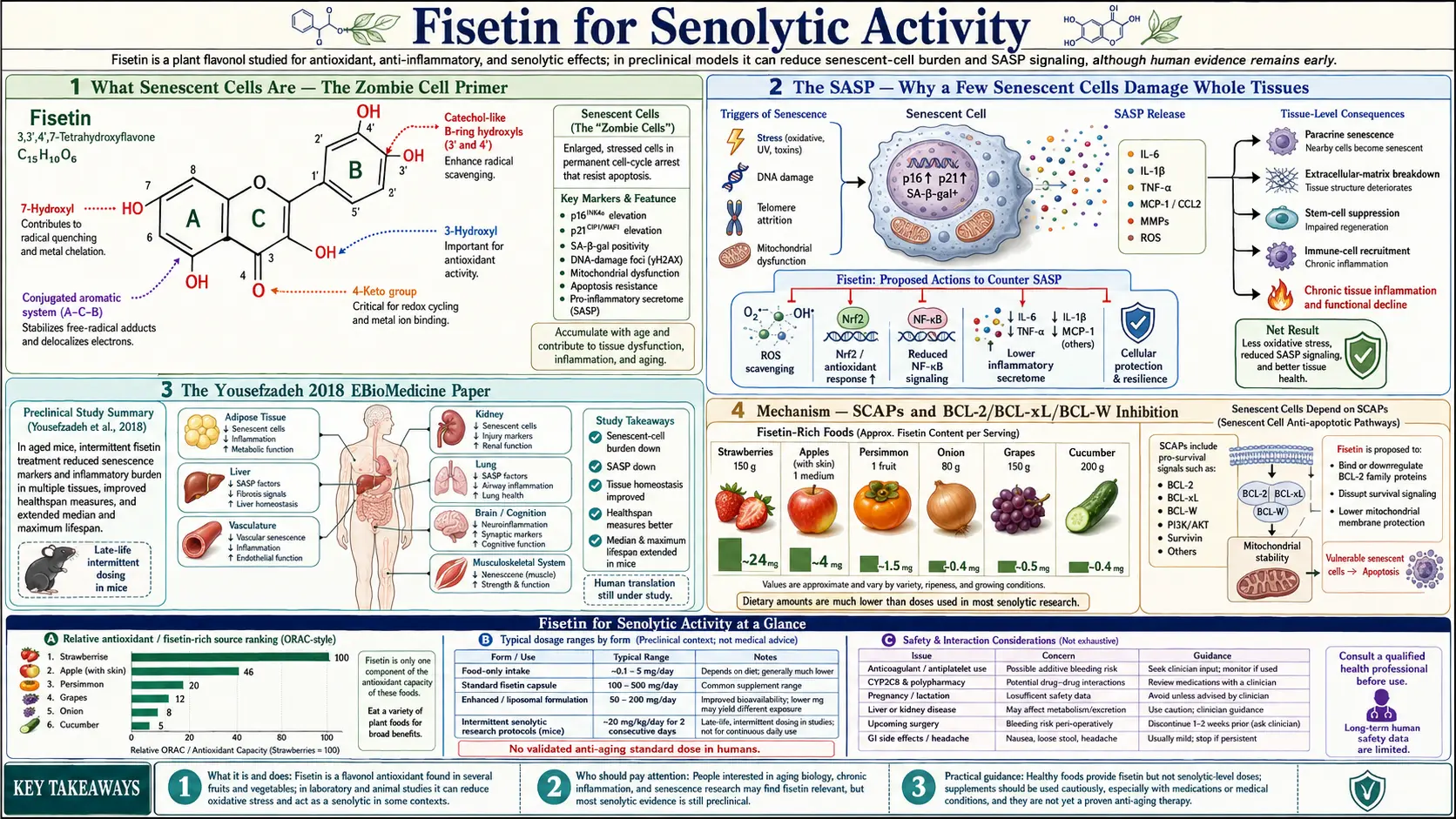
In October 2018, EBioMedicine published a paper by Matthew Yousefzadeh, Yi Zhu, James Kirkland, Paul Robbins, Laura Niedernhofer and colleagues at the Scripps Research Institute and the Mayo Clinic that drew attention to fisetin, a flavonoid found in strawberries and other plants. The team screened a panel of 10 flavonoids for “senolytic” activity — the ability to selectively clear senescent cells — and found fisetin the most potent of those tested. In wild-type mice fed a fisetin diet from 85 weeks of age (which the authors describe as roughly equivalent to age 75 in humans), median and maximum lifespan were extended. A later lifespan study in genetically heterogeneous mice (Harrison 2024) found no significant lifespan effect of fisetin at the dose and schedule it used. In people, the Mayo Clinic AFFIRM and AFFIRM-LITE trials are registered on ClinicalTrials.gov and, as of October 2026, list no posted results. This page reports what senescent cells are, what the 2018 paper found, what is and is not known about how fisetin acts on senescent cells, the related dasatinib + quercetin (D+Q) research, and where the human evidence stands.
Table of Contents
- What Senescent Cells Are — The Zombie Cell Primer
- The SASP — Why Senescent Cells Damage Whole Tissues
- The Yousefzadeh 2018 EBioMedicine Paper
- Mechanism — SCAPs and What Is Known for Fisetin
- The Mayo Clinic Translational Program (Kirkland & Tchkonia)
- The Dasatinib + Quercetin (D+Q) Context
- AFFIRM, AFFIRM-LITE, and Other Registered Fisetin Trials
- The “Hit and Run” Dosing Rationale
- Senescence Biomarkers Used in Research
- The Animal-vs-Human Evidence Gap
- What Is Reported About Fisetin Doses and Safety
- Key Research Papers
- Connections
- Featured Videos
What Senescent Cells Are — The Zombie Cell Primer
Cellular senescence is a cellular response to stress — DNA damage, telomere shortening, oncogene activation, or oxidative stress — in which a cell stops dividing essentially permanently while remaining metabolically active and resistant to apoptosis (programmed cell death). Senescent cells are commonly identified by markers such as the cell-cycle inhibitors p16INK4a and p21CIP1, senescence-associated β-galactosidase activity, and a distinctive secretory profile (the SASP, described in the next section).
Senescence is not simply harmful. It suppresses cancer by halting the division of damaged cells, and reviews describe further roles in development and tissue repair (van Deursen 2014). The problem, as reviews describe it, is that senescent cells accumulate in various tissues with ageing and at sites of disease in many chronic conditions (Kirkland and Tchkonia 2017), where they stay in place and keep secreting inflammatory factors.
Whether senescent cells drive age-related decline became testable with a transgenic mouse (INK-ATTAC) in which p16INK4a-positive cells can be eliminated on demand with a drug. In progeroid BubR1 mice, life-long removal of these cells delayed age-related changes in adipose tissue, skeletal muscle and the eye, and late-life clearance slowed disorders already under way (Baker et al., Nature 2011). In normal (wild-type) mice, removing p16INK4a-positive cells from one year of age extended median lifespan in both sexes, delayed tumour formation and lessened age-related deterioration of the kidney, heart and fat (Baker et al., Nature 2016). These were genetic tools in mice, not drugs, but they motivated the search for senolytic drugs.
The SASP — Why Senescent Cells Damage Whole Tissues
The mechanism by which senescent cells are thought to damage surrounding tissue is the senescence-associated secretory phenotype or SASP. Coppé and colleagues (2010) describe the SASP as turning senescent fibroblasts into pro-inflammatory cells able to promote tumour progression. Factors measured as SASP markers in the studies on this page include:
- Pro-inflammatory cytokines — interleukin-6 (IL-6), interleukin-8 (IL-8), interleukin-1α, interleukin-1β and tumour necrosis factor alpha (TNF-α)
- Chemokines — such as MCP-1 and CXCL2, which recruit immune cells
- Matrix metalloproteinases (MMPs) — enzymes that degrade the extracellular matrix (MMP-9 and MMP-12 were measured in Hickson 2019)
- Plasminogen activator inhibitor-1 (PAI-1)
Reviews attribute several downstream effects to the SASP. Kirkland and Tchkonia (2017) list senescence-related inflammation, metabolic dysregulation, stem cell dysfunction, ageing phenotypes, chronic diseases, geriatric syndromes and loss of resilience among the conditions the SASP can contribute to, and Tchkonia and colleagues (2013) describe senescence as a source of chronic inflammation through the SASP. In mice, transplanting relatively small numbers of senescent cells into young animals caused persistent physical dysfunction and spread senescence to the host's own tissues (Xu 2018).
The Yousefzadeh 2018 EBioMedicine Paper
The paper is Yousefzadeh MJ, Zhu Y, McGowan SJ, Angelini L, Fuhrmann-Stroissnigg H, Xu M, Ling YY, Melos KI, Pirtskhalava T, Inman CL, McGuckian C, Wade EA, Kato JI, Grassi D, Wentworth M, Burd CE, Arriaga EA, Ladiges WL, Tchkonia T, Kirkland JL, Robbins PD, Niedernhofer LJ. “Fisetin is a senotherapeutic that extends health and lifespan.” EBioMedicine 2018; 36: 18-28. Its background states that the group had earlier shown D+Q to be a potent senolytic and that the goal was to find flavonoids with more potent senolytic activity. What it reports:
- Screen design — a panel of compounds (the abstract counts 10 flavonoids; the methods list fisetin, quercetin, luteolin, rutin, myricetin, apigenin, catechin, epigallocatechin gallate, curcumin and resveratrol) was tested at 5 μM against senescent mouse embryonic fibroblasts from Ercc1-deficient mice, with activity confirmed in senescent human IMR90 fibroblasts.
- Result in cells — of the 10 tested, fisetin was the most potent senolytic. Luteolin and curcumin showed weak activity at a dose where quercetin was ineffective. The paper notes that in human endothelial cells fisetin induces apoptosis, whereas in the mouse fibroblasts it suppressed senescence markers without evidence of cell killing.
- Progeroid mice — in Ercc1-/Δ mice, a 500 ppm fisetin diet given intermittently (two weeks on, then off) lowered a p16INK4a reporter signal, which stayed lower during the 4-week period off fisetin. Chronic dietary fisetin reduced senescence and SASP markers in fat, spleen, liver and kidney.
- Old wild-type mice, short course — 22–24-month-old mice given 100 mg/kg fisetin by mouth for 5 consecutive days had fewer senescent cells in fat tissue, including senescent stem/progenitor cells, T cells, natural killer cells and endothelial cells.
- Human tissue explants — fat tissue removed during surgery from 3 people and treated with fisetin in the laboratory showed fewer senescent cells and lower IL-6, IL-8 and MCP-1. This was tissue in a dish, not treatment of living people.
- Lifespan — wild-type mice fed a 500 ppm fisetin diet from 85 weeks of age (8–9 mice per group) had extended median and maximum lifespan, lower age-related pathology scores in several tissues, and lower serum markers of liver and pancreatic dysfunction. The abstract and figure legends do not give a percentage for the lifespan gain.
The authors concluded that fisetin has senotherapeutic activity in mice and in human tissues and that these characteristics suggest the feasibility of translation to human clinical studies. The paper discloses that several authors and the Mayo Clinic have a financial interest related to the research (patents on senolytic drugs).
A larger lifespan test came later. In the National Institute on Aging Interventions Testing Program's genetically heterogeneous UM-HET3 mice, Harrison and colleagues (2024, GeroScience) found that fisetin did not significantly increase lifespan in either sex at the dose and method of administration tested. Mouse lifespan results for fisetin therefore differ between studies.
Mechanism — SCAPs and What Is Known for Fisetin
Kirkland and Tchkonia (2020) describe the most harmful senescent cells as resistant to apoptosis because they up-regulate anti-apoptotic pathways — the “senescent-cell anti-apoptotic pathways,” or SCAPs — which defend them against their own inflammatory SASP. Senolytics transiently disable these pathways, causing apoptosis of senescent cells. In the 2015 Aging Cell paper that introduced senolytics, Zhu and colleagues found that silencing key nodes of these pro-survival networks killed senescent cells but not proliferating or quiescent cells. The nodes they named were:
- Ephrins (EFNB1 or EFNB3)
- PI3Kδ (the delta isoform of phosphoinositide 3-kinase)
- p21
- BCL-xL, a BCL-2-family protein that blocks the mitochondrial route to apoptosis
- Plasminogen activator inhibitor-2
For fisetin specifically, the cell-type picture is mixed. Zhu and colleagues (2017, Aging) reported that fisetin selectively induced apoptosis in senescent, but not proliferating, human umbilical vein endothelial cells, and that it was not senolytic in senescent IMR90 human lung fibroblasts or in primary human preadipocytes. In the Yousefzadeh 2018 mouse fibroblasts it suppressed senescence markers without evidence of cell killing. The cited papers do not establish which specific SCAP protein fisetin acts on.
The same 2017 paper reported that two selective BCL-xL inhibitors (A1331852 and A1155463) are senolytic in some cell types and noted that the broader BCL-2-family inhibitor navitoclax is associated with hematological toxicity; the authors suggested the newer agents may be better candidates for eventual translation.
The Mayo Clinic Translational Program (Kirkland & Tchkonia)
James Kirkland and Tamar Tchkonia at the Mayo Clinic Robert and Arlene Kogod Center on Aging are senior authors on the founding senolytic papers. Their 2015 Aging Cell paper (“The Achilles' heel of senescent cells”) introduced senolytics and identified dasatinib plus quercetin by targeting the pro-survival networks of senescent cells; their 2017 Aging paper reported fisetin as senolytic in one human cell type; and the Yousefzadeh fisetin paper, a collaboration with the Scripps group, extended the screen to a flavonoid panel. Kirkland and Tchkonia (2020) list dasatinib, quercetin, fisetin and navitoclax as the first senolytic drugs.
The work has followed a sequence of discovery in cell culture, testing in aged and progeroid mice, and then small human studies — the D+Q pilots described in the next section and the fisetin trials registered by the Mayo Clinic and other centres.
In their 2020 review, Kirkland and Tchkonia wrote that early pilot trials suggest senolytics decrease senescent cells, reduce inflammation and alleviate frailty in humans, and that “until such studies are done, it is too early for senolytics to be used outside of clinical trials.” The review discloses that the authors have a financial interest related to this research and that Mayo Clinic holds patents on senolytic drugs. Online marketing claims that fisetin is a proven longevity intervention go beyond what the published clinical literature reports.
The Dasatinib + Quercetin (D+Q) Context
The first senolytic combination to enter human trials was dasatinib + quercetin (D+Q). Dasatinib is a prescription kinase inhibitor approved for certain leukemias; quercetin is a flavonol related to fisetin. In the Zhu 2015 paper, dasatinib eliminated senescent human fat-cell progenitors, quercetin was more effective against senescent human endothelial cells and mouse bone-marrow stem cells, and the combination was effective against senescent mouse embryonic fibroblasts — the reason the two are used together. In naturally aged mice, intermittent oral D+Q increased post-treatment survival by 36% and reduced the mortality hazard to 65% (Xu 2018, a mouse study).
The early and later human D+Q studies (details, and the randomized trials, are on the Quercetin Senolytic Activity page):
- Justice et al. EBioMedicine 2019 — the first clinical trial of senolytics: an open-label pilot with no control group in which 14 people with idiopathic pulmonary fibrosis took dasatinib 100 mg/day and quercetin 1250 mg/day, three days a week for three weeks. Retention was 100%; 6-minute walk distance, 4-metre gait speed and chair-stand time improved significantly, while pulmonary function, a frailty index and reported health were unchanged.
- Hickson et al. EBioMedicine 2019 — an open-label pilot with no control group in which 9 people with diabetic kidney disease took dasatinib 100 mg and quercetin 1000 mg for a single 3-day course. Eleven days after it ended, adipose tissue and skin showed fewer p16INK4a- and p21CIP1-expressing cells, and circulating SASP factors (including IL-1α, IL-6 and MMP-9 and -12) were lower. It was the first peer-reviewed study to show directly that a senolytic decreased senescent cells in humans.
- Farr et al. Nature Medicine 2024 — a phase 2 randomized controlled trial of intermittent D+Q in 60 postmenopausal women. The primary endpoint, change in the bone-resorption marker CTx at 20 weeks, did not differ between groups (P = 0.611); the authors concluded that D+Q did not reduce bone resorption in the overall group. The trial's registry entry (NCT04313634) also lists a fisetin arm (about 20 mg/kg/day for three consecutive days every 28 days over 20 weeks); the published abstract reports only the D+Q comparison.
- Koning et al. Nature Metabolism 2026 — a phase 2, double-blind, placebo-controlled trial in 31 people with fibrotic metabolic dysfunction-associated steatohepatitis (MASH). The primary liver-biopsy endpoint (at least one stage of fibrosis improvement without MASH worsening) was reached in 47% on D+Q versus 7% on placebo (P = 0.02); adverse events were more frequent with D+Q (82% versus 43%) and were all self-limiting.
The practical difference between the two approaches is a factual one. Dasatinib is a prescription cancer drug whose FDA label (DailyMed: dasatinib labels) warns of myelosuppression and serious bleeding, fluid retention including pleural effusion, cardiovascular toxicity, pulmonary arterial hypertension, QT prolongation, severe skin reactions, tumour lysis syndrome, hepatotoxicity and fetal harm, based on continuous daily treatment of leukemia. Fisetin is a dietary flavonoid sold without prescription. No head-to-head human comparison of fisetin and D+Q has been published among the papers cited here.
AFFIRM, AFFIRM-LITE, and Other Registered Fisetin Trials
The Mayo Clinic AFFIRM trials (Alleviation by Fisetin of Frailty, Inflammation, and Related Measures) are the best-known human studies of fisetin as a senolytic. Their ClinicalTrials.gov entries, as last updated in May 2026, describe them as follows:
- AFFIRM (NCT03430037) — a phase 2, randomized, double-blind, placebo-controlled study in healthy postmenopausal women aged 70 or older. Fisetin 20 mg/kg/day by mouth on 2 consecutive days, for 2 consecutive months, against placebo. The listed primary outcome is improved 6-minute walk (gait speed) at one month. Estimated enrolment 40; started February 2018; status “enrolling by invitation”, with estimated primary completion in November 2026. No results posted.
- AFFIRM-LITE (NCT03675724) — a phase 2, randomized, double-blind, placebo-controlled study in adults aged 70 or older. Fisetin 20 mg/kg/day by mouth on 2 consecutive days, against placebo. The listed primary outcome is the percent decrease in blood inflammation markers at seven days. Estimated enrolment 40; started November 2018; status “enrolling by invitation”, with estimated primary completion in November 2026. No results posted.
A ClinicalTrials.gov search for fisetin as an intervention returned 37 registered studies of all statuses on 14 October 2026, including withdrawn studies and studies of multi-ingredient products. Among those testing fisetin as a senolytic or anti-inflammatory agent:
- Knee osteoarthritis (NCT04210986) — a completed, randomized, placebo-controlled phase 1/2 trial giving about 20 mg/kg/day on days 1–2 and 31–32. Its posted results report the primary outcome, participants with one or more treatment-emergent adverse events: 28 of 34 on fisetin and 33 of 40 on placebo (P > 0.9). Posted secondary outcomes for C-reactive protein and a cartilage-breakdown marker show no significant difference between groups.
- Carpal tunnel syndrome (NCT05416515) — a completed single-arm phase 2 study of 40 participants with posted results; with no comparison group, changes cannot be attributed to fisetin.
- Kidney disease (NCT03325322) — a Mayo Clinic phase 2 placebo-controlled study in diabetic and chronic kidney disease, listed as suspended.
- Cancer survivors — recruiting or active trials in breast cancer survivors (NCT05595499, NCT06113016), adult survivors of childhood cancer (NCT04733534, which also includes a D+Q arm) and older adult cancer survivors with fatigue (NCT06819254).
- Other recruiting or active trials — vascular function in older adults (NCT06133634, NCT07871162), peripheral artery disease (NCT06399809), sepsis in older patients (NCT05758246), interstitial lung disease in common variable immunodeficiency (NCT05593588), and multimorbidity and healthy ageing (NCT06431932, NCT07195318).
No peer-reviewed report of a randomized trial showing a clinical benefit of fisetin as a senolytic was found in PubMed as of October 2026. The published human fisetin papers found were trial protocols and design descriptions; an uncontrolled pilot in which 19 participants took D+Q plus fisetin for 6 months and DNA-methylation “epigenetic clocks” were measured (Lee 2024; the authors report non-significant changes in epigenetic age acceleration with the combination); and a laboratory study of a blood senescence marker that reports lower values in a small subgroup of participants taking fisetin (Hambright 2024).
The fisetin senolytic evidence cited on this page, by model and size. Mouse and cell figures are from each paper; trial figures and status are from the ClinicalTrials.gov registry.
The “Hit and Run” Dosing Rationale
Conventional drugs for chronic conditions are usually taken daily to keep blood levels up. Senolytics are studied differently. Kirkland and Tchkonia (2020) explain that because senescent cells take weeks to reaccumulate, senolytics can be given intermittently — a “hit-and-run” approach. The Yousefzadeh 2018 mouse data fit that idea: in progeroid mice, the p16INK4a reporter signal stayed lower during a 4-week period off fisetin, which the authors describe as consistent with senescent cells being cleared or senescence being reversed rather than fisetin needing to be present continuously. Hickson and colleagues (2019) likewise note that dasatinib and quercetin have elimination half-lives under 11 hours, yet senescent-cell counts were lower 11 days after their 3-day D+Q course.
Fisetin regimens listed in trial registrations:
- AFFIRM — 20 mg/kg/day on 2 consecutive days, for 2 consecutive months.
- AFFIRM-LITE — 20 mg/kg/day on 2 consecutive days.
- Knee osteoarthritis trial (NCT04210986) — about 20 mg/kg/day on days 1–2 and again on days 31–32.
- Postmenopausal bone trial, fisetin arm (NCT04313634) — about 20 mg/kg/day for three consecutive days, every 28 days over 20 weeks.
These are research regimens chosen by trial teams; the mouse studies used diets and gavage doses that do not translate directly to people. None of these trials has published a result establishing an effective or safe dose, frequency or duration of fisetin for any clinical outcome.
Senescence Biomarkers Used in Research
There is no routine clinical test for senescent-cell burden. The studies on this page used research measurements:
- p16INK4a and p21CIP1 — measured in tissue biopsies (Hickson 2019: fat and skin) or in blood T cells (Yousefzadeh 2018 in mice; Farr 2024 used T-cell p16 to group women by senescent-cell burden)
- Senescence-associated β-galactosidase staining — tissue-based (Hickson 2019; Yousefzadeh 2018)
- Circulating SASP factors — such as IL-1α, IL-6, MCP-1 and MMPs; these are not specific to senescent cells, since infection and other inflammatory conditions also raise them
- Functional measures — 6-minute walk distance, gait speed, chair-stand time and frailty indices (Justice 2019; the AFFIRM primary outcome)
Biological ageing tests are discussed further in the broader Longevity Protocols page.
The Animal-vs-Human Evidence Gap
The fisetin senolytic evidence is mainly from cells and mice, and the human evidence is preliminary:
- Cell data — fisetin was the most potent of 10 flavonoids in the Yousefzadeh 2018 screen, but it was senolytic in some human cell types and not others (Zhu 2017).
- Mouse data — Yousefzadeh 2018 reported reduced senescence markers in several tissues and extended median and maximum lifespan in a small late-life diet study; Harrison 2024, in genetically heterogeneous mice, found no significant lifespan effect at its dose and schedule.
- Human tissue — fisetin reduced senescent cells and SASP factors in fat-tissue explants from 3 people (in the laboratory).
- Human trials — as of October 2026, no peer-reviewed randomized trial has reported that fisetin improves a clinical endpoint such as frailty, fractures, cognitive decline or survival. The AFFIRM trials have no posted results; the one completed placebo-controlled trial with posted results (knee osteoarthritis) reports similar adverse-event numbers in both groups and no significant difference in its posted inflammation and cartilage markers.
- Related D+Q trials — human evidence for the senolytic approach comes mostly from D+Q, with mixed results: the bone trial missed its primary endpoint (Farr 2024) and the liver trial met its primary endpoint with more adverse events than placebo (Koning 2026).
Kirkland and Tchkonia (2020) wrote that “it is too early for senolytics to be used outside of clinical trials.” Decisions about supplements and medicines belong with a clinician.
What Is Reported About Fisetin Doses and Safety
- Doses in research — the human regimens are those registered for trials (20 mg/kg/day on 2 consecutive days, or about 20 mg/kg/day for three days, repeated at intervals; listed above). These are trial protocols, not established doses.
- Forms — the cited papers do not compare the absorption of different fisetin products, so differences between formulations are not established here.
- Safety data — the completed knee osteoarthritis trial's posted results show treatment-emergent adverse events in 28 of 34 participants on fisetin and 33 of 40 on placebo. Long-term safety of repeated high-dose courses has not been reported.
- Who the trials excluded — the AFFIRM-LITE registration excludes, among others, people who are pregnant, people with a QTc above 450 ms, and people taking medicines that are sensitive or narrow-therapeutic-range substrates of the liver enzymes CYP3A4, CYP2C8, CYP2C9 or CYP2D6, or strong CYP3A4 inhibitors or inducers (such as cyclosporine, tacrolimus or sirolimus). These exclusions reflect the trial team's concern about drug interactions; they are not a complete list of risks.
- Dasatinib — the label warnings summarized in the D+Q section apply to dasatinib, a prescription drug, not to fisetin.
The senolytic research is one of several areas in which fisetin has been studied. For the neuroprotective research in animal models, see the Fisetin Brain Health page. For the broader anti-aging context, including mitochondrial and AMPK effects, see the Fisetin Anti-Aging page.
Key Research Papers
- Yousefzadeh MJ, Zhu Y, McGowan SJ, et al. (2018). Fisetin is a senotherapeutic that extends health and lifespan. EBioMedicine 36:18-28. — PubMed PMID: 30279143
- Zhu Y, Tchkonia T, Pirtskhalava T, et al. (2015). The Achilles' heel of senescent cells: from transcriptome to senolytic drugs. Aging Cell 14:644-658. — PubMed PMID: 25754370
- Kirkland JL, Tchkonia T (2020). Senolytic drugs: from discovery to translation. Journal of Internal Medicine 288:518-536. — PubMed PMID: 32686219
- Hickson LJ, Langhi Prata LGP, Bobart SA, et al. (2019). Senolytics decrease senescent cells in humans: preliminary report from a clinical trial of dasatinib plus quercetin in individuals with diabetic kidney disease. EBioMedicine 47:446-456. — PubMed PMID: 31542391
- Justice JN, Nambiar AM, Tchkonia T, et al. (2019). Senolytics in idiopathic pulmonary fibrosis: results from a first-in-human, open-label, pilot study. EBioMedicine 40:554-563. — PubMed PMID: 30616998
- Xu M, Pirtskhalava T, Farr JN, et al. (2018). Senolytics improve physical function and increase lifespan in old age. Nature Medicine 24:1246-1256. — PubMed PMID: 29988130
- Baker DJ, Wijshake T, Tchkonia T, et al. (2011). Clearance of p16Ink4a-positive senescent cells delays ageing-associated disorders. Nature 479:232-236. — PubMed PMID: 22048312
- Baker DJ, Childs BG, Durik M, et al. (2016). Naturally occurring p16Ink4a-positive cells shorten healthy lifespan. Nature 530:184-189. — PubMed PMID: 26840489
- Kirkland JL, Tchkonia T (2017). Cellular senescence: a translational perspective. EBioMedicine 21:21-28. — PubMed PMID: 28416161
- van Deursen JM (2014). The role of senescent cells in ageing. Nature 509:439-446. — PubMed PMID: 24848057
- Tchkonia T, Zhu Y, van Deursen J, Campisi J, Kirkland JL (2013). Cellular senescence and the senescent secretory phenotype: therapeutic opportunities. Journal of Clinical Investigation 123:966-972. — PubMed PMID: 23454759
- Coppe JP, Desprez PY, Krtolica A, Campisi J (2010). The senescence-associated secretory phenotype: the dark side of tumor suppression. Annual Review of Pathology 5:99-118. — PubMed PMID: 20078217
- Zhu Y, Doornebal EJ, Pirtskhalava T, et al. (2017). New agents that target senescent cells: the flavone, fisetin, and the BCL-X(L) inhibitors, A1331852 and A1155463. Aging (Albany NY) 9(3):955-963. — PubMed PMID: 28273655
- Harrison DE, Strong R, Reifsnyder P, et al. (2024). Astaxanthin and meclizine extend lifespan in UM-HET3 male mice; fisetin, SG1002 (hydrogen sulfide donor), dimethyl fumarate, mycophenolic acid, and 4-phenylbutyrate do not significantly affect lifespan in either sex at the doses and schedules used. GeroScience 46(1):795-816. — PubMed PMID: 38041783
- Farr JN, Atkinson EJ, Achenbach SJ, et al. (2024). Effects of intermittent senolytic therapy on bone metabolism in postmenopausal women: a phase 2 randomized controlled trial. Nature Medicine 30(9):2605-2612. — PubMed PMID: 38956196
- Koning M, Kovynev A, Fondevila MF, et al. (2026). Senolytics dasatinib and quercetin in metabolic dysfunction-associated steatohepatitis: a proof-of-principle randomized, controlled trial. Nature Metabolism. — PubMed PMID: 42823536
- Lee E, Carreras-Gallo N, Lopez L, et al. (2024). Exploring the effects of Dasatinib, Quercetin, and Fisetin on DNA methylation clocks: a longitudinal study on senolytic interventions. Aging (Albany NY) 16(4):3088-3106. — PubMed PMID: 38393697
- Hambright WS, Duke VR, Goff AD, et al. (2024). Clinical validation of C12FDG as a marker associated with senescence and osteoarthritic phenotypes. Aging Cell 23(5):e14113. — PubMed PMID: 38708778
- ClinicalTrials.gov registry entries (accessed 14 October 2026): AFFIRM, NCT03430037; AFFIRM-LITE, NCT03675724; knee osteoarthritis fisetin trial with posted results, NCT04210986; postmenopausal bone trial with a fisetin arm, NCT04313634.
PubMed Topic Searches
Connections
- Fisetin Overview
- Fisetin Benefits Hub
- Fisetin Brain Health & Cognition
- Fisetin Anti-Aging
- Fisetin Inflammation & Allergy
- Quercetin (D+Q Cocktail Partner)
- Spermidine (Autophagy Inducer)
- Longevity Protocols
- Rapamycin (mTOR Inhibitor)
- NAD+ and NMN
- Kidney Disease
- Pulmonary Fibrosis
- Diabetes
- Osteoporosis
- Oxidative Stress
- History