Apigenin for Calm & Sleep: The Chamomile Flavone
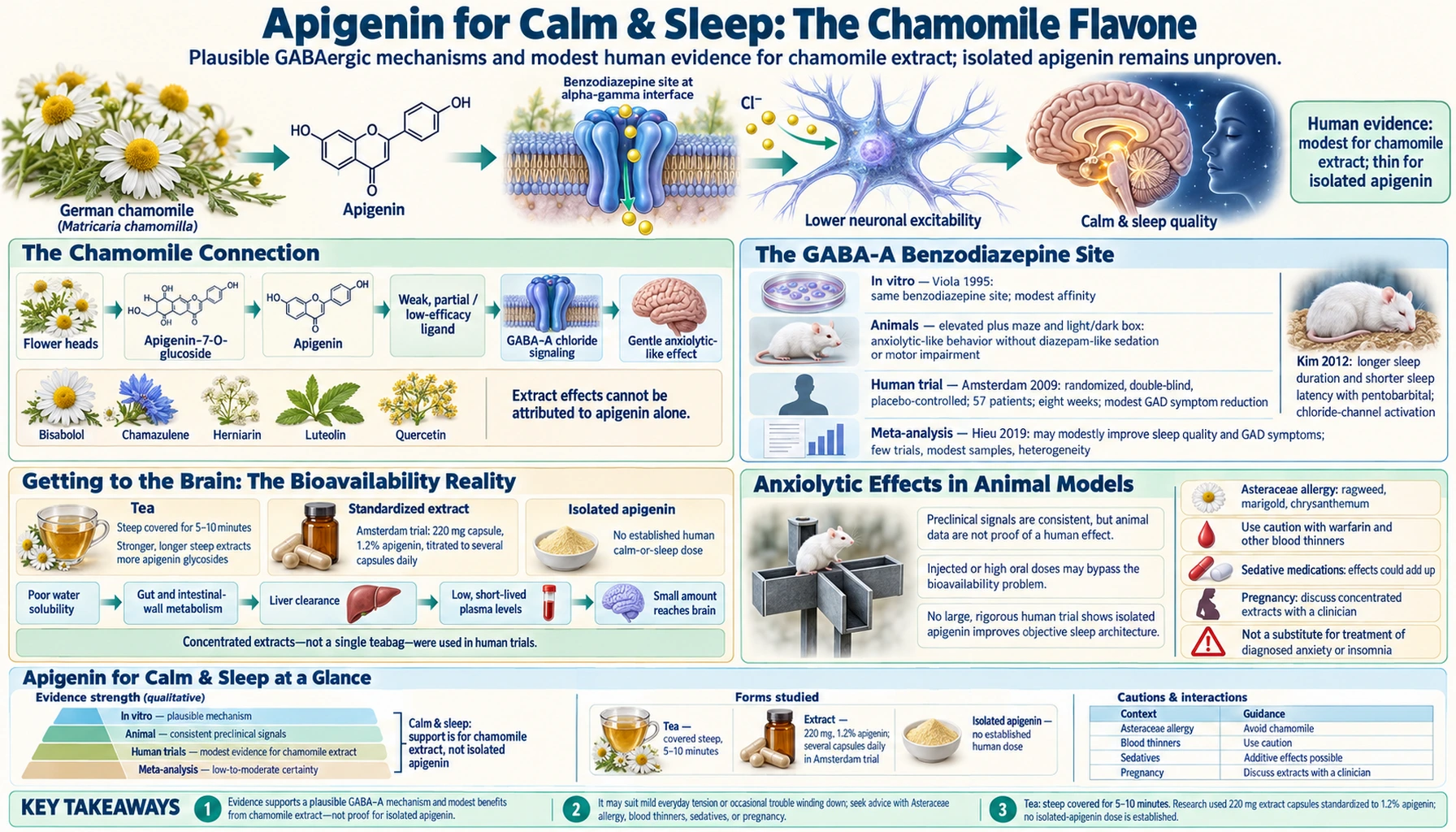
Chamomile tea at bedtime is a long-standing folk remedy for a restless mind, and apigenin is the molecule most often credited for the effect. The science behind that reputation is real but modest: in 1995, researchers showed in binding assays and in mice that apigenin occupies the benzodiazepine site on the GABA-A receptor that anti-anxiety drugs use — with micromolar affinity, and without the muscle-relaxant or anticonvulsant effects of a classical benzodiazepine. Only a small and variable share of dietary apigenin reaches the bloodstream. This page follows the chain from the receptor pharmacology to the human chamomile trials, separating where the evidence is stronger (a plausible mechanism; randomized trials of chamomile extract in generalized anxiety) from where it is thin (no trial of isolated apigenin for calm or sleep in humans was found).
Table of Contents
- The Chamomile Connection
- The GABA-A Benzodiazepine Site
- Getting to the Brain: The Bioavailability Reality
- Anxiolytic Effects in Animal Models
- Sleep and Sedation
- What the Human Chamomile Trials Actually Show
- Apigenin Is Not a Benzodiazepine Drug
- Tea, Extracts & Safety Findings
- Key Research Papers
- Connections
- Featured Videos
The Chamomile Connection
German chamomile (Matricaria chamomilla, also written Matricaria recutita) is described in a 2010 review as one of the most ancient medicinal herbs known; its preparations are used traditionally for insomnia among many other complaints, most often as an herbal tea (Srivastava 2010). Apigenin is a leading candidate studied for the plant's reputation as a mild sedative and anxiolytic. The same review notes that water extracts such as tea contain quite low concentrations of free apigenin but high levels of its glucoside, apigenin-7-O-glucoside.
The pivotal paper is Viola and colleagues in Planta Medica in 1995, titled almost as a thesis statement: "Apigenin, a component of Matricaria recutita flowers, is a central benzodiazepine receptors-ligand with anxiolytic effects." That result — that a chamomile flavone occupies the brain's benzodiazepine binding site — is the starting point cited for many modern "chamomile for calm" claims. The sections below set out what it does and does not establish.
Chamomile is a complex mixture. Alongside apigenin, the flowers contain the essential-oil terpenoids α-bisabolol and chamazulene, the coumarins herniarin and umbelliferone, and other flavonoids such as luteolin, patuletin and quercetin (Srivastava 2010). When a human chamomile trial shows benefit, the effect cannot be attributed to apigenin alone — apigenin is the best-characterized candidate mechanism, not a proven sole cause.
The GABA-A Benzodiazepine Site
GABA (gamma-aminobutyric acid) is the brain's principal inhibitory neurotransmitter — the "brake pedal" that quiets neuronal firing. It acts on the GABA-A receptor, a chloride channel built from five protein subunits. When GABA binds, the channel opens, chloride flows into the neuron, the cell becomes harder to excite, and the net effect is calming.
Benzodiazepine drugs (diazepam, lorazepam, alprazolam) do not open the channel themselves. Instead they bind a separate site — the "benzodiazepine site," located in the cleft between an alpha and a gamma subunit — and act as positive allosteric modulators: they make the receptor respond more strongly to whatever GABA is already present. Other ligands of the same site act as negative modulators or as antagonists (Sigel & Lüscher 2011).
Apigenin binds that same benzodiazepine site. But the pharmacology matters:
- Affinity. In Viola's binding assays apigenin competitively displaced the benzodiazepine flunitrazepam with a Ki of 4 µM (micromolar), and had no effect on muscimol binding at the GABA-A receptor itself. Paladini's 1999 review notes that chemical modification of the flavone nucleus dramatically increases anxiolytic potency.
- What it does once bound is disputed. Viola found anxiolytic activity in mice without sedation or muscle relaxation at doses similar to those used for classical benzodiazepines, and no anticonvulsant action; a 10-fold higher dose produced mild sedation (a 26% reduction in locomotor activity). Avallone and colleagues (2000) found the opposite direction at the receptor: apigenin reduced GABA-activated chloride currents in cultured neurons, an effect blocked by the benzodiazepine antagonist Ro 15-1788 (flumazenil); in rats, injected apigenin reduced locomotor activity but showed no anxiolytic, muscle-relaxant or anticonvulsant activity, and the authors attributed the locomotor effect to systems other than the benzodiazepine receptor.
- Marder and Paladini's review of "GABA(A)-receptor ligands of flavonoid structure" places apigenin within a family of natural flavonoids that bind this site, alongside flavone, chrysin and cirsiliol.
A separate line of work adds a second mechanism: Kim and colleagues (2012) reported in mice that apigenin prolonged pentobarbital-induced sleep and increased chloride influx in cultured cerebellar granule cells, and concluded that the effect works through chloride-channel activation; apigenin did not change the expression of GABA-A receptor subunits in the mouse hippocampus. A 2025 mouse study by Socała and colleagues, using injected apigenin, found a relatively minor effect on acute seizure thresholds and more GABA-A-receptor-immunoreactive hippocampal neurons after 14 days of treatment. The overall picture from animal and cell studies is a real interaction with the GABA system, of modest size and not always in the same direction.
Getting to the Brain: The Bioavailability Reality
Binding a receptor in a test tube is one thing; reaching that receptor in a living brain after drinking tea is another. This is the main caveat on the whole page.
Human absorption data are limited and the estimates vary. In a study of 11 healthy volunteers who ate a single serving of blanched parsley (2 g per kilogram of body weight), plasma apigenin peaked at an average of 127 nmol/L about 7 hours later, varied widely between people, and fell below the detection limit within 28 hours; 0.22% of the ingested apigenin was recovered in 24-hour urine (Meyer 2006). A 2021 review of human and rodent pharmacokinetic studies put oral bioavailability in the region of 30%, with an elimination half-life averaging about 2.5 hours and enterohepatic recirculation; it concluded that reaching 1–5 µmol/L in blood (the range it used as an anticancer target) would require "heroic" amounts of food, whereas semi-purified apigenin capsules could reach it (DeRango-Adem & Blay 2021). No measurement of apigenin in the human brain was found; in mice given apigenin by injection it accumulated in the brain and was eliminated slowly (Socała 2025).
The human trials below mostly used concentrated chamomile extracts in capsules, and one used tea. They report clinical outcomes rather than apigenin levels in blood or brain, and none can separate an effect of apigenin from the other chamomile constituents or from the setting of a bedtime drink. More on absorption is on the Sources page.
Anxiolytic Effects in Animal Models
In mice, Viola 1995 reported anxiolytic-like behavior in the elevated plus maze (animals spend more time in the exposed, "risky" open arms when less anxious) at doses similar to those used for classical benzodiazepines, without sedation or muscle relaxation; only a 10-fold higher dose produced mild sedation. Not every study agrees: Avallone 2000 found no anxiolytic activity in rats given apigenin by injection, only reduced locomotor activity.
A 2024 systematic review by Olasehinde and colleagues reviewed 34 preclinical studies in rats and mice with impaired memory and behaviour; the included studies reported anxiolytic effects, reduced depressive-like behaviour and better learning, memory and motor coordination. The authors called for further work to establish effective and safe doses, and for a clinical trial. The historical framing comes from Paladini and colleagues' 1999 review, subtitled "from forgotten factors to potent anxiolytic compounds," which recounts that their laboratory described natural anxiolytic flavonoids from 1990 on — chrysin first, then apigenin.
Animal data are genuinely useful for establishing mechanism and plausibility. They are not proof of a human effect, and dosing in these studies rarely reflects what a person absorbs from food.
Sleep and Sedation
The sleep story overlaps with the anxiety story but has its own mechanism thread. In mice, Kim and colleagues (2012) found that apigenin prolonged pentobarbital-induced sleep time and, combined with muscimol, potentiated sleep onset. These are drug-induced sleep models in animals, not measurements of natural sleep in people.
A 2024 Frontiers in Nutrition review by Kramer and Johnson, "Apigenin: a natural molecule at the intersection of sleep and aging," ties the sleep literature together with apigenin's cellular-aging biology (covered on the Cellular & Longevity page). It summarizes sedative effects in mice and rats, human trials of chamomile extract, and a report that dietary apigenin intake correlates with sleep quality in a large cohort of adults; it presents no sleep-lab data for isolated apigenin. Both authors disclosed employment by a company that paid the publication fee.
Bottom line on sleep: the mechanism is plausible and the tradition is old, but a PubMed search (October 2026) found no randomized trial of isolated apigenin for sleep or anxiety in humans. The closest human data are trials of chamomile extract or tea, below, and their sleep results are mixed.
What the Human Chamomile Trials Actually Show
The human evidence is for chamomile extract or tea, not isolated apigenin.
- Amsterdam 2009 (J Clin Psychopharmacol) — a randomized, double-blind, placebo-controlled trial of oral Matricaria recutita extract in 57 patients with mild-to-moderate generalized anxiety disorder (GAD), 28 on chamomile and 29 on placebo, for eight weeks. Mean total Hamilton Anxiety (HAM-A) scores fell significantly more on chamomile (P = 0.047); the authors concluded chamomile "may have modest anxiolytic activity." One patient in each group stopped for adverse events.
- Mao 2016 (Phytomedicine) — a longer-term study from the same group in moderate-to-severe GAD. Of 179 people given 12 weeks of open-label chamomile extract (500 mg three times daily), 93 responders were randomized to 26 more weeks of chamomile or placebo. Relapse was 15.2% on chamomile versus 25.5% on placebo, a difference that was not statistically significant (hazard ratio 0.52, 95% CI 0.20–1.33, P = 0.16); GAD symptoms stayed significantly lower on chamomile during follow-up (P = 0.0032), and adverse-event rates were similarly low in both groups.
- Zick 2011 (BMC Complementary and Alternative Medicine) — a pilot randomized, double-blind, placebo-controlled trial in 34 adults with chronic primary insomnia, 270 mg chamomile extract twice daily for 28 days. There were no significant differences from placebo in any sleep-diary measure (total sleep time, sleep efficiency, sleep latency, wake after sleep onset, sleep quality, awakenings); a modest advantage in daytime functioning did not reach significance.
- Adib-Hajbaghery 2017 (Complementary Therapies in Medicine) — a single-blind randomized trial in 60 elderly nursing-home residents, 200 mg chamomile extract capsules twice daily for 28 days versus wheat-flour capsules. Pittsburgh Sleep Quality Index scores were significantly better on chamomile after the intervention (P < 0.05).
- Chang 2016 (Journal of Advanced Nursing) — 80 postnatal women with poor sleep quality were assigned to drink chamomile tea for 2 weeks or to regular postpartum care (no placebo). The tea group had lower scores for physical-symptoms-related sleep inefficiency and depression at 2 weeks, but all scores were similar between groups at the 4-week follow-up.
- Hieu 2019 (Phytotherapy Research) — a systematic review and meta-analysis of 12 randomized trials. Pooling three trials showed no difference in anxiety (standardized mean difference −0.15, 95% CI −0.46 to 0.16); the only trial on insomnia found no change in insomnia severity; GAD improved on the HAM-A scale at 2 and 4 weeks, and sleep quality improved (standardized mean difference −0.73). The authors concluded chamomile "appears to be efficacious and safe for sleep quality and GAD," with "little evidence" for anxiety and insomnia, and called for larger trials.
- Zhang 2022 (Pharmacological Research) — a network meta-analysis of 29 trials of 12 medicinal herbs for anxiety. For chamomile versus placebo (mean difference in HAM-A 0.54, 95% credible interval −5.13 to 6.25), the authors found insufficient evidence to confirm either its effectiveness or its ineffectiveness, and described all of their results as preliminary.
- Jin 2025 (BMC Public Health) — an observational analysis of 1,637 U.S. adults (NHANES 2017–2018) in which apigenin intake was among the flavonoid measures associated with lower anxiety risk. A cross-sectional association of this kind cannot show cause and effect.
Taken together, the chamomile trials are small and mixed: positive on GAD symptom scores and on some sleep-quality measures, null on sleep diaries in the one insomnia trial and on the primary relapse endpoint in the long-term GAD trial. Apigenin is the leading mechanistic candidate for any benefit, but no trial has tested isolated apigenin against placebo for calm or sleep. The claim "apigenin calms you and helps you sleep" is more accurately stated as "apigenin is a plausible active ingredient in chamomile, which has modest and mixed human evidence for calm and sleep."
Apigenin Is Not a Benzodiazepine Drug
Because apigenin touches the benzodiazepine site, it is sometimes described as a natural benzodiazepine. The evidence points to clear differences:
- Dependence and withdrawal. Benzodiazepine drugs can cause tolerance, physical dependence and a withdrawal syndrome. The chamomile trials above reported low adverse-event rates similar to placebo, but none was designed to measure dependence, and no study of dependence on apigenin was found.
- Strength of the interaction. Apigenin's affinity for the site is micromolar (Viola 1995), and studies disagree on whether it enhances or reduces GABA's effect (Viola 1995; Avallone 2000). Respiratory depression, a recognized hazard of benzodiazepines combined with alcohol or opioids, has not been reported for apigenin or chamomile in the research cited here.
- Size of effect. The trial effects on anxiety were described by their authors as modest, and no trial has tested apigenin or chamomile for acute panic.
The chamomile trials enrolled people with diagnosed generalized anxiety disorder or insomnia and compared chamomile with placebo, not with standard anxiety or insomnia treatments. The broader clinical picture is covered on the Anxiety and Insomnia pages.
Tea, Extracts & Safety Findings
- Tea. The only trial above that used tea was the postpartum study (Chang 2016); the trials cited here did not compare brewing methods. Tea contains mostly apigenin-7-O-glucoside rather than free apigenin (Srivastava 2010).
- Extracts used in the trials. The Amsterdam trial used 220 mg capsules of chamomile extract standardized to 1.2% apigenin, starting at one capsule daily and increased by response to as many as five; the Mao trial used 500 mg three times daily; the insomnia pilot used 270 mg twice daily; the elderly sleep-quality trial used 200 mg twice daily.
- Side effects and allergy. A 2025 systematic review of 72 trials and 11 case reports found the most common adverse events were gastrointestinal complaints and drowsiness, self-limiting and non-serious; no allergic events were reported in the trials, but six of the case reports described allergic reactions, three of them anaphylactic (Ostovar 2025). Chamomile belongs to the Asteraceae (daisy) family; in a series of 14 people sensitized to chamomile, 10 had immediate-type reactions to it, in some cases life-threatening, and 11 were also sensitized to mugwort pollen (Reider 2000).
- Drug interactions. A 2006 case report describes a 70-year-old woman taking warfarin who was admitted with multiple internal hemorrhages after using chamomile tea and lotion; the authors noted that no such case had been reported before and that chamomile is thought to contain coumarin constituents (Segal & Pilote 2006). Added sedation with sedative medicines is a theoretical concern that the trials cited here did not test. Drug-metabolizing enzymes are discussed on the Sources page.
- Pregnancy. The 2025 adverse-event review found insufficient data on the safety of chamomile during pregnancy and lactation (Ostovar 2025). Decisions about supplements in pregnancy belong with a clinician.
Key Research Papers
- Viola H, Wasowski C, Levi de Stein M, et al. (1995). Apigenin, a component of Matricaria recutita flowers, is a central benzodiazepine receptors-ligand with anxiolytic effects. Planta Medica — PubMed PMID: 7617761
- Marder M, Paladini AC (2002). GABA(A)-receptor ligands of flavonoid structure. Current Topics in Medicinal Chemistry — PubMed PMID: 12171576
- Paladini AC, Marder M, Viola H, et al. (1999). Flavonoids and the central nervous system: from forgotten factors to potent anxiolytic compounds. Journal of Pharmacy and Pharmacology — PubMed PMID: 10411210
- Kim JW, Kim CS, Hu Z, et al. (2012). Enhancement of pentobarbital-induced sleep by apigenin through chloride ion channel activation. Archives of Pharmacal Research — PubMed PMID: 22370792
- Socała K et al. (2025). Effect of apigenin on seizure susceptibility, parvalbumin immunoreactivity, and GABA(A) receptor expression in hippocampal neurons in mice. European Journal of Pharmacology — PubMed PMID: 40157704
- Amsterdam JD, Li Y, Soeller I, et al. (2009). A randomized, double-blind, placebo-controlled trial of oral Matricaria recutita (chamomile) extract therapy for generalized anxiety disorder. Journal of Clinical Psychopharmacology — PubMed PMID: 19593179
- Mao JJ, Xie SX, Keefe JR, et al. (2016). Long-term chamomile (Matricaria chamomilla L.) treatment for generalized anxiety disorder: a randomized clinical trial. Phytomedicine — PubMed PMID: 27912875
- Hieu TH, Dibas M, Surya Dila KA, et al. (2019). Therapeutic efficacy and safety of chamomile for state anxiety, generalized anxiety disorder, insomnia, and sleep quality: a systematic review and meta-analysis. Phytotherapy Research — PubMed PMID: 31006899
- Zhang W et al. (2022). Medicinal herbs for the treatment of anxiety: a systematic review and network meta-analysis. Pharmacological Research — PubMed PMID: 35378276
- Olasehinde TA, Olaokun OO (2024). The beneficial role of apigenin against cognitive and neurobehavioural dysfunction: a systematic review of preclinical investigations. Biomedicines — PubMed PMID: 38255283
- Kramer DJ, Johnson AA (2024). Apigenin: a natural molecule at the intersection of sleep and aging. Frontiers in Nutrition — PubMed PMID: 38476603
- Jin L et al. (2025). Association between dietary flavonoid intake and anxiety: data from NHANES 2017–2018. BMC Public Health — PubMed PMID: 40264109
- Avallone R, Zanoli P, Puia G, et al. (2000). Pharmacological profile of apigenin, a flavonoid isolated from Matricaria chamomilla. Biochemical Pharmacology 59(11):1387-94 — PubMed PMID: 10751547
- Sigel E, Lüscher BP (2011). A closer look at the high affinity benzodiazepine binding site on GABAA receptors. Current Topics in Medicinal Chemistry 11(2):241-6 — PubMed PMID: 21189125
- Srivastava JK, Shankar E, Gupta S (2010). Chamomile: a herbal medicine of the past with bright future. Molecular Medicine Reports 3(6):895-901 — PubMed PMID: 21132119
- Meyer H, Bolarinwa A, Wolfram G, Linseisen J (2006). Bioavailability of apigenin from apiin-rich parsley in humans. Annals of Nutrition and Metabolism 50(3):167-72 — PubMed PMID: 16407641
- DeRango-Adem EF, Blay J (2021). Does oral apigenin have real potential for a therapeutic effect in the context of human gastrointestinal and other cancers? Frontiers in Pharmacology 12:681477 — PubMed PMID: 34084146
- Zick SM, Wright BD, Sen A, Arnedt JT (2011). Preliminary examination of the efficacy and safety of a standardized chamomile extract for chronic primary insomnia: a randomized placebo-controlled pilot study. BMC Complementary and Alternative Medicine 11:78 — PubMed PMID: 21939549
- Adib-Hajbaghery M, Mousavi SN (2017). The effects of chamomile extract on sleep quality among elderly people: a clinical trial. Complementary Therapies in Medicine 35:109-114 — PubMed PMID: 29154054
- Chang SM, Chen CH (2016). Effects of an intervention with drinking chamomile tea on sleep quality and depression in sleep disturbed postnatal women: a randomized controlled trial. Journal of Advanced Nursing 72(2):306-15 — PubMed PMID: 26483209
- Ostovar M, Rezaee Z, Najibi SM, Hashempur MH (2025). Chamomile: a systematic review of adverse events. Complementary Therapies in Medicine 91:103192 — PubMed PMID: 40374153
- Reider N, Sepp N, Fritsch P, et al. (2000). Anaphylaxis to camomile: clinical features and allergen cross-reactivity. Clinical and Experimental Allergy 30(10):1436-43 — PubMed PMID: 10998021
- Segal R, Pilote L (2006). Warfarin interaction with Matricaria chamomilla. CMAJ 174(9):1281-2 — PubMed PMID: 16636327