Apigenin: Dietary Sources (Parsley, Chamomile, Celery)
Apigenin is not distributed evenly across the plant kingdom. A handful of everyday foods carry almost all of it: parsley by a wide margin, then chamomile tea, celery and celery seed, and a scattering of dried culinary herbs. This page gives realistic content figures, explains the crucial difference between the apigenin bound to sugars in the plant and the forms that reach the blood (mostly glucuronide and sulfate metabolites), and confronts the central caveat head-on — apigenin's oral bioavailability is low, which is why food is a better delivery vehicle than most claims imply and why "apigenin content" numbers can be misleading if read as "apigenin absorbed."
Table of Contents
- The Short List of Real Sources
- Parsley: The Richest Common Source
- Chamomile Tea
- Celery & Celery Seed
- Dried Herbs: Oregano, Thyme & More
- Glycosides vs Free Apigenin: What the Numbers Mean
- The Bioavailability Problem
- How Food Choices Change Apigenin Intake
- Supplements & Safety
- Key Research Papers
- Connections
- Featured Videos
The Short List of Real Sources
One of the most useful facts about apigenin is how concentrated its food sources are. Rather than a little bit everywhere, most of the dietary apigenin people consume comes from just a few plants in the parsley family (Apiaceae) and the daisy family (Asteraceae). In rough order of importance for a typical diet:
- Parsley — far and away the richest common source, especially dried parsley.
- Chamomile tea — the most-consumed beverage source, and the one behind apigenin's calming reputation.
- Celery and celery seed — a staple vegetable source, with celery seed more concentrated than the stalk.
- Dried culinary herbs — oregano, thyme, and others contribute meaningfully by weight because drying concentrates the flavones.
- Minor sources — small amounts appear in some peppers, artichoke, and citrus.
Reviews of dietary apigenin, such as Wang and colleagues (2019), consistently identify this same short list and note that overall population apigenin intake is low and highly skewed toward people who eat a lot of parsley, celery, and herbs, or who drink chamomile tea regularly.
Parsley: The Richest Common Source
Parsley is in a class of its own. In the widely used U.S. Department of Agriculture (USDA) Database for the Flavonoid Content of Selected Foods, parsley records by far the highest apigenin values of any common food — in Release 3.3 (2018), fresh parsley averages 215.46 mg of apigenin per 100 g (26 samples, ranging from 0 to 630 mg), and dried parsley averages 4,503.5 mg per 100 g because drying removes water and concentrates the flavone. No other everyday food comes close on a per-gram basis.
The practical catch is portion size. You might eat 100 g of celery in a sitting, but a tablespoon of chopped fresh parsley as a garnish is only a few grams, and a teaspoon of dried parsley is a fraction of a gram. So while parsley is the most apigenin-dense food, the amount you get depends entirely on whether you treat it as a garnish or as an ingredient. Parsley-forward dishes — tabbouleh (which can use whole bunches of parsley), chimichurri, salsa verde, and green sauces — are among the highest realistic dietary deliveries of apigenin available.
In the plant, parsley's apigenin is stored largely as apiin (apigenin-7-O-apioglucoside), a sugar-bound form that must be cleaved during digestion to release absorbable apigenin — a theme we return to below.
Chamomile Tea
Chamomile (Matricaria chamomilla) is the source most people associate with apigenin, thanks to the tea's traditional use for calm and sleep covered on the Calm & Sleep page. In the flower heads, apigenin is present both as apigenin-7-O-glucoside (cosmosiin) and as free apigenin. Nováková and colleagues (2010), who developed an ultra-high-performance liquid chromatography with tandem mass spectrometry (UHPLC-MS/MS) method for phenolics in chamomile flowers and tea, found chlorogenic acid, umbelliferone, apigenin and apigenin-7-glucoside to be the most abundant phenolic compounds in both. In the tea extracts, flavonoid glycosides such as rutin and quercitrin were relatively more abundant, while apigenin and its glucoside were present in lower amounts — one reason a brewed cup carries less apigenin than the dry flower suggests.
How much apigenin actually ends up in a cup depends on several factors:
- Steep time and temperature — longer, hotter steeping extracts more glycosides. A 5–10 minute covered steep pulls out considerably more than a quick dunk.
- Covering the cup — a lid keeps volatile compounds in and helps a fuller extraction.
- Flower quality and quantity — whole-flower or loose chamomile generally yields more than dust-grade teabags, and using more material yields more.
Even so, the apigenin in a single cup of tea is modest — although its glucoside form was the best absorbed of the forms tested in a 2022 human study (see The Bioavailability Problem). Chamomile tea is best understood as a gentle, pleasant, low-dose source — consistent with its gentle effects — rather than a high-potency apigenin delivery.
Celery & Celery Seed
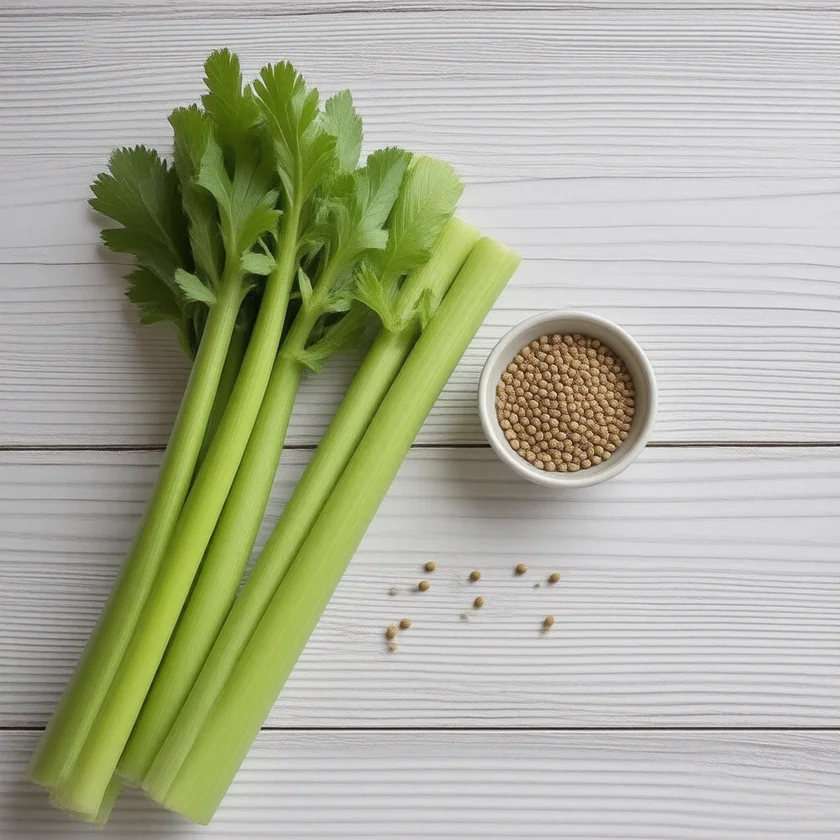
Celery (Apium graveolens) is a reliable everyday vegetable source of apigenin, usually accompanied by its cousin luteolin. The apigenin is concentrated more in the leaves and seeds than in the pale stalks, and celery seed is notably richer than the stalk: the USDA Flavonoid Database (Release 3.3, 2018) lists raw celery at an average of 2.85 mg of apigenin per 100 g (25 samples) and celery seed at 78.65 mg per 100 g. Hang and colleagues (2022) developed green-chemistry methods specifically to extract apigenin and luteolin from celery seed. Because celery is eaten in real quantity (a whole stalk, a cup of diced celery in a soup base), it adds steady amounts to a day, although per gram the stalk carries far less apigenin than parsley.
Celery apigenin has enough commercial and agricultural interest that researchers have engineered celery to make more of it: Tan and colleagues (2017) showed that overexpressing a flavone-synthase gene increased apigenin (while decreasing anthocyanins) in celery petioles, and Sun and colleagues (2025) built a monoclonal-antibody immunoassay to quantify apigenin in celery precisely. For cooking, this means the leafy celery tops hold more apigenin than the pale stalk, and celery seed (in spice blends, pickling, and celery-salt) is a small but concentrated addition.
For celery as a whole food and the celery-juice trend, see our Celery page and Celery Juice page.
Dried Herbs: Oregano, Thyme & More
Because drying concentrates flavones, dried culinary herbs carry more apigenin per gram than fresh ones. In the USDA Flavonoid Database (Release 3.3, 2018), dried Mexican oregano averages 17.71 mg of apigenin per 100 g, against 2.57 mg for fresh oregano and 2.5 mg for fresh thyme; dried parsley (above) far exceeds them all. The catch, again, is portion: you use these in teaspoon quantities, so their contribution to total intake is real but small compared with a parsley-heavy dish or a habit of chamomile tea.
Still, herbs add apigenin (and a wide range of other polyphenols) at essentially no calorie cost, along with flavor. The apigenin in the food travels with dozens of other plant compounds, which an isolated supplement does not supply.
Glycosides vs Free Apigenin: What the Numbers Mean
This is the single most important technical point for reading any apigenin "content" figure. In plants, apigenin is almost never present as the free molecule (the "aglycone"). It is bound to sugars as a glycoside — apiin in parsley and celery, cosmosiin (apigenin-7-O-glucoside) in chamomile, and others. Food-composition databases may report either the free aglycone after chemical hydrolysis, the intact glycosides, or a converted "total apigenin" value, and these are not the same number. That is one reason published apigenin contents for the same food can differ severalfold between sources and methods.
It matters biologically because your body has to cleave the sugar off before it can absorb the apigenin, a job done partly by enzymes in the small intestine and partly by bacteria in the colon. In the 2022 human study by Borges and colleagues, the glucoside in chamomile tea was absorbed in the upper gut, while the apiin in a parsley drink was absorbed lower down. Which glycoside it is, and which gut bacteria you have, both affect how much free apigenin is released and absorbed. So a food's listed apigenin content is an upper bound on what you might get, not a measure of what you actually absorb.
The Bioavailability Problem
Apigenin's oral bioavailability is low, and this is the caveat that governs the honesty of every apigenin health claim on this site. The human data are clear on the mechanics:
- Poor water solubility limits how much dissolves and crosses the gut wall.
- Extensive first-pass metabolism — once absorbed, apigenin is rapidly conjugated into glucuronides and sulfates by the intestine and liver, so much of what circulates is metabolite rather than free apigenin.
- Gut-microbiome dependence — because colonic bacteria release apigenin from its glycosides and also further break it down, absorption varies from person to person.
- Relatively rapid clearance keeps peak blood levels low and brief.
Borges and colleagues (2022) tracked the absorption, distribution, metabolism, and excretion of apigenin and its glycosides in healthy men. What circulated were conjugated metabolites (two glucuronides and a sulfate), but how much was absorbed depended strongly on the form. Pure apigenin was poorly absorbed: metabolites equal to only 0.5% of the intake were excreted in urine over 24 hours. A parsley drink gave 11.2%, and chamomile tea 34% — about a third of its apigenin. The chamomile glucoside peaked in the blood at about 2 hours, in keeping with absorption in the upper gut; the parsley drink peaked at 4 hours (lower gut), and dried parsley eaten with yogurt at 6 hours. In this study, the plant forms in tea and parsley were absorbed far better than pure apigenin powder. Tang and colleagues (2017) reviewed apigenin's pharmacokinetics and drug interactions in the same vein. This is why researchers pursue enhanced-delivery formulations — nanoemulsions and self-nanoemulsifying systems (Sato and colleagues, 2024), phospholipid complexes, and potassium-salt derivatives (Sánchez-Marzo and colleagues, 2019) — to try to raise how much actually gets absorbed. In rats (not people), Sato's two self-nanoemulsifying formulations raised apigenin's oral relative bioavailability 3.8-fold and 3.3-fold compared with apigenin powder. In a laboratory model of the gut wall (Caco-2 cell layers, not people), Sánchez-Marzo's team found that the more water-soluble potassium salt passed through at the same rate as plain apigenin (1.78 versus 1.81 × 10⁻⁵ cm/s).
The honest interpretation is not "apigenin does nothing." It is that the dramatic effects seen in high-concentration lab experiments have not been shown to occur at the low levels food produces, and that apigenin supplements have not been shown to produce drug-like results in people.
How Food Choices Change Apigenin Intake
Within an overall plant-rich diet (apigenin is not a magic bullet), a few food habits change how much apigenin a meal carries:
- Parsley as an ingredient, not a garnish. Tabbouleh, chimichurri, salsa verde, and herb-heavy salads use parsley by the bunch, which is where the real apigenin is.
- Celery leaves and seed. The leafy tops (used in soups and stocks) and celery seed (used in spice blends) carry more apigenin than the pale stalk.
- Chamomile steeping. A covered cup steeped 5–10 minutes with a generous amount of whole-flower chamomile extracts more than a quick dunk.
- Apigenin foods and fat. Apigenin dissolves poorly in water, and fat in the same meal is often described as helping its absorption, but this has not been measured in people: in the 2022 Borges study, dried parsley eaten with yogurt delayed the blood peak to 6 hours, and the abstract reports no larger amount absorbed. The olive oil in chimichurri or a herb salad is part of the traditional dish.
- Whole foods and isolated pills. The vegetable delivers apigenin alongside fiber, vitamins, and other polyphenols that a capsule does not.
Supplements & Safety
Isolated apigenin is sold as a supplement, often marketed for sleep or "longevity." A few honest points:
- Evidence for isolated-apigenin supplements is thin. As covered across this hub, the human trial evidence is strongest for chamomile extract in anxiety, not for isolated apigenin, and the longevity claims are preclinical.
- Apigenin appears well tolerated at dietary and typical supplement doses, with no established serious toxicity, but long-term high-dose safety in humans has not been well studied.
- Drug interactions. Apigenin can inhibit certain drug-metabolizing enzymes, including cytochrome P450 (CYP450) enzymes, and reviews raise a concern about interactions with anticoagulants (blood thinners) and other prescription medications; chamomile's coumarin content adds a mild blood-thinning consideration.
- Allergy note. Chamomile-derived products can trigger reactions in people allergic to ragweed and related Asteraceae plants.
- Not an established treatment. Apigenin is a food compound, not an approved therapy for any disease, and no apigenin supplement has been shown to replace medical care.
In summary, apigenin-rich foods bring flavor and whole-diet benefits, chamomile tea is traditionally used as a gentle wind-down drink, and the evidence for isolated supplements is thin.
Key Research Papers
- Wang M et al. (2019). A review on flavonoid apigenin: dietary intake, ADME, antimicrobial effects, and interactions with human gut microbiota. BioMed Research International — PubMed PMID: 31737673
- Borges G et al. (2022). Absorption, distribution, metabolism and excretion of apigenin and its glycosides in healthy male adults. Free Radical Biology and Medicine — PubMed PMID: 35452808
- Tang D, Chen K, Huang L, Li J (2017). Pharmacokinetic properties and drug interactions of apigenin, a natural flavone. Expert Opinion on Drug Metabolism & Toxicology — PubMed PMID: 27766890
- Nováková L, Vildová A, Mateus JP, Gonçalves T, Solich P (2010). Development and application of UHPLC-MS/MS method for the determination of phenolic compounds in Chamomile flowers and Chamomile tea extracts. Talanta — PubMed PMID: 20801328
- Engelhardt UH, Finger A, Kuhr S (1993). Determination of flavone C-glycosides in tea. Zeitschrift für Lebensmittel-Untersuchung und -Forschung (black, green and oolong tea, not chamomile) — PubMed PMID: 8237118
- Hang NT et al. (2022). Green extraction of apigenin and luteolin from celery seed using deep eutectic solvent. J. Pharmaceutical and Biomedical Analysis — PubMed PMID: 34653746
- Tan GF et al. (2017). AgFNS overexpression increases apigenin and decreases anthocyanins in petioles of transgenic celery. Plant Science — PubMed PMID: 28818381
- Sun D et al. (2025). Development of apigenin monoclonal antibodies and an immunoassay for the quantification of apigenin in celery. Food Chemistry — PubMed PMID: 41240868
- Sánchez-Marzo N et al. (2019). Antioxidant and photoprotective activity of apigenin and its potassium salt derivative in human keratinocytes and absorption in Caco-2 cell monolayers. Int. J. Molecular Sciences — PubMed PMID: 31052292
- Sato VH et al. (2024). Enhancement of in vitro transcellular absorption and in vivo oral bioavailability of apigenin by self-nanoemulsifying drug delivery systems. Scientific Reports — PubMed PMID: 39738511
- Haytowitz DB, Wu X, Bhagwat S (2018). USDA Database for the Flavonoid Content of Selected Foods, Release 3.3. U.S. Department of Agriculture, Agricultural Research Service, Nutrient Data Laboratory — USDA Flavonoid Database, Release 3.3 (PDF)
- Cai H et al. (2007). Tissue distribution in mice and metabolism in murine and human liver of apigenin and tricin. Cancer Chemotherapy and Pharmacology — PubMed PMID: 17089164