Lycopene for Heart & Cardiovascular Health
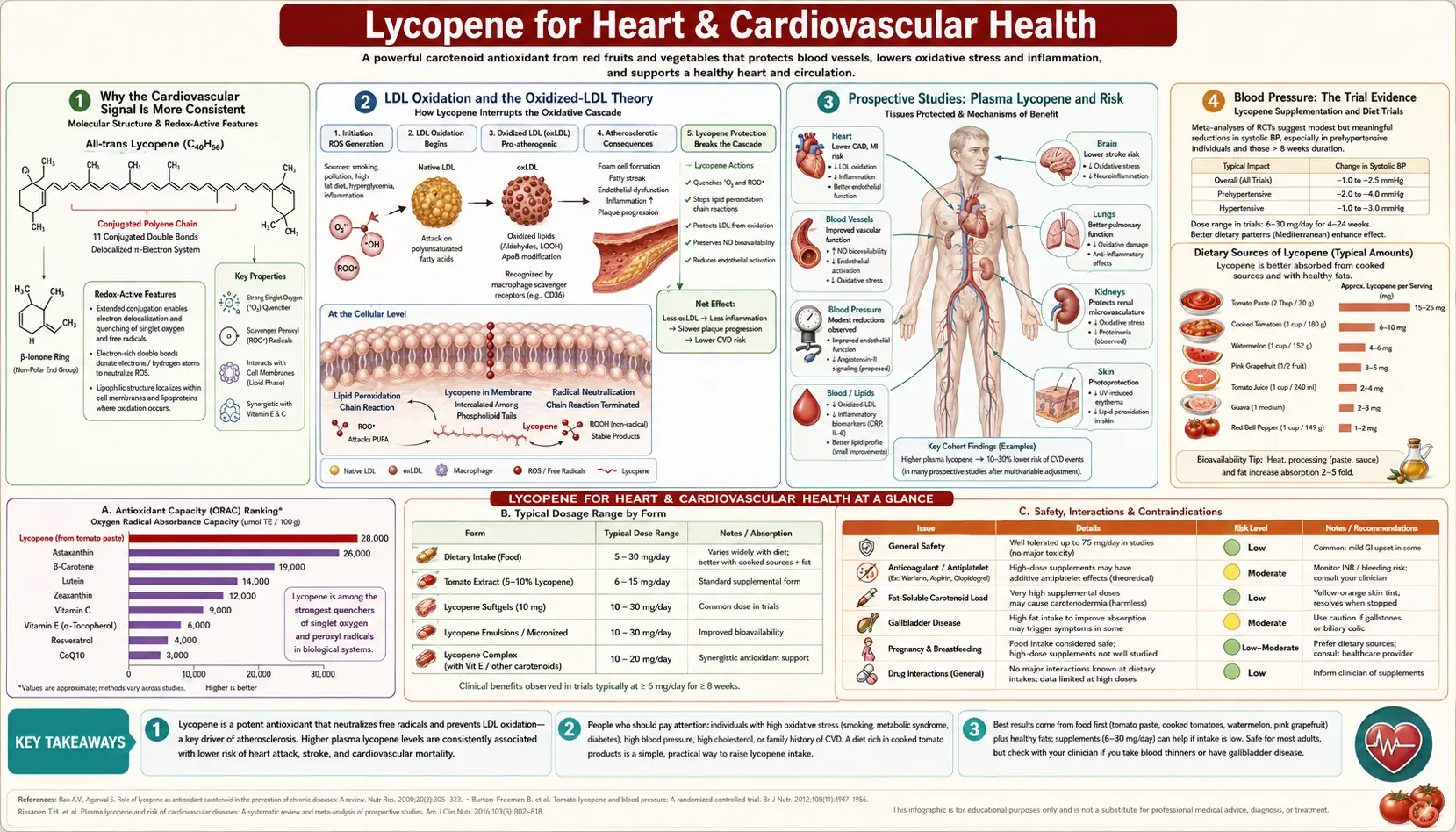
Lycopene's cardiovascular research rests on risk markers and observational data rather than on trials counting heart attacks or strokes, and much of it is hard to separate from the general healthiness of a tomato-rich diet. The central idea: atherosclerosis is driven in part by the oxidation of LDL cholesterol inside artery walls; in a 1989 laboratory study lycopene had the highest singlet-oxygen quenching rate of the carotenoids measured; and lycopene travels in the bloodstream inside lipoproteins, including LDL. Meta-analyses of intervention trials report modest reductions in systolic blood pressure and, at doses of 25 mg a day or more, in LDL cholesterol, and a meta-analysis of observational studies links higher lycopene intake or blood levels with lower risk of stroke and cardiovascular disease, though not of myocardial infarction. This page sets out what each line of evidence found and where it is weak.
Table of Contents
- Why Cardiovascular Effects Are Easier to Study
- LDL Oxidation and the Oxidized-LDL Theory
- Prospective Studies: Plasma Lycopene and Risk
- Blood Pressure: The Trial Evidence
- Cholesterol and Lipids
- Endothelial Function and Arterial Stiffness
- Inflammation and Oxidative-Stress Markers
- Where the Evidence Is Weak or Conflicting
- What the Trials Used
- Key Research Papers
- Connections
- Featured Videos
Why Cardiovascular Effects Are Easier to Study
Three features set the cardiovascular research apart from the cancer research. First, risk markers can be measured in the short term: instead of waiting decades for cancer to appear, researchers can measure blood pressure, LDL cholesterol and blood-vessel function in weeks, which makes randomized trials feasible. Second, there is a biologically plausible mechanism (LDL oxidation) that laboratory and small human studies connect to lycopene. Third, the effects reported in pooled trials — a few millimeters of mercury off systolic blood pressure and, at higher doses, a reduction in LDL cholesterol — are modest rather than drug-like.
No trial has tested lycopene as a treatment for heart disease. Mordente and colleagues' 2011 review notes that the lower cardiovascular mortality of the Mediterranean area is attributed, at least in part, to its plant-rich diet, of which tomato is a staple, and examines lycopene as one candidate contributor.
LDL Oxidation and the Oxidized-LDL Theory
Atherosclerosis — the buildup of fatty plaque in artery walls that underlies most heart attacks and strokes — is not simply a matter of too much cholesterol. A pivotal step is the oxidation of LDL particles after they lodge in the artery wall. Oxidized LDL is far more damaging than native LDL: it is taken up by immune cells (macrophages) that swell into foam cells, it triggers inflammation, and it accelerates plaque growth. This “oxidative modification hypothesis” is one of the foundational ideas in cardiovascular biology and is discussed in more depth on the Atherosclerosis page.
Because lycopene is fat-soluble, it is carried through the blood inside LDL and other lipoproteins — the same particles that are vulnerable to oxidation. In a dietary intervention in 19 healthy adults, a week each of tomato juice, spaghetti sauce and tomato oleoresin at least doubled serum lycopene and significantly lowered serum lipid peroxidation and LDL oxidation, without changing serum cholesterol (Agarwal and Rao, 1998). The hypothesis is that lycopene carried in LDL makes the particles more resistant to the oxidative damage that starts atherosclerosis. Rao and Agarwal's 2000 review summarized this antioxidant rationale and noted that other mechanisms — gap-junction communication between cells and hormonal, immune and metabolic pathways — may also be involved.
Prospective Studies: Plasma Lycopene and Risk
Some of the most persuasive cardiovascular evidence comes from prospective cohort studies that measured blood lycopene — an objective biomarker — and then followed people for years to count cardiovascular events. Sesso and colleagues examined this in nested case-control analyses of two cohorts. In the Women's Health Study (published 2004; 483 women who developed cardiovascular disease and 483 matched controls, mean follow-up 4.8 years), women in the upper half of plasma lycopene had a relative risk of 0.66 (95% CI 0.47–0.95) compared with the lower half, and for cardiovascular disease excluding angina, women in the upper three quartiles had a 50% lower risk than those in the lowest quartile in multivariate models. In the Physicians' Health Study (published 2005; 499 men with cardiovascular events and 499 matched controls, mean follow-up 2.1 years), higher plasma lycopene was not associated with cardiovascular risk, and the authors called for evaluation in more diverse populations.
Across the broader literature, a 2019 meta-analysis of observational studies by Cheng and colleagues (25 studies with quantitative data) found that people in the highest category of lycopene intake or serum concentration had a lower risk of stroke (hazard ratio 0.74) and of cardiovascular disease (0.86), and that the highest serum lycopene was associated with lower mortality (0.63); lycopene was not significantly associated with myocardial infarction. Because these are observational studies, they carry the same caveat as the prostate cohorts — association is not causation, and people with high blood lycopene tend to eat more vegetables and live healthier lives in general. The use of an objective blood biomarker (rather than a diet questionnaire) makes the serum findings harder to dismiss than pure food-frequency data, though the null result in older men shows the direction has not been uniform.
Blood Pressure: The Trial Evidence
Blood pressure is where lycopene has been tested in randomized, placebo-controlled trials. In Paran and colleagues' 2009 double-blind crossover trial, 50 patients with moderate hypertension, treated with one or two antihypertensive drugs but still above target, took a standardized tomato extract or an identical placebo for 6 weeks each. During the extract period systolic blood pressure fell from 145.8 to 132.2 mmHg and from 140.4 to 128.7 mmHg in the two groups, and diastolic pressure also fell; there was no significant change during the placebo period, and no side effects were recorded. The authors described the effect as clinically significant: more than 10 mmHg systolic and more than 5 mmHg diastolic.
Ried and Fakler's 2011 meta-analysis pooled only four trials on blood pressure. Across all four, systolic blood pressure fell by a mean of 5.60 mm Hg (p = 0.04). The abstract reports no dose threshold for the blood-pressure effect and does not give the result of its subgroup analysis by baseline blood pressure; the 25 mg-a-day threshold it describes applies to LDL cholesterol (next section). The authors concluded that more research is needed to confirm the suggested effect on systolic blood pressure. Cheng and colleagues' 2017 meta-analysis found a similar reduction with lycopene supplements (−5.66 mmHg, p = 0.002). These are risk-marker results: no trial has shown that lycopene's effect on blood pressure reduces heart attacks or strokes, and in Paran's trial the extract was added to existing antihypertensive treatment rather than replacing it.
Cholesterol and Lipids
In the same 2011 meta-analysis, twelve studies (13 trial arms) examined serum lipids. In the subgroup of trials using 25 mg of lycopene a day or more, total cholesterol fell by a mean of 7.55 mg/dl (p = 0.02) and LDL cholesterol by 10.35 mg/dl (p = 0.0003); trials using lower doses showed no significant effect. Ried and Fakler summarized this as an LDL reduction of about 10%, which they described as comparable to low doses of statins in people with slightly elevated cholesterol, and said the effect on total cholesterol still needs confirmation. One proposed mechanism comes from a 1997 study by Fuhrman and colleagues: in a macrophage cell line, lycopene suppressed cholesterol synthesis by 73% (the statin fluvastatin by 91%) and increased LDL-receptor activity, and in the same paper 60 mg a day of tomato lycopene for 3 months lowered plasma LDL cholesterol by 14% in 6 men. The authors attributed the effect to inhibition of HMG-CoA reductase, the cholesterol-synthesis enzyme that statins block.
The 2017 systematic review and meta-analysis by Cheng and colleagues pooled 21 intervention trials. Tomato interventions were associated with lower LDL cholesterol (−0.22 mmol/L), lower interleukin-6 and improved flow-mediated dilation (+2.53%); lycopene supplements lowered systolic blood pressure (−5.66 mmHg); no other outcome — including total and HDL cholesterol, triglycerides, oxidized LDL, C-reactive protein and pulse-wave velocity — was significantly affected. In this analysis the lipid, inflammation and endothelial findings came from tomato products and the blood-pressure finding from lycopene supplements.
Endothelial Function and Arterial Stiffness
The endothelium is the single-cell lining of the blood vessels, and its ability to relax and dilate in response to blood flow (measured as flow-mediated dilation or by peripheral arterial tonometry) is an early marker of vascular health that declines before overt heart disease appears. Kim and colleagues' 2011 randomized trial gave 126 healthy men placebo, 6 mg or 15 mg of lycopene a day for 8 weeks and measured endothelial function by reactive-hyperemia peripheral arterial tonometry (RH-PAT). Compared with placebo, the 15 mg group had a greater rise in plasma superoxide dismutase activity and a greater reduction in lymphocyte DNA damage (comet tail length). Within the 15 mg group, the RH-PAT index rose 23% from baseline, and hs-CRP, systolic blood pressure, sICAM-1 and sVCAM-1 fell — within-group changes reported only in the 15 mg group. The effects on endothelial function were most marked in men whose endothelial function was relatively impaired at the start.
Endothelial dysfunction is an early step in the atherosclerotic process, so an improvement would be a plausible bridge between the antioxidant chemistry and the lower cardiovascular risk seen in observational studies. In the 2017 meta-analysis, the significant flow-mediated dilation result came from tomato interventions, not from lycopene supplements. Endothelial-function studies are small, use surrogate endpoints rather than heart attacks, and have not always agreed — so this remains supportive rather than conclusive evidence.
Inflammation and Oxidative-Stress Markers
Chronic low-grade inflammation is now understood to be central to atherosclerosis. Individual trials report that tomato or lycopene intake lowers circulating markers of oxidative stress and inflammation — LDL oxidation and serum lipid peroxidation in Agarwal and Rao's 1998 study, and hs-CRP within the 15 mg group of Kim's 2011 trial. Pooled, the picture is narrower: in Cheng's 2017 meta-analysis tomato interventions lowered interleukin-6, but neither C-reactive protein nor oxidized LDL changed significantly. Mordente and colleagues' 2011 review described lycopene as an antioxidant scavenger, a hypolipaemic agent and an inhibitor of pro-inflammatory and pro-thrombotic factors, and noted that while epidemiological studies mostly support a role in preventing cardiovascular disease, intervention trials have reported conflicting results.
Laboratory research has also examined whether lycopene acts as a signaling molecule as well as a direct antioxidant. In cell experiments, lycopene upregulated the antioxidant response element, the switch (governed by the Nrf2 pathway) that leads cells to make their own cytoprotective enzymes (reviewed by van Breemen and Pajkovic, 2008). How much this contributes in people has not been established.
Where the Evidence Is Weak or Conflicting
- No hard-outcome trials. There is no large randomized trial showing that lycopene supplements prevent heart attacks, strokes, or cardiovascular death. All the trial evidence is on surrogate markers (blood pressure, cholesterol, endothelial function), and surrogate improvements do not always translate into fewer events.
- The antioxidant-supplement track record. Large trials of other antioxidant supplements have not reduced cardiovascular events despite promising laboratory and observational data. In the Physicians' Health Study II, 14,641 male physicians took vitamin E, vitamin C or placebo for a mean of 8 years, and neither vitamin reduced major cardiovascular events (Sesso and colleagues, 2008) — a precedent that applies to lycopene pills specifically.
- Confounding by healthy diet, and mixed cohorts. Much of the cohort evidence may reflect the overall healthiness of tomato-rich diets rather than lycopene itself, and the men's plasma-lycopene analysis found no association at all.
- Dose and form inconsistency. Trials used everything from tomato juice to purified lycopene to tomato extract, at widely varying doses, making the literature hard to pool cleanly.
What the Trials Used
- Food and supplement forms. In the 2017 meta-analysis, the LDL, interleukin-6 and flow-mediated dilation results came from tomato products and the blood-pressure result from lycopene supplements. Lycopene is absorbed better from cooked, processed tomato products eaten with fat, such as tomato sauce cooked in olive oil; the absorption studies are on the Sources & Bioavailability page.
- Amounts in the studies. Kim's trial used 6 and 15 mg a day for 8 weeks and Fuhrman's small study 60 mg a day for 3 months; in Ried and Fakler's meta-analysis the LDL-lowering effect appeared in trials using 25 mg a day or more, and lower doses showed no significant effect. The lycopene content of tomato products, from USDA FoodData Central, is listed on the Sources & Bioavailability page.
- A risk-marker literature. The trials measured blood pressure, lipids and vascular markers; none tested lycopene as a replacement for blood-pressure or cholesterol medication, and in Paran's trial the extract was added to existing treatment. Decisions about medicines and supplements belong with a clinician.
Key Research Papers
- Rao AV, Agarwal S (2000). Role of antioxidant lycopene in cancer and heart disease. Journal of the American College of Nutrition — PubMed PMID: 11022869
- Sesso HD, Buring JE, Norkus EP, Gaziano JM (2004). Plasma lycopene, other carotenoids, and retinol and the risk of cardiovascular disease in women. American Journal of Clinical Nutrition — PubMed PMID: 14684396
- Sesso HD, Buring JE, Norkus EP, Gaziano JM (2005). Plasma lycopene, other carotenoids, and retinol and the risk of cardiovascular disease in men. American Journal of Clinical Nutrition — PubMed PMID: 15883420
- Paran E, Novack V, Engelhard YN, Hazan-Halevy I (2009). The effects of natural antioxidants from tomato extract in treated but uncontrolled hypertensive patients. Cardiovascular Drugs and Therapy — PubMed PMID: 19052855
- Ried K, Fakler P (2011). Protective effect of lycopene on serum cholesterol and blood pressure: meta-analyses of intervention trials. Maturitas — PubMed PMID: 21163596
- Kim JY, Paik JK, Kim OY, et al. (2011). Effects of lycopene supplementation on oxidative stress and markers of endothelial function in healthy men. Atherosclerosis — PubMed PMID: 21194693
- Mordente A, Guantario B, Meucci E, et al. (2011). Lycopene and cardiovascular diseases: an update. Current Medicinal Chemistry — PubMed PMID: 21291369
- Cheng HM, Koutsidis G, Lodge JK, et al. (2017). Tomato and lycopene supplementation and cardiovascular risk factors: a systematic review and meta-analysis. Atherosclerosis — PubMed PMID: 28129549
- Giovannucci E (1999). Tomatoes, tomato-based products, lycopene, and cancer: review of the epidemiologic literature (background on lycopene biomarkers). Journal of the National Cancer Institute — PubMed PMID: 10050865
- van Breemen RB, Pajkovic N (2008). Multitargeted therapy of cancer by lycopene (mechanistic review of antioxidant and signaling actions). Cancer Letters — PubMed PMID: 18585855
- Di Mascio P, Kaiser S, Sies H (1989). Lycopene as the most efficient biological carotenoid singlet oxygen quencher. Archives of Biochemistry and Biophysics — PubMed PMID: 2802626
- Agarwal S, Rao AV (1998). Tomato lycopene and low density lipoprotein oxidation: a human dietary intervention study. Lipids — PubMed PMID: 9832077
- Fuhrman B, Elis A, Aviram M (1997). Hypocholesterolemic effect of lycopene and beta-carotene is related to suppression of cholesterol synthesis and augmentation of LDL receptor activity in macrophages. Biochemical and Biophysical Research Communications — PubMed PMID: 9168909
- Cheng HM, Koutsidis G, Lodge JK, et al. (2019). Lycopene and tomato and risk of cardiovascular diseases: a systematic review and meta-analysis of epidemiological evidence. Critical Reviews in Food Science and Nutrition — PubMed PMID: 28799780
- Sesso HD, Buring JE, Christen WG, et al. (2008). Vitamins E and C in the prevention of cardiovascular disease in men: the Physicians' Health Study II randomized controlled trial. JAMA — PubMed PMID: 18997197