Lycopene Sources & Bioavailability
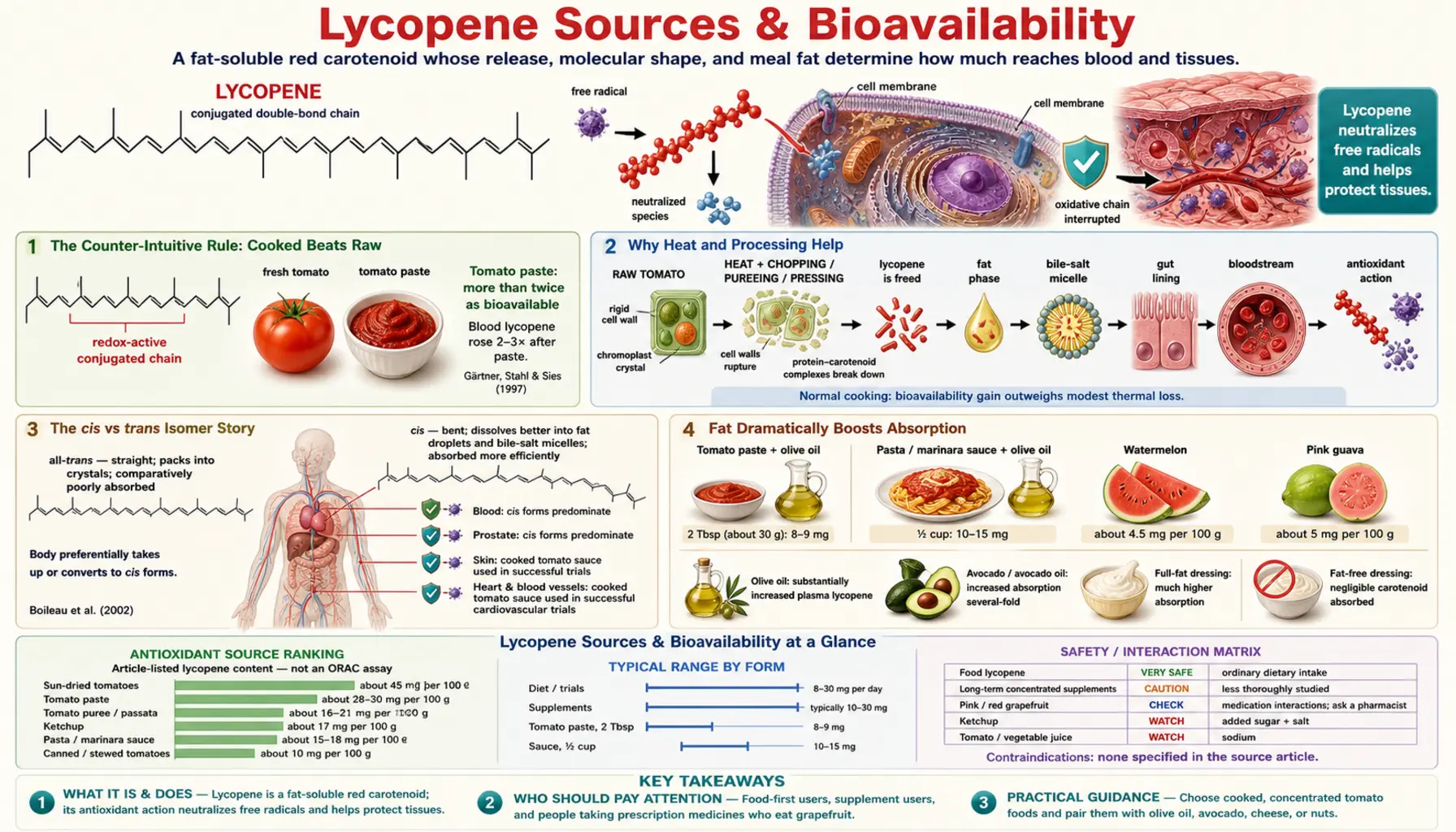
Lycopene runs against the general pattern that raw produce is the better source of a nutrient. In human feeding studies, more lycopene was absorbed from tomato paste than from fresh tomatoes, and more was absorbed when tomatoes were eaten with fat. Researchers attribute this to heat and processing breaking down the plant cell walls that hold the pigment, to heat converting part of it into cis forms that trials found better absorbed, and to dietary fat carrying lycopene into the micelles the gut absorbs. This page covers what those studies measured, how cooking and the molecule's shape affect absorption, the lycopene content of common foods in USDA FoodData Central, and where watermelon, guava and pink grapefruit fit.
Table of Contents
- The Counter-Intuitive Finding: Cooked Beats Raw
- Why Heat and Processing Help
- The cis vs trans Isomer Story
- Dietary Fat and Absorption
- Lycopene Content of Common Foods
- Tomato Products Compared
- Beyond Tomatoes: Watermelon, Grapefruit, Guava
- Intake Levels and What the Studies Used
- A Note on Supplements
- Key Research Papers
- External Authoritative Resources
- Connections
- Featured Videos
The Counter-Intuitive Finding: Cooked Beats Raw
A frequently cited 1997 study by Gärtner, Stahl and Sies compared a single serving of fresh tomatoes with a serving of tomato paste, each supplying 23 mg of lycopene and each eaten with 15 g of corn oil. The researchers measured lycopene in the chylomicron fraction of the blood (the particles that carry newly absorbed fat). Tomato paste produced 2.5-fold higher peak total lycopene concentrations and a 3.8-fold higher area-under-the-curve response than fresh tomatoes. The lycopene isomer pattern was the same in both foods, so the difference in that study was not explained by the cis/trans shape of the molecule.
This runs against the usual pattern for heat-sensitive nutrients. Dewanto and colleagues (2002) heated tomatoes at 88 °C for 2, 15 and 30 minutes: vitamin C fell with heating, total phenolics and flavonoids did not change significantly, and measured trans-lycopene and total antioxidant activity rose. The authors described the rise as an increase in bioaccessible lycopene. That was a laboratory measurement of the tomatoes, not of absorption in people. A fresh tomato still supplies lycopene; in Gärtner's study, less of it was absorbed than from paste.
Why Heat and Processing Help
In a red tomato, lycopene sits in crystalline form inside the chromoplasts, the pigment-containing organelles (Cooperstone and colleagues, 2015, by light and electron microscopy), and the cells are enclosed by plant cell walls. A 2000 review by Shi and Le Maguer describes how processing changes this:
- Cell walls break down. The review states that food processing may improve lycopene bioavailability by breaking down cell walls, which weakens the bonding between lycopene and the tissue matrix and makes lycopene more accessible.
- Concentration rises. Making paste or puree removes water, so paste carries far more lycopene per gram than fresh tomato (see the FoodData Central figures below).
Processing has costs as well. The same review identifies isomerization and oxidation as the main causes of lycopene degradation during processing, states that thermal processing generally causes some loss of lycopene, and reports that dehydrated and powdered tomatoes have poor lycopene stability unless carefully processed and sealed, while frozen and heat-sterilized foods keep their lycopene well through normal storage. Its overall conclusion is that lycopene bioavailability is higher from processed tomato products than from unprocessed fresh tomatoes.
The cis vs trans Isomer Story
In fresh tomatoes, lycopene occurs essentially in the all-trans configuration — a long, straight molecule. Heat converts part of it into cis forms (bent shapes), and the cis share rises with temperature and processing time (Shi and Le Maguer, 2000). Boileau and colleagues (2002) reviewed the proposals that cis-isomers are better absorbed because they are shorter, more soluble in bile-acid micelles, and less prone to aggregate. In ferrets, a species that absorbs carotenoids intact, the lycopene dose and gut contents held 6–18% cis-lycopene while the mesenteric lymph held 77% cis-isomers.
Human tissues show the same contrast. Clinton and colleagues (1996) found that tomatoes, tomato paste and tomato soup contained 79–91% all-trans lycopene, whereas men's serum held 58–73% cis-isomers and prostate tissue 79–88% cis-isomers. Unlu and colleagues (2007) noted that this pattern suggests all-trans lycopene is either isomerized in the body or less bioavailable.
Two crossover trials tested absorption directly. Unlu and colleagues (2007) gave 12 healthy adults 150 g of each of two tomato sauces made by different heat-processing methods — one with 5% cis-isomers, the other with 45% — and found that lycopene absorption, adjusted for the amount eaten, was significantly higher from the cis-rich sauce. Cooperstone and colleagues (2015) gave 11 adults juice delivering 10 mg of lycopene from either tangerine tomatoes (a natural variety, 94% cis-lycopene) or red tomatoes (10% cis). Lycopene bioavailability was 8.5-fold higher from the tangerine juice, with fractional absorption of 47.70% versus 4.98%, and large differences between individuals. In the tangerine tomatoes, lycopene was in a globular, lipid-dissolved state rather than crystalline.
Ordinary processed tomato products remain mostly all-trans (79–91% in the products Clinton measured), and Gärtner's paste and fresh tomatoes had the same isomer pattern — so the higher absorption from everyday paste in that study was not explained by isomer shape.
Dietary Fat and Absorption
Lycopene is fat-soluble. Dietary fat stimulates bile release and forms the micelles that carry carotenoids across the gut lining. Three human studies measured how much fat matters for lycopene:
- Olive oil: Fielding and colleagues (2005) fed healthy adults one meal a day of 470 g of diced tomatoes cooked with or without 25 ml of extra virgin olive oil for five days. Plasma trans-lycopene rose 82% and cis-lycopene 40% in the 11 people who ate the tomatoes cooked in olive oil; in the 12 who ate them cooked without it, trans-lycopene did not change significantly and cis-lycopene rose 15%. The authors note that cooking tomatoes with olive oil is characteristic of the Southern Mediterranean diet.
- Avocado: Unlu and colleagues (2005) added 150 g of avocado to tomato salsa in a crossover study of 11 healthy adults. Lycopene absorption, measured in plasma triacylglycerol-rich lipoproteins over 9.5 hours, was 4.4 times that after avocado-free salsa. A second study in the same paper used salad and found that avocado and avocado oil raised alpha-carotene, beta-carotene and lutein absorption to a similar degree.
- Fat-free versus full-fat dressing: Brown and colleagues (2004) gave 7 people identical salads of spinach, romaine lettuce, cherry tomatoes and carrots with dressings containing 0, 6 or 28 g of canola oil. With the fat-free dressing, the appearance of alpha-carotene, beta-carotene and lycopene in chylomicrons was negligible; it was higher with 6 g and higher again with 28 g.
Many traditional dishes already combine tomato and fat — sauces cooked in olive oil, salsa with avocado, tomatoes dressed with olive oil. In each study above, adding fat raised the lycopene absorbed from the same tomatoes.
Lycopene Content of Common Foods
The figures below are the lycopene values in USDA FoodData Central (SR Legacy records), in micrograms (µg) per 100 grams of food, with each record's FDC ID. Actual content varies with variety, ripeness and processing, and the amount in a food is not the same as the amount absorbed — see the sections above.
- Tomatoes, sun-dried — 45,900 µg per 100 g (FDC ID 168567)
- Tomato paste, canned, without salt added — 28,800 µg per 100 g (FDC ID 170459)
- Tomato puree, canned, without salt added — 21,800 µg per 100 g (FDC ID 170460)
- Tomato sauce, canned — 13,900 µg per 100 g (FDC ID 170054)
- Pasta sauce, spaghetti/marinara, ready-to-serve — 12,700 µg per 100 g (FDC ID 171192)
- Catsup (ketchup) — 12,100 µg per 100 g (FDC ID 168556)
- Tomato soup, canned, condensed (undiluted) — 10,900 µg per 100 g (FDC ID 172882)
- Tomato juice, canned, with salt added — 9,040 µg per 100 g (FDC ID 170458)
- Guava, common, raw — 5,200 µg per 100 g (FDC ID 173044)
- Watermelon, raw — 4,530 µg per 100 g (FDC ID 167765)
- Tomatoes, red, ripe, canned, stewed — 4,090 µg per 100 g (FDC ID 170052)
- Tomatoes, red, ripe, cooked — 3,040 µg per 100 g (FDC ID 170050)
- Tomatoes, red, ripe, raw (year-round average) — 2,570 µg per 100 g (FDC ID 170457)
- Papaya, raw — 1,830 µg per 100 g (FDC ID 169926)
- Grapefruit, raw, pink and red — 1,420 µg per 100 g (FDC ID 174673)
- Grapefruit, raw, white — 0 µg per 100 g (FDC ID 174676)
Tomato Products Compared
Tomato products differ in three ways that the studies on this page measured: how concentrated the lycopene is, whether the tomato has been heated and broken down, and whether it is eaten with fat.
- Tomato paste — the most concentrated everyday tomato product in the table above (28,800 µg per 100 g) and the form Gärtner and colleagues found more bioavailable than fresh tomatoes.
- Tomato and pasta sauces — 12,700–13,900 µg per 100 g in the records above; cooked, and often made with olive oil, the combination Fielding and colleagues studied.
- Tomato soup and canned tomatoes — cooked; 10,900 µg per 100 g for condensed soup and 4,090 µg for canned stewed tomatoes.
- Tomato juice — heat-processed; 9,040 µg per 100 g. FoodData Central lists versions with and without added salt. In Edwards and colleagues (2003), canned tomato juice raised plasma lycopene to a level that did not differ from watermelon juice.
- Ketchup — 12,100 µg per 100 g; it contains added sugar and salt and is usually eaten in small amounts.
- Fresh raw tomatoes — 2,570 µg per 100 g; in Gärtner's study, less lycopene was absorbed from fresh tomatoes than from paste even though both were eaten with oil.
Beyond Tomatoes: Watermelon, Grapefruit, Guava
Tomatoes and processed tomato products are the major source of lycopene in the North American diet (Rao and Agarwal, 2000), but they are not the only source.
- Watermelon lists 4,530 µg of lycopene per 100 g in FoodData Central, more than the 2,570 µg listed for raw tomatoes. Edwards and colleagues (2003), at the USDA Beltsville Human Nutrition Research Center, gave 23 healthy adults fresh-frozen watermelon juice in three-week periods. Plasma lycopene after juice supplying 20.1 mg a day did not differ from that after canned tomato juice supplying 18.4 mg a day, and doubling the watermelon dose to 40.2 mg a day did not raise plasma lycopene further. The watermelon juice was not heat-processed.
- Pink and red grapefruit list 1,420 µg per 100 g; white grapefruit lists none. Grapefruit is known to interact with a number of prescription medications; questions about a specific drug are for a pharmacist or clinician.
- Guava (common, raw) lists 5,200 µg per 100 g, the highest of the raw fruits in the table above.
- Papaya lists 1,830 µg per 100 g.
Not everything red is a lycopene source — strawberries, cherries and red apples get their color from anthocyanins, not lycopene. Lycopene is found in tomatoes and a limited number of red- and pink-fleshed fruits.
Intake Levels and What the Studies Used
No Dietary Reference Intake has been set for lycopene; it is not considered an essential nutrient. The absorption studies on this page used amounts from food: a single 23 mg serving of paste or fresh tomato (Gärtner, 1997), 18.4–40.2 mg a day from tomato or watermelon juice (Edwards, 2003), and 470 g of cooked tomatoes a day (Fielding, 2005).
Across these studies, the findings line up as follows:
- Heating and processing: lycopene was absorbed better from tomato paste than from fresh tomatoes, and heating raised the measured lycopene in tomatoes in the laboratory.
- Dietary fat: olive oil, avocado and full-fat dressing each raised lycopene absorption from the same tomatoes; with a fat-free dressing it was negligible.
- Isomer shape: cis-rich sauces and tangerine-tomato juice were absorbed better than all-trans-rich red-tomato products.
- Raw fruit: unheated watermelon juice raised plasma lycopene as much as canned tomato juice.
- Traditional cooking: tomato sauce cooked in olive oil, a staple of Southern Mediterranean cooking, combines heat processing and fat — the two factors studied above.
A Note on Supplements
Isolated lycopene supplements are sold. The bioavailability studies on this page used foods, not capsules. In a rat model of prostate cancer, Boileau and colleagues (2003) found that rats fed whole tomato powder had a lower risk of death with prostate cancer than controls (hazard ratio 0.74), while rats fed purified lycopene beadlets did not differ from controls; the authors suggested tomatoes contain compounds besides lycopene that affect prostate carcinogenesis. That was an animal study. The human evidence comparing tomato foods with purified lycopene is covered on the Prostate Health and Heart pages. Because lycopene is fat-soluble, the dietary-fat findings above concern absorption from any source. Concentrated long-term supplementation has not been studied as thoroughly as ordinary dietary intake, and decisions about supplements belong with a clinician.
Key Research Papers
- Gärtner C, Stahl W, Sies H (1997). Lycopene is more bioavailable from tomato paste than from fresh tomatoes. American Journal of Clinical Nutrition — PubMed PMID: 9209178
- Boileau TW, Boileau AC, Erdman JW Jr (2002). Bioavailability of all-trans and cis-isomers of lycopene. Experimental Biology and Medicine — PubMed PMID: 12424334
- Unlu NZ, Bohn T, Clinton SK, Schwartz SJ (2005). Carotenoid absorption from salad and salsa by humans is enhanced by the addition of avocado or avocado oil. Journal of Nutrition — PubMed PMID: 15735074
- Fielding JM, Rowley KG, Cooper P, O'Dea K (2005). Increases in plasma lycopene concentration after consumption of tomatoes cooked with olive oil. Asia Pacific Journal of Clinical Nutrition — PubMed PMID: 15927929
- Brown MJ, Ferruzzi MG, Nguyen ML, et al. (2004). Carotenoid bioavailability is higher from salads ingested with full-fat than with fat-reduced salad dressings as measured with electrochemical detection. American Journal of Clinical Nutrition — PubMed PMID: 15277161
- Edwards AJ, Vinyard BT, Wiley ER, et al. (2003). Consumption of watermelon juice increases plasma concentrations of lycopene and beta-carotene in humans. Journal of Nutrition — PubMed PMID: 12672916
- Giovannucci E (1999). Tomatoes, tomato-based products, lycopene, and cancer: review of the epidemiologic literature (dietary-source context). Journal of the National Cancer Institute — PubMed PMID: 10050865
- Rao AV, Agarwal S (2000). Role of antioxidant lycopene in cancer and heart disease (sources and intake background). Journal of the American College of Nutrition — PubMed PMID: 11022869
- Dewanto V, Wu X, Adom KK, Liu RH (2002). Thermal processing enhances the nutritional value of tomatoes by increasing total antioxidant activity. Journal of Agricultural and Food Chemistry — PubMed PMID: 11982434
- Shi J, Le Maguer M (2000). Lycopene in tomatoes: chemical and physical properties affected by food processing. Critical Reviews in Food Science and Nutrition — PubMed PMID: 10674200
- Clinton SK, Emenhiser C, Schwartz SJ, et al. (1996). cis-trans lycopene isomers, carotenoids, and retinol in the human prostate. Cancer Epidemiology, Biomarkers & Prevention — PubMed PMID: 8896894
- Unlu NZ, Bohn T, Francis DM, et al. (2007). Lycopene from heat-induced cis-isomer-rich tomato sauce is more bioavailable than from all-trans-rich tomato sauce in human subjects. British Journal of Nutrition — PubMed PMID: 17391568
- Cooperstone JL, Ralston RA, Riedl KM, et al. (2015). Enhanced bioavailability of lycopene when consumed as cis-isomers from tangerine compared to red tomato juice, a randomized, cross-over clinical trial. Molecular Nutrition & Food Research — PubMed PMID: 25620547
- Boileau TW, Liao Z, Kim S, et al. (2003). Prostate carcinogenesis in N-methyl-N-nitrosourea (NMU)-testosterone-treated rats fed tomato powder, lycopene, or energy-restricted diets. Journal of the National Cancer Institute — PubMed PMID: 14600090
PubMed Topic Searches
External Authoritative Resources
- USDA FoodData Central — searchable lycopene content of tomato products, watermelon, and grapefruit
- Linus Pauling Institute — Carotenoids (Sources and Bioavailability)
- MyPlate — Vegetables
- PubMed — Lycopene bioavailability (all results)