Chlorella Nutrient Profile
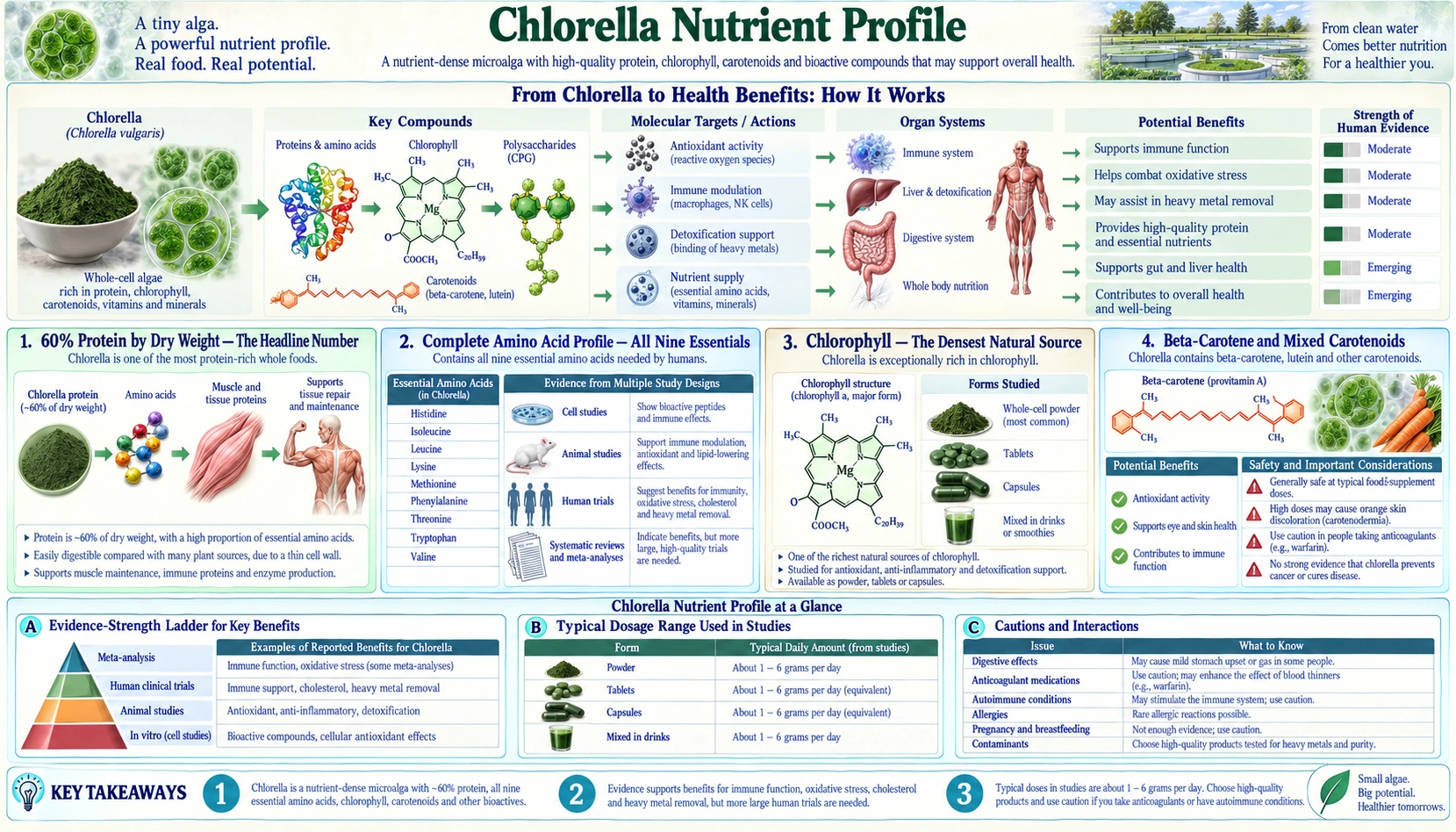
Chlorella is roughly half to three-fifths protein by dry weight — about 59% on average across product labels and 47% in an independent analysis of commercial biomass — which is high for a plant food and comparable to defatted soybean flour, though below lean beef or chicken breast on a dry-weight basis (about 80-86%). The chlorella amino acid profile is complete: all nine essential amino acids (histidine, isoleucine, leucine, lysine, methionine, phenylalanine, threonine, tryptophan, valine) are present, at or close to the FAO/WHO reference amino acid pattern. Chlorella is also dense in chlorophyll (about 2.5% by dry weight in a classic analysis, though it varies widely with growing conditions), in mixed carotenoids led by beta-carotene, and in iron. The most contentious area of chlorella nutrition is its vitamin B12 content: measured B12 ranges from almost none to over 400 mcg per 100 g between products, true B12 was the main form in the chlorella tablets analysed by a Japanese university group, but some high-B12 tablets also held inactive corrinoid compounds. The research does not establish chlorella as a dependable sole B12 source for vegans.
Table of Contents
- Protein by Dry Weight — The Headline Number
- Complete Amino Acid Profile — All Nine Essentials
- Chlorophyll — A Dense but Variable Source
- Beta-Carotene and Mixed Carotenoids
- Iron — Bioavailability and the Anemia Use Case
- The B12-Analog Controversy — Pseudovitamin B12
- Other Vitamins (B-Complex, K1, Folate)
- Other Minerals (Magnesium, Potassium, Zinc, Selenium)
- Omega-3 Fatty Acids (Alpha-Linolenic Acid)
- Nucleic Acid Content and the Purine / Gout Caution
- Chlorella vulgaris vs Chlorella pyrenoidosa
- Key Research Papers
- Connections
- Featured Videos
Protein by Dry Weight — The Headline Number
The most-cited nutritional headline for chlorella is its protein content, which depends on the species (vulgaris vs pyrenoidosa), the strain, and the growing conditions. Label figures on 13 commercial products range from 50% to 72% and average about 59%, and published analyses give 57% for C. pyrenoidosa and 51-58% for C. vulgaris (Bito 2020). An independent analysis of commercial chlorella biomass from several producers measured less: 47 ± 8% (Muys 2019). The figure commonly quoted is 60%. For comparison (the other foods are calculated from USDA FoodData Central protein and water values):
| Food | Protein (% dry weight) | Notes |
|---|---|---|
| Chlorella | ~47-59% | Label average ~59% (Bito 2020); independent analysis 47 ± 8% (Muys 2019) |
| Spirulina | ~60% | USDA dried spirulina; independent analysis 48 ± 4%, similar to chlorella (Muys 2019) |
| Defatted soybean flour | ~55% | USDA defatted soy flour |
| Whey protein isolate | ~90% | A processed isolate, not a whole food |
| Beef (lean, dry weight) | ~80% | USDA 95%-lean ground beef, raw |
| Chicken breast (dry weight) | ~86% | USDA skinless chicken breast, raw |
| Hemp seeds (dry weight) | ~33% | USDA hulled hemp seed |
| Quinoa (cooked, dry weight) | ~16% | USDA cooked quinoa |
The practical caveat: nobody eats chlorella as a primary protein source. A daily 3-5 g chlorella supplement supplies roughly 1.5-3 g of protein — a small fraction of the 50-150 g typical adult protein requirement. The protein content is nutritionally interesting for two reasons that are not "daily protein intake":
- Quality of the amino acid profile — the 3 g of chlorella protein supplied per day is high-quality complete protein, supplying small but well-balanced amounts of all nine essential amino acids. This is more notable for vegetarians and vegans rounding out an otherwise plant-restricted profile than for omnivores already getting complete protein from animal sources.
- The historical context — the Japanese Tamiya project of the 1950s was specifically aimed at chlorella as a scalable protein source for postwar food security. The protein content of the dried cells — “about 50 per cent,” in the words of the Carnegie Institution of Washington's 1953 monograph — is the reason that monograph gives for pursuing large-scale culture (Burlew 1953). Chlorella never became the staple food that was planned: a review attributes this to high production costs and the technical difficulty of making algal material into palatable food, and notes that most microalgal preparations are now marketed as health food (Becker 2007).
Complete Amino Acid Profile — All Nine Essentials
The amino acid composition of chlorella is the property that elevates it from "high protein" to "high-quality protein." All nine essential amino acids are present:
| Essential Amino Acid | Chlorella (g per 100 g protein, two commercial products) | FAO/WHO reference | Notes |
|---|---|---|---|
| Histidine | ~1.8 | 1.5 | Above reference |
| Isoleucine | ~2.9-3.6 | 3.0 | Just below reference in one product, above in the other |
| Leucine | ~6.6-7.9 | 5.9 | Above reference |
| Lysine | ~5.5-7.4 | 4.5 | Above reference (limiting in many grains) |
| Methionine + Cysteine | ~2.6-3.3 | 2.2 | Above reference (often limiting in legumes) |
| Phenylalanine + Tyrosine | ~6.3-7.9 | 3.8 | Well above reference |
| Threonine | ~3.5-4.4 | 2.3 | Well above reference |
| Tryptophan | ~1.6-1.9 | 0.6 | Well above reference |
| Valine | ~4.4-5.4 | 3.9 | Above reference |
The chlorella figures above are calculated from the amino acid analyses and label protein contents (63% and 57%) of two commercial products reported by Bito et al. (2020). In both products chlorella meets or exceeds the FAO/WHO essential amino acid reference for every essential amino acid except isoleucine in one product, which sits just under it (2.9 vs 3.0). Protein-quality comparisons are not uniform: the 2020 review cites essential amino acid index values for chlorella above that of soybean protein (Bito 2020), while an independent analysis of commercial biomass found chlorella's amino acid index and its protein digestibility (51 ± 9%) lower than spirulina's (Muys 2019). Chlorella is high in lysine (often limiting in cereal grains) and adequate in methionine + cysteine (often limiting in legumes), which makes it complementary to both grain-based and legume-based vegetarian diets. Its leucine content (about 6.6-7.9 g per 100 g protein in these products) is above the reference pattern, which is the compositional basis for the muscle-recovery and muscle-protein-synthesis claims occasionally made for chlorella in athletic populations.
The non-essential amino acid profile is also useful nutritionally:
- Glutamine and glutamate — substrates for hepatic glutathione synthesis and gut enterocyte energy metabolism
- Glycine — second component of glutathione, also substrate for collagen synthesis
- Arginine — substrate for nitric oxide synthesis and immune cell function
- Alanine — gluconeogenic substrate and ammonia transport carrier
- Proline — collagen synthesis substrate
The broader essential amino acid context is covered in the Amino Acids index.
Chlorophyll — A Dense but Variable Source
Chlorella derives its name from the Greek chloros ("green"). Its chlorophyll content is high but varies enormously with growing conditions: pigment analyses of C. pyrenoidosa summarised in the Carnegie Institution's 1953 monograph found about 2.5-2.6% chlorophyll a + b by dry weight, other samples ranged from about 6% down to under 0.01%, and the monograph contrasted green algae with dehydrated alfalfa, the commercial chlorophyll source of the day, at under 0.2% (Burlew 1953). At 2.5%, a 3 g chlorella dose would hold roughly 75 mg of chlorophyll; the Qidong trial described below used 100 mg of chlorophyllin, a semi-synthetic derivative, three times a day.
Chlorophyll itself is the green photosynthetic pigment, structurally a porphyrin ring with a central magnesium atom. The molecule has several relevant biological effects:
- Aflatoxin and mycotoxin binding — the planar porphyrin ring binds aflatoxin, polycyclic aromatic hydrocarbons, and heterocyclic amines via pi-pi stacking interactions, preventing absorption from the gut. The Egner Qidong trial used 100 mg chlorophyllin three times daily and reduced median urinary aflatoxin-DNA adducts by 55% in a high-exposure Chinese population (180 adults, 4 months).
- Mild antioxidant activity — chlorophyll scavenges hydroxyl radicals and singlet oxygen, contributing to gut and serum antioxidant capacity
- Magnesium delivery — the central magnesium atom contributes a small amount of bioavailable magnesium upon chlorophyll digestion
- Wound-healing and odor-reducing applications — topical chlorophyllin has been used as a wound-deodorizing agent and as part of pressure-ulcer treatment
- Gut transit effects — high chlorophyll intake can produce a green tint to the stool, which is benign but visually noticeable to first-time chlorella users
The conversion of dietary chlorophyll to chlorophyllin (the more water-soluble form used in most cancer-prevention trials) occurs during digestion as the magnesium is displaced and the phytol tail is cleaved. Both forms have biological activity, though chlorophyllin is the better-characterized intervention molecule.
Beta-Carotene and Mixed Carotenoids
Chlorella contains significant amounts of beta-carotene (the same provitamin A carotenoid found in carrots, sweet potatoes, and dark leafy greens), plus lutein, zeaxanthin, alpha-carotene, and several other carotenoids in smaller amounts. The total carotenoid content of dried chlorella is approximately 0.1-0.4% by weight, varying by species and growing conditions.
The biological relevance:
- Provitamin A activity — beta-carotene is cleaved in the gut by BCMO1 (beta-carotene-15,15'-monooxygenase) to two molecules of retinal, which can be reduced to retinol (the active form of vitamin A). The conversion is regulated by retinol status, so vitamin A toxicity from chlorella beta-carotene is essentially impossible.
- Lutein and zeaxanthin in the macula — these two carotenoids are concentrated in the macula of the eye and filter blue light. In the AREDS2 trial (4,203 participants), adding lutein (10 mg) + zeaxanthin (2 mg) to the AREDS formulation did not further reduce progression to advanced macular degeneration in the primary analysis; because more lung cancers occurred in the beta-carotene group, mostly in former smokers, the investigators described lutein + zeaxanthin as an appropriate substitute for beta-carotene in the formulation (AREDS2 Research Group 2013).
- Antioxidant activity — all carotenoids are lipid-soluble antioxidants, scavenging singlet oxygen and lipid peroxyl radicals
- Cellular communication — some carotenoids modulate gap junction communication between cells, a mechanism relevant to tumor suppression
The chlorella carotenoid content is one of the marketing "superfood" claims for the algae that the composition data bear out — it supplies a mixed carotenoid spectrum more typical of dark leafy greens than of single-source supplements. The broader vitamin A and beta-carotene discussion is on the Beta-Carotene vs Preformed Retinol page.
Iron — Bioavailability and the Anemia Use Case
A 2020 review gives about 104 mg of iron per 100 g dry weight for chlorella products and describes chlorella as containing more iron than other plant-derived foods; label figures on 13 products vary widely, from about 10 mg to well over 100 mg per 100 g (Bito 2020). At about 104 mg per 100 g, a 3-5 g daily chlorella dose supplies roughly 3-5 mg of iron, a meaningful share of the daily requirement (8 mg/day for adult men, 18 mg/day for menstruating women).
The clinically interesting question is bioavailability. Plant-source iron (non-heme iron) is generally less bioavailable than animal-source heme iron, and the human results for chlorella point in different directions. In a Japanese trial of 70 pregnant women, those given 6 g of C. pyrenoidosa a day from weeks 12-18 of pregnancy until delivery had a significantly lower proportion of anemia (hemoglobin below 11 g/dL) in the second and third trimesters than the control group (Nakano 2010); the supplement supplies folate and B12 as well as iron, so the result cannot be credited to iron alone. In a 14-day randomized study of 80 healthy adults in Germany, by contrast, 15 g of chlorella a day lowered serum iron, ferritin, transferrin saturation and selenium, and the authors concluded that regular chlorella intake may affect iron and selenium status negatively (Sandgruber 2023). A 2025 systematic review of 32 studies (7 human, 25 animal) reported improved hemoglobin, ferritin and red-cell counts with chlorella or spirulina, and called for longer human trials (Lacurezeanu 2025).
How the iron content compares in practice:
- Menstruating women and vegetarians/vegans, who often run low on iron stores, are the groups for whom chlorella's iron content is most often discussed
- Its iron supply is far below the 60-200 mg elemental iron per day typically used with ferrous sulfate or other prescription-strength iron in iron-deficiency anemia
- Chlorella iron does not produce the GI distress (constipation, nausea, dark stools) common with ferrous sulfate, which is why it is sometimes discussed as an ongoing maintenance option after iron repletion
- In hereditary hemochromatosis, where total iron intake matters, an added 3-5 mg a day is not negligible; no studies of chlorella in hemochromatosis were found on PubMed
Iron and anemia are covered on the Iron page.
The B12-Analog Controversy — Pseudovitamin B12
The vitamin B12 content of chlorella is the most contentious area of its nutritional profile, and one where marketing claims and laboratory measurements need to be read side by side.
The marketing claim is that chlorella is a rich vegan source of B12. The measurements show how much that depends on the product: B12 in 19 dried chlorella supplements ranged from under 0.1 mcg to about 415 mcg per 100 g dry weight (Bito 2016), and an earlier analysis of chlorella tablets found about 200-286 mcg per 100 g (Kittaka-Katsura 2002). Typical assays count corrinoid compounds (the chemical family that includes B12 and its analogs), so a high figure does not by itself show active B12.
What the Watanabe group at Tottori University in Japan found over many years of research: in chlorella tablets, true vitamin B12 was the predominant form (Watanabe 2002; Kittaka-Katsura 2002), whereas in spirulina tablets about 83% of the B12-like compounds that bind intrinsic factor was pseudovitamin B12, an inactive analog that does not satisfy human B12 requirements (Watanabe 1999). A later survey found that some high-B12 chlorella tablets also contained inactive corrinoid compounds, including a cobalt-free corrinoid and one called factor IIIm (Bito 2016). The spirulina study reported that pseudovitamin B12 binds intrinsic factor, the protein that carries B12 into the body; the papers cited here did not measure whether eating it lowers a person's B12 status.
Important caveats:
- Products differ. In four chlorella tablets with high or moderate B12, the coenzyme forms adenosylcobalamin (about 32%) and methylcobalamin (about 8%) made up a considerable share, and cyanocobalamin the smallest (Bito 2016; two of the co-authors worked for a chlorella manufacturer). The same study suggests that the B12 in tablets comes from B12-producing ingredients in the growth medium or from B12-making bacteria growing alongside the alga in open culture.
- The Watanabe 2014 Nutrients review (cited below) surveys plant foods for B12 and concludes that dried purple laver (nori) is the most suitable B12 source presently available for vegetarians
- Spirulina is the weaker B12 source of the two: pseudovitamin B12 predominated in spirulina tablets, which the Watanabe group judged unsuitable as a B12 source, especially for vegetarians (Watanabe 2002)
- Nori (the dried purple laver used in sushi) contains true B12 as its predominant form, and feeding it to B12-deficient rats improved their B12 status — an animal result (Watanabe 2002). Nori products also vary in arsenic, cadmium and allergen content (Bito 2017).
- In people, the evidence is one small open-label study without a control group: 17 vegan or vegetarian adults with raised methylmalonic acid (MMA) took 9 g of C. pyrenoidosa a day for about 60 days; serum MMA fell by an average of about 34%, homocysteine trended down and serum B12 trended up (Merchant 2015).
What this means for vegans: the research does not establish chlorella as a dependable sole B12 source — content varies more than a thousand-fold between products, and the human evidence is one small uncontrolled study. Vegan B12 guidance commonly cites a cyanocobalamin or methylcobalamin supplement (typical doses cited: 1000 mcg orally several times per week, or 25-100 mcg daily). B12 status in vegans and vegetarians is commonly assessed with serum B12, methylmalonic acid and homocysteine testing. B12 itself is covered in more depth on the Vitamin B12 page.
Other Vitamins (B-Complex, K1, Folate)
Beyond the contentious B12 question, chlorella supplies measurable amounts of several B vitamins and other water-soluble micronutrients:
- Folate — label figures range from about 0.3 to 3.6 mg (300-3,600 mcg) per 100 g dry weight; the 2020 review gives about 2.5 mg per 100 g for C. vulgaris products, more than spinach (Bito 2020). At that level a 3-5 g daily dose supplies roughly 75-125 mcg.
- Niacin (B3) — roughly 10-80 mg per 100 g dry weight on product labels, a small but meaningful contribution to daily intake
- Riboflavin (B2) — roughly 2-9 mg per 100 g dry weight on product labels, contributing to flavin cofactor pools for redox enzymes
- Pyridoxine (B6) — roughly 1-3 mg per 100 g dry weight on product labels, a modest contribution
- Vitamin K1 — chlorella is chlorophyll-rich, and chlorophyll is biosynthetically related to phylloquinone (K1). The K1 content is significant enough to interact with warfarin (clinical caution noted earlier) and to make a meaningful contribution to daily vitamin K intake
- Pantothenic acid (B5), thiamine (B1), biotin (B7) — present in small but measurable amounts
- Vitamin E — modest amounts of mixed tocopherols (alpha and gamma)
- Vitamin C — low to moderate amounts; chlorella is not a primary vitamin C source
The aggregate effect is that chlorella functions as a modest broad-spectrum multivitamin in addition to its specific functional roles. Its amounts are below those of a dedicated multivitamin used for frank deficiency, but it adds a measurable nutritional floor to the diet.
Other Minerals (Magnesium, Potassium, Zinc, Selenium)
Beyond the heavy iron content discussed above, chlorella supplies a mineral profile typical of green leafy plants:
- Magnesium — about 250-350 mg per 100 g dry weight on most labels that list it (Bito 2020), derived in part from the chlorophyll central atoms. A 3-5 g daily dose supplies roughly 8-18 mg magnesium, a modest contribution.
- Potassium — about 1,000 mg per 100 g dry weight in the 2020 review (986 mg); labels range from about 200 to 1,500 mg
- Calcium — labels range from about 100 to 1,500 mg per 100 g dry weight, most between about 430 and 850 mg
- Phosphorus — about 1,300-1,600 mg per 100 g dry weight on the two labels that list it
- Zinc — about 1-2 mg per 100 g dry weight on the two product labels that list it (Bito 2020), so a 5 g daily dose supplies under 0.1 mg — a negligible share of the 8-11 mg RDA.
- Selenium — variable depending on the selenium in the growth medium. Selenium-enriched C. vulgaris supplements are sold, with the selenium held mainly as selenoamino acids (Vu 2019). In the 14-day NovAL trial, 15 g a day of chlorella lowered serum selenium (Sandgruber 2023).
- Iodine — small amounts; chlorella is not a major iodine source and does not supply the amounts found in sea vegetables or iodine supplements
- Manganese, copper — trace amounts
The mineral profile is broadly aligned with what one would expect from a dense plant-source food — high in the minerals that plants accumulate efficiently (magnesium, potassium, iron), low in the minerals that plants accumulate poorly (iodine, sodium).
Omega-3 Fatty Acids (Alpha-Linolenic Acid)
Chlorella contains a modest amount of omega-3 fatty acids, predominantly alpha-linolenic acid (ALA), the 18-carbon plant-source omega-3. Reported ALA content of chlorella products is in the low grams per 100 g dry weight, so a 5 g amount supplies on the order of 0.1 g of ALA or less — a small contribution to the commonly cited 1-2 g/day plant-source omega-3 intake.
Chlorella is not a meaningful source of the longer-chain marine omega-3s EPA and DHA. For EPA/DHA, the canonical sources remain fish, fish oil, or microalgae-derived EPA/DHA products (Schizochytrium or Crypthecodinium — not chlorella).
The ALA-to-EPA conversion efficiency in humans is poor (typically 5-10%) and the ALA-to-DHA conversion is even worse (1-5%), so ALA cannot fully substitute for direct EPA/DHA intake. Chlorella ALA amounts to a small contribution to the omega-3 background, not a primary intervention. Omega-3s are covered on the Omega-3 Fatty Acids page.
Nucleic Acid Content and the Purine / Gout Caution
Chlorella is rich in nucleic acids (DNA and RNA), reflecting the alga's rapid cell-division rate. While nucleic acids are a normal dietary constituent, their purine bases are broken down to uric acid, so high intake can elevate serum uric acid. A randomized trial shows this happening with chlorella: in 80 healthy adults, 15 g of chlorella a day for 14 days raised serum and urine uric acid, and the authors described the rise as a potential health risk (Sandgruber 2023). Typical supplement doses (3-5 g) are smaller than the trial dose and were not tested; the finding matters most for someone with gout, hyperuricemia, or a kidney stone history.
What the purine content means for different groups:
- Healthy adults without uric acid concerns: chlorella nucleic acid is generally described as harmless and has been proposed to contribute as nucleotide substrate for cellular regeneration (the basis of the CGF concept)
- Patients with gout, hyperuricemia, or recurrent uric acid kidney stones: the research raises a concern for this group; approaches described range from 1-2 g/day of chlorella, to spirulina instead (lower nucleic acid content), to no algal supplements at all
- Patients on uric-acid-lowering medication (allopurinol, febuxostat): chlorella is generally described as compatible; serum uric acid is the measure that would show an effect after it is introduced
The Chlorella Growth Factor (CGF) extract is even higher in nucleic acid content than whole chlorella because the manufacturing process concentrates the cell-interior contents. CGF-fortified products therefore carry a larger purine load, which matters most for people with gout.
Chlorella vulgaris vs Chlorella pyrenoidosa
The two species most commonly sold as "chlorella" are Chlorella vulgaris and Chlorella pyrenoidosa (the latter has been taxonomically reclassified by some workers as Auxenochlorella pyrenoidosa or as a member of Parachlorella, but is still sold under the pyrenoidosa name commercially; a 2016 study refers to the supplement strain as Chlorella sorokiniana, formerly C. pyrenoidosa).
The differences are modest but real:
| Property | C. vulgaris | C. pyrenoidosa |
|---|---|---|
| Protein content | ~51-58% (published analyses) | ~57% (published analysis) |
| Chlorophyll content | Varies widely with growing conditions | ~2.5% in a 1950s analysis; varies widely with growing conditions |
| CGF content | Lower | Higher (the species used for most CGF research) |
| Cell wall | Thinner, easier to break | Thicker, requires more aggressive processing |
| Heavy-metal binding | Slightly lower per gram | Slightly higher per gram |
| Common growing region | Germany, Korea, Hawaii | Japan, Taiwan |
| Typical commercial use | Whole-food supplements, food-additive use | Premium supplements emphasizing CGF and detoxification |
The practical reading: both species are reported to produce essentially the same effects as broken-cell-wall preparations. C. pyrenoidosa is described as having higher CGF content and is the species used in most of the Japanese clinical research literature, so the published research applications (heavy-metal chelation, detoxification, immune support) apply most directly to it. C. vulgaris is used interchangeably for most general purposes and is often somewhat less expensive.
Key Research Papers
- Watanabe F et al. (2014). Vitamin B12-containing plant food sources for vegetarians. Nutrients. — PubMed · PubMed PMID: 24803097
- Kanazawa K et al. (1995). Studies on availability of vitamin B12 from algal food sources. Journal of Nutritional Science and Vitaminology. (Pseudovitamin B12 documentation in spirulina and chlorella.) — PubMed
- Becker EW (2007). Micro-algae as a source of protein. Biotechnology Advances. (Comprehensive review of algal protein, including chlorella.) — PubMed · PubMed PMID: 17196357
- Tokusoglu O, Unal MK (2003). Biomass nutrient profiles of three microalgae: Spirulina platensis, Chlorella vulgaris, and Isochrysis galbana. Journal of Food Science. — PubMed · doi:10.1111/j.1365-2621.2003.tb09615.x
- Henrikson R (2009). Earth Food Spirulina (Spirulina and chlorella comparative nutrition reference). — PubMed
- Panahi Y et al. (2016). A randomized controlled trial of chlorella on metabolic parameters and inflammatory markers in NAFLD patients. Journal of Dietary Supplements. — PubMed
- Egner PA et al. (2001). Chlorophyllin intervention reduces aflatoxin-DNA adducts in individuals at high risk for liver cancer. PNAS. (Chlorophyll bioactivity reference.) — PubMed · PubMed PMID: 11724948
- Bito T, Teng F, Watanabe F (2017). Bioactive compounds of edible purple laver Porphyra sp. (Nori). Journal of Agricultural and Food Chemistry. — PubMed · PubMed PMID: 29161815
- Day AG et al. (2009). Safety evaluation of a high-lipid algal biomass from Chlorella protothecoides. Regulatory Toxicology and Pharmacology. — PubMed · PubMed PMID: 19580838
- Lordan S et al. (2011). Marine bioactives as functional food ingredients: potential to reduce the incidence of chronic diseases. Marine Drugs. — PubMed PMID: 21747748
- Safi C et al. (2014). Morphology, composition, production, processing and applications of Chlorella vulgaris: A review. Renewable and Sustainable Energy Reviews. (Comprehensive technical review of C. vulgaris.) — PubMed · doi:10.1016/j.rser.2014.04.007
- Merchant RE, Andre CA (2001). A review of recent clinical trials of the nutritional supplement Chlorella pyrenoidosa in the treatment of fibromyalgia, hypertension, and ulcerative colitis. Alternative Therapies in Health and Medicine. — PubMed · PubMed PMID: 11347287
- Watanabe F, Katsura H, Takenaka S, et al. (1999). Pseudovitamin B12 is the predominant cobamide of an algal health food, spirulina tablets. Journal of Agricultural and Food Chemistry. — PubMed PMID: 10552882
- Watanabe F, Takenaka S, Kittaka-Katsura H, Ebara S, Miyamoto E (2002). Characterization and bioavailability of vitamin B12-compounds from edible algae. Journal of Nutritional Science and Vitaminology. — PubMed PMID: 12656203
- Kittaka-Katsura H, Fujita T, Watanabe F, Nakano Y (2002). Purification and characterization of a corrinoid compound from Chlorella tablets as an algal health food. Journal of Agricultural and Food Chemistry. — PubMed PMID: 12166996
- Bito T, Bito M, Asai Y, et al. (2016). Characterization and quantitation of vitamin B12 compounds in various Chlorella supplements. Journal of Agricultural and Food Chemistry. — PubMed PMID: 27776413
- Merchant RE, Phillips TW, Udani J (2015). Nutritional supplementation with Chlorella pyrenoidosa lowers serum methylmalonic acid in vegans and vegetarians with a suspected vitamin B12 deficiency. Journal of Medicinal Food. (Open-label, 17 participants, no control group.) — PubMed PMID: 26485478
- Nakano S, Takekoshi H, Nakano M (2010). Chlorella pyrenoidosa supplementation reduces the risk of anemia, proteinuria and edema in pregnant women. Plant Foods for Human Nutrition. — PubMed PMID: 20013055
- Bito T, Okumura E, Fujishima M, Watanabe F (2020). Potential of Chlorella as a dietary supplement to promote human health. Nutrients. (Composition tables compiled from 13 product labels; two authors worked for a chlorella manufacturer.) — PubMed PMID: 32825362
- Muys M, Sui Y, Schwaiger B, et al. (2019). High variability in nutritional value and safety of commercially available Chlorella and Spirulina biomass indicates the need for smart production strategies. Bioresource Technology. — PubMed PMID: 30594834
- Sandgruber F, Höger AL, Kunze J, et al. (2023). Impact of regular intake of microalgae on nutrient supply and cardiovascular risk factors: results from the NovAL intervention study. Nutrients. — PubMed PMID: 37049486
- Lacurezeanu A, Vodnar DC (2025). Arthrospira platensis and Chlorella vulgaris consumption on iron status: a systematic review of in vivo studies. Molecular Nutrition & Food Research. — PubMed PMID: 41255135
- Vu DL, Saurav K, Mylenko M, et al. (2019). In vitro bioaccessibility of selenoamino acids from selenium (Se)-enriched Chlorella vulgaris biomass in comparison to selenized yeast; a Se-enriched food supplement; and Se-rich foods. Food Chemistry. — PubMed PMID: 30611470
- Age-Related Eye Disease Study 2 Research Group (2013). Lutein + zeaxanthin and omega-3 fatty acids for age-related macular degeneration: the Age-Related Eye Disease Study 2 (AREDS2) randomized clinical trial. JAMA. — PubMed PMID: 23644932
- Burlew JS, editor (1953). Algal Culture: From Laboratory to Pilot Plant. Carnegie Institution of Washington Publication 600. (Book; protein and chlorophyll figures.) — Carnegie Science (full text, PDF)