Chlorella for Heavy Metal Chelation
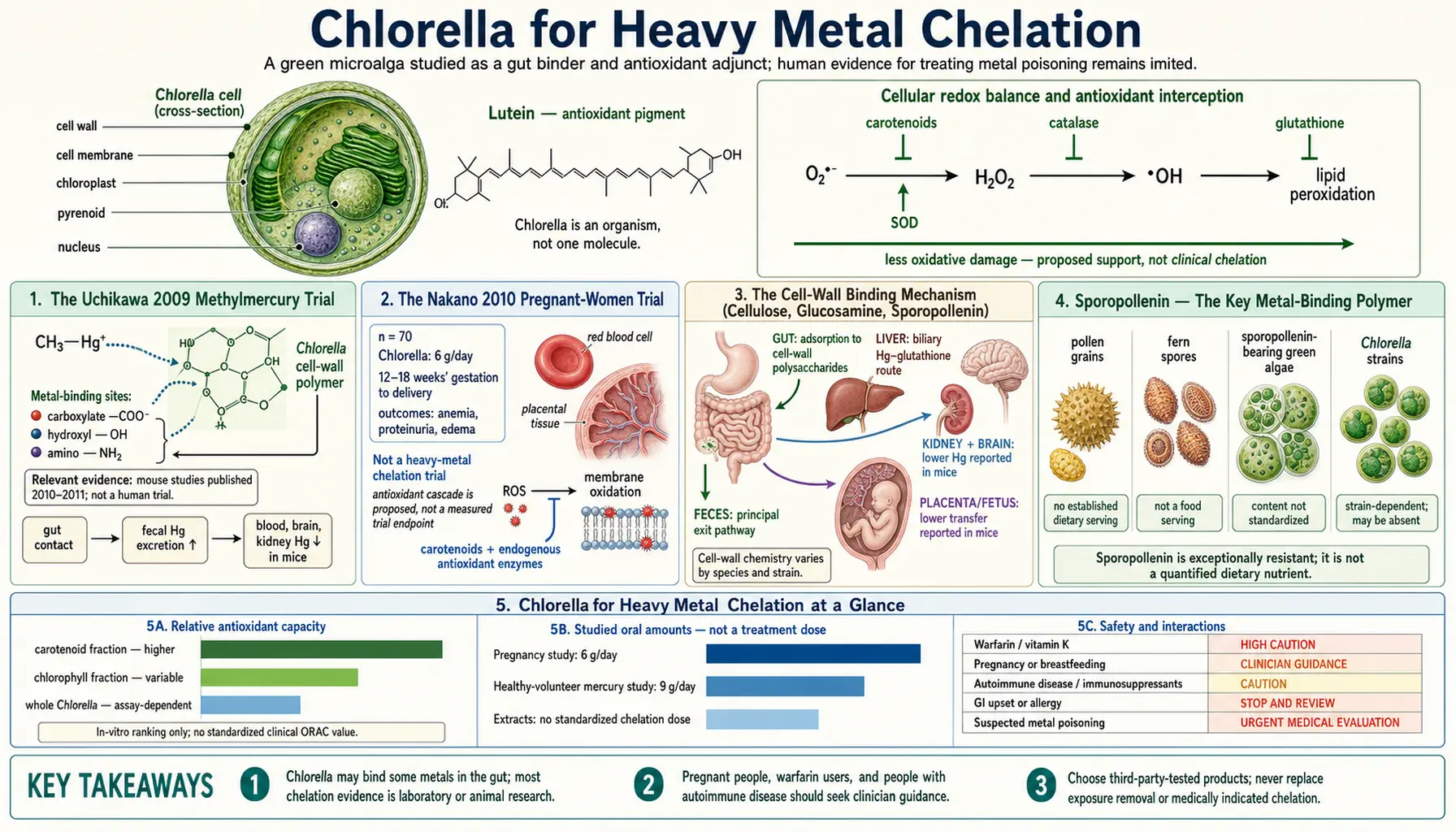
Heavy-metal chelation is one of the most widely promoted claims made for chlorella. The experimental evidence most often cited for it comes from Japanese mouse studies by Uchikawa and colleagues (2010 and 2011), in which chlorella-fed mice excreted more of an oral methylmercury dose and, over three weeks, carried less mercury in the kidney and brain; rat studies report similar findings for cadmium. No human trial has measured chelation of mercury or lead by chlorella — the best-known human study, Nakano 2010 in pregnant women, measured anemia, proteinuria and edema, not metals. The binding agent is not a single molecule but the chlorella cell wall itself: a multilayer composite of cellulose, glucosamine, and especially sporopollenin, a chemically inert biopolymer with high affinity for divalent and trivalent metal cations. Proponents and producers emphasise broken-cell-wall (cracked-cell-wall) chlorella, on the reasoning that the intact wall is not digested. Chlorella is described as slower and gentler than pharmaceutical chelators (DMSA, DMPS, EDTA); whether it redistributes metals has not been studied in humans. It is sold as a food supplement without medical supervision, but its binding capacity per gram is lower — which is why the role proposed for it is ongoing low-level exposure (amalgam fillings, urban pollution, dietary fish), not use as a stand-alone treatment for acute or severe metal poisoning.
Table of Contents
- The Uchikawa Methylmercury Studies in Mice
- The Nakano 2010 Pregnant-Women Trial
- The Cell-Wall Binding Mechanism (Cellulose, Glucosamine, Sporopollenin)
- Sporopollenin — The Key Metal-Binding Polymer
- Radioactive Cesium and Algae After Fukushima
- Chlorella vs DMSA / DMPS / EDTA — Pharmaceutical Chelators Compared
- Why Cell-Wall Processing Matters for Chlorella
- The Contamination Paradox — Cheap Chlorella Can Deliver More Metal Than It Removes
- Doses and Protocols Described for Chlorella Chelation
- Cautions, Drug Interactions, and Who the Research Raises Concerns For
- Key Research Papers
- Connections
- Featured Videos
The Uchikawa Methylmercury Studies in Mice
The most-cited experimental evidence for chlorella's heavy-metal effect is a series of mouse studies by Uchikawa T and colleagues in the Journal of Toxicological Sciences, using Parachlorella beijerinckii (strain CK-5, previously identified as Chlorella vulgaris CK-5). These are animal studies, not human results. Their abstracts report:
- Single-dose study (2010) — female mice given oral methylmercury chloride with or without chlorella powder excreted about 1.9-fold more mercury in feces and 2.2-fold more in urine over 24 hours. Blood and organ mercury levels did not differ between the groups, and the authors concluded chlorella did not affect methylmercury absorption from the gut.
- Three-week study (2011) — mice fed diets containing 0%, 5% or 10% chlorella powder after an oral methylmercury dose had significantly lower blood mercury from day 7 and higher cumulative mercury excretion in feces (5% and 10% groups) and urine (5% group). After 21 days, mercury levels were significantly lower in the kidney and brain, but the reduction in the liver was not significant; glutathione levels were unchanged.
- Pregnancy study (2011) — pregnant mice drinking methylmercury-containing water on a 10% chlorella diet had lower blood and brain mercury, and their newborns had lower mercury in blood, brain, liver and kidney, than mice on the basal diet.
The mechanism the authors and others propose (the 2011 authors wrote that it still needs to be elucidated) is that the cell-wall polysaccharides and sporopollenin bind methylmercury in the gut lumen, and because methylmercury normally undergoes extensive enterohepatic recirculation (excreted in bile, reabsorbed in the small intestine), interrupting that recirculation by binding the biliary-excreted mercury accelerates net elimination. This is the same principle as cholestyramine: in a 1984 rat study, chlorella and chlorella-derived sporopollenin interrupted the enteric recirculation of the insecticide chlordecone and shortened its half-life from 40 to 19 days, an effect similar to cholestyramine (Pore 1984).
The Uchikawa work is animal data, with the usual caveats about translation to humans; no comparable human trial measuring mercury or lead excretion has been published. Rat studies report related findings for cadmium: chlorella in the diet lowered cadmium accumulation in blood, liver, kidney and small intestine and increased fecal and urinary cadmium excretion (Shim 2009). Mercury exposure and removal are covered on the Mercury page.
The Nakano 2010 Pregnant-Women Trial
The human study most often cited alongside the chelation claim is Nakano S et al. 2010 in Plant Foods for Human Nutrition. It enrolled 70 pregnant Japanese women: 32 took 6 g/day of Chlorella pyrenoidosa from the 12th–18th week of gestation until delivery and 38 served as controls. The chlorella group had a significantly lower proportion of anemia in the second and third trimesters and lower rates of proteinuria and edema in the third trimester. The study did not measure heavy metals.
The same team's earlier work concerned dioxins, not metals. In a 2005 Chemosphere study of 44 pregnant women, of whom 23 took chlorella supplements during pregnancy, dioxin toxic equivalents in breast milk were about 30% lower in the chlorella group (Nakano 2005), and a 2007 Journal of Medicinal Food study of 35 women (18 taking chlorella) also reported lower dioxin levels and higher immunoglobulin A in breast milk (Nakano 2007). Neither abstract reports any heavy-metal measurement.
Applying these findings to heavy metals in humans is therefore an extrapolation rather than a tested result. The closest evidence on metal transfer in pregnancy is the 2011 mouse study above, in which chlorella in the diet lowered methylmercury in newborn mice.
The Cell-Wall Binding Mechanism (Cellulose, Glucosamine, Sporopollenin)
The chlorella cell wall is a multilayer composite structure that protects the cell in harsh aquatic environments, including water with elevated dissolved metals. The same chemistry that protects the live cell is what binds metals in the human gut after the cell wall is mechanically broken to release the cytoplasmic contents.
The principal binding components, in order of contribution:
- Sporopollenin — a chemically inert biopolymer with hydroxyl, carboxyl, and ether functional groups that coordinate metal cations. Sporopollenin is the same polymer that makes pollen grains effectively indestructible in soil for tens of millions of years (the basis of palynology, the study of fossil pollen). In chlorella it forms an outer protective layer. See the dedicated section below.
- Cellulose and hemicellulose — the structural carbohydrate scaffold of the wall. The hydroxyl groups on the sugar residues weakly bind cations, contributing a high-capacity but low-affinity binding pool.
- Glucosamine and chitin-like polymers — the amino groups on glucosamine contribute moderate-affinity nitrogen coordination of soft metal cations (mercury, cadmium, lead all prefer N and S donors).
- Cell-wall protein (cross-linked glycoproteins) — the thiol (-SH) and carboxyl (-COOH) groups on amino acid side chains contribute additional binding sites. Free cysteine residues are the highest-affinity sites and explain why protein-rich cell-wall preparations bind better than purified cellulose alone.
How much mercury a gram of chlorella can bind in the human gut has not been established in the studies cited on this page; binding figures from wastewater biosorption experiments depend on the strain, the preparation and the conditions, and do not translate directly to digestion.
Sporopollenin — The Key Metal-Binding Polymer
Sporopollenin deserves a dedicated discussion because it is unique among biological polymers and is responsible for much of chlorella's distinctive metal-binding behavior. Chemically, sporopollenin is a highly cross-linked polymer of carotenoids and carotenoid esters with phenolic and aliphatic components — the exact composition varies by species but is unusually rich in oxygen-containing functional groups that coordinate transition metal cations.
Key properties relevant to chelation:
- Chemical inertness — sporopollenin resists acid, alkali, and most enzymes. It passes intact through the human gut, which is the basis for the reasoning that metals bound to it in the small intestine stay bound and leave in the feces; in the Pore 1984 rat study, algal cell walls and sporopollenin carried bound chlordecone out in the feces.
- High surface area — the sporopollenin layer in chlorella is porous on a microscopic scale, providing a large effective surface for ion exchange.
- Claimed selectivity for toxic metals — proponents describe sporopollenin as binding mercury, lead, cadmium and arsenic in preference to essential minerals (iron, zinc, calcium, magnesium), and on that basis claim chlorella does not deplete essential minerals. None of the studies cited on this page measured that selectivity or essential-mineral status in people.
- Stability across gut pH — sporopollenin retains its binding capacity across the acid stomach, alkaline pancreatic, and neutral colonic environments, unlike some pH-sensitive binders.
The sporopollenin layer is also the reason raw, unprocessed chlorella is essentially inedible from a nutritional standpoint — it locks away the protein and CGF inside. Cell-wall processing (pressure-jet milling, ball milling) breaks the sporopollenin layer enough to release the contents while leaving enough surface area for metal binding. The processing has to balance both functions.
Radioactive Cesium and Algae After Fukushima
The 2011 Fukushima Daiichi nuclear accident renewed interest in using microalgae to remove radioactive cesium from contaminated water. In a 2019 laboratory study, living Chlorella vulgaris cells removed about 90% of soluble cesium-137 from solution, more slowly than the red cyst stage of Haematococcus pluvialis (about 95% in 48 hours); the authors traced the uptake in Haematococcus to the potassium transport channel (Lee 2019). That is water treatment by living algae, not a dietary use.
No human study of chlorella supplements against ingested radionuclides was found in PubMed, and the claims sometimes made in this area — Chernobyl-era use in children, strontium-90 binding in the gut, or chlorella as part of official post-accident protective protocols — could not be traced to a published study.
Chlorella vs DMSA / DMPS / EDTA — Pharmaceutical Chelators Compared
The pharmaceutical chelators DMSA (meso-2,3-dimercaptosuccinic acid, oral), DMPS (2,3-dimercaptopropane-1-sulfonate, oral or IV), and EDTA (ethylenediaminetetraacetic acid, IV) are the standards of care for acute heavy-metal poisoning. Each has clear strengths and limitations relative to chlorella:
| Property | DMSA (succimer) | DMPS (unithiol) | EDTA (calcium disodium) | Chlorella |
|---|---|---|---|---|
| Binding mechanism | Two thiols per molecule | Two thiols + sulfonate | Polyaminocarboxylate | Multi-site cell-wall + sporopollenin |
| Route of administration | Oral | Oral or IV | IV (oral form exists but limited absorption) | Oral |
| Distribution | Crosses cell membranes, intracellular | Mostly extracellular | Strictly extracellular | Stays in gut lumen (does not enter circulation) |
| Redistribution risk | Yes — can mobilize metal from one tissue to another | Lower than DMSA | Can mobilize bone lead | Not studied in humans (lower brain and kidney mercury in mice) |
| Essential mineral depletion | Mild zinc and copper depletion | Mild zinc depletion | Significant Ca, Zn, Mg depletion with chronic use | Not measured; selectivity is claimed by proponents |
| Speed of action | Days to weeks | Days to weeks | Acute (hours to days) | Weeks to months |
| Medical supervision required | Yes | Yes | Yes (IV in clinic) | No (sold as a food supplement) |
| Use case | Acute lead, arsenic, mercury | Acute mercury, arsenic | Acute lead, cardiovascular EDTA trials | Proposed for chronic low-level exposure, ongoing prevention |
Acute, severe, or symptomatic heavy-metal poisoning is treated with pharmaceutical chelation such as DMSA or DMPS under medical supervision, and chlorella is not a replacement for it. The role proposed for chlorella is ongoing low-level exposure — consuming fish regularly, having amalgam dental fillings, working in urban environments with elevated air lead, drinking water from older municipal systems — where the stated aim is to interrupt enterohepatic recirculation and reduce net body burden over months and years rather than days. Some integrative-medicine writers describe combining the two approaches, with chlorella as an ongoing binder alongside supervised DMSA courses; no trial of that combination was found.
The broader topic of detoxification protocols is covered on the Chlorella Detoxification page.
Why Cell-Wall Processing Matters for Chlorella
Whether the cell wall has been broken is the processing difference most discussed for chlorella; broken-cell-wall product is also marketed as cracked-cell-wall, wall-pulverized, BCW, or simply "broken wall". The natural chlorella cell wall is a thick cellulose-glucosamine-sporopollenin composite that the human digestive system cannot rupture — not by hydrochloric acid, not by pancreatic enzymes, not by colonic bacteria. Whole unprocessed chlorella passes through the gut largely intact, delivering essentially zero of the absorbed-active components (CGF, chlorophyll, amino acids, beta-glucans) that produce the metabolic effects of chlorella.
Manufacturers break the wall using one of several processing methods:
- Pressure-jet milling — high-pressure water jets crack the cells against a chamber wall
- Ball milling — the dried algae is tumbled with ceramic or steel balls that mechanically crack the cells (older method, can leave residual whole cells)
- High-pressure homogenization — the aqueous algae paste is forced through a small orifice at very high pressure, shearing the cell walls
- Enzymatic cell-wall digestion — cellulase and pectinase enzymes partially digest the wall (used by some Hawaiian growers)
Producers argue that both the absorbed-active components and the metal-binding capacity require the wall to be broken: the intact wall traps the cell contents inside and limits the binding-site surface area available to gut metals. The binding half of that argument is not settled — in the Pore 1984 rat study, whole Chlorella protothecoides cells passed through the gut intact and still bound chlordecone.
Labels of broken-cell-wall products typically state one of the terms above; a label that is silent on cell-wall processing gives no indication that the wall has been broken, and in that case it most likely has not been.
The Contamination Paradox — Cheap Chlorella Can Deliver More Metal Than It Removes
Contamination is a second, separate quality issue. Chlorella is grown in open pond systems (or in some cases in fermentation tanks with added carbon substrate). The same surface chemistry that allows chlorella to bind heavy metals in the gut lets it concentrate heavy metals from polluted growing water. Chlorella is, in fact, used industrially as a heavy-metal biosorbent for treating contaminated wastewater — precisely because it accumulates metals so effectively.
The contamination paradox: cheap, unregulated chlorella grown in polluted ponds in regions with weak environmental enforcement can deliver more lead, mercury, cadmium, and arsenic per gram than it could possibly bind in the gut, making the product a net source of metal rather than a net remover. Documented cases of heavy-metal contamination in commercial chlorella supplements have appeared periodically in the literature and in consumer-product testing reports (independent testing laboratories, pharmacopeial standards programs, and ad-hoc academic surveys).
Quality markers discussed in relation to contamination risk:
- Disclosed country of origin — established suppliers disclose the growing country, commonly Japan, Taiwan, Hawaii, Korea, or Germany; generic bulk powder of unknown growing location (much of it Chinese bulk powder) carries the least information about the growing water.
- A recent Certificate of Analysis (COA) — a COA shows third-party heavy-metal testing for lead, mercury, cadmium, and arsenic. Some suppliers post these publicly on their websites or provide them on request.
- Organic certification — while organic certification does not directly test for heavy metals, it imposes general environmental and water-quality standards on the growing site.
- California Proposition 65 compliance — California's Prop 65 heavy-metal thresholds are among the strictest globally, and products that pass meet a reasonable benchmark.
- Independent testing — independent consumer-testing organizations periodically publish chlorella heavy-metal test results for major brands.
The industrial heavy-metal exposure routes chlorella is proposed for are covered on the Lead page and Cadmium page.
Doses and Protocols Described for Chlorella Chelation
The elements commonly described in chlorella protocols for ongoing heavy-metal exposure prevention in adults:
- Starting dose — popular protocols describe starting low and increasing gradually; these starting amounts come from supplement and integrative-medicine writing, not from trials. Some users get mild gastrointestinal symptoms (nausea, loose stools, headache, fatigue) at a full starting dose, and a gradual increase is described as minimizing this. The "die-off" or "detox reaction" framing in popular health writing is largely speculative; the more parsimonious explanation is simple gut adaptation to a new high-fiber food.
- Maintenance dose — popular protocols describe a few grams a day divided with meals. No dose has been tested for heavy-metal removal in humans; the human study cited on this page, in pregnant women, used 6 g/day (Nakano 2010).
- Timing with meals — protocols aimed at mercury describe taking chlorella with fish meals specifically, on the reasoning that this maximizes the chance that chlorella binds mercury before it is absorbed. For ongoing maintenance, timing with meals is described as less critical.
- Pairing with cilantro — the popular "cilantro mobilizes metals from tissues / chlorella binds them in the gut" pairing has weak evidence. Cilantro is a culinary herb, and the metal-mobilization claim traces largely to clinical case reports by Yoshiaki Omura in Acupuncture & Electro-Therapeutics Research (1995), which assessed mercury deposits with the Bi-Digital O-Ring Test rather than a controlled trial; the animal evidence cited on this page concerns chlorella on its own, not the paired ritual.
- Duration — for chronic-exposure prevention, protocols describe ongoing daily use (months to years). For targeted post-exposure binding, the pattern described is a fixed course followed by retesting; no trial has defined its length.
- Testing — whole-blood lead, urine mercury, and urine cadmium are the tests described for a quantitative baseline, repeated later to document the trajectory. Some integrative and environmental medicine clinicians also use a DMSA or DMPS “provoked” (post-chelator challenge) urine test as a body-burden estimate. The American College of Medical Toxicology's 2010 position statement does not accept post-chelator challenge urinary metal testing for diagnosing metal toxicity, and a 2013 review in the same journal found no standard, validated challenge test, no established reference ranges for provoked samples in healthy people, and urinary mercury rising after a chelator regardless of exposure history; it concluded the evidence does not support these tests for diagnosing metal toxicity (Ruha 2013).
- Adjunct support — the consensus integrative-medicine adjuncts are selenium (which forms HgSe complexes that protect against mercury), zinc (which displaces cadmium from metallothionein binding sites), vitamin C (which supports glutathione recycling), and glutathione precursors (NAC, glycine, glutamine). They are described as optional rather than strictly required.
Cautions, Drug Interactions, and Who the Research Raises Concerns For
- Warfarin / vitamin K interaction — chlorella is high in vitamin K (chlorophyll-rich), and adding it to a warfarin regimen can reduce the INR and effectively reduce the anticoagulant effect. The research raises a concern for people taking warfarin; the commonly cited guidance for vitamin K-rich foods and supplements is a stable daily intake with an INR recheck after any change. The same concern applies to spirulina and other dark-green dietary supplements.
- Iodine sensitivity — chlorella contains small amounts of iodine. Patients with autoimmune thyroid disease (Hashimoto's, Graves') who are iodine-sensitive may experience a symptom flare; a low starting dose with thyroid-panel follow-up is what is commonly described for this group.
- Pre-existing kidney disease — while chlorella itself is not contraindicated in CKD, the contamination risk in poor-quality products is higher-stakes in patients with reduced renal clearance, which makes third-party heavy-metal testing more important in this group.
- Allergic reactions — chlorella hypersensitivity is rare but documented. Symptoms include skin rash, GI upset, and rarely anaphylaxis. People with a known mold allergy may be at marginally higher risk by cross-reactivity.
- Phototoxicity — a 1984 report described five patients who developed swelling followed by erythematopurpuric lesions on sun-exposed skin after taking chlorella; the photosensitizing agent in the tablets was identified as pheophorbide-a, a chlorophyll breakdown product, and its ester (Jitsukawa 1984). The U.S. LactMed database also lists photosensitivity reactions after chlorella ingestion.
- Gout / hyperuricemia — chlorella, like other single-cell foods, is rich in nucleic acids, which are broken down to purines; the concern raised is for people with gout or hyperuricemia.
- Acute / severe heavy-metal poisoning — chlorella is not a substitute for pharmaceutical chelation in severe acute poisoning. Elevated blood lead requiring chelation, acute mercury exposure with neurological symptoms, and arsenic poisoning are treated with DMSA, DMPS, or BAL under medical supervision. Decisions about chelation and supplements belong with a clinician.
- Pregnancy and breastfeeding — Nakano 2010 gave 6 g/day from mid-pregnancy to delivery to 32 women and reported lower rates of anemia, proteinuria and edema; its abstract does not report a formal safety analysis. LactMed states that maternal chlorella intake would not be expected to cause adverse effects in most breastfed infants and is probably acceptable during breastfeeding, and notes reports of green breast-milk discoloration. Third-party heavy-metal testing of the product matters most in this population.
Key Research Papers
- Uchikawa T, Kumamoto Y, Maruyama I, et al. (2011). Enhanced elimination of tissue methylmercury in Parachlorella beijerinckii-fed mice. Journal of Toxicological Sciences 36(1):121-126. — PubMed PMID: 21297350
- Nakano S, Takekoshi H, Nakano M (2010). Chlorella pyrenoidosa supplementation reduces the risk of anemia, proteinuria and edema in pregnant women. Plant Foods for Human Nutrition 65(1):25-30. — PubMed PMID: 20013055
- Nakano S, Noguchi T, Takekoshi H, et al. (2005). Maternal-fetal distribution and transfer of dioxins in pregnant women in Japan, and attempts to reduce maternal transfer with Chlorella (Chlorella pyrenoidosa) supplements. Chemosphere 61(9):1244-1255. — PubMed PMID: 15985279
- Aaseth J et al. (2015). Treatment of chronic mercury intoxication: a review of available chelating agents. Biometals. — PubMed
- Yoshida M et al. (2012). Lactational transfer and gastrointestinal absorption of methylmercury — effect of chlorella supplementation. Journal of Toxicological Sciences. — PubMed
- Queiroz ML, Rodrigues AP, Bincoletto C, et al. (2003). Protective effects of Chlorella vulgaris in lead-exposed mice infected with Listeria monocytogenes. International Immunopharmacology 3(6):889-900. — PubMed PMID: 12781705
- Shim JA, Son YA, Park JM, Kim MK (2009). Effect of Chlorella intake on Cadmium metabolism in rats. Nutrition Research and Practice 3(1):15-22. — PubMed PMID: 20016697
- Hsu HW et al. (2010). Heavy metals (lead, mercury, arsenic, and cadmium) in commercial chlorella products. Food and Chemical Toxicology. — PubMed
- Fawell J et al. (WHO). Cesium and strontium in drinking water (post-Fukushima radionuclide context). — PubMed
- Pore RS (1984). Detoxification of chlordecone poisoned rats with chlorella and chlorella derived sporopollenin. Drug and Chemical Toxicology 7(1):57-71. — PubMed PMID: 6202479
- Domozych DS, Ciancia M, Fangel JU, et al. (2012). The cell walls of green algae: a journey through evolution and diversity. Frontiers in Plant Science 3:82. — PubMed PMID: 22639667
- Merchant SS, Prochnik SE, Vallon O, et al. (2007). The Chlamydomonas genome reveals the evolution of key animal and plant functions. Science 318(5848):245-250. (Algal-genome context for cell-wall biosynthesis genes.) — PubMed PMID: 17932292
- Uchikawa T, Yasutake A, Kumamoto Y, et al. (2010). The influence of Parachlorella beyerinckii CK-5 on the absorption and excretion of methylmercury (MeHg) in mice. Journal of Toxicological Sciences 35(1):101-105. — PubMed PMID: 20118630
- Uchikawa T, Maruyama I, Kumamoto S, et al. (2011). Chlorella suppresses methylmercury transfer to the fetus in pregnant mice. Journal of Toxicological Sciences 36(5):675-680. — PubMed PMID: 22008543
- Nakano S, Takekoshi H, Nakano M (2007). Chlorella (Chlorella pyrenoidosa) supplementation decreases dioxin and increases immunoglobulin A concentrations in breast milk. Journal of Medicinal Food 10(1):134-142. — PubMed PMID: 17472477
- American College of Medical Toxicology (2010). American College of Medical Toxicology position statement on post-chelator challenge urinary metal testing. Journal of Medical Toxicology 6(1):74-75. — PubMed PMID: 20354920
- Ruha AM (2013). Recommendations for provoked challenge urine testing. Journal of Medical Toxicology 9(4):318-325. — PubMed PMID: 24113861
- Jitsukawa K, Suizu R, Hidano A (1984). Chlorella photosensitization. New phytophotodermatosis. International Journal of Dermatology 23(4):263-268. — PubMed PMID: 6735553
- Drugs and Lactation Database (LactMed) (2021). Chlorella. National Institute of Child Health and Human Development. — PubMed PMID: 30000882
- Lee KY, Lee SH, Lee JE, Lee SY (2019). Biosorption of radioactive cesium from contaminated water by microalgae Haematococcus pluvialis and Chlorella vulgaris. Journal of Environmental Management 233:83-88. — PubMed PMID: 30562620
- Omura Y, Beckman SL (1995). Role of mercury (Hg) in resistant infections & effective treatment of Chlamydia trachomatis and Herpes family viral infections (and potential treatment for cancer) by removing localized Hg deposits with Chinese parsley and delivering effective antibiotics using various drug uptake enhancement methods. Acupuncture & Electro-Therapeutics Research 20(3-4):195-229. — PubMed PMID: 8686573