Chlorella for Detoxification
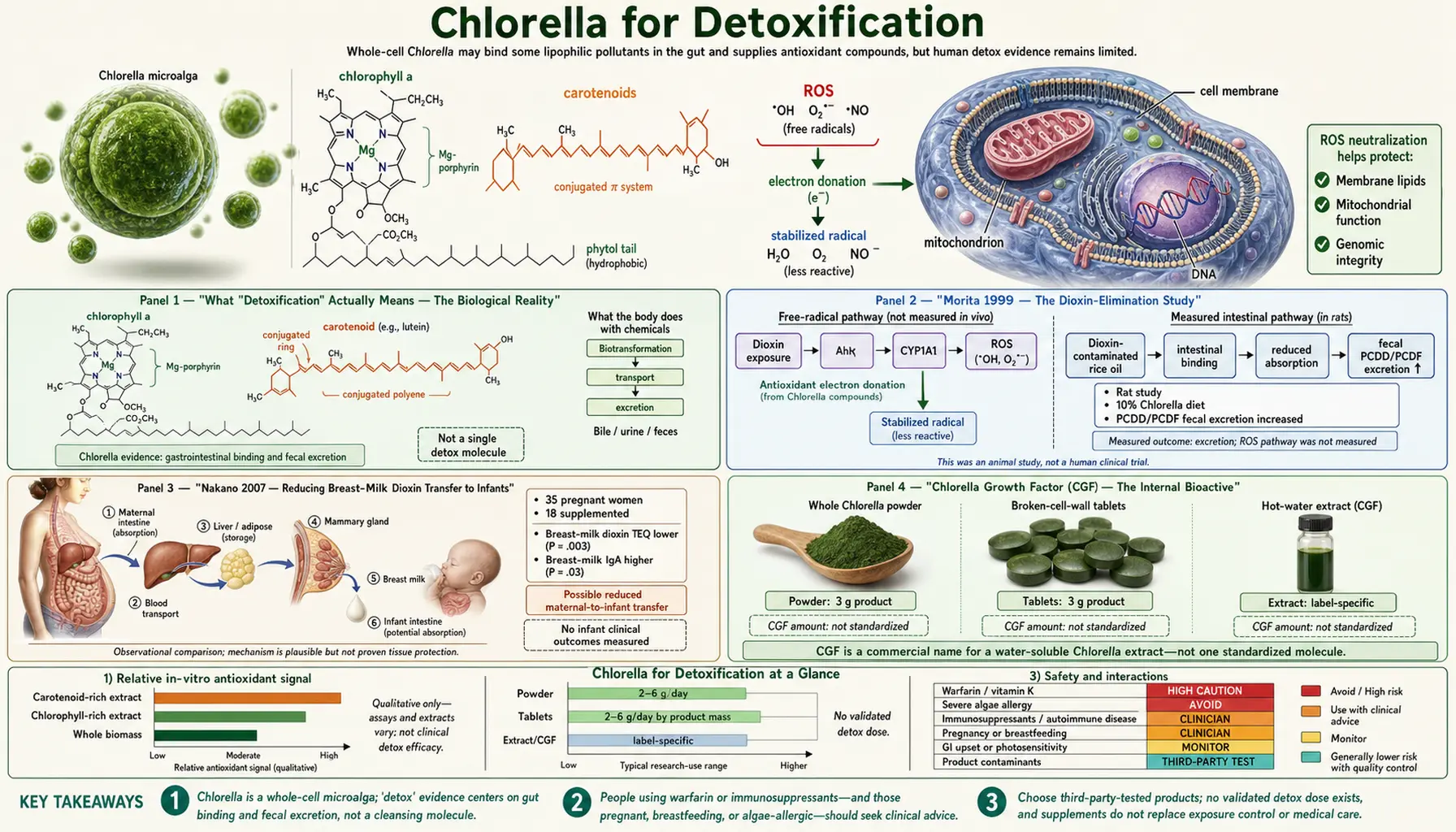
Chlorella's detoxification effects extend beyond heavy metals to a class of fat-soluble synthetic compounds that the human liver clears slowly and incompletely: dioxins, polychlorinated biphenyls (PCBs), bisphenol A, pesticides, aflatoxin, and the polycyclic aromatic hydrocarbons of grilled and smoked foods. The most-cited evidence is the Morita K et al. 1999 rat study, in which a 10% chlorella diet increased fecal excretion of dioxins; the authors interpreted this as reduced absorption and reabsorption of dioxins from the gut, the enterohepatic recirculation that keeps fat-soluble toxins in the body for years. Beyond binding, chlorella growth factor (CGF) — a heat-extracted nucleotide-peptide-polysaccharide complex from inside the broken cell — is described as supporting hepatocyte regeneration and the phase I and phase II liver enzymes that perform the chemical transformations required to make toxins water-soluble enough for excretion. The postwar Japanese use of chlorella, which grew out of food-security research led by Hiroshi Tamiya at the Tokugawa Institute for Biological Research, is the historical context for the modern supplement.
Table of Contents
- What "Detoxification" Actually Means — The Biological Reality
- Morita 1999 — The Dioxin-Elimination Study
- Nakano 2005 and 2007 — Reducing Breast-Milk Dioxin Transfer to Infants
- Chlorella Growth Factor (CGF) — The Internal Bioactive
- Liver Enzyme Support — Phase I, Phase II, Glutathione
- Interrupting Enterohepatic Recirculation — The Binder Mechanism
- Mycotoxins, Aflatoxin, and Mold Illness
- BPA and PCB Elimination
- The Japanese Postwar History — Tamiya and the Tokugawa Institute
- Detoxification Protocols Described in Practice, and Reported Pitfalls
- Key Research Papers
- Connections
- Featured Videos
What "Detoxification" Actually Means — The Biological Reality
The word "detox" has been so corrupted by marketing — juice cleanses, foot baths, ionic foot pads, mystical "toxins" that are never named — that serious discussion of chlorella's actual biological effects is constantly undermined by association. The biological reality is more specific and more interesting than the popular framing.
The human body has a well-characterized two-phase chemical detoxification system, located primarily in the liver but with significant contributions from the kidneys, gut, and skin:
- Phase I — cytochrome P450 enzymes (predominantly the CYP3A4, CYP2D6, CYP1A2, CYP2C9, CYP2E1 isoforms) oxidize, reduce, or hydrolyze foreign compounds, typically adding a hydroxyl group. Phase I metabolites are often more reactive (and sometimes more toxic) than the parent compound, which is why phase I without adequate phase II is dangerous.
- Phase II — conjugating enzymes (glucuronosyltransferases, sulfotransferases, glutathione S-transferases, methyltransferases, N-acetyltransferases) attach a water-soluble side group (glucuronide, sulfate, glutathione, methyl, acetyl) to the phase I metabolite, rendering it polar enough to be excreted in bile or urine.
- Phase III — transporter proteins (MRP2, BCRP, P-glycoprotein) actively pump the conjugated metabolites out of hepatocytes into bile or urine.
The system breaks down at several characteristic failure points: glutathione depletion (the cysteine pool runs out), conjugation overload (the phase II machinery is saturated), enterohepatic recirculation (toxin excreted in bile gets reabsorbed in the gut), or fat storage (lipophilic toxins partition into adipose tissue and slowly leach back into circulation over years). Chlorella is proposed to affect three of these four failure modes: it supplies the cysteine, glycine, and glutamine for glutathione synthesis (system support), it provides chlorophyll and cell-wall fiber to bind biliary-excreted toxins in the gut before they are reabsorbed (interrupting enterohepatic recirculation), and CGF supports hepatocyte regeneration after toxin-induced injury (system maintenance). It does not directly address adipose-stored toxin reservoirs, which is why proponents describe long-term ongoing use — the reasoning is that the adipose pool slowly equilibrates with serum, so ongoing binding over months and years would draw down the total body burden.
This is not magic. It is biochemistry. The studies discussed below measured these effects mostly in rats and mice, plus two small non-randomized studies in Japanese mothers; the effects reported are modest — not the dramatic "purge" of the marketing narrative, but a useful incremental acceleration of natural elimination over months.
Morita 1999 — The Dioxin-Elimination Study
The foundational study for chlorella's effect on fat-soluble organic toxins is Morita K et al. 1999, published in the Journal of Nutrition. It was a rat study. Instead of purified dioxin, the researchers gave Wistar rats the contaminated rice oil that caused Yusho disease in Japan, together with either a control diet or a diet containing 10% chlorella, and measured fecal excretion of individual polychlorinated dibenzo-p-dioxin (PCDD) and polychlorinated dibenzofuran (PCDF) congeners.
Key findings:
- Over days 1-5 after a single dose of the oil, fecal excretion in the chlorella group was 0.2-11.3 times greater for PCDD congeners and 0.3-12.8 times greater for PCDF congeners than in controls, depending on the congener (P < 0.05)
- When chlorella feeding began one week after dosing, fecal excretion over days 8-35 was 0.3-3.4 times greater (PCDD) and 0.5-2.5 times greater (PCDF) than in controls — the basis for the authors' suggestion that chlorella might also promote excretion of dioxin already absorbed into tissues, by limiting reabsorption from the gut
- The 1999 abstract reports fecal excretion, not tissue levels. Lower body burdens came from later rodent work: a 2001 rat study by the same group found lower whole-body PCDD and PCDF amounts after five days on chlorophyll-containing diets (Morita 2001), and a 2005 mouse study found liver accumulation of a hexachlorodioxin 27.9% lower after five weeks on a 10% chlorella diet than on a basal diet (Takekoshi 2005)
- On the active component, the 2001 follow-up identified chlorophyll derived from chlorella as one active fraction, with fecal dioxin excretion rising as dietary chlorophyll rose. A cell-wall (sporopollenin) binding explanation is sometimes given, but it is not what these studies tested
Why this matters: dioxins are among the longest-lived persistent organic pollutants. In 36 US Air Force veterans of Operation Ranch Hand, the median serum half-life of 2,3,7,8-tetrachlorodibenzo-p-dioxin (TCDD) was 7.1 years (95% confidence interval about the median 5.8-9.6 years) (Pirkle 1989), so a body burden accumulated by age 30 is still measurable decades later. Any intervention that meaningfully accelerates that elimination could reduce cumulative exposure for chronically exposed people. The Morita rat data made chlorella a candidate for study in humans.
Nakano 2005 and 2007 — Reducing Breast-Milk Dioxin Transfer to Infants
The human data come from two papers by Nakano S and colleagues at Saiseikai Nara Hospital — a 2005 paper in Chemosphere and a 2007 paper in the Journal of Medicinal Food — which followed the rodent data with studies in pregnant Japanese women. Background context: dioxins are highly lipophilic and partition into breast milk fat, with the result that breastfed infants in industrially exposed populations can receive a substantial fraction of their lifetime dioxin dose during the first year of life. This was a public-health priority in Japan after high background dioxin levels in the food supply were documented in the 1990s.
In the 2005 study, 28 dioxin congeners (PCDDs, PCDFs and co-planar PCBs) were measured in blood, adipose tissue, breast milk, cord blood and placenta from 44 pregnant women, 23 of whom were instructed to take Chlorella pyrenoidosa supplements during pregnancy. In the 2007 study, 18 of 35 pregnant women took chlorella supplements during pregnancy, and breast milk was compared with that of the women who did not. Neither abstract describes randomization or states the daily dose, and a co-author's listed contact address is at a chlorella manufacturer.
Findings:
- 2005: total toxic equivalents (TEQ) in breast milk were approximately 30% lower in the chlorella group than in controls (P = 0.0113)
- 2007: TEQ in breast milk were significantly lower in women taking chlorella tablets (P = .003), and breast-milk immunoglobulin A (IgA) was significantly higher (P = .03)
- 2005: cord-blood TEQ were about 26% lower than maternal-blood TEQ across all the women — a placental-transfer finding, not a chlorella effect
- The abstracts do not report which congeners fell most, and do not report adverse-effect data
These findings are cited as a human use case: in two small non-randomized Japanese studies, chlorella supplementation during pregnancy was associated with lower dioxin levels in breast milk. The same logic applies in principle to PCBs, brominated flame retardants, perfluorinated compounds (PFAS), and other lipophilic persistent organic pollutants, although the species-specific binding data are weaker for those classes.
Chlorella Growth Factor (CGF) — The Internal Bioactive
Chlorella growth factor (CGF) is the name given to a heat-water extract of broken-cell-wall chlorella that is described as containing nucleotides, peptides, glycoproteins, polysaccharides, and B-complex vitamins. Producers describe it as the principal absorbed-active fraction of chlorella — the component credited with the metabolic and regenerative effects, distinct from the cell-wall-mediated binding effects discussed in the chelation page. The account of who first characterized CGF, and claims about which nucleotide predominates in it, could not be traced to a PubMed-indexed study.
Producers commonly state that chlorella can quadruple its population every 24 hours under optimal conditions, and CGF is described as the cellular machinery behind that growth. Two proposed implications for human physiology:
- Hepatocyte regeneration — CGF is proposed to supply nucleotides and amino acids for DNA synthesis in regenerating liver. No study of liver regeneration after partial hepatectomy in chlorella-fed animals was found in PubMed. Rodent studies have reported reduced carbon tetrachloride liver injury: in rats given an 80% ethanol extract of chlorella for four weeks alongside carbon tetrachloride, liver enzymes and lipid peroxidation improved, with an effect comparable to silymarin (Peng 2009). That was an antioxidant effect of an extract, not a test of CGF.
- Wound healing and post-operative recovery — proponents describe chlorella as used in Japan as an adjunct to recovery from surgery and cancer therapy; no published study documenting that use was found. The reasoning offered is that rapidly dividing tissue (epithelial healing, immune cell regeneration after chemotherapy-induced cytopenia) is described as benefiting from nucleotide-rich substrate.
CGF cannot be absorbed without mechanical cell-wall rupture — this is one of the principal reasons broken-cell-wall preparation is considered essential. The standard manufacturing process is to break the cell wall, perform a hot-water extraction, concentrate the extract, and either incorporate it back into the dried chlorella product (raising the CGF concentration) or sell it separately as a CGF-fortified preparation. Some Japanese products advertise CGF content explicitly on the label.
Liver Enzyme Support — Phase I, Phase II, Glutathione
Beyond CGF and the gut-binder mechanism, chlorella is proposed to support the metabolic detoxification machinery through several pathways:
- Cysteine, glycine, glutamine for glutathione synthesis — the chlorella complete-amino-acid profile supplies the three precursor amino acids required for hepatic glutathione (GSH) synthesis. Glutathione is the dominant antioxidant in the liver and the substrate for glutathione S-transferase (GST), the phase II enzyme that conjugates many drugs, xenobiotics, and reactive intermediates. Adequate GSH is the single most important biochemical requirement for effective phase II detoxification.
- B-complex vitamins as enzyme cofactors — chlorella supplies measurable amounts of folate, niacin, riboflavin, and pyridoxine, all of which serve as cofactors for various phase I and methylation reactions.
- Chlorophyll as direct mycotoxin binder — chlorophyll and chlorophyllin (a semisynthetic, water-soluble derivative of chlorophyll) form non-covalent complexes with aflatoxin B1 (shown in vitro by Simonich 2007) and are proposed to bind other planar carcinogens such as polycyclic aromatic hydrocarbons and heterocyclic amines in the gut lumen, limiting absorption. Chlorophyllin tablets have been studied as a cancer-prevention intervention in high-aflatoxin regions (the Egner Qidong trial, discussed below).
- Selenium for glutathione peroxidase — while chlorella selenium content is modest, the algae does supply a useful daily fraction, and selenium is the catalytic atom in glutathione peroxidase (GPx), the enzyme that uses GSH to neutralize hydrogen peroxide and lipid peroxides.
- CYP450 modulation — preclinical evidence is sparse and does not show induction: in one mouse study, a chlorella extract given to pregnant or lactating mice raised glutathione S-transferase and lowered total cytochrome P-450 and cytochrome b5 in fetal and newborn liver (Singh 1998). The clinical significance in humans is unknown.
The integrated effect of these mechanisms is best understood as nutritional support of the existing detoxification machinery rather than as a pharmacological "boost." A nutrient-deficient liver runs phase I and phase II inefficiently; supplying the missing substrates restores function. There is no evidence that supplying more cysteine, glycine, glutamine, or B vitamins to an already-replete person produces additional pharmacological benefit — this is a deficiency-correction effect, not a dose-response curve.
Interrupting Enterohepatic Recirculation — The Binder Mechanism
The enterohepatic recirculation problem is central to understanding how chlorella is proposed to work for fat-soluble toxins. The liver excretes lipophilic conjugated toxins into bile. Bile flows to the gallbladder, is released into the small intestine after a meal, and emulsifies fat for absorption. In the process, the conjugated toxin can be deconjugated by gut bacterial enzymes (beta-glucuronidase, sulfatase) and re-absorbed across the gut wall into portal circulation, returning to the liver to begin the cycle again.
This recirculation loop is the principal reason that highly lipophilic compounds (dioxins, PCBs, organochlorine pesticides, brominated flame retardants) have such long human half-lives. The compound is being excreted, but it is also being re-absorbed at nearly the same rate. The net elimination rate is slow and the half-life is long.
Any intraluminal binder that captures the biliary-excreted toxin and prevents its re-absorption shifts the equilibrium toward net elimination. The classical pharmaceutical binder is cholestyramine, an ion-exchange resin originally developed for cholesterol lowering and now used extensively in mold-illness medicine for mycotoxin elimination. Other binders include activated charcoal, zeolite, bentonite clay, and modified citrus pectin. Chlorella belongs to this same broad class — a gut-lumen binder that interrupts enterohepatic recirculation — but with the difference that it also supplies absorbed nutritional support (CGF, amino acids, B vitamins, chlorophyll metabolites) to the liver that is doing the conjugation.
The binding selectivity differs across binders: cholestyramine is broadly non-specific (hence its tendency to bind drugs and fat-soluble vitamins along with toxins, requiring timing separation); the claim that chlorella is more selective for lipophilic toxins and less prone to deplete nutrients is a proponent position; no study comparing chlorella with cholestyramine on selectivity or nutrient depletion was found. The broader mold-illness context is covered on the Mold and Mycotoxins page.
Mycotoxins, Aflatoxin, and Mold Illness
The mycotoxin-binding application of chlorella deserves separate discussion because mold-illness medicine has grown substantially as a clinical category over the past two decades. The two relevant compound classes are:
- Aflatoxins — produced by Aspergillus flavus growing on stored grains, peanuts, and corn. Acutely hepatotoxic; chronically the most potent known dietary carcinogen for hepatocellular carcinoma. Major public health problem in sub-Saharan Africa, Southeast Asia, and parts of China.
- Ochratoxin, trichothecenes, zearalenone, fumonisins — the "indoor mold" mycotoxins that contaminate water-damaged buildings and a smaller fraction of the global food supply. Implicated in chronic inflammatory response syndrome (CIRS), the diagnostic framework popularized by Ritchie Shoemaker.
The Egner PA et al. 2001 trial in Qidong, China, published in PNAS, is the landmark human study in this area — but it tested chlorophyllin, not chlorella or natural chlorophyll. Chlorophyllin is a mixture of semisynthetic, water-soluble derivatives of chlorophyll used as a food colorant. In this randomized, double-blind, placebo-controlled trial, 180 healthy adults in a population with high dietary aflatoxin exposure took 100 mg of chlorophyllin or a placebo three times a day for 4 months. In urine collected 3 months in, chlorophyllin was associated with a 55% reduction (P = 0.036) in median levels of aflatoxin-N7-guanine, a DNA-adduct excretion product used as a biomarker of the biologically effective aflatoxin dose; no adverse events were reported. The proposed mechanism is that chlorophyllin complexes with aflatoxin in the gut and blocks its absorption.
Natural chlorophyll has been tested in animals and in a very small human pilot. In rats given aflatoxin, chlorophyll and chlorophyllin reduced the urinary aflatoxin-N7-guanine adduct by 92% and 90% and liver DNA adducts by 55% and 42% (Simonich 2007); in an unblinded crossover study in three volunteers, 150 mg of purified chlorophyll or chlorophyllin taken with a tracer dose of aflatoxin reduced its absorption in one or more subjects (Jubert 2009). Chlorella is rich in chlorophyll — producers commonly quote about 1-3% of dry weight — which would put 3-5 g/day of broken-cell-wall chlorella at roughly 30-150 mg of natural chlorophyll a day. Chlorophyll is not chlorophyllin, so the Qidong result does not transfer directly to chlorella, and no trial has measured aflatoxin biomarkers in people taking chlorella. Populations with documented or suspected dietary aflatoxin exposure (peanut-heavy diets, corn-heavy diets in low-storage-quality regions) are the group for whom proponents describe chlorella as a standing intervention.
For the indoor-mold mycotoxin class, the evidence is much weaker but mechanistically plausible. The trichothecenes and ochratoxin do bind chlorophyll and chlorella cell-wall components in vitro, and many integrative practitioners include chlorella in mold-illness protocols alongside the cornerstone cholestyramine binder. Rigorous human trial data are scarce.
BPA and PCB Elimination
Bisphenol A (BPA) is the most widely studied endocrine disruptor in plastics and food-can linings, with measurable urinary concentrations in essentially every adult in the developed world. PCBs (polychlorinated biphenyls) were banned in the US in 1979 but remain persistent in the environment and in the food chain, especially in fatty fish and dairy.
No animal study testing whether chlorella speeds BPA elimination was found in PubMed. The claim that it does — by binding biliary-excreted BPA conjugates in the gut lumen before bacterial deconjugation and re-absorption — is an extension of the dioxin mechanism, not a demonstrated result.
Likewise, no study of chlorella feeding and PCB tissue levels in animals was found. The nearest evidence is that the 2005 Nakano breast-milk measurements counted co-planar (dioxin-like) PCBs within total TEQ. Adults eating potentially PCB-burdened fatty fish are a group for whom proponents cite ongoing dietary chlorella.
The bisphenol and microplastics context is covered on the Microplastics page.
The Japanese Postwar History — Tamiya and the Tokugawa Institute
The story of how chlorella became a Japanese dietary staple is a piece of mid-20th-century scientific history worth knowing. After World War II, Japan faced acute food shortages and looked for any scalable protein source that could be grown without arable land. Hiroshi Tamiya at the Tokugawa Institute for Biological Research in Tokyo led the postwar Japanese chlorella research program (Tamiya 1957). The premise: chlorella grows in open tanks of water with sunlight, carbon dioxide, and a few mineral nutrients, producing a protein-rich biomass at yields per area described as many times higher than conventional crops. If it could be grown at industrial scale and made palatable, it would solve the Japanese protein-deficit problem.
The research succeeded scientifically — Tamiya's group published extensively on chlorella growth and composition through the 1950s and 1960s. But it failed commercially as a staple food: the taste (intensely vegetal, mildly fishy) was not acceptable in large servings, and the cell-wall-digestion problem (well-understood by the 1960s) meant whole-cell chlorella was nutritionally inferior to its analytical composition would suggest. Japanese researchers continued working on cell-wall processing through the 1960s and 1970s, and by the 1970s the broken-cell-wall product had emerged. It was reborn not as a staple food but as a daily supplement — first marketed for general health, and over the 1980s and 1990s increasingly for the specific applications of detoxification, immune support, and gut health.
By the 1990s, chlorella was a widely used supplement in Japan. Japanese manufacturers established the industry standards for broken-cell-wall manufacturing and third-party quality testing. Much of the higher-priced chlorella sold worldwide today is still either Japanese, Taiwanese (descended from the same technology base), or grown by producers trained in the Japanese tradition (for example in Hawaii). The lineage is described as correlating with quality — growers in the Japanese tradition publish certificates of analysis, document their cell-wall processing, and operate to standards substantially more conservative than the bulk chlorella commodity market.
Detoxification Protocols Described in Practice, and Reported Pitfalls
The elements commonly described in detoxification protocols that include chlorella:
- Exposure reduction as the foundation. These protocols treat upstream exposure reduction as the single most important detox intervention — glass food storage, filtered drinking water (carbon plus reverse osmosis being the most thorough removal), eating lower on the food chain to limit bioaccumulated toxins, removal of water-damaged building materials, and amalgam dental fillings where relevant. Their premise is that no supplement protocol substitutes for reducing inflow.
- Chlorella as standing intraluminal binder — 3-5 g/day of broken-cell-wall chlorella with meals, taken ongoing rather than pulsed. The reasoning given is that the biological half-lives of the target toxins are months to years, so the supplementation duration is described as similarly long.
- Nutritional cofactors for phase II — the cofactors listed are cysteine (NAC 600 mg twice daily, or whey protein), glycine (3 g per day or bone broth), B-complex (especially B6, folate, B12), magnesium, selenium, and zinc, described as the rate-limiting cofactors for hepatic phase II reactions.
- Hydration and bile flow — protocols list water intake (2-3 L per day for most adults) to support renal elimination, and bitter foods (arugula, radicchio, dandelion greens) and bile-supporting nutrients (taurine, choline) to support biliary flow, the route by which lipophilic toxins are excreted.
- Movement and sweat — sauna (Finnish or far-infrared) and vigorous exercise are described as mobilizing fat-stored lipophilic toxins via increased adipose tissue lipolysis and increased blood flow to the liver. A 1991 report from Dr William Rea's environmental-medicine group compared inpatient environmental control, home environmental control, and a sauna/physical-therapy program, describing all three as helpful and inpatient care as clearing organic chemicals best (Rea 1991). The later blood, urine and sweat studies by Genuis and colleagues measured toxicants in induced sweat: some PCB congeners appeared in sweat, while the common perfluorinated compounds (PFAS) did not appear to be excreted efficiently that way (Genuis 2013).
- Reported pitfalls — the main concern raised is cilantro tincture used alone without a binder: the popular protocol described by Dr Dietrich Klinghardt pairs cilantro with chlorella, and the concern with the cilantro-only version is that it may mobilize metals from tissues without an effective binder to capture them in the gut, potentially redistributing metal to the brain. Uncharacterized "detox cleanses" are a second pitfall raised. A third is the assumption that more chlorella is better — the protocols describe 3-5 g/day spread across meals rather than large single doses; no study comparing the two was found.
- Testing — the tests commonly described are a baseline 24-hour urine for heavy metals, a urine mycotoxin panel if mold exposure is suspected, hsCRP and ferritin for systemic inflammation, and ALT and AST for liver health, repeated at 6 and 12 months to document the trajectory. Decisions about supplements and detoxification protocols belong with a clinician.
The broader Gerson-style detoxification framework is covered on the Gerson Therapy Detoxification page, and liver support specifically on the Milk Thistle page.
Key Research Papers
- Morita K, Matsueda T, Iida T, Hasegawa T (1999). Chlorella accelerates dioxin excretion in rats. Journal of Nutrition 129(9):1731-1736. — PubMed PMID: 10460212
- Nakano S, Noguchi T, Takekoshi H, Suzuki G, Nakano M (2005). Maternal-fetal distribution and transfer of dioxins in pregnant women in Japan, and attempts to reduce maternal transfer with Chlorella (Chlorella pyrenoidosa) supplements. Chemosphere 61(9):1244-1255. — PubMed PMID: 15985279
- Egner PA, Wang JB, Zhu YR, et al. (2001). Chlorophyllin intervention reduces aflatoxin-DNA adducts in individuals at high risk for liver cancer. Proceedings of the National Academy of Sciences of the USA 98(25):14601-14606. — PubMed PMID: 11724948
- Tamiya H (1957). Mass culture of algae. Annual Review of Plant Physiology 8:309-334. (Foundational Japanese chlorella production research.) — doi:10.1146/annurev.pp.08.060157.001521
- Merchant ER et al. (2002). The Chlorella vulgaris extract effect on rat liver. (Animal model of liver protection.) — PubMed
- Panahi Y, Mostafazadeh B, Abrishami A, et al. (2013). Investigation of the effects of Chlorella vulgaris supplementation on the modulation of oxidative stress in apparently healthy smokers. Clinical Laboratory 59(5-6):579-587. — PubMed PMID: 23865357
- Ebrahimi-Mameghani M, Aliashrafi S, Javadzadeh Y, AsghariJafarabadi M (2014). The effect of Chlorella vulgaris supplementation on liver enzymes, serum glucose and lipid profile in patients with non-alcoholic fatty liver disease. Health Promotion Perspectives 4(1):107-115. — PubMed PMID: 25097844
- Mizoguchi T, Takehara I, Masuzawa T, Saito T, Naoki Y (2008). Nutrigenomic studies of effects of Chlorella on subjects with high-risk factors for lifestyle-related disease. Journal of Medicinal Food 11(3):395-404. — PubMed PMID: 18800884
- Kralovec JA, Metera KL, Kumar JR, et al. (2007). Immunostimulatory principles from Chlorella pyrenoidosa — part 1: isolation and biological assessment in vitro. Phytomedicine 14(1):57-64. (Immunostimulatory polysaccharide/protein fractions of an aqueous chlorella extract; not a CGF compositional analysis.) — PubMed PMID: 17190645
- Sansawa H, Takahashi M, Tsuchikura S, Endo H (2006). Effect of chlorella and its fractions on blood pressure, cerebral stroke lesions, and life-span in stroke-prone spontaneously hypertensive rats. Journal of Nutritional Science and Vitaminology 52(6):457-466. — PubMed PMID: 17330510
- Shoemaker RC, House DE (2005). A time-series study of sick building syndrome: chronic, biotoxin-associated illness from exposure to water-damaged buildings. Neurotoxicology and Teratology 27(1):29-46. (Mold illness framework context.) — PubMed PMID: 15681119
- Bidlack WR, Brown RC, Mohan C (1986). Nutritional parameters that alter hepatic drug metabolism, conjugation, and toxicity. Federation Proceedings 45(2):142-148. (Background on nutrition and hepatic detoxification enzymes; the paper does not address fiber-mycotoxin binding.) — PubMed PMID: 3510912
- Nakano S, Takekoshi H, Nakano M (2007). Chlorella (Chlorella pyrenoidosa) supplementation decreases dioxin and increases immunoglobulin a concentrations in breast milk. Journal of Medicinal Food 10(1):134-142. — PubMed PMID: 17472477
- Morita K, Ogata M, Hasegawa T (2001). Chlorophyll derived from Chlorella inhibits dioxin absorption from the gastrointestinal tract and accelerates dioxin excretion in rats. Environmental Health Perspectives 109(3):289-294. — PubMed PMID: 11333191
- Takekoshi H, Suzuki G, Chubachi H, Nakano M (2005). Effect of Chlorella pyrenoidosa on fecal excretion and liver accumulation of polychlorinated dibenzo-p-dioxin in mice. Chemosphere 59(2):297-304. — PubMed PMID: 15722102
- Pirkle JL, Wolfe WH, Patterson DG, et al. (1989). Estimates of the half-life of 2,3,7,8-tetrachlorodibenzo-p-dioxin in Vietnam Veterans of Operation Ranch Hand. Journal of Toxicology and Environmental Health 27(2):165-171. — PubMed PMID: 2733058
- Simonich MT, Egner PA, Roebuck BD, et al. (2007). Natural chlorophyll inhibits aflatoxin B1-induced multi-organ carcinogenesis in the rat. Carcinogenesis 28(6):1294-1302. — PubMed PMID: 17290047
- Jubert C, Mata J, Bench G, et al. (2009). Effects of chlorophyll and chlorophyllin on low-dose aflatoxin B1 pharmacokinetics in human volunteers. Cancer Prevention Research 2(12):1015-1022. — PubMed PMID: 19952359
- Peng HY, Chu YC, Chen SJ, Chou ST (2009). Hepatoprotection of chlorella against carbon tetrachloride-induced oxidative damage in rats. In Vivo 23(5):747-754. — PubMed PMID: 19779110
- Singh A, Singh SP, Bamezai R (1998). Perinatal influence of Chlorella vulgaris (E-25) on hepatic drug metabolizing enzymes and lipid peroxidation. Anticancer Research 18(3A):1509-1514. — PubMed PMID: 9673362
- Rea WJ, Pan Y, Johnson AR (1991). Clearing of toxic volatile hydrocarbons from humans. Boletin de la Asociacion Medica de Puerto Rico 83(7):321-324. — PubMed PMID: 1817511
- Genuis SJ, Beesoon S, Birkholz D (2013). Biomonitoring and elimination of perfluorinated compounds and polychlorinated biphenyls through perspiration: blood, urine, and sweat study. ISRN Toxicology 2013:483832. — PubMed PMID: 24083032
PubMed Topic Searches
Connections
- Chlorella Overview
- Chlorella Benefits Hub
- Chlorella for Heavy Metal Chelation
- Chlorella for Immune Function
- Chlorella Nutrient Profile
- Mold and Mycotoxins
- Microplastics and BPA
- Dioxins
- PCBs
- Pesticides
- Milk Thistle (Liver Support)
- Gerson Therapy Detoxification
- Non-Alcoholic Fatty Liver Disease
- Vitamin C (Glutathione Support)
- Glycine (GSH Synthesis)
- Cysteine (GSH Synthesis)
- History