Chlorella for Immune Function
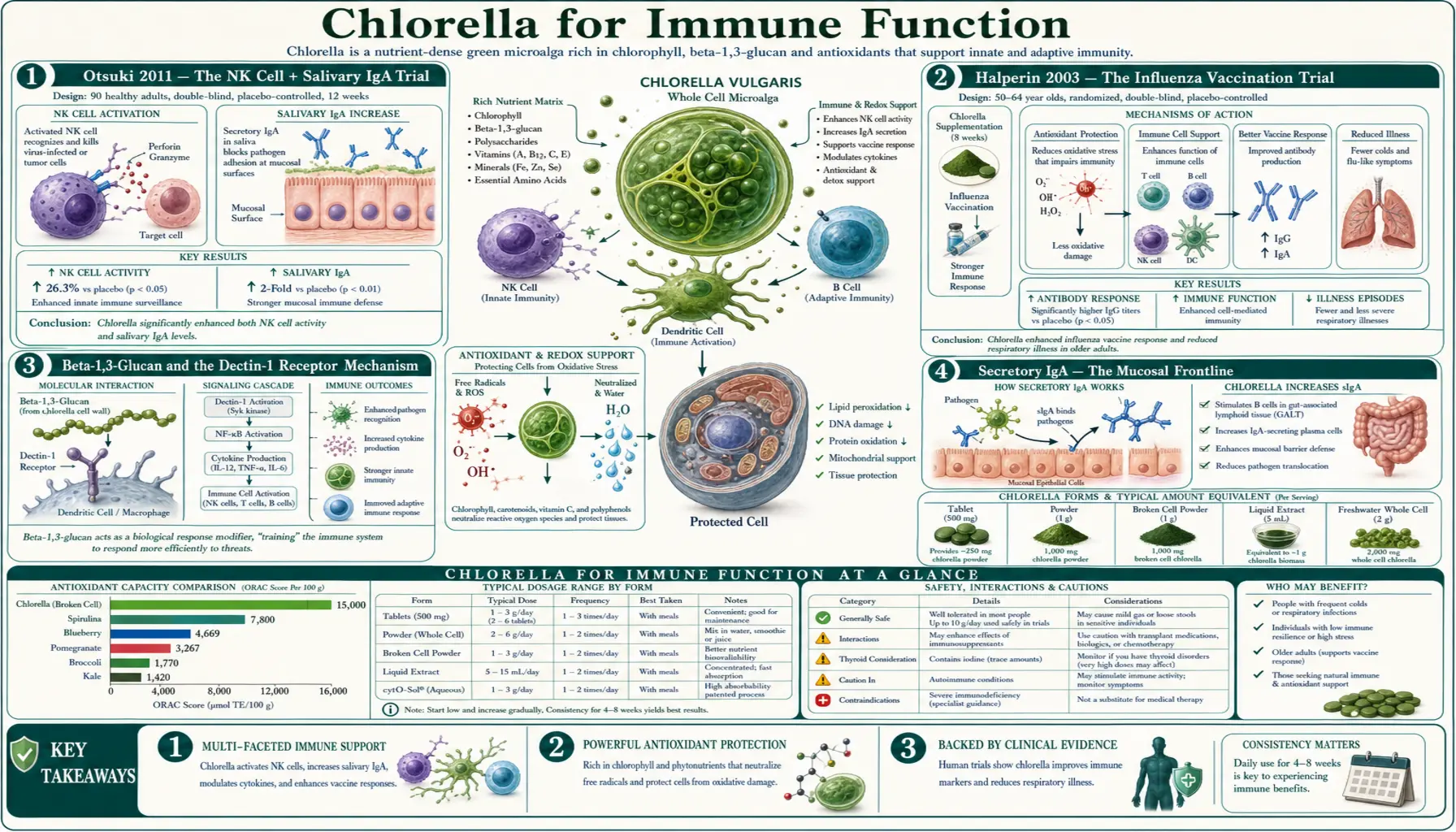
Chlorella's effects on the human immune system have been tested in a handful of small randomized trials. In the Otsuki T et al. 2011 randomized cross-over trial, 4 weeks of a chlorella-derived multicomponent supplement increased salivary secretory IgA in 15 healthy men — the principal mucosal antibody class that defends the gut, respiratory tree, and oral cavity from incoming pathogens. A Korean 8-week trial (Kwak JH et al. 2012) reported increased NK cell activity. The Halperin SA et al. 2003 trial found no effect on the antibody response to influenza vaccination in adults aged 50 and over as a whole, with higher antibody titres only in a 50-55-year-old subgroup taking the higher dose. The proposed mechanism is the beta-1,3-glucan content of the cell wall, which binds the dectin-1 receptor on macrophages and dendritic cells and triggers innate immune activation, including increased NK cell cytotoxicity. Unlike Vitamin A's immune effect (which is large in deficiency and absent in repletion), these chlorella trials were run in healthy adults rather than deficient ones — the beta-glucan immune-activator mechanism is the same one proposed for medicinal mushrooms (reishi, maitake, shiitake, turkey tail). No dose-response relationship has been established in human trials.
Table of Contents
- Otsuki 2011 — The Salivary IgA Trial
- Halperin 2003 — The Influenza Vaccination Trial
- Beta-1,3-Glucan and the Dectin-1 Receptor Mechanism
- Secretory IgA — The Mucosal Frontline
- Natural Killer Cell Activation
- Macrophage and Dendritic Cell Activation
- Vaccination Response and the Older-Adult Setting
- Upper Respiratory Infection Prevention
- Cancer Immunology and the Japanese Adjunct-Therapy Tradition
- Cautions, Autoimmunity, and Drug Interactions
- Key Research Papers
- Connections
- Featured Videos
Otsuki 2011 — The Salivary IgA Trial
Otsuki T et al. (2011), published in Nutrition Journal, tested a chlorella-derived multicomponent supplement against mucosal immunity in a blind, randomized cross-over design in 15 Japanese men. Each took 30 chlorella tablets a day for 4 weeks and 30 placebo tablets a day for 4 weeks, with a 12-week washout between the two periods. Salivary secretory IgA (sIgA) was measured by ELISA before and after each period.
Key findings:
- Salivary sIgA concentration rose significantly after the 4-week chlorella period compared with baseline (P < 0.01); it did not change after the placebo period (P = 0.38)
- The sIgA secretion rate likewise rose after chlorella (P < 0.01) but not after placebo (P = 0.36); saliva flow rate showed no trial-by-period interaction
- Compliance was about 95-97% in both periods
- NK cell activity was not measured in this trial. The NK cell evidence comes from a separate Korean randomized trial (Kwak JH et al. 2012: 5 g/day of chlorella, n=23, or placebo, n=28, for 8 weeks), which reported a significantly larger rise in NK cell activity and in serum interferon-gamma and interleukin-1-beta with chlorella than with placebo
The cross-over design means each subject serves as their own control, which reduces between-subject variability. The trial was small (15 men), its abstract reports each period against its own baseline rather than a direct chlorella-versus-placebo comparison, and it measured a mucosal marker rather than infections. The participants were healthy, so the rise in sIgA was above a normal baseline rather than the correction of a deficiency. A follow-up by the same group in 10 female kendo athletes (Otsuki T et al. 2012) found that salivary sIgA secretion fell during a training camp while they took placebo but not while they took chlorella, started 4 weeks before the camp.
Halperin 2003 — The Influenza Vaccination Trial
The Halperin SA et al. (2003) trial published in the Canadian Medical Association Journal tested whether a supplement derived from Chlorella pyrenoidosa could enhance the antibody response to influenza vaccination. The investigators randomized 124 healthy adults aged 50 or older to 200 mg or 400 mg of the supplement or to placebo, once daily for 28 days. A trivalent inactivated influenza vaccine was given on day 21, and hemagglutination-inhibition (HI) antibody titers were measured before and 7 and 21 days after vaccination.
Overall, the supplement did not increase the antibody response: the proportion of participants reaching at least a 4-fold antibody rise did not differ between the 200-mg, 400-mg and placebo groups for any of the three vaccine strains. In a subgroup analysis, participants aged 50-55 who took 400 mg had significantly higher geometric mean titers against influenza A/New Caledonia 21 days after vaccination (p = 0.047) and against B/Yamanashi 7 days after vaccination (p = 0.034), with a nonsignificant trend for A/Panama. The authors concluded that the supplement had no effect on the antibody response in the overall study population, with an increase among participants aged 50-55, and called for further studies.
The subgroup signal sat in the youngest age band of the trial, not among its older participants, so the trial does not show a benefit in age-impaired immunity, and a subgroup result of this kind is a lead for further study rather than a finding. A PubMed search did not turn up a later trial of chlorella and vaccine response in older Korean or Japanese adults; the Korean trial that followed (Kwak JH et al. 2012) measured NK cell activity and cytokines in healthy adults, not vaccine response.
On safety, 117 of the 124 participants (94%) completed the study, and adverse events were reported at similar rates with the supplement and with placebo, except fatigue, which was reported more often with 200 mg (44%) than with 400 mg (20%) or placebo (19%).
Beta-1,3-Glucan and the Dectin-1 Receptor Mechanism
The molecular mechanism for most of chlorella's immune effects is the beta-1,3-glucan content of the cell wall. Beta-1,3-glucan is a polysaccharide composed of glucose units linked by beta-1,3 glycosidic bonds with beta-1,6 branches — the same molecule found in baker's yeast, oats, medicinal mushrooms, and several algae. Beta-glucans are recognized by mammalian immune cells as a pathogen-associated molecular pattern (PAMP) — the cell wall of fungi is rich in beta-glucan, so the mammalian immune system evolved to recognize this molecular signature as a fungal infection signal.
The principal receptor for beta-glucans on mammalian immune cells is dectin-1, a C-type lectin receptor expressed on macrophages, dendritic cells, neutrophils, and some lymphocyte populations. Beta-glucan binding to dectin-1 triggers a signaling cascade through Syk kinase and CARD9, activating NF-kappa-B and producing pro-inflammatory cytokines (TNF-alpha, IL-6, IL-23), increased phagocytic activity, and enhanced antigen presentation to T cells. Dectin-1 signaling also drives Th17 polarization through IL-23, contributing to mucosal defense.
The proposed reasons chlorella beta-glucan is active:
- The chlorella cell-wall beta-glucan has the appropriate molecular weight and branching pattern to engage dectin-1 effectively
- Broken-cell-wall processing releases the beta-glucan in a form accessible to gut-associated immune tissue
- Beta-glucan does not need to be absorbed into circulation to have systemic effect — gut-associated macrophages and dendritic cells sample the gut lumen continuously and transmit immune signals throughout the body via cytokine release and cellular trafficking
- No dose-response relationship has been established in human trials; the doses tested range from 200-400 mg/day of a chlorella-derived extract (Halperin 2003) to 5 g/day of chlorella tablets (Kwak 2012)
The same beta-glucan / dectin-1 mechanism explains the immune effects of medicinal mushrooms, oat fiber, and baker's yeast extract. Chlorella is one of the few non-fungal natural sources of immunologically active beta-glucan, which may explain its complementary role alongside mushroom supplements in integrative immune-support protocols.
Secretory IgA — The Mucosal Frontline
Secretory IgA (sIgA) is the most abundant antibody class in the human body when measured by mass, despite being far less prominent in serum than IgG. The reason: sIgA is the dominant antibody secreted across mucosal surfaces — the gut, the respiratory tree from nasal mucosa to alveoli, the salivary glands, the lacrimal glands, the breast milk, and the genitourinary tract. The collective mucosal surface area is enormous (roughly 200 square meters for the gut alone), and sIgA continuously coats it.
The protective mechanisms of sIgA:
- Pathogen neutralization at the surface — sIgA binds bacterial and viral pathogens before they attach to epithelial cells, preventing infection establishment
- Toxin neutralization — sIgA binds bacterial toxins (cholera toxin, tetanus toxin, etc.) and food allergens, preventing systemic absorption
- Immune exclusion — sIgA-coated pathogens are physically excluded from the mucus layer and flushed away by ciliary or peristaltic action
- Non-inflammatory clearance — unlike IgG, sIgA does not activate complement or recruit neutrophils, so pathogen neutralization occurs without inflammation — appropriate for the chronically pathogen-rich environment of the gut and airways
Low sIgA is associated with increased frequency of upper respiratory infections, gastrointestinal infections, dental caries, and (in some studies) atopic disease. Selective IgA deficiency — the most common primary immunodeficiency — is often found by chance in people with no symptoms, but some patients present with recurrent respiratory and gastrointestinal infections, allergic disorders, and autoimmune manifestations (Yel L 2010).
The Otsuki finding that chlorella increased salivary sIgA in healthy men is therefore of interest. The increase is not in serum IgA (a less protective compartment) but specifically in the secretory mucosal antibody class. This is consistent with the beta-glucan / dectin-1 mechanism — dectin-1 activation in gut-associated lymphoid tissue promotes B-cell class switching to IgA via TGF-beta and IL-21 co-signals.
The related role of Vitamin A in IgA class switching is covered on the Vitamin A Immune Function page. The two interventions act through different upstream mechanisms (chlorella via beta-glucan / dectin-1, Vitamin A via retinoic acid / RAR/RXR) but converge on the same downstream effect of enhanced mucosal IgA production.
Natural Killer Cell Activation
Natural killer (NK) cells are the principal innate lymphocyte population responsible for surveillance against virally infected and malignantly transformed cells. Unlike T cells, NK cells do not require prior sensitization to a specific antigen — they recognize generic "stress" signals on target cells (loss of self MHC class I, expression of stress-induced ligands) and kill via perforin and granzyme release.
NK cell activity declines with age (NK senescence) and with chronic stress, chronic illness, and certain pharmaceuticals. Low NK cell activity is associated with increased viral reactivation (especially herpesviruses: EBV, CMV, HSV, VZV) and possibly with increased cancer incidence, although the latter association is debated.
The human evidence for chlorella and NK cells comes from one randomized, double-blind, placebo-controlled trial (Kwak 2012, 51 healthy Korean adults, 5 g/day or placebo for 8 weeks):
- NK cell cytotoxicity rose significantly in the chlorella group compared with placebo
- Serum interferon-gamma and IL-1β rose significantly; IL-12 tended to rise (p < 0.1)
- The trial did not report NK cell counts, granzyme B, or perforin
- The proposed mechanism — beta-glucan engagement of myeloid cells (dectin-1) and IL-12-driven NK activation — comes from laboratory work and has not been tested directly in people taking chlorella
No trial has tested chlorella in older adults with low NK activity, in people with recurrent herpesvirus reactivation, or in cancer care. The general claim that chlorella "boosts immunity" rests, in human studies, on two narrower findings: higher NK cytotoxicity over 8 weeks in healthy adults (Kwak 2012) and higher salivary sIgA over 4 weeks in young men (Otsuki 2011).
Macrophage and Dendritic Cell Activation
The upstream effect of chlorella beta-glucan is on the myeloid innate immune cells: macrophages and dendritic cells. These cells:
- Phagocytose chlorella-derived particulate beta-glucan in the gut and in gut-associated lymphoid tissue (Peyer's patches, mesenteric lymph nodes)
- Engage dectin-1, triggering Syk / CARD9 signaling and NF-kB activation
- Produce pro-inflammatory and immunomodulatory cytokines (TNF-alpha, IL-6, IL-12, IL-23)
- Up-regulate MHC class II and costimulatory molecules (CD80, CD86), increasing antigen-presentation efficiency to T cells
- Drive maturation of dendritic cells from immature antigen-sampling cells into mature antigen-presenting cells that migrate to lymph nodes
- Promote Th17 polarization via IL-23 production, supporting mucosal defense
- Activate macrophage phagocytic function via classical (M1) macrophage activation
The cascade of effects from gut dendritic cell activation translates to systemic immune enhancement: better antigen presentation means better vaccine response; better macrophage phagocytosis means better clearance of bacterial pathogens; better Th17 polarization means better mucosal defense against fungal and extracellular bacterial pathogens; and the cytokine production drives downstream NK cell and Th1 activation as discussed above.
An important nuance: dectin-1 activation drives inflammation as well as immunity. In patients with autoimmune or autoinflammatory conditions where chronic immune activation is already pathological, chlorella could in principle worsen rather than improve clinical status. The clinical observation is that chlorella is generally well tolerated in autoimmune patients; the theoretical concern applies most to people with very active disease.
Vaccination Response and the Older-Adult Setting
Immunosenescence — the age-related decline in immune function — is one of the principal reasons vaccine efficacy drops with age. Antibody responses to the influenza vaccine, for example, are generally weaker in older adults than in younger ones.
Several mechanisms drive immunosenescence:
- Thymic involution reduces production of new naive T cells
- Accumulation of senescent T cells (CD28-, CD57+) that respond poorly to new antigens
- Reduced B-cell class-switch efficiency and affinity maturation
- Reduced dendritic cell function and antigen-presentation efficiency
- Chronic low-grade inflammation ("inflammaging") that interferes with the kinetics of acute immune response
In the one published chlorella vaccine trial (Halperin 2003), the supplement did not improve the antibody response overall in adults aged 50 and over; the only signal was in the 50-55-year-old subgroup on the higher dose — the youngest participants rather than the oldest. No later trial testing chlorella against vaccine response in older adults was found. In that trial the supplement was taken for 28 days, with the vaccine given on day 21.
The broader question of whether routine chlorella supplementation benefits older adults — in the absence of a specific vaccine event — depends on baseline immune status, recurrent infection frequency, and other dietary considerations. There is no rigorous evidence for or against this practice.
Upper Respiratory Infection Prevention
A widely marketed claim for chlorella in the immune category is reduction of upper respiratory infection (URI) frequency. The supporting evidence is indirect:
- No randomized trial measuring the frequency of colds or other upper respiratory infections with chlorella was found in PubMed; the human trials measure markers (salivary sIgA, NK cell activity, antibody titers) rather than infections
- In 10 female kendo athletes (Otsuki T et al. 2012), salivary sIgA secretion fell during a training camp on placebo but not on chlorella; illness was not an outcome of the study
- The URI case for chlorella is extrapolated from these markers and from the broader beta-glucan literature, including baker's yeast beta-glucan
- The mechanism is mucosal sIgA enhancement (reducing pathogen establishment) plus NK cell enhancement (reducing viral replication if pathogens do establish)
Integrative-medicine protocols for URI prevention typically describe broken-cell-wall chlorella as one part of a combined approach that also includes vitamin D repletion (a commonly cited target is 40-60 ng/mL 25(OH)D), zinc lozenges at first symptom, adequate sleep, and stress management. No controlled trial has shown an effect of chlorella on URI rates; in these protocols it is described as an addition to other measures.
Immune support more broadly is covered on the Immune Boosting page. The medicinal mushroom family (reishi, maitake, shiitake, turkey tail) delivers beta-glucan through the same dectin-1 mechanism.
Cancer Immunology and the Japanese Adjunct-Therapy Tradition
The Japanese clinical research tradition has long included chlorella as part of integrative oncology, paralleling the much more extensively documented use of mushroom-derived beta-glucans (PSK, polysaccharide-K, from Trametes versicolor; lentinan from Lentinula edodes) as adjuncts to conventional cancer therapy. The biological rationale is the same: beta-glucan activation of innate immunity (NK cells, dendritic cells, macrophages) may enhance immune surveillance against residual or recurrent tumor cells after primary treatment.
The chlorella evidence base in oncology is weaker than the mushroom evidence base — smaller trials, less rigorous methodology, fewer formal regulatory endpoints — but is suggestive in two main settings:
- Chemotherapy supportive care — reducing chemotherapy-induced mucositis, supporting bone marrow recovery from cytopenia, and reducing the rate of opportunistic infection during cytopenic windows. The CGF (Chlorella Growth Factor) nucleotide content is the proposed mechanism for bone marrow support, and the mucosal IgA enhancement is the proposed mechanism for mucositis reduction.
- Post-curative-treatment survivorship — ongoing immune support during the survivorship period when surveillance for recurrence is the priority. This is the most common use case in Japanese integrative oncology practice.
It is important to be clear about what the evidence does not support: chlorella is not a cancer treatment, has not been shown to shrink tumors directly, and the research does not support it as a substitute for evidence-based oncological care. The role is strictly adjunctive and supportive.
Cautions, Autoimmunity, and Drug Interactions
- Autoimmune disease — a theoretical concern — chlorella beta-glucan is immune-activating, which is generally desirable but could theoretically worsen autoimmune conditions where chronic immune activation is pathological. The clinical observation is that most autoimmune patients tolerate chlorella well, but those with active flares of rheumatoid arthritis, multiple sclerosis, lupus, Hashimoto's, Graves', or psoriasis are the group for whom this theoretical concern matters most.
- Immunosuppressive medication interaction — patients on tacrolimus, cyclosporine, mycophenolate, methotrexate, or biological immunosuppressants for organ transplant or autoimmune disease are the group this concerns; decisions about supplements alongside these drugs belong with the transplant or rheumatology team. The immune-stimulating effect could theoretically reduce efficacy of immunosuppression.
- Warfarin / vitamin K — chlorella is chlorophyll-rich and therefore vitamin-K-rich. The research raises a concern for people taking warfarin, whose INR can shift when chlorella is started or stopped; the clinical approaches described are not using chlorella, or a stable daily dose with an INR recheck after it is introduced.
- Pregnancy — in Nakano S et al. (2010), 32 Japanese pregnant women took 6 g/day of chlorella from weeks 12-18 of gestation until delivery and had lower rates of anemia, proteinuria and edema than 38 controls; the abstract reports no formal safety evaluation, so the study does not establish safety in pregnancy. A related study (Nakano S et al. 2007) found higher IgA concentrations in the breast milk of women who took chlorella during pregnancy.
- Allergic reactions — chlorella hypersensitivity is rare but documented. Symptoms include GI upset, urticaria, and rarely anaphylaxis. People with known mold allergy may have marginally elevated cross-reactivity risk.
- Product quality and dose — the immune effects described depend on intact functional beta-glucan content, which depends on broken-cell-wall manufacturing and adequate quality control; products vary in this respect, as they do for the chelation use case. The trials described above used broken-cell-wall preparations.
- Concurrent infection — during an acute febrile infection, the immune system is already maximally activated. Adding chlorella during the illness is unlikely to provide additional benefit and may worsen GI symptoms. Its proposed role is prevention rather than acute treatment.
Key Research Papers
- Otsuki T et al. (2011). Salivary secretory immunoglobulin A secretion increases after 4-weeks ingestion of chlorella-derived multicomponent supplement in humans: a randomized cross over study. Nutrition Journal. — PubMed
- Halperin SA et al. (2003). Safety and immunoenhancing effect of a Chlorella-derived dietary supplement in healthy adults undergoing influenza vaccination: randomized, double-blind, placebo-controlled trial. CMAJ. — PubMed PMID: 12874157
- Kwak JH et al. (2012). Beneficial immunostimulatory effect of short-term Chlorella supplementation: enhancement of natural killer cell activity and early inflammatory response (randomized, double-blinded, placebo-controlled trial). Nutrition Journal. — PubMed
- Brown GD, Gordon S (2001). Immune recognition: a new receptor for beta-glucans. Nature. (Foundational dectin-1 paper.) — PubMed
- Goodridge HS et al. (2009). Beta-glucan recognition by the innate immune system. Immunological Reviews. — PubMed
- Tanaka K et al. (1986). Augmentation of host defense by a unicellular green alga, Chlorella vulgaris, to Escherichia coli infection. Infection and Immunity. (Classical Japanese murine infection model.) — PubMed
- Tanaka K et al. (1998). Oral administration of a unicellular green algae, Chlorella vulgaris, prevents stress-induced ulcer. Planta Medica. — PubMed
- Queiroz ML et al. (2008). Effects of Chlorella vulgaris extract on cytokines production in Listeria monocytogenes infected mice. Immunopharmacology and Immunotoxicology. — PubMed
- Justo GZ et al. (2001). Chlorella vulgaris extract reduces production of nitric oxide in lipopolysaccharide stimulated mouse macrophages. Immunopharmacology and Immunotoxicology. — PubMed
- Pawlikowska-Pawlega B et al. (2014). Chlorella vulgaris polysaccharide and immune response — review. — PubMed
- Suzuki I et al. (1990). Antitumor and immunological activities of lentinan in relation to immunological adjuvant effect. Cancer Detection and Prevention. (Lentinan/mushroom beta-glucan context for chlorella beta-glucan.) — PubMed
- Akramiene D et al. (2007). Effects of beta-glucans on the immune system. Medicina (Kaunas). (Beta-glucan immunology review.) — PubMed
- Otsuki T, Shimizu K, Iemitsu M, Kono I (2012). Chlorella intake attenuates reduced salivary SIgA secretion in kendo training camp participants. Nutrition Journal 11:103. — PubMed PMID: 23227811
- Nakano S, Takekoshi H, Nakano M (2010). Chlorella pyrenoidosa supplementation reduces the risk of anemia, proteinuria and edema in pregnant women. Plant Foods for Human Nutrition 65(1):25-30. — PubMed PMID: 20013055
- Nakano S, Takekoshi H, Nakano M (2007). Chlorella (Chlorella pyrenoidosa) supplementation decreases dioxin and increases immunoglobulin A concentrations in breast milk. Journal of Medicinal Food 10(1):134-42. — PubMed PMID: 17472477
- Yel L (2010). Selective IgA deficiency. Journal of Clinical Immunology 30(1):10-6. — PubMed PMID: 20101521