Astaxanthin: History and Discovery
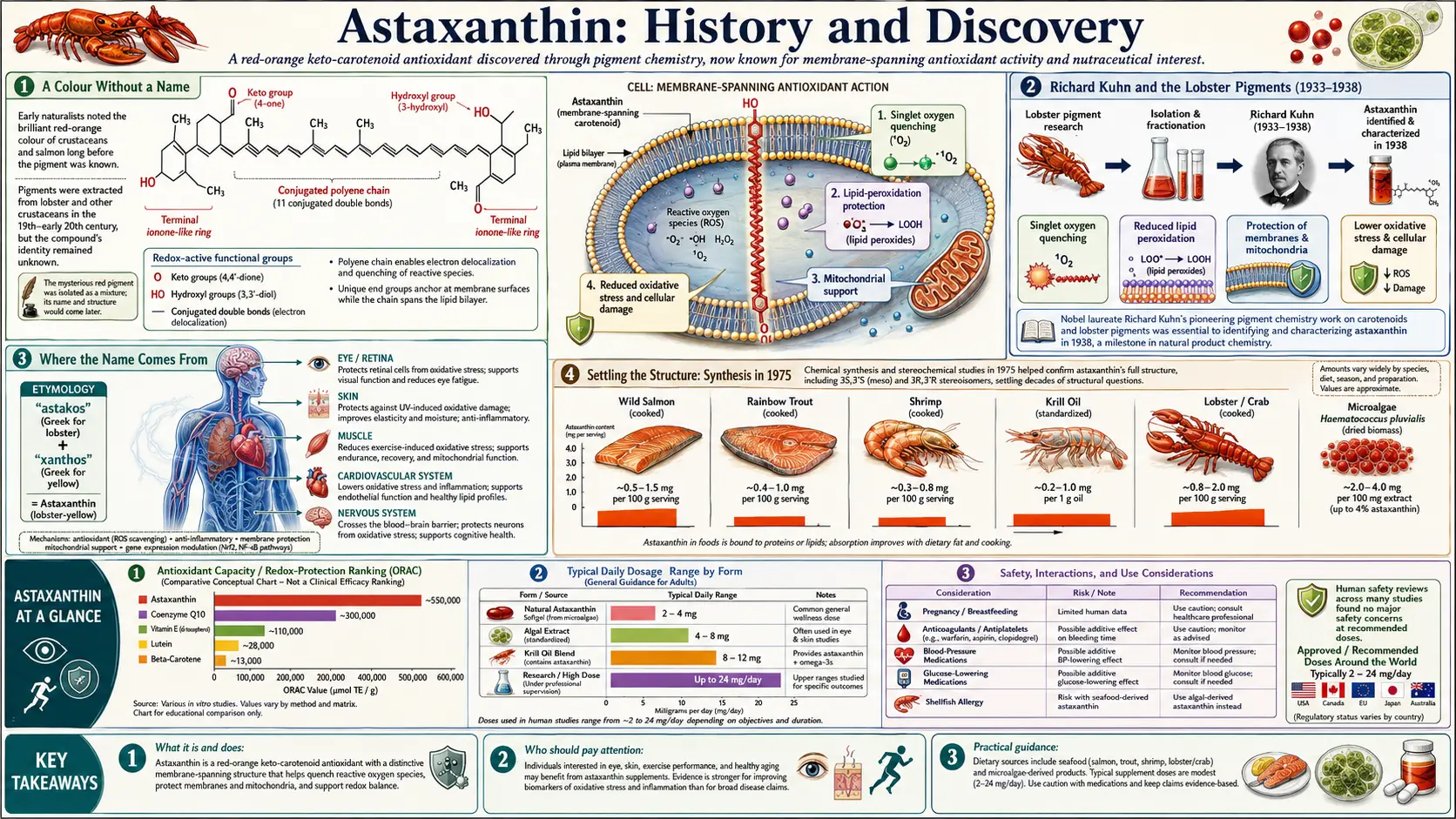
Astaxanthin is the deep red-orange pigment that colours salmon, trout, shrimp, lobster, krill, and the feathers of flamingos. People had eaten it for as long as they had eaten seafood, but nobody knew it was a single, definable molecule until the twentieth century. Its story is mostly a scientific one: a famous German chemist pulling pigments out of lobster shells in the 1930s, a careful piece of synthetic chemistry in the 1970s that finally confirmed its exact structure, and then a slow shift — first as a colourant for farmed fish, later as a human supplement — from a curiosity of crustacean biology to one of the most studied antioxidants in nature. This page traces what the record actually supports: who named it and when, where the name comes from, how its chemistry was settled, how it came to be grown from microalgae, and how it became something you can buy in a capsule. Where a date or attribution is firm we say so; where the popular telling blurs two separate steps, we keep them apart.
Table of Contents
- A Colour Without a Name
- Richard Kuhn and the Lobster Pigments (1933–1938)
- Where the Name Comes From
- Settling the Structure: Synthesis in 1975
- Finding the Source: Haematococcus pluvialis
- From Fish Feed to the Pink Salmon You Buy
- Becoming a Human Supplement (1990s Onward)
- A Quiet Molecule Becomes Heavily Researched
- Research Papers and References
- Connections
- Featured Videos
A Colour Without a Name
For most of human history, astaxanthin was experienced as a colour rather than known as a chemical. The pink-to-scarlet flesh of wild salmon, the orange of cooked shrimp and lobster, the rich red of salmon roe, and the famous pink of flamingos are all the same pigment at work. Coastal peoples ate it constantly without any idea that a single compound lay behind all these reds. One everyday observation in particular hinted that something interesting was going on: a live or raw lobster is a dull blue-green, yet it turns bright red the instant it is cooked. That colour change — pigment bound up in protein, then released by heat — was one of the puzzles that eventually drew chemists to the molecule.
The scientific path to astaxanthin runs through the study of carotenoids, the large family of yellow, orange, and red pigments that includes beta-carotene (from carrots) and lycopene (from tomatoes). In the first decades of the twentieth century, carotenoid chemistry was one of the most active frontiers in organic chemistry, and the pigments of animals — especially the vivid colours of crustaceans and fish eggs — were an obvious target. It was within this wave of research, not as an isolated discovery, that astaxanthin was first pinned down.
Richard Kuhn and the Lobster Pigments (1933–1938)
The molecule we now call astaxanthin was isolated and named by the Austrian-German chemist Richard Kuhn (1900–1967) and his collaborators, working in Heidelberg, Germany. The work came in two documented steps that the popular version often merges into one.
The first step, in 1933, was carried out by Kuhn together with Edgar Lederer. Working with the European lobster — then classified as Astacus gammarus (the same animal is now usually called Homarus gammarus) — they isolated pigments from its shell and eggs and gave them early names, including "astacin" and "ovoester." These were the raw materials of the discovery, not yet the finished molecule under its modern name.
The second step, in 1938, was the decisive one. In that year Kuhn, now working with Nils Andreas Sörensen, characterised the pigment more fully and gave it the name it still carries: astaxanthin. Their paper, "Über Astaxanthin und Ovoverdin," appeared in the German chemistry journal Berichte der deutschen chemischen Gesellschaft in 1938. ("Ovoverdin," the other subject of the paper, is the blue-green astaxanthin–protein complex of lobster eggs — part of the same colour-change story that had made crustacean pigments so intriguing.) This 1938 paper is generally cited as the first formal description of astaxanthin as a defined compound.
It is worth being clear about Kuhn's stature, because it explains why this attribution is so secure. Kuhn was one of the leading carotenoid chemists of his era and was awarded the Nobel Prize in Chemistry for 1938 "for his work on carotenoids and vitamins." The timing was grim: the Nazi government forbade him from accepting the prize, and he was only able to receive the diploma and medal after the Second World War. The discovery of astaxanthin belongs to exactly this body of pigment-and-vitamin chemistry for which he is remembered.
Where the Name Comes From
The name astaxanthin is built from two parts, and tracing them is a small lesson in how chemical names are made. The ending "-xanthin" comes from the Greek xanthos, meaning "yellow," and marks the molecule as a xanthophyll — the oxygen-containing branch of the carotenoid family, as opposed to the pure-hydrocarbon "carotenes" like beta-carotene.
The first part, "asta-," comes from Astacus, the scientific genus name of the lobster from which Kuhn and his colleagues first drew the pigment. The genus name Astacus itself derives from the ancient Greek astakos, meaning "lobster" or "crayfish" — which is why some sources describe astaxanthin's name as coming directly from the Greek for "lobster" plus "yellow." Both tellings point to the same origin; the molecule is, quite literally, "the yellow (xanthophyll) pigment of the lobster." The related early name "astacin," from the same 1930s work, comes from the same root.
The name is a fitting one. Although astaxanthin is now produced commercially from microalgae rather than from shellfish, the crustacean it was first found in is preserved permanently in its name — a common pattern in chemistry, where a molecule is christened after the organism that first gave it up.
Settling the Structure: Synthesis in 1975
Naming a pigment and isolating it is not the same as knowing its exact molecular structure with certainty. For carotenoids, the gold-standard proof is total synthesis: building the molecule from scratch in the laboratory and showing that the synthetic product is identical to the natural one. For astaxanthin, that confirmation is generally dated to 1975.
In that year, a group of British chemists — Robin D. G. Cooper, John B. Davis, Allan P. Leftwick, Colin Price, and Basil C. L. Weedon — published the synthesis of astaxanthin (along with several related pigments) as part of a long-running series on carotenoid chemistry, in the Journal of the Chemical Society, Perkin Transactions 1. Weedon's laboratory was one of the great centres of carotenoid synthesis in the twentieth century, and this work helped place astaxanthin's structure beyond reasonable doubt. The molecule is, in modern terms, 3,3'-dihydroxy-β,β-carotene-4,4'-dione — a beta-carotene skeleton carrying an extra hydroxyl and keto group on each end ring, the very feature that gives astaxanthin its unusual antioxidant behaviour.
This synthetic chemistry had a large practical consequence. Because astaxanthin could now be made industrially, chemical manufacturers — notably Hoffmann-La Roche and BASF — were able, from around the early 1980s, to produce synthetic astaxanthin on a commercial scale. As the next sections explain, that synthetic product became the workhorse colourant of the farmed-fish industry, while a separate, natural source was developed for human use.
Finding the Source: Haematococcus pluvialis
Astaxanthin's natural history is one of its most elegant features: animals do not make it themselves. The pigment in a salmon's flesh, a flamingo's feathers, or a lobster's shell is borrowed, passed up the food chain from the organisms at the bottom that actually manufacture it. The most important of those producers is a humble freshwater green microalga, Haematococcus pluvialis.
This alga has a long pedigree in biology quite apart from astaxanthin. The genus Haematococcus was first described by the botanist J. von Flotow in 1844, and its peculiar life cycle — in which green, swimming cells transform into round red resting cysts — was studied in detail around the turn of the twentieth century. Researchers later understood why the cells turn red: when sunlight is intense, nutrients run short, or the pool it lives in dries up, Haematococcus floods its cells with astaxanthin as a built-in sunscreen, protecting itself from light and oxidative damage. A stressed cyst can become one of the richest natural reservoirs of astaxanthin known.
That biological trick is the foundation of the modern natural-astaxanthin industry. Rather than harvest the pigment from shellfish, growers cultivate Haematococcus, deliberately stress it to drive astaxanthin production, then dry the cysts and extract the pigment. A separate natural source — the red yeast once called Phaffia rhodozyma (now Xanthophyllomyces dendrorhous) — was also identified and developed, though microalgae remain the dominant source for human supplements.
From Fish Feed to the Pink Salmon You Buy
The first large commercial use of astaxanthin had nothing to do with human health — it was about the colour of fish. Wild salmon and trout are pink because their diet of krill and other small creatures is rich in astaxanthin. Farmed salmon, raised on prepared feed, get none of this naturally and would grow up an unappetising grey. To match consumer expectations, fish farmers add astaxanthin (or the related pigment canthaxanthin) to feed, and the deposited pigment turns the flesh pink.
Once astaxanthin could be synthesised industrially in the early 1980s, this became the molecule's biggest market by far: most astaxanthin made in the world is synthetic and goes into aquaculture feed. The industry even uses standardised colour charts — such as the well-known SalmoFan scale — so that farmers can dial in a target flesh colour. The pink of farmed salmon at the supermarket is, quite literally, a feed-formulation decision.
Regulators treated this feed use specifically and cautiously. In the United States, the Food and Drug Administration listed Haematococcus algae meal (and Phaffia yeast) as colour additives exempt from certification for use in salmonid fish feed around the year 2000, and astaxanthin itself is regulated as a colour additive restricted to salmonid feed. Crucially, these approvals are about colouring farmed fish, not about adding the pigment to human food — a distinction that matters for the separate story of astaxanthin as a supplement.
Becoming a Human Supplement (1990s Onward)
The idea of taking astaxanthin itself — as a capsule, for its antioxidant properties — is comparatively recent, and it tracks the rise of microalgal cultivation. To sell astaxanthin to people rather than to fish, producers needed a natural source they could grow reliably and at scale, and Haematococcus pluvialis was the answer.
Commercial cultivation of Haematococcus for natural astaxanthin developed through the late 1980s and 1990s, with production established in places such as Hawaii, Sweden, Israel, and India, using open ponds and enclosed tubular photobioreactors. One of the longest-running producers, Cyanotech Corporation in Kona, Hawaii, grew Haematococcus from the late 1980s and brought a natural-astaxanthin product (marketed as BioAstin) to the human-nutrition market at the end of the 1990s. By the late 1990s, natural astaxanthin was being reviewed by the U.S. FDA for use as a dietary-supplement ingredient and permitted for sale on that basis, and Japan was among the first countries to allow Haematococcus-derived astaxanthin as a food and supplement.
This history left an important divide that still shapes the supplement aisle today. Synthetic astaxanthin — a mixture of mirror-image forms — is approved for fish feed but is not the product used in human clinical studies; natural astaxanthin from Haematococcus, dominated by a single natural form, is what reputable human supplements contain and what the research has overwhelmingly tested. The practical guidance to choose natural, algae-derived astaxanthin is a direct echo of how the two industries grew up separately.
A Quiet Molecule Becomes Heavily Researched
For decades after Kuhn named it, astaxanthin was mostly of interest to pigment chemists and the aquaculture trade. That changed as researchers began to measure its antioxidant behaviour and noticed how unusual it is — able to sit across a cell membrane and protect it from both sides, and structurally resistant to the "pro-oxidant" failure that turned beta-carotene into a liability for heavy smokers in the famous ATBC and CARET trials of the 1990s. Interest in astaxanthin as a human nutrient grew alongside the natural-source industry that finally made it practical to study and to take.
The growth of the scientific literature captures the shift plainly. A recent overview, the 2023 review "Astaxanthin: Past, Present, and Future," notes that PubMed-indexed papers on astaxanthin rose from around 29 in 2001 to over 400 by 2022 — a roughly fourteen-fold increase in a single decade — with thousands of papers in total. A pigment first pulled from lobster shells before the Second World War is now one of the more intensively studied antioxidants in nutrition science.
That is where the history hands off to the present. The mechanisms, the clinical evidence for eye, skin, cardiovascular, exercise, brain, and other outcomes, the dosing, and the cautions are covered in the companion Astaxanthin Benefits articles and on the main Astaxanthin page; this history is concerned only with how the molecule came to be known, named, made, and eventually taken on purpose. The honest summary is simple: tradition supplied the colour, twentieth-century chemistry supplied the molecule and its structure, and microalgal biotechnology supplied the means to study and use it.
Research Papers and References
The list below combines the key primary and review literature on astaxanthin's discovery, chemistry, and history with curated PubMed topic-search links. Author names, titles, and journals are given as plain text; only the stable DOI, PMID, or archive link is hyperlinked, and each opens in a new tab. The original 1938 naming paper and the 1975 synthesis paper are listed as the historical primary sources.
- Kuhn R, Sörensen NA. Über Astaxanthin und Ovoverdin. Berichte der deutschen chemischen Gesellschaft (A and B Series). 1938;71(9):1879–1888. — doi:10.1002/cber.19380710918
- Cooper RDG, Davis JB, Leftwick AP, Price C, Weedon BCL. Carotenoids and related compounds. Part XXXII. Synthesis of astaxanthin, phoenicoxanthin, hydroxyechinenone, and the corresponding diosphenols. Journal of the Chemical Society, Perkin Transactions 1. 1975:2195–2204. — doi:10.1039/p19750002195
- Nishida Y, Berg PC, Shakersain B, Hecht K, Takikawa A, Tao R, Kakuta Y, Uragami C, Hashimoto H, Misawa N, Maoka T. Astaxanthin: Past, Present, and Future. Marine Drugs. 2023;21(10):514. — doi:10.3390/md21100514 Search PubMed
- Shah MMR, Liang Y, Cheng JJ, Daroch M. Astaxanthin-producing green microalga Haematococcus pluvialis: from single cell to high value commercial products. Frontiers in Plant Science. 2016;7:531. — doi:10.3389/fpls.2016.00531 · PMID: 27200009
- Ambati RR, Phang SM, Ravi S, Aswathanarayana RG. Astaxanthin: sources, extraction, stability, biological activities and its commercial applications — a review. Marine Drugs. 2014;12(1):128–152. — doi:10.3390/md12010128 · PMID: 24402174
- Astaxanthin discovery, history, and naming PubMed: astaxanthin history and discovery
- Haematococcus pluvialis astaxanthin production and commercialisation PubMed: Haematococcus pluvialis astaxanthin production
External Authoritative Resources
- NobelPrize.org — The Nobel Prize in Chemistry 1938 (Richard Kuhn)
- Linus Pauling Institute — Carotenoids
- MedlinePlus — Astaxanthin
- PubMed — All research on astaxanthin
Connections
- Astaxanthin
- Astaxanthin Benefits
- All Antioxidants
- Beta-Carotene
- Lutein
- Zeaxanthin
- Lycopene
- Spirulina
- Salmon