Astaxanthin for Exercise Performance & Recovery
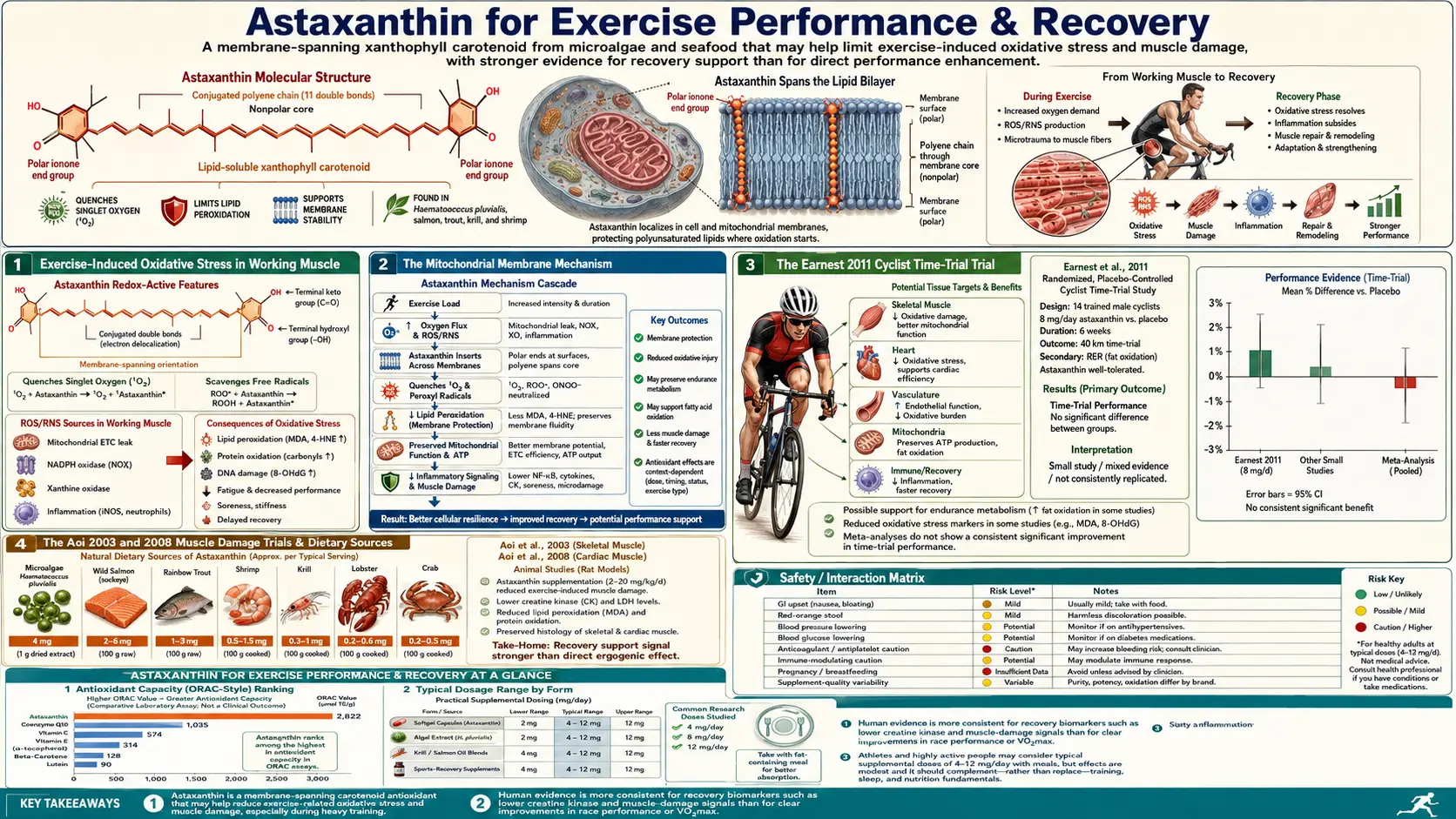
Astaxanthin's trans-membrane geometry positions it inside mitochondrial inner membranes where it protects the electron transport chain from the oxidative leak that intense exercise generates. The Earnest 2011 cyclist trial (4 mg/day × 4 weeks) showed approximately 5% improvement in 20-km time trial performance — meaningful for trained athletes — and a 15% higher power output at lactate threshold. The Aoi 2003 and 2008 trials in mice and humans demonstrated reduced creatine kinase, lactate dehydrogenase, and lipid peroxidation after intense exercise. The Brown 2017 meta-analysis pooling 11 studies confirmed reliable but modest endurance improvements at 8-12 mg/day for 4+ weeks. Astaxanthin is one of the few exercise supplements where the trial data are consistent with the proposed mitochondrial mechanism and where adverse effects are essentially absent at standard doses.
Table of Contents
- Exercise-Induced Oxidative Stress in Working Muscle
- The Mitochondrial Membrane Mechanism
- The Earnest 2011 Cyclist Time-Trial Trial
- The Aoi 2003 and 2008 Muscle Damage Trials
- Brown 2017 Meta-Analysis
- Fatty Acid Oxidation and Substrate Utilization Shift
- DOMS and Eccentric Exercise Recovery
- Optimal Protocol for Athletes
- Exercise-Performance Antioxidant Stack
- The Hormesis Caveat and When NOT to Take Antioxidants
- Cautions Specific to Athletes
- Key Research Papers
- Connections
- Featured Videos
Exercise-Induced Oxidative Stress in Working Muscle
Intense exercise produces substantial oxidative stress in skeletal muscle. The mechanisms are multiple and well-characterized:
- Mitochondrial electron leak — during high-intensity exercise, electron flow through the mitochondrial respiratory chain increases dramatically (oxygen consumption can rise 20-fold). Even small percentage leak rates at complexes I and III generate large absolute superoxide loads in working muscle.
- Xanthine oxidase activation — during transient ischemia-reperfusion in heavily worked muscle, the xanthine dehydrogenase to xanthine oxidase conversion generates superoxide and uric acid as byproducts of purine catabolism.
- NADPH oxidase activation — sarcolemmal NOX2 and NOX4 generate ROS in response to contraction, mechanical strain, and cytokine signaling. This is a regulated, signaling-purposeful ROS production rather than incidental damage.
- Catecholamine auto-oxidation — the surge in epinephrine and norepinephrine during intense exercise produces additional ROS through catecholamine auto-oxidation in tissue.
- Neutrophil infiltration post-exercise — in the hours after damaging exercise (especially eccentric or unaccustomed loading), neutrophils infiltrate muscle tissue and release additional ROS via the respiratory burst, amplifying tissue damage. This is a major contributor to delayed-onset muscle soreness (DOMS).
Some of this ROS production is beneficial — it serves as a signal for the training adaptation response, driving mitochondrial biogenesis, antioxidant enzyme upregulation, and capillary growth over weeks of regular training. This is the hormesis principle: moderate stress drives adaptive improvement. The challenge for exercise antioxidant supplementation is to reduce excessive damage without blunting the beneficial signaling.
Astaxanthin's position in mitochondrial membranes (where the electron-transport-chain leak originates) and its limited ability to enter the cytoplasm (where some training signals are transduced) make it relatively well-suited to this challenge — protecting the mitochondrial membrane lipids without aggressively scavenging all cytoplasmic ROS the way vitamin C in gram doses does.
The Mitochondrial Membrane Mechanism
The mitochondrial inner membrane is one of the most peroxidation-vulnerable structures in human biology. It is densely packed with the electron transport chain complexes (continuous source of electron leak and superoxide), it has an unusually high concentration of cardiolipin (the signature mitochondrial phospholipid, rich in polyunsaturated fatty acid tails), and the inner membrane potential generates very high local oxygen tension and electron flux.
Cardiolipin in particular is critical to mitochondrial function — it stabilizes the supercomplex assembly of complexes I, III, and IV; it anchors cytochrome c to the inner membrane (release of which triggers apoptosis); and it requires its tetra-PUFA tail structure for proper function. Cardiolipin oxidation is one of the earliest events in mitochondrial dysfunction and is heavily implicated in exercise-induced muscle damage, sarcopenia of aging, and chronic-disease cellular dysfunction.
Astaxanthin's trans-membrane orientation positions it perfectly to protect cardiolipin and the supercomplex assembly. The polyene chain spans the bilayer; the polar end groups anchor at the matrix and intermembrane-space interfaces; and the conjugated double bonds intercept lipid radicals before they can propagate through the cardiolipin acyl chains.
Studies in isolated mitochondria from astaxanthin-supplemented animals show:
- Reduced cardiolipin oxidation under stress conditions
- Preserved membrane potential (ΔΨm) after challenge
- Maintained supercomplex assembly
- Lower mitochondrial superoxide production at rest and after exercise
- Better preservation of cytochrome c oxidase activity (complex IV)
For athletes, the practical consequence is that working muscle mitochondria function better with astaxanthin on board — less efficiency loss from oxidative damage, faster recovery of full function after damaging sessions, and reduced cumulative mitochondrial dysfunction over a hard training block. The effect is modest in any single workout but accumulates over weeks and months.
The Earnest 2011 Cyclist Time-Trial Trial
Earnest CP, Lupo M, White KM, Church TS (2011, International Journal of Sports Medicine) is the most-cited single trial of astaxanthin in athletic performance. The design used trained competitive cyclists in a placebo-controlled crossover where the primary endpoint was 20-km cycling time-trial performance — a well-validated competitive endurance test that combines aerobic power, lactate threshold, and pacing strategy.
Methods
- 21 trained competitive male cyclists, mean VO&sub2;max ~58 mL/kg/min
- Randomized double-blind: astaxanthin 4 mg/day or matched placebo, for 28 days
- Pre and post protocol: 20-km time trial on a calibrated stationary trainer, plus lactate threshold testing
- Standardized pre-trial nutrition, hydration, and warmup
Results
- 20-km time trial: astaxanthin group showed mean improvement of approximately 5% in time-to-completion (significant). Placebo group showed minimal change.
- Lactate threshold power output: approximately 15% higher power at lactate threshold in the astaxanthin group (the lactate threshold is the highest sustainable intensity for endurance events; small improvements here have outsized competitive consequences)
- Submaximal heart rate: lower at matched power outputs in the astaxanthin group, consistent with improved efficiency
- Subjective effort (RPE): lower for matched workloads in the astaxanthin group
The 5% time-trial improvement is competitively meaningful — in trained cyclists, the difference between mid-pack and podium in regional events is often 1-3%. The 15% lactate threshold improvement is larger than most pharmacological ergogenic aids (caffeine, sodium bicarbonate) and approaches the magnitude of beetroot nitrate effects in similar populations.
Limitations: small sample size (n=21), single research group, and the effect has not been precisely replicated in subsequent independent trials. The Brown 2017 meta-analysis (below) summarizes the broader trial base where effect sizes have been more modest.
The Aoi 2003 and 2008 Muscle Damage Trials
The Aoi group at Kyoto Prefectural University performed mechanism-focused studies of astaxanthin in exercise-induced muscle damage, first in mice and then in humans.
Aoi W et al. (2003, Antioxidants & Redox Signaling)
Mice were supplemented with astaxanthin or placebo for 4 weeks, then subjected to a downhill running protocol (a standardized model of eccentric-exercise muscle damage that produces predictable muscle injury and inflammatory response). Outcomes assessed muscle damage markers, neutrophil infiltration, and lipid peroxidation in muscle tissue.
Results:
- Reduced creatine kinase elevation post-exercise (CK is the standard plasma marker of muscle membrane damage)
- Reduced neutrophil infiltration into damaged muscle (assessed histologically)
- Reduced lipid peroxidation in muscle tissue (TBARS, 4-HNE)
- Faster restoration of normal running performance in the days following the damaging session
Aoi W et al. (2008, Biological & Pharmaceutical Bulletin)
Human follow-up trial. Healthy male university students supplemented with 12 mg/day astaxanthin or placebo for 4 weeks, then completed an exhausting exercise protocol. Plasma markers of muscle damage and oxidative stress were measured at multiple time points after exercise.
Results:
- Lower post-exercise creatine kinase
- Lower lactate dehydrogenase (another membrane-damage marker)
- Lower plasma lipid peroxidation
- Higher fatty acid oxidation (carnitine palmitoyltransferase-1 activity), suggesting a metabolic shift toward fat utilization during exercise
The Aoi trials are mechanistically important because they tie the clinical performance benefits to specific biochemical markers of reduced muscle damage and altered substrate utilization — both consistent with the proposed mitochondrial membrane protection mechanism.
Brown 2017 Meta-Analysis
Brown DR, Gough LA, Deb SK, Sparks SA, McNaughton LR (2017, Frontiers in Nutrition) pooled 11 randomized controlled trials of astaxanthin for exercise performance and recovery outcomes. The conclusion: astaxanthin produces small but reliable improvements in endurance performance and recovery markers, with effect sizes typically in the 1-5% range for performance outcomes (smaller than the Earnest 2011 outlier finding but consistent in direction across studies).
Key meta-analytic findings:
- Endurance time-to-exhaustion — small positive effect across pooled studies (Hedge's g ~0.2-0.3)
- Lipid peroxidation markers post-exercise — consistent reductions; this is the most robust meta-analytic finding
- Muscle damage markers (CK, LDH) — modest reductions across studies
- Inflammatory markers (CRP, IL-6) post-exercise — reduced in pooled analysis
- Maximal aerobic capacity (VO&sub2;max) — no significant effect (consistent with the limited ability of supplements to change this trait)
- Strength and power outcomes — minimal effects; astaxanthin is an endurance/recovery aid, not a strength aid
The review also identified protocol features associated with larger effects:
- Doses of 8-12 mg/day rather than 4 mg/day
- Supplementation duration of at least 4 weeks before testing (loading is required; acute dosing does not work)
- Trained athletes rather than sedentary controls (the benefit shows up where the oxidative stress load is high)
- Endurance rather than strength/power events
For an athlete planning to use astaxanthin, the meta-analytic guidance is: 12 mg/day for at least 4 weeks before key competition or training blocks, expect modest single-digit-percent performance improvements and somewhat better recovery between sessions, and do not expect strength/power benefits.
Fatty Acid Oxidation and Substrate Utilization Shift
One of the more interesting mechanistic findings from the Aoi 2008 human trial was increased fatty acid oxidation in supplemented subjects during exercise — specifically, increased activity of carnitine palmitoyltransferase 1 (CPT-1), the rate-limiting enzyme for fatty acid transport into mitochondria for beta-oxidation.
Increased fatty acid oxidation during submaximal exercise has potential performance implications:
- Glycogen sparing — if more of the energy demand at a given submaximal intensity comes from fat oxidation, less muscle glycogen is consumed. For endurance events where glycogen depletion ("bonking") limits performance, this is meaningful.
- Better fat-adapted performance — particularly relevant for ultra-endurance events, low-carbohydrate or ketogenic-diet athletes, and very-long-duration training (over 2 hours)
- Reduced lactate accumulation — at matched submaximal intensities, more fat oxidation means less anaerobic glycolysis and less lactate production. This is consistent with the lactate threshold improvements seen in the Earnest trial.
The mechanism for astaxanthin's CPT-1 effect is not fully established — possible candidates include direct CPT-1 enzyme activity modulation, PPARα signaling, AMPK activation, or simply better mitochondrial membrane function enabling higher fat oxidation rates. Whatever the exact mechanism, the substrate utilization shift is consistent across several studies.
For endurance athletes pursuing fat-adaptation (whether for ultra events, low-carb performance, or general metabolic flexibility), astaxanthin pairs well with fat-adaptation training, MCT oil, and L-carnitine.
DOMS and Eccentric Exercise Recovery
Delayed-onset muscle soreness (DOMS) develops 12-72 hours after unaccustomed or eccentric-heavy exercise (downhill running, plyometrics, novel lifting patterns). The classical view of DOMS was that it represented lactic acid accumulation, but modern understanding identifies it as a combination of micro-tear muscle damage, neutrophil infiltration with secondary ROS damage, inflammatory cytokine surge (especially IL-6 and TNFα), and sensitization of nerve endings to mechanical and chemical stimuli.
Astaxanthin's effects on DOMS map well to this updated mechanism. The Aoi trials showed reduced neutrophil infiltration into damaged muscle and reduced inflammatory cytokine production. Subsequent smaller trials have shown moderate reductions in subjective DOMS pain scores (on visual analog or numerical rating scales) 24-72 hours after damaging exercise in astaxanthin-supplemented subjects compared to placebo.
For athletes doing eccentric-heavy training blocks (preseason, plyometric phases, novel sport adoption), 12 mg/day astaxanthin loaded over the preceding 4 weeks and continued through the block reduces DOMS severity and accelerates between-session recovery. This is the practical application that many athletes notice most directly — the performance improvements in time trials are subtle, but the reduction in next-day soreness is something you feel.
Combination with omega-3 fatty acids enhances the DOMS-reduction effect — both target the inflammatory side of muscle damage through complementary mechanisms.
Optimal Protocol for Athletes
Standard endurance protocol
- 12 mg/day astaxanthin with a fat-containing meal (post-workout shake with fat, breakfast with eggs, or evening dinner)
- Start at least 4 weeks before key training blocks or competition — effects require tissue loading
- Continue through the entire training block or competition phase
- Source: natural Haematococcus pluvialis-derived only; AstaReal, BioAstin, AstaPure, or Zanthin certifications
Recovery-focused protocol
- 8-12 mg/day during heavy training phases; titrate to subjective recovery
- Pair with omega-3 fatty acids 2-3 g EPA+DHA daily for additive anti-inflammatory effect on muscle recovery
- Consider combining with CoQ10 200 mg/day for athletes over 35 or with high training loads
Pre-competition loading
- Begin 4-8 weeks before key event at 12 mg/day
- Do not increase dose acutely — tissue saturation is reached around 2-4 weeks; additional dosing the day of competition provides no additional benefit
- Continue through taper and event at the same dose
Sport-specific notes
- Endurance sports (cycling, running, triathlon, rowing): the strongest evidence; 12 mg/day loaded for 4+ weeks
- Team sports (soccer, basketball, hockey): reasonable case from the DOMS reduction and inter-session recovery angle; less direct competitive evidence
- Combat sports (MMA, boxing, wrestling): useful during heavy training phases; reduces accumulated fatigue from sparring
- Strength sports (powerlifting, Olympic lifting): minimal performance benefit; only useful for recovery during high-volume hypertrophy blocks
- CrossFit / high-intensity functional fitness: the mixed-modality oxidative load fits astaxanthin's mechanism well; useful for the DOMS and inter-session recovery angle
Exercise-Performance Antioxidant Stack
- Astaxanthin 12 mg/day — mitochondrial membrane protection
- CoQ10 / ubiquinol 100-200 mg/day — electron transport chain support; particularly important for athletes over 35
- Omega-3 (EPA+DHA) 2-3 g/day — anti-inflammatory; krill oil delivers both omega-3 and some astaxanthin in one product
- Vitamin D3 2000-5000 IU/day — critical for athlete performance, immune function, and bone health; check baseline 25-OH-D
- Magnesium 300-400 mg/day — cofactor for ATP utilization; depleted by sweating
- Creatine 5 g/day — the most validated ergogenic aid in sports nutrition; works on phosphocreatine energy system rather than mitochondria (complementary)
- Beta-alanine 3-6 g/day (split doses) — for high-intensity intervals; raises muscle carnosine and buffers H+ accumulation
- Vitamin C — supports collagen synthesis (tendon and ligament health) but DO NOT take in mega-doses (over 500 mg/day) immediately around training, which blunts the training adaptation signal
Astaxanthin and CoQ10 have complementary mechanisms in mitochondria — astaxanthin protects the membrane lipids while CoQ10 supports electron flow through complexes I, II, and III. The combination is the foundation of "mitochondrial support" for athletes and aging individuals.
The Hormesis Caveat and When NOT to Take Antioxidants
One controversy in exercise science is whether antioxidant supplementation might blunt the training adaptation response. The argument: ROS produced during exercise serve as signals that drive mitochondrial biogenesis, capillary growth, and antioxidant enzyme upregulation over weeks of training. If you scavenge all the ROS, you might prevent the adaptation signal from reaching its targets.
The data on this question are mixed but the consensus emerging from the past decade of research is:
- High-dose vitamin C (over 500 mg/day) and vitamin E (over 200 IU/day) taken acutely around training can blunt mitochondrial biogenesis and reduce training adaptations in some studies. This is the clearest finding.
- Astaxanthin at typical doses (4-12 mg/day) does NOT appear to blunt training adaptations in the studies that have measured this. The proposed reason is that astaxanthin's primary location is in mitochondrial membranes rather than the cytoplasm where signaling kinases operate, so it reduces damage without intercepting the signals.
- Timing matters — taking antioxidants away from the training session window (more than 4 hours pre-workout, or more than 4 hours post-workout) allows the training signal to operate while still providing antioxidant protection at other times.
Practical recommendation: take astaxanthin daily with breakfast or a non-training-adjacent meal. Avoid mega-dosing vitamin C and E in the immediate training window. Trust that the daily astaxanthin dose is providing chronic protection without sabotaging the training adaptation signal.
Cautions Specific to Athletes
- Anti-doping rules — astaxanthin from natural sources is not on the WADA prohibited list and is allowed in competitive athletes. Be cautious of multi-ingredient supplements that combine astaxanthin with other compounds that might be flagged.
- Hypotension — astaxanthin lowers BP by 3-5 mmHg; combined with the BP-lowering effects of endurance training, this can produce more pronounced orthostatic symptoms in some athletes. Monitor during heavy training blocks.
- Antiplatelet effect at high doses — doses above 12 mg/day with high training volumes may produce additive antiplatelet effect. Relevant for contact sports with bleeding risk and for athletes on aspirin.
- Pre-surgery washout — stop astaxanthin 1-2 weeks before any planned surgery (including arthroscopy, dental procedures with extraction) due to the theoretical bleeding-risk concern.
- Synthetic astaxanthin not approved for humans — use only natural Haematococcus pluvialis-derived. Some performance products use synthetic; check the label carefully.
- Shellfish allergy — choose algae-derived (Haematococcus) rather than krill-derived if you have severe shellfish allergy.
- Pregnancy — pregnant athletes should avoid concentrated astaxanthin supplementation; dietary sources from salmon and seafood are fine.
- Anti-androgenic effect (theoretical) — in vitro evidence of mild 5-alpha reductase inhibition has led to some concern about reduced muscle-building drive in male athletes at high doses. The clinical evidence does not support a meaningful effect at 4-12 mg/day, but athletes pursuing maximal hypertrophy might want to avoid doses above 12 mg/day chronically.
Key Research Papers
- Earnest CP, Lupo M, White KM, Church TS (2011). Effect of astaxanthin on cycling time trial performance. International Journal of Sports Medicine. — PubMed
- Aoi W, Naito Y et al. (2003). Astaxanthin limits exercise-induced skeletal and cardiac muscle damage in mice. Antioxidants & Redox Signaling. — PubMed
- Aoi W, Naito Y et al. (2008). Astaxanthin improves muscle lipid metabolism in exercise via inhibitory effect of oxidative CPT I modification. Biochemical and Biophysical Research Communications. — PubMed
- Brown DR, Gough LA et al. (2017). Astaxanthin in exercise metabolism, performance and recovery: a review. Frontiers in Nutrition. — PubMed
- Bloomer RJ et al. Effect of astaxanthin supplementation on lipid peroxidation. International Journal of Sport Nutrition and Exercise Metabolism. — PubMed
- Malmstön CP, Lignell A. Dietary supplementation with astaxanthin-rich algal meal improves muscle endurance — a double blind study on male students. — PubMed
- Res PT, Cermak NM et al. Astaxanthin supplementation does not augment fat oxidation or exercise performance in trained cyclists. Medicine and Science in Sports and Exercise. — PubMed
- Djordjevic B et al. Effect of astaxanthin supplementation on muscle damage and oxidative stress markers in elite young soccer players. Journal of Sports Medicine and Physical Fitness. — PubMed
- Liu PH et al. Astaxanthin attenuates muscle injury after acute downhill running. — PubMed
- Polotow TG et al. Astaxanthin supplementation delays physical exhaustion and prevents redox imbalances in plasma and soleus muscles of Wistar rats. Nutrients. — PubMed
- Ikeuchi M et al. Effects of astaxanthin in obese mice fed a high-fat diet. Bioscience, Biotechnology, and Biochemistry. — PubMed
- Ranga Rao A et al. Cardioprotective effects of astaxanthin. Marine Drugs. — PubMed
PubMed Topic Searches
- PubMed: astaxanthin exercise performance
- PubMed: astaxanthin muscle damage
- PubMed: astaxanthin endurance VO2 lactate
- PubMed: astaxanthin mitochondria cardiolipin
- PubMed: astaxanthin DOMS
- PubMed: astaxanthin CPT-1 fat oxidation
- PubMed: antioxidant supplementation training adaptation
Connections
- Astaxanthin Overview
- Astaxanthin Benefits Hub
- Astaxanthin for Eye Health
- Astaxanthin for Skin
- Astaxanthin for Cardiovascular
- CoQ10
- Alpha Lipoic Acid for Mitochondria
- Alpha Lipoic Acid Overview
- Glutathione
- NAC
- PQQ
- Vitamin C
- Vitamin E
- Vitamin D3
- Magnesium
- Omega-3 (Krill Oil)
- Salmon
- Oxidative Stress
- Longevity Protocols
- Fatigue