Serine: Food Sources & Daily Intake
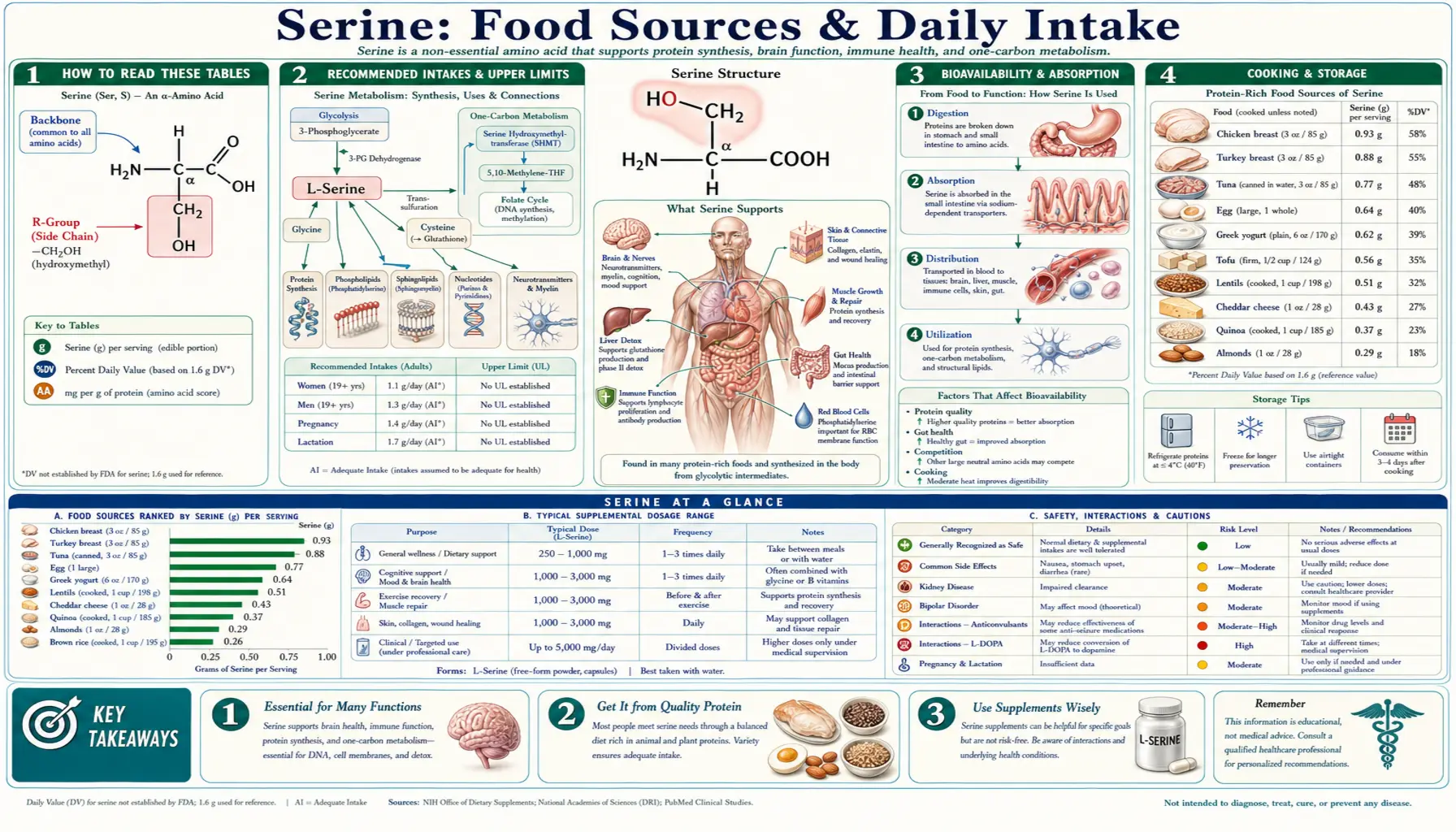
Serine is a non-essential amino acid — your body makes all it needs, building it from the amino acid glycine and from a normal sugar-breakdown intermediate (3-phosphoglycerate), so there is no dietary requirement. It is far from idle, though: serine is a building block of the phospholipids that form cell membranes (including phosphatidylserine, which is concentrated in the brain), a major donor in the methylation / one-carbon cycle, and the raw material the body uses to make glycine and cysteine and to help synthesize neurotransmitters. The richest dietary sources are concentrated animal proteins — hard cheeses, meat, poultry, fish and eggs — followed by legumes, peanuts and seeds. The table below shows grams of serine per 100 g of food; there is no FDA Daily Value for individual amino acids, so amounts are absolute.
| Serine: Food Sources & Daily Intake | |||||
|---|---|---|---|---|---|
| Rank | Food (serving) | Per 100 g | Glucose | Fructose | Notes |
| 1 | Parmesan Cheese 1 oz / 28 g | 🟢 2.1 g | — | — | Concentrated protein. |
| 2 | Pumpkin Seeds 1 oz / 28 g | 🟢 1.6 g | 0.1 | 0.1 | |
| 3 | Cheddar Cheese 1 oz / 28 g | 🟢 1.4 g | 0 | 0 | |
| 4 | Pork Organ Meats 3 oz / 85 g | 🟢 1.3 g | — | — | Nutrient-dense organ meat. |
| 5 | Peanuts 1 oz / 28 g | 🟢 1.3 g | — | — | |
| 6 | Beef Meat 3 oz / 85 g | 🟢 1.2 g | 0 | 0 | |
| 7 | Chicken Organ Meats 3 oz / 85 g | 🟢 1.1 g | — | — | Nutrient-dense organ meat (giblets). |
| 8 | Pork 3 oz / 85 g | 🟢 1.1 g | 0 | 0 | |
| 9 | Beef Organ Meats 3 oz / 85 g | 🟢 1.1 g | — | — | Nutrient-dense organ meat. |
| 10 | Turkey Breast 3 oz / 85 g | 🟢 1.1 g | 0 | 0 | |
| 11 | Salmon 3 oz / 85 g | 🟢 1.1 g | 0 | 0 | |
| 12 | Tuna 3 oz / 85 g | 🟢 1.0 g | 0 | 0 | |
| 13 | Egg 1 large / 50 g | 🟡 0.9 g | — | — | |
| 14 | Walnuts 1 oz / 28 g | 🟡 0.9 g | 0.1 | 0.1 | |
| 15 | Sunflower Seeds 1 oz / 28 g | 🟡 0.8 g | — | — | |
| 16 | White Beans 1 cup / 179 g | 🟡 0.5 g | — | — | |
| 17 | Brown Rice 1 cup / 195 g | ⚪ 0.1 g | 0 | 0 | Common staple. |
Table of Contents
- How to Read These Tables
- Recommended Intakes & Upper Limits
- Bioavailability & Absorption
- Cooking & Storage
- Vegetarian & Vegan Sources
- Who Needs to Pay Attention
- Data Sources & References
- Connections
- Featured Videos
How to Read These Tables
- Non-essential amino acid. Your body can synthesize serine on its own — from glycine and from a glucose-breakdown intermediate — so a steady dietary supply is not required the way it is for the nine essential amino acids. Food still contributes, and serine comes along naturally with any protein you eat.
- Grams per 100 g, not %DV. There is no FDA Daily Value for individual amino acids, so this table reports the absolute grams per 100 g of food and ranks foods by that. A typical serving is shown beside each food.
- Complete vs incomplete protein. Animal foods are “complete” — they carry all the essential amino acids in good proportion and are serine-rich. Most single plant foods are lower in one or two essentials; eating a variety of legumes, nuts and seeds across the day covers the gaps.
Recommended Intakes & Upper Limits
Your personal target depends on age, sex and pregnancy. The Daily Value used for the %DV column above is a single label figure; the table below is the age-specific guidance.
| Reference | Adult value | Notes |
|---|---|---|
| Essential? | No — non-essential | The body makes its own serine, so there is no dietary requirement. |
| Adult requirement | None set | The body builds serine from glycine and from a glucose-breakdown intermediate (3-phosphoglycerate), so no intake level is required. |
| Main roles | Cell membranes & methylation | A core part of membrane phospholipids (incl. phosphatidylserine) and a one-carbon donor that also builds glycine and cysteine. |
| Richest in | Animal protein & legumes | Cheese, meat, poultry, fish, eggs, then beans, lentils, peanuts and seeds. |
Bioavailability & Absorption
Serine from food is well absorbed as part of dietary protein, but it is one amino acid you rarely need to think about: the body manufactures its own from glycine and from a routine step in glucose metabolism, so internal supply — not the plate — sets how much you have. What food contributes is simply total protein quality and quantity: animal proteins (meat, poultry, fish, eggs, dairy) are complete and serine-dense, while plant proteins are a little lower and benefit from variety. Any normal protein intake supplies serine alongside everything else.
Cooking & Storage
Amino acids are stable to ordinary cooking — serine is not destroyed by normal heat, and cooking actually makes protein easier to digest. Very high, prolonged dry heat (charring) can damage some heat-sensitive amino acids, but typical cooking leaves serine intact. No special handling is needed.
Vegetarian & Vegan Sources
Getting enough serine on a plant-based diet is easy, for two reasons: the body makes its own, and plant proteins still supply it. The strongest plant sources are lentils, white and other beans, chickpeas, peanuts, pumpkin and sunflower seeds, and walnuts. Eating a variety across the day (legumes + nuts + seeds) covers all the essential amino acids; because serine is non-essential, there is no need to target it specifically.
Who Needs to Pay Attention
Dietary serine deficiency essentially never happens — the body synthesizes its own serine, so even diets low in it are covered. The only people who run short are those with rare inherited disorders of serine synthesis (such as 3-phosphoglycerate dehydrogenase deficiency and related serine-biosynthesis defects), where the body cannot make enough. Because the brain depends on locally made serine and the blood-brain barrier limits delivery from the bloodstream, these conditions affect the brain and nervous system — causing problems such as small head size (microcephaly), seizures and developmental delay — and are managed medically with serine (and sometimes glycine) supplementation, not through ordinary diet.
Data Sources & References
- NIH MedlinePlus — Amino acids
- Linus Pauling Institute — protein and amino acids
- PubMed — serine, glycine and one-carbon metabolism
- PubMed — serine biosynthesis deficiency and the brain