Glutamine: Food Sources & Daily Intake
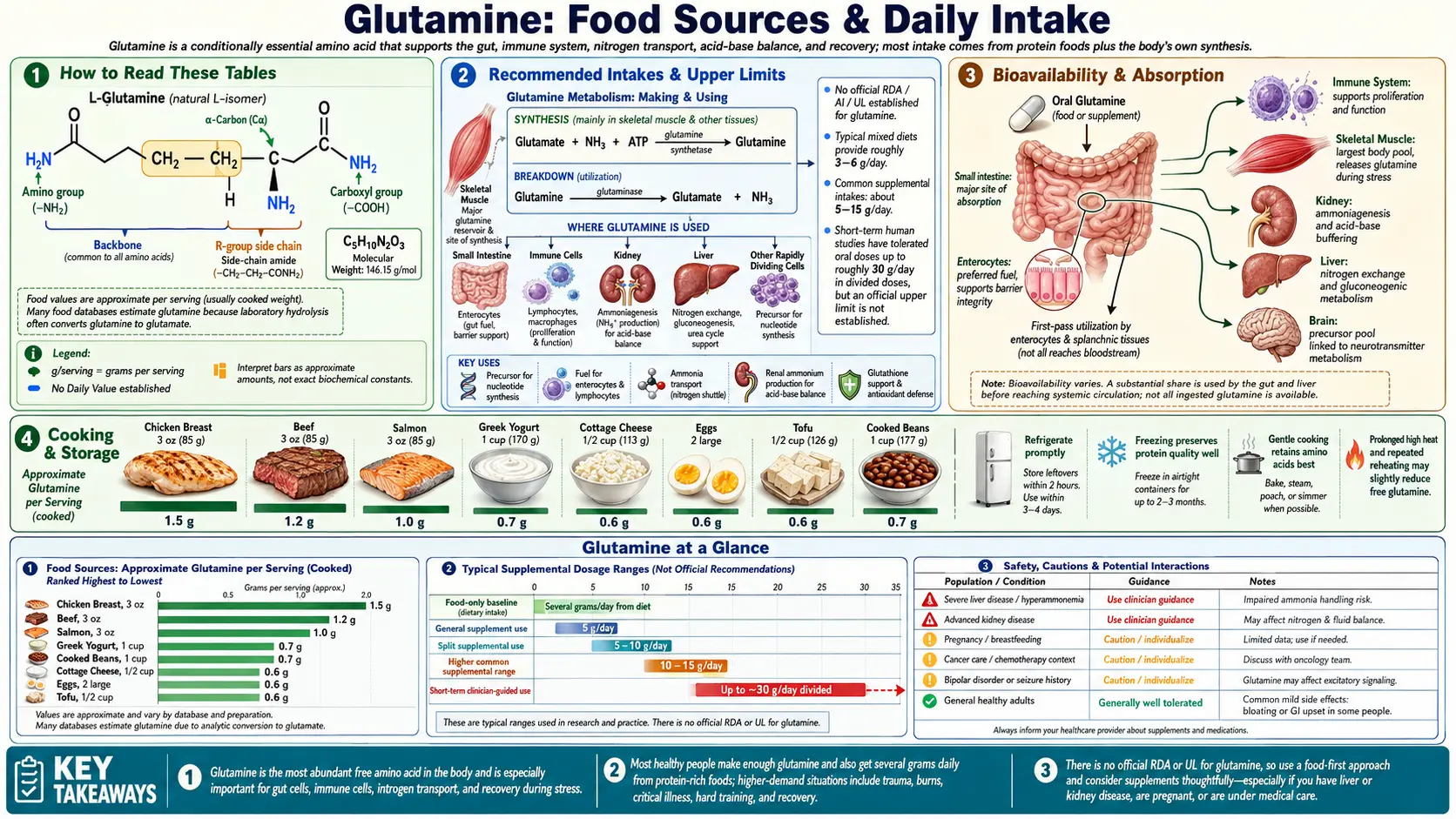
Glutamine is the most abundant free amino acid in the bloodstream and in muscle, and it is the preferred fuel of two demanding tissues: the cells that line the gut and the cells of the immune system. It is also the body’s main way of moving nitrogen safely from one tissue to another. In healthy people the body makes all the glutamine it needs, so it is normally non-essential; but during serious illness, surgery, burns, injury or very intense training the demand can outrun supply, which is why glutamine is called conditionally essential. One thing to know about the numbers: standard food analysis cannot tell glutamine and glutamic acid apart — the lab step that breaks protein down converts glutamine into glutamate — so the value in the table is the combined glutamine + glutamic-acid total, and high-protein foods naturally lead. The table shows grams per 100 g of food; there is no FDA Daily Value for individual amino acids, so amounts are absolute.
| Glutamine: Food Sources & Daily Intake | |||||
|---|---|---|---|---|---|
| Rank | Food (serving) | Per 100 g | Glucose | Fructose | Notes |
| 1 | Parmesan Cheese 1 oz / 28 g | 🟢 8.2 g | — | — | Concentrated protein. |
| 2 | Pumpkin Seeds 1 oz / 28 g | 🟢 6.1 g | 0.1 | 0.1 | Top plant source. |
| 3 | Cheddar Cheese 1 oz / 28 g | 🟢 5.7 g | 0 | 0 | |
| 4 | Peanuts 1 oz / 28 g | 🟢 5.4 g | — | — | |
| 5 | Beef Meat 3 oz / 85 g | 🟢 4.6 g | 0 | 0 | |
| 6 | Pork 3 oz / 85 g | 🟢 4.2 g | 0 | 0 | |
| 7 | Chicken Organ Meats 3 oz / 85 g | 🟡 3.9 g | — | — | Nutrient-dense organ meat (giblets). |
| 8 | Salmon 3 oz / 85 g | 🟡 3.9 g | 0 | 0 | |
| 9 | Tuna 3 oz / 85 g | 🟡 3.8 g | 0 | 0 | |
| 10 | Pork Organ Meats 3 oz / 85 g | 🟡 3.0 g | — | — | Nutrient-dense organ meat. |
| 11 | Beef Organ Meats 3 oz / 85 g | 🟡 2.6 g | — | — | Nutrient-dense organ meat. |
| 12 | Chicken Breast 3 oz / 85 g | 🟡 2.1 g | — | — | |
| 13 | Egg 1 large / 50 g | 🟡 1.6 g | — | — | |
| 14 | Chickpeas 1 cup / 164 g | 🟡 1.6 g | — | — | |
| 15 | White Beans 1 cup / 179 g | 🟡 1.5 g | — | — | |
| 16 | Lentils 1 cup / 198 g | 🟡 1.4 g | — | — | Rich plant source. |
| 17 | Brown Rice 1 cup / 195 g | ⚪ 0.5 g | 0 | 0 | Common staple. |
Table of Contents
- How to Read These Tables
- Recommended Intakes & Upper Limits
- Bioavailability & Absorption
- Cooking & Storage
- Vegetarian & Vegan Sources
- Who Needs to Pay Attention
- Data Sources & References
- Connections
- Featured Videos
How to Read These Tables
- Reported together with glutamic acid. Glutamine and glutamic acid are chemically almost identical, and the standard laboratory method (acid hydrolysis) converts glutamine into glutamate before it is measured. Food databases therefore report a single combined figure that covers both — there is no widely available number for glutamine on its own. Read the values below as “glutamine + glutamic acid,” a reliable guide to which foods are richest in glutamine.
- Grams per 100 g, not %DV. There is no FDA Daily Value for individual amino acids, so this table reports the absolute grams per 100 g of food and ranks foods by that combined glutamine + glutamic-acid total. A typical serving is shown beside each food.
- Conditionally essential. Your body normally makes plenty of glutamine, so most people never need to think about it. It moves onto the “essential” list only under heavy physical stress — major illness, surgery, burns, sepsis or very hard training — when the gut and immune system burn through it faster than the body can resupply.
Recommended Intakes & Upper Limits
Your personal target depends on age, sex and pregnancy. The Daily Value used for the %DV column above is a single label figure; the table below is the age-specific guidance.
| Reference | Adult value | Notes |
|---|---|---|
| Status | Conditionally essential | The most abundant free amino acid in blood and muscle; the body normally makes plenty, but demand can outstrip supply during illness, injury or intense training — when it becomes “conditionally essential.” |
| Adult requirement | None set (body makes it) | No recommended intake exists because healthy people synthesize all they need; food simply adds to the supply. |
| Main roles | Gut & immune-cell fuel, nitrogen transport | Primary energy source for the cells lining the intestine and for immune cells, and the body’s main shuttle for carrying nitrogen safely between tissues. |
| How it is measured | Reported together with glutamic acid | Standard food analysis converts glutamine to glutamate, so the per-100 g figure below is the combined glutamine + glutamic-acid total. |
Bioavailability & Absorption
Glutamine from food is well absorbed as part of dietary protein, but most of it never reaches the bloodstream intact: the cells lining the intestine use glutamine as their primary fuel and consume a large share of it on the spot — one of the reasons glutamine is so important to gut health. What matters for nutrition is simply eating adequate total protein; glutamine comes along automatically because it is one of the most plentiful amino acids in protein. Because the body also synthesizes glutamine on demand (chiefly in muscle), blood levels are tightly regulated and food is a top-up rather than the sole source.
Cooking & Storage
Glutamine is stable to ordinary cooking as part of food protein, and cooking actually makes that protein easier to digest. Worth noting: isolated free glutamine (as in supplements) is heat- and moisture-sensitive and can degrade, but the protein-bound glutamine in everyday foods like meat, cheese, eggs and beans is robust and needs no special handling. Long, gentle simmering — as in a bone or meat broth — releases free amino acids including glutamine into the liquid, which is why brothy, slow-cooked dishes are a traditional, gut-friendly source.
Vegetarian & Vegan Sources
Glutamine is easy to get on a plant-based diet because it is one of the most abundant amino acids in plant protein. The strongest plant sources are cabbage (a classic dietary source), lentils, white beans and chickpeas, peanuts, pumpkin and sunflower seeds, and leafy greens like spinach. For those who include them, whole-milk dairy and eggs are excellent and concentrated sources. Eating enough total protein from a variety of legumes, seeds and vegetables across the day supplies all the glutamine a healthy body needs — no supplement required.
Who Needs to Pay Attention
Dietary glutamine deficiency does not occur in healthy people eating enough protein, because the body makes its own. The situation changes under severe catabolic stress — major burns, trauma, sepsis, major surgery or critical illness — when muscle glutamine stores can be depleted faster than they are replaced; this is the setting where clinicians sometimes provide supplemental glutamine, and where most of the research has focused. Some athletes and people with gut conditions also take glutamine supplements, though evidence for benefit in otherwise-healthy people is mixed. For the general public the practical takeaway is simply to eat adequate quality protein; isolated glutamine supplements are a clinical or sports tool, not an everyday dietary need, and are best used under guidance.
Data Sources & References
- NIH MedlinePlus — Amino acids
- Linus Pauling Institute — protein and amino acids
- PubMed — glutamine metabolism, gut and immune function
- PubMed — glutamine supplementation in critical illness
Connections
- All Amino Acids
- Glutamine (Main Page)
- Glutamine Benefits
- Glutamine History
- Glutamic Acid
- Arginine
- Glycine
- Bone Broth