D-Serine — Benefits & Research Deep Dive
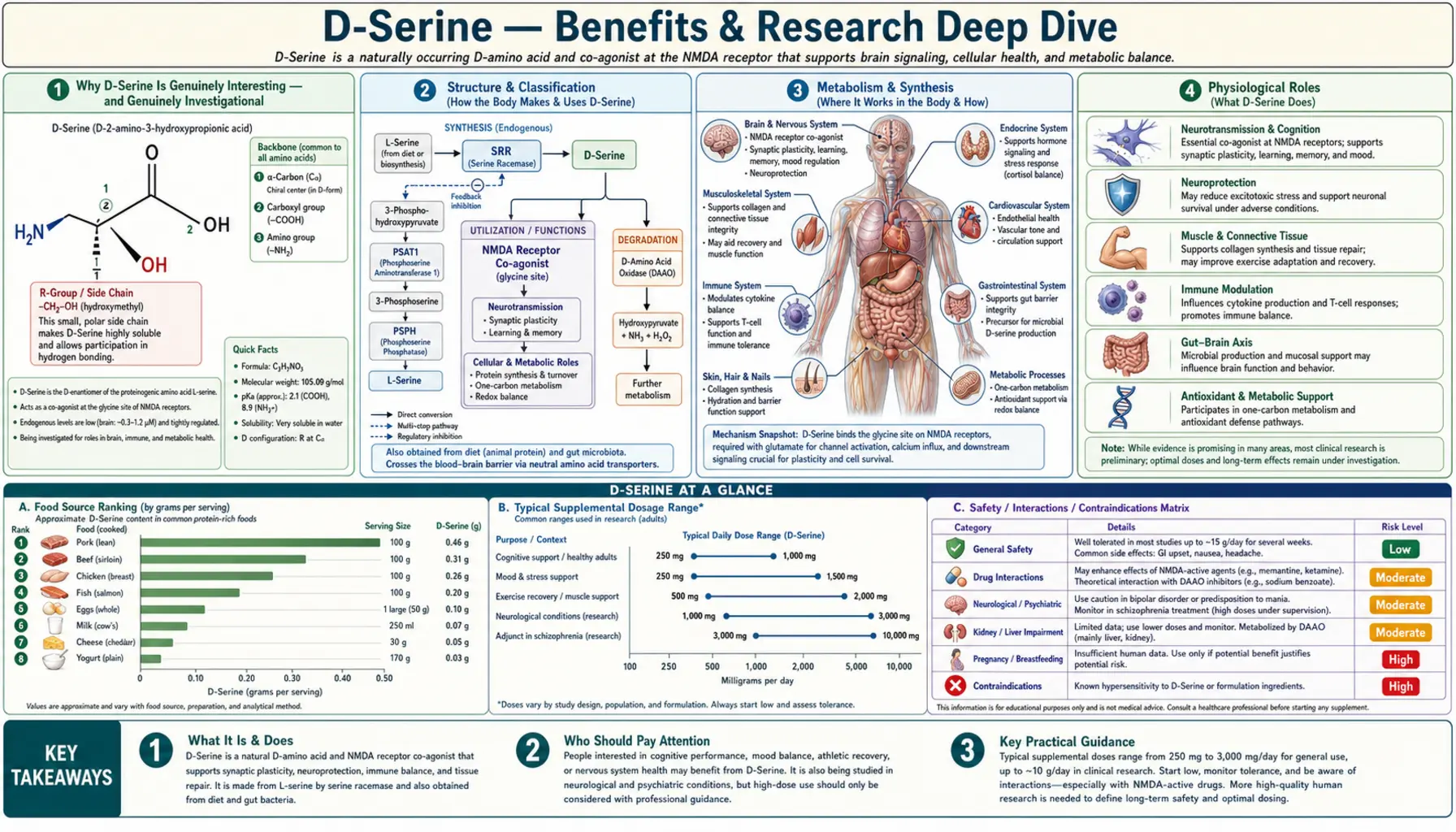
D-Serine is one of the very few D-amino acids the human body makes and uses on purpose. In the brain it is the primary co-agonist that opens the NMDA glutamate receptor — the molecular switch at the heart of learning, memory, and synaptic plasticity. That role has made D-Serine a magnet for research into schizophrenia, cognitive aging, and memory. But an honest guide has to lead with the caveat, not bury it: D-Serine is investigational. It is a research molecule studied in clinical trials, not an established, proven, over-the-counter supplement — and high doses are clearly nephrotoxic (kidney-damaging) in animal models. The four deep-dive pages below explain the mechanism, walk through the mixed human trial evidence honestly, and place the safety questions front and center. Nothing here is dosing advice; this is a science explainer.
Deep-Dive Articles
NMDA Receptor & Brain
How D-Serine works as the co-agonist at the NMDA receptor's glycine-B site, why the receptor needs two keys (glutamate plus D-Serine) to open, the astrocyte "gliotransmitter" story, serine racemase and D-amino acid oxidase (DAAO), and the role of all this in long-term potentiation — the cellular basis of memory.
Schizophrenia Research
The NMDA-hypofunction hypothesis of schizophrenia, the landmark Tsai 1998 add-on trial, the mixed and modest results of later randomized trials, why negative symptoms and cognition are the targets, the DAOA/DAAO genetics, and the honest bottom line: promising signal, no approved therapy, still investigational.
Cognition & Memory
The age-related fall in brain D-Serine, animal studies restoring long-term potentiation in old hippocampus, the related NMDA co-agonist-site drug D-cycloserine in fear-extinction and exposure therapy, and why translating any of this into human cognitive benefit remains preliminary and unproven.
Safety & the Kidney Caveat
The critical, honest page. High-dose D-Serine causes selective necrosis of the proximal kidney tubule in rats (Ganote and Carone, 1974–1975). What the cross-species safety review actually concluded, why this is not an established safe consumer supplement, and why you should not self-experiment with it.
Table of Contents
- Deep-Dive Articles
- Why D-Serine Is Genuinely Interesting — and Genuinely Investigational
- Research Papers: Mechanism & the NMDA Receptor
- Research Papers: Schizophrenia
- Research Papers: Cognition, Aging & Memory
- Research Papers: Safety & Nephrotoxicity
- Research Papers: Genetics & Enzymes (DAAO / Serine Racemase)
- External Authoritative Resources
- Connections
- Featured Videos
Why D-Serine Is Genuinely Interesting — and Genuinely Investigational
Most amino acids you read about on this site are dietary building blocks: you eat protein, your body cleaves it into L-amino acids, and those get reassembled into your own proteins. D-Serine is different on almost every count. It is a D-amino acid — the mirror-image form that biology normally excludes — and it is not used to build protein at all. Instead, the brain manufactures it deliberately from ordinary L-Serine using an enzyme called serine racemase, and uses it as a signaling molecule at the synapse. In that sense D-Serine behaves less like a nutrient and more like a neurotransmitter.
Its single most important job is to serve as a co-agonist at the NMDA receptor. This receptor is the brain's principal detector of coincident activity: it opens only when glutamate is released and a co-agonist (D-Serine or glycine) is bound at a separate site. When it opens, calcium floods in and triggers long-term potentiation — the strengthening of synapses that encodes a memory. Because D-Serine gates this switch, three big questions naturally follow: Does too little D-Serine contribute to schizophrenia, where NMDA receptors seem underactive? Does the age-related decline in brain D-Serine contribute to memory loss? And could supplementing it help either? Those questions have driven three decades of research, summarized across the four deep-dive pages here.
The honest answer to "does it work as a treatment or supplement?" is: not established. The human clinical trials in schizophrenia are real but small, and their results are mixed and generally modest. There is no regulatory approval of D-Serine for any condition. And crucially, the safety story includes a genuine red flag: in rats, high-dose D-Serine produces a distinctive, selective injury to the proximal tubule of the kidney. That does not automatically translate to humans at every dose, but it is exactly why D-Serine should be treated as a research compound handled under medical supervision in trials — not as a nootropic to buy and self-dose. This hub keeps that framing throughout.
One recent thread has renewed popular interest: a 2023 study (widely re-covered in 2026) reported that a longevity-associated protein called Menin regulates D-Serine production in the hypothalamus, and that restoring either Menin or D-Serine rescued cognitive deficits in aging mice (Leng et al., PLOS Biology, DOI: 10.1371/journal.pbio.3002033). That is a fascinating animal finding — and still an animal finding. The fuller account lives on the D-Serine History page.
Research Papers: Mechanism & the NMDA Receptor
- Mothet JP, et al. (2000). D-serine is an endogenous ligand for the glycine site of the NMDA receptor. Proc Natl Acad Sci USA. — PMID 10781100
- Wolosker H, et al. (1999). Serine racemase: a glial enzyme synthesizing D-serine to regulate NMDA transmission. Proc Natl Acad Sci USA. — PMID 10557334
- Panatier A, et al. (2006). Glia-derived D-serine controls NMDA receptor activity and synaptic memory. Cell. — PMID 16713567
- Henneberger C, et al. (2010). Long-term potentiation depends on release of D-serine from astrocytes. Nature. — PMID 20075918
- Papouin T, et al. (2012). Synaptic and extrasynaptic NMDA receptors are gated by different endogenous coagonists. Cell. — PMID 22863013
- Wolosker H (2018). The Neurobiology of D-Serine Signaling. Adv Pharmacol. — PMID 29413526
Research Papers: Schizophrenia
- Tsai G, et al. (1998). D-serine added to antipsychotics for the treatment of schizophrenia. Biol Psychiatry. — PMID 9836012
- Hashimoto K, et al. (2003). Decreased serum levels of D-serine in patients with schizophrenia. Arch Gen Psychiatry. — PMID 12796220
- Heresco-Levy U, et al. (2005). D-serine efficacy as add-on pharmacotherapy to risperidone and olanzapine. Biol Psychiatry. — PMID 15780844
- Kantrowitz JT, et al. (2010). High dose D-serine in the treatment of schizophrenia. Schizophr Res. — PMID 20541910
- Balu DT, Coyle JT (2015). The NMDA receptor 'glycine modulatory site' in schizophrenia. Curr Opin Pharmacol. — PMID 25540902
- Sehatpour P, et al. (2025). Finding the Right Dose: NMDA Receptor-Modulating Treatments for Cognition and Plasticity. Biol Psychiatry. — PMID 39218136
Research Papers: Cognition, Aging & Memory
- Turpin FR, et al. (2011). Reduced serine racemase expression contributes to age-related deficits in hippocampal cognitive function. Neurobiol Aging. — PMID 19800712
- Billard JM (2015). D-Serine in the aging hippocampus. J Pharm Biomed Anal. — PMID 25740810
- Panizzutti R, et al. (2014). The co-agonist site of NMDA-glutamate receptors: a novel therapeutic target for age-related cognitive decline. Curr Pharm Des. — PMID 24410562
- Norberg MM, et al. (2008). A meta-analysis of D-cycloserine and the facilitation of fear extinction and exposure therapy. Biol Psychiatry. — PMID 18313643
- Huang CC, et al. (2023). Determination of D-serine and D-alanine tissue levels in the prefrontal cortex and hippocampus. Neurochem Res. — PMID 36786942
Research Papers: Safety & Nephrotoxicity
- Meftah A, et al. (2021). D-Serine: A Cross Species Review of Safety. Front Psychiatry. — PMID 34447324
- Ganote CE, et al. (1974). The nature of D-serine-induced nephrotoxicity. Am J Pathol. — PMID 4447130
- Carone FA, Ganote CE (1975). D-serine nephrotoxicity: proteinuria, glucosuria, and aminoaciduria. Arch Pathol. — PMID 1203037
- Williams RE, et al. (2005). D-Serine-induced nephrotoxicity: a HPLC-TOF/MS-based metabonomics approach. Toxicology. — PMID 15596249
- Williams RE, et al. (2005). Sodium benzoate attenuates D-serine induced nephrotoxicity in the rat. Toxicology. — PMID 15590120
Research Papers: Genetics & Enzymes (DAAO / Serine Racemase)
- Balu DT, et al. (2013). Multiple risk pathways for schizophrenia converge in serine racemase knockout mice. Proc Natl Acad Sci USA. — PMID 23729812
- Shinkai T, et al. (2007). Association analyses of the DAOA/G30 and D-amino-acid oxidase genes in schizophrenia. Neuromolecular Med. — PMID 17627036
- Corvin A, et al. (2007). Evidence for association and epistasis at the DAOA/G30 and D-amino acid oxidase loci in schizophrenia. Am J Med Genet B. — PMID 17492767
- Lin CH, et al. (2018). Sodium Benzoate, a D-Amino Acid Oxidase Inhibitor, Added to Clozapine for Schizophrenia. Biol Psychiatry. — PMID 29397899
- Wolosker H, Mothet JP (2008). D-amino acids in the brain: D-serine in neurotransmission and neurodegeneration. FEBS J. — PMID 18564180
External Authoritative Resources
- PubMed — D-serine and the NMDA receptor (primary literature)
- PubChem — D-Serine compound record (chemistry, identifiers, toxicity data)
- NCBI Gene — SRR (serine racemase)
- NCBI Gene — DAO (D-amino acid oxidase)
- ClinicalTrials.gov — registered D-serine studies
Connections
- All Amino Acids
- D-Serine (Main Page)
- NMDA Receptor & Brain
- Schizophrenia Research
- Cognition & Memory
- Safety & the Kidney Caveat
- D-Serine History
- Serine (L-Serine)
- Glycine
- Glutamic Acid (Glutamate)
- GABA
- Schizophrenia
- Alzheimer's Disease
- Kidney Disease