D-Serine: History and Discovery
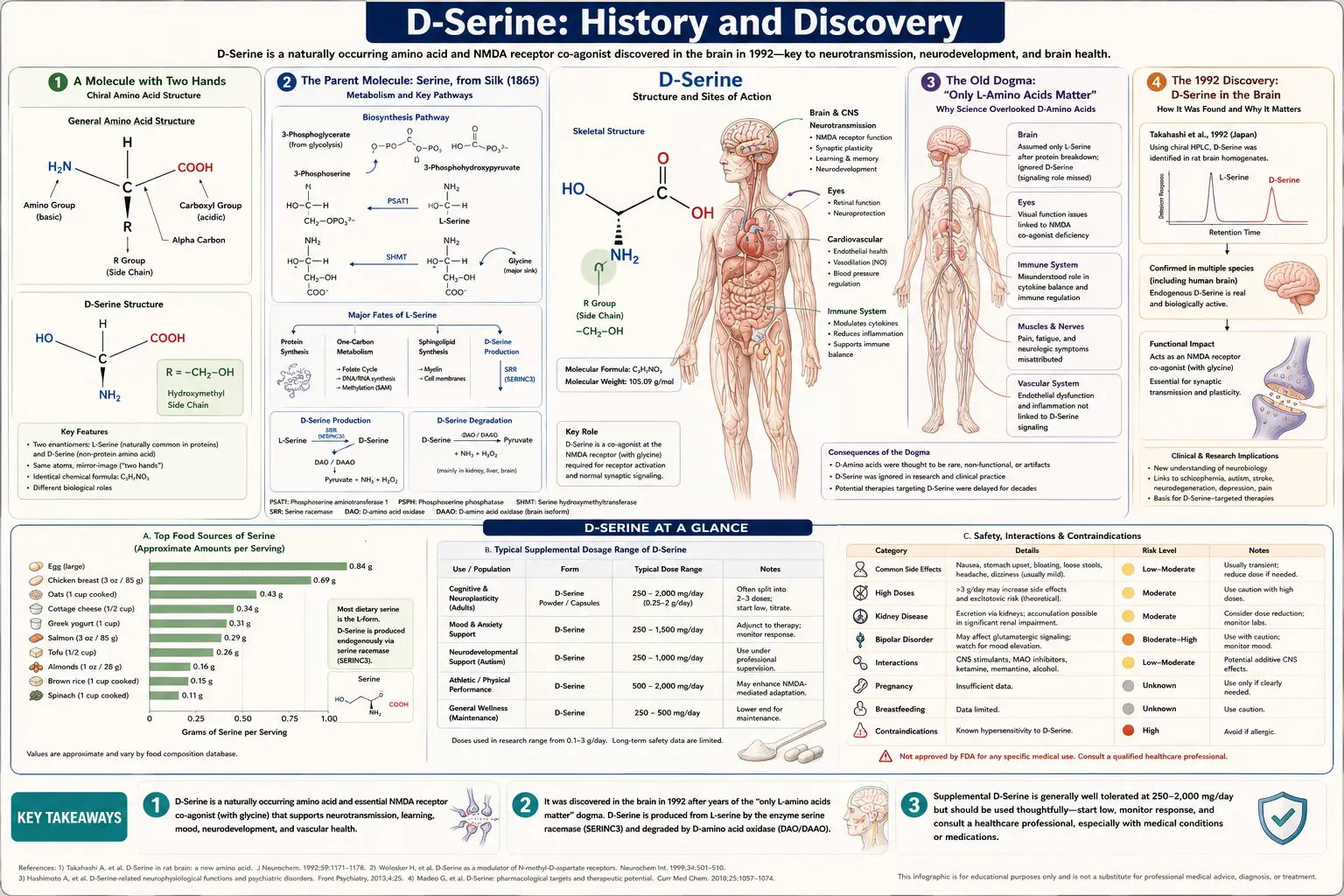
For most of the twentieth century, biology textbooks taught a simple rule: living things use only the left-handed (L-) forms of amino acids, while the mirror-image right-handed (D-) forms are inert curiosities, found in bacteria or laboratory flasks but not in the higher animal brain. D-Serine is the molecule that broke that rule. In 1992 a team in Tokyo, led by Akikazu Hashimoto, reported that the mammalian brain is in fact loaded with one particular D-amino acid — D-serine — in amounts rivalling the most abundant ordinary neurotransmitters. The years that followed turned that surprise into one of the most important shifts in modern neuroscience: D-serine was shown to be the brain's own key for the NMDA receptor, the switch that lets memories form. This page tells that story — how the parent molecule serine was first pulled out of silk in 1865, why anyone bothered to look for its mirror image in the brain, the run of discoveries between 1992 and 2000 that proved D-serine matters, and where the science stands today. Every name, date, and finding below has been checked against the primary literature; where a claim is recent or still debated, it is flagged as such.
Table of Contents
- A Molecule with Two Hands
- The Parent Molecule: Serine, from Silk (1865)
- The Old Dogma: "Only L-Amino Acids Matter"
- The 1992 Discovery: D-Serine in the Brain
- Tracing It to the Astrocytes (1995)
- Finding the Maker: Serine Racemase (1999)
- The Co-Agonist Proven (2000)
- Into the Clinic: Schizophrenia
- Aging, Menin, and the Modern Era
- Research Papers and References
- Connections
- Featured Videos
A Molecule with Two Hands
Most amino acids, like your hands, come in two shapes that are mirror images of each other and cannot be superimposed. Chemists call these the L-form (from the Latin laevus, "left") and the D-form (from dexter, "right"). The difference sounds trivial, but to the precisely shaped machinery of a cell it is everything: an enzyme built to grip a left hand simply cannot hold a right one. Life on Earth settled, very early and almost universally, on the L-forms to build proteins. The D-forms were long treated as the road not taken — chemically real, but biologically beside the point.
D-Serine is the right-handed mirror image of the amino acid serine. To understand why its discovery in the brain caused such a stir, it helps to first meet the ordinary, left-handed parent molecule and the long assumption that its mirror image was nothing more than a chemical footnote. That is the subject of the next two sections; the heart of this article — the moment the footnote turned out to be a headline — begins in 1992.
The Parent Molecule: Serine, from Silk (1865)
The story of D-serine begins with its parent. Ordinary serine was first isolated in 1865 by the German chemist Emil Cramer, who was studying the proteins of silk. Silk turned out to be an unusually rich source of this particular building block. Working with sericin — the gummy protein that coats silk fibres — Cramer broke it down and pulled out a new amino acid from the mixture. He named it after the material it came from: the name serine derives from the Latin word for silk, sericum. (The same root gives us the word "sericulture" for silk farming.) The full three-dimensional structure of serine was worked out later, around the turn of the twentieth century.
Cramer's serine was, like nearly every amino acid isolated from a natural protein, the L-form. That is an important detail for this history: when chemists said "serine" for the next 130 years, they almost always meant L-serine, the form that proteins are built from and that the body makes and eats. The right-handed version, D-serine, was known to chemists — it can be made in the laboratory, and it turns up in some bacteria — but no one had any particular reason to think it played a meaningful role inside the human body. That assumption, reasonable as it was, is exactly what the brain would later overturn.
It is worth placing Cramer's work in its era. The nineteenth century was the great age of amino-acid isolation: asparagine had been the first ever isolated, from asparagus juice in 1806; glycine was pulled from gelatin in 1820 and named the "sugar of gelatin" for its sweet taste; tyrosine came out of cheese in 1846 (its name from the Greek tyros, "cheese"). Serine, drawn from silk in 1865, belongs squarely in this tradition of naming an amino acid for the humble material it was first found in.
The Old Dogma: "Only L-Amino Acids Matter"
To feel the force of the 1992 discovery, you have to understand how firmly the opposite was believed. By the middle of the twentieth century, biochemistry had established a tidy and largely correct picture: the proteins of plants and animals are assembled, on the ribosome, exclusively from L-amino acids. Cells even carry "quality-control" enzymes — the D-amino acid oxidases — whose job appears partly to be clearing away stray D-amino acids. The natural conclusion was that wherever a D-amino acid showed up in an animal, it was probably a contaminant, a measurement error, or a bit of bacterial debris from the gut.
There were a few early hints that the rule was not absolute. D-amino acids were known in bacterial cell walls, and trace D-aspartate had been reported in some animal tissues. But these were treated as exceptions at the margins, not as a reason to rethink the brain. The prevailing view, stated plainly, was that free D-amino acids had no meaningful role in the physiology of higher mammals. This was not dogma in a lazy sense — it reflected real evidence and the genuine difficulty of measuring tiny amounts of one mirror-image molecule against a flood of its twin. Telling L-serine from D-serine in a brain sample is a hard analytical problem, and until the tools were good enough, the question could not really be asked. By the late 1980s, those tools — sensitive gas chromatography and mass spectrometry, paired with chemistry that could separate the two mirror images — had finally arrived.
The 1992 Discovery: D-Serine in the Brain
The turning point came in 1992. A group at the National Center of Neurology and Psychiatry in Tokyo — Akikazu Hashimoto, Toru Nishikawa, and colleagues — set out to measure, carefully and quantitatively, whether free D-amino acids really were present in the mammalian brain. Using gas chromatography to separate the mirror-image forms, they found a clear, large peak that matched authentic D-serine. Their report, The presence of free D-serine in rat brain, published in the journal FEBS Letters, put a number on it: roughly 0.27 micromoles of D-serine per gram of brain tissue — not a trace, but a substantial pool.
Two features of the finding made it impossible to dismiss as contamination. First, the amount was enormous by the standards of D-amino acids: D-serine was present at concentrations comparable to many ordinary, important neurochemicals, far above the other D-amino acids the same methods detected. Second, and more striking, was its distribution. In follow-up work, Hashimoto's group and others mapped where in the brain D-serine was concentrated, and the map was telling: D-serine was richest in the forebrain — the cortex and hippocampus — and scarce in regions like the cerebellum and brainstem. That pattern did not match random contamination; it matched, almost exactly, the distribution of a specific protein already famous in neuroscience: the NMDA receptor. A molecule that mirrors the geography of a key receptor is not noise. It is a clue.
This is the genuine hinge of D-serine's history. Before 1992, the right-handed amino acids were a closed chapter in mammalian biology. After 1992, the field had a concrete, quantified anomaly: a D-amino acid, abundant, brain-specific, and sitting precisely where the brain's main learning receptor lives. The obvious next question — what is it doing there? — would take the rest of the decade to answer.
Tracing It to the Astrocytes (1995)
The next major step came from the laboratory of Solomon H. Snyder at Johns Hopkins, one of the most influential neuroscience labs of the era. In 1995, Michael J. Schell, Mark E. Molliver, and Snyder published a paper in the Proceedings of the National Academy of Sciences titled D-serine, an endogenous synaptic modulator: localization to astrocytes and glutamate-stimulated release. Using antibodies that could pick out D-serine specifically, they asked not just where in the brain it sat, but which cells held it.
The answer was a surprise within a surprise. D-serine was concentrated not in neurons — the cells everyone associates with brain signalling — but in astrocytes, the star-shaped "support" cells that wrap around synapses. For decades astrocytes had been cast as the brain's housekeeping crew: feeding neurons, mopping up waste, holding the tissue together. Finding the brain's main pool of D-serine inside astrocytes hinted that these cells might be active partners in signalling, not just passive scaffolding. The same study reported that astrocytes could release D-serine when stimulated by glutamate, the brain's principal excitatory transmitter — exactly the behaviour you would expect of a molecule that helps regulate the response to glutamate.
This is the origin of the modern idea that D-serine is a gliotransmitter — a signalling molecule released by glia (the astrocyte family) rather than by neurons. The concept was, and to some degree remains, an area of active research and debate, with later work refining exactly how much D-serine comes from astrocytes versus neurons. But the 1995 paper firmly established the central, then-radical claim: the cells that make and release the brain's NMDA-receptor co-factor are not the neurons themselves.
Finding the Maker: Serine Racemase (1999)
By the late 1990s the case for D-serine as a real brain signal was strong, but a crucial piece was missing: how does the brain make it? If D-serine were merely a contaminant or a stray, there would be no dedicated machinery to produce it. If it were a genuine signalling molecule, the brain should possess a specific enzyme to manufacture it on purpose. Finding that enzyme would be close to a clincher.
In 1999, again from the Snyder laboratory, that enzyme was caught. Herman Wolosker and colleagues published two landmark papers in the Proceedings of the National Academy of Sciences. The first, Purification of serine racemase: biosynthesis of the neuromodulator D-serine, isolated from rat brain a previously unknown enzyme that performs a single, elegant trick: it takes ordinary L-serine and flips it into D-serine. An enzyme that converts one mirror image into the other is called a racemase, so the new enzyme was named serine racemase. The second 1999 paper, Serine racemase: a glial enzyme synthesizing D-serine to regulate glutamate-N-methyl-D-aspartate neurotransmission, cloned the gene for the enzyme and confirmed that it lives in glial cells, tying the production of D-serine directly to the astrocytes that the 1995 work had already implicated.
The discovery of serine racemase mattered for two reasons. Practically, it gave researchers a handle: if you could block or delete the enzyme, you could lower the brain's D-serine and watch what happened — a powerful way to test the molecule's function. Conceptually, it closed the loop. The brain was now shown to have a dedicated, purpose-built factory for D-serine. You do not evolve a specific enzyme to manufacture a contaminant. With serine racemase in hand, D-serine could no longer be waved away; it was, beyond reasonable doubt, a molecule the brain makes on purpose for a reason.
The Co-Agonist Proven (2000)
Everything pointed to one role, and in 2000 it was nailed down. The NMDA receptor — the channel at the heart of learning and memory — had long been known to be peculiar: it refuses to open for glutamate alone. It demands a second small molecule bound to a separate site, historically called the "glycine site," before it will let the calcium through that triggers memory formation. For years that second molecule was assumed to be glycine, the simplest amino acid. The accumulating D-serine evidence suggested an alternative.
Jean-Pierre Mothet, working with the Snyder group and others, supplied the decisive experiment, published in the Proceedings of the National Academy of Sciences as D-serine is an endogenous ligand for the glycine site of the N-methyl-D-aspartate receptor. The logic was clean. They used the enzyme D-amino acid oxidase — which selectively destroys D-amino acids — to strip D-serine out of brain tissue. If D-serine were the receptor's true partner, removing it should shut the receptor down even with glutamate present. That is exactly what happened: degrading D-serine sharply reduced NMDA-receptor activity. The receptor's mysterious second key, in the brain regions that matter for memory, was D-serine itself.
With the 2000 paper, the arc that began in 1992 was complete. In eight years D-serine had gone from a startling measurement, to a molecule localized in astrocytes, to a substance with its own dedicated synthesizing enzyme, to a proven co-agonist of the brain's central learning receptor. The textbook rule that "only L-amino acids matter in the mammalian body" had a clear, well-documented exception. D-serine had earned its place as the first widely accepted D-amino acid neuromodulator in the mammalian brain.
Into the Clinic: Schizophrenia
Even before the co-agonist role was fully proven, the clinical implications were obvious enough to act on. A leading theory of schizophrenia holds that the illness involves an under-active NMDA receptor — the "NMDA hypofunction" model, supported by the observation that NMDA-blocking drugs such as ketamine and PCP can mimic the symptoms of schizophrenia in healthy people. If the receptor is under-active and D-serine is the molecule that helps switch it on, then giving D-serine might help.
The first test of that idea was reported in 1998 by Guochuan Tsai, Joseph Coyle, and colleagues, in the journal Biological Psychiatry. In a six-week, double-blind, placebo-controlled trial, schizophrenia patients who received D-serine added on top of their usual antipsychotic medication showed measurable improvements in symptoms — including the "negative" symptoms (flat mood, social withdrawal) and cognitive difficulties that standard antipsychotics treat poorly. It was a modest, early study, but it was the first time the brain's newly discovered D-amino acid had been deliberately given to patients as a treatment, and it opened a line of psychiatric research that continues today.
Two honest cautions belong here. First, the schizophrenia results across many later trials have been mixed: D-serine is promising as an add-on, not a cure, and the right dose, the right patients, and the long-term safety are still being worked out. Second, this history page is not medical advice. D-serine remains an investigational compound; the detailed evidence on dosing, kidney-safety considerations, and ongoing trials is covered on the main D-Serine page, not here. What matters for the history is the milestone: within a decade of being found in the brain at all, D-serine was in human trials — an unusually fast trip from basic discovery to the clinic.
Aging, Menin, and the Modern Era
Since 2000, D-serine research has broadened from "what is it?" to "what changes when we have too little?" A consistent theme has emerged around aging. Multiple groups have reported that brain D-serine levels, especially in the memory-forming hippocampus, tend to fall in older animals, and that this decline tracks with the well-known weakening of NMDA-dependent plasticity in the aging brain. A 2022 study by Nava-Gómez and colleagues in the journal eNeuro, titled Aging-Associated Cognitive Decline is Reversed by D-Serine Supplementation, reported that supplementing aged rats with D-serine restored aspects of cognitive flexibility and brain connectivity — results that, in animals, were striking enough to draw wider attention.
That attention sharpened around a 2023 paper that has since become the public face of the field. Lige Leng and colleagues at Xiamen University in China published, in PLOS Biology, a study titled Hypothalamic Menin regulates systemic aging and cognitive decline. They reported that a protein called Menin — long studied in cancer biology — acts in a small region of the hypothalamus to help control D-serine production, and that restoring Menin (or supplying D-serine directly) improved memory and other aging measures in mice. An important accuracy note: although this work circulated widely in news coverage in 2026, the underlying study was published in March 2023; the 2026 wave was renewed media interest, not a new paper. As with all such findings, these are animal results, and the leap to a proven anti-aging therapy in humans has not been made.
Stepping back, the larger significance of the last three decades is conceptual. D-serine forced biology to abandon a comfortable rule — that the right-handed amino acids are biologically inert in higher animals — and to take seriously the idea that astrocytes are active participants in thought and memory. It opened the now-busy field of D-amino-acid neuroscience, in which other once-dismissed mirror-image molecules are being re-examined. From a strand of silk unwound in 1865 to a co-agonist of the memory receptor mapped a century and a half later, D-serine's history is a reminder of a recurring lesson in science: the things we are most sure do not matter are sometimes precisely the things we have not yet learned to measure.
Research Papers and References
The list below gives the primary papers that mark the milestones described above, followed by curated PubMed topic-search links and authoritative external resources. The 1865 isolation of serine by Emil Cramer is described in the article as a historical event from the chemical literature of that era. Author names, titles, and journals are given as plain text; only the stable DOI, PMID, or archive link is hyperlinked, and each opens in a new tab.
- Hashimoto A, Nishikawa T, Hayashi T, Fujii N, Harada K, Oka T, Takahashi K. The presence of free D-serine in rat brain. FEBS Letters. 1992;296(1):33-36. — doi:10.1016/0014-5793(92)80397-Y Search PubMed
- Schell MJ, Molliver ME, Snyder SH. D-serine, an endogenous synaptic modulator: localization to astrocytes and glutamate-stimulated release. Proceedings of the National Academy of Sciences USA. 1995;92(9):3948-3952. — doi:10.1073/pnas.92.9.3948 · PMID: 7732010
- Tsai G, Yang P, Chung LC, Lange N, Coyle JT. D-serine added to antipsychotics for the treatment of schizophrenia. Biological Psychiatry. 1998;44(11):1081-1089. — doi:10.1016/S0006-3223(98)00279-0 · PMID: 9836012
- Wolosker H, Sheth KN, Takahashi M, Mothet JP, Brady RO Jr, Ferris CD, Snyder SH. Purification of serine racemase: biosynthesis of the neuromodulator D-serine. Proceedings of the National Academy of Sciences USA. 1999;96(2):721-725. — doi:10.1073/pnas.96.2.721 Search PubMed
- Wolosker H, Blackshaw S, Snyder SH. Serine racemase: a glial enzyme synthesizing D-serine to regulate glutamate-N-methyl-D-aspartate neurotransmission. Proceedings of the National Academy of Sciences USA. 1999;96(23):13409-13414. — doi:10.1073/pnas.96.23.13409 · PMID: 10557334
- Mothet JP, Parent AT, Wolosker H, Brady RO Jr, Linden DJ, Ferris CD, Rogawski MA, Snyder SH. D-serine is an endogenous ligand for the glycine site of the N-methyl-D-aspartate receptor. Proceedings of the National Academy of Sciences USA. 2000;97(9):4926-4931. — doi:10.1073/pnas.97.9.4926 Search PubMed
- Nava-Gómez L, Calero-Vargas I, Higinio-Rodríguez F, et al. Aging-Associated Cognitive Decline is Reversed by D-Serine Supplementation. eNeuro. 2022;9(3):ENEURO.0176-22.2022. — doi:10.1523/ENEURO.0176-22.2022 · PMID: 35584913
- Leng L, Yuan Z, Su X, et al. Hypothalamic Menin regulates systemic aging and cognitive decline. PLOS Biology. 2023;21(3):e3002033. — doi:10.1371/journal.pbio.3002033 · PMID: 36928253
Live PubMed Searches
- D-serine discovery in brain and the NMDA receptor
- Serine racemase, astrocytes, and the gliotransmitter story
External Authoritative Resources
Connections
- All Amino Acids
- D-Serine
- Serine — the L-form parent molecule
- Glycine — the other NMDA co-agonist
- Schizophrenia — the NMDA-hypofunction connection
- Alzheimer's Disease
- Menin Protein — upstream regulator of D-serine