Cysteine: Food Sources & Daily Intake
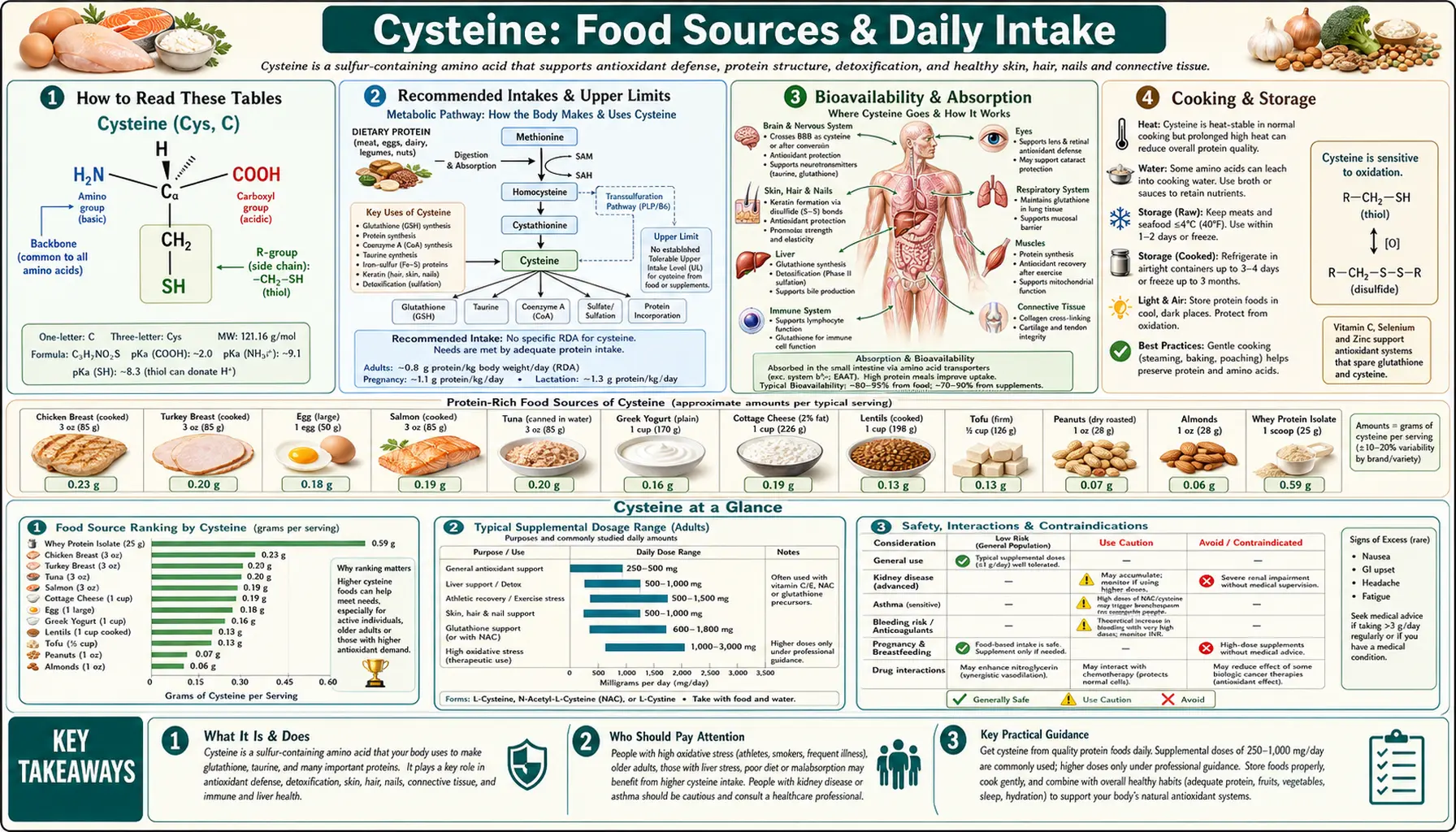
Cysteine is a sulfur-containing amino acid and the single most important building block your body uses to make glutathione, its master antioxidant. It is also rich in keratin, where its sulfur atoms form the disulfide bonds that give hair, skin and nails their strength. Cysteine is conditionally essential: the body can build it from the essential amino acid methionine, but it must come from food when methionine is limited or in infants. Sulfur amino acids are counted together — cysteine and methionine share a combined requirement. The richest sources are concentrated animal proteins — meat, poultry, eggs, fish and cheese — followed by sunflower and sesame seeds, oats, legumes and nuts. Supplements often use N-acetylcysteine (NAC), a stable form that delivers cysteine to raise glutathione. The table below shows grams of cysteine per 100 g of food (standard food databases reports it as “cystine”, the paired form); there is no FDA Daily Value for individual amino acids, so amounts are absolute.
| Cysteine: Food Sources & Daily Intake | |||||
|---|---|---|---|---|---|
| Rank | Food (serving) | Per 100 g | Glucose | Fructose | Notes |
| 1 | Pork Organ Meats 3 oz / 85 g | 🟢 0.6 g | — | — | Nutrient-dense organ meat. |
| 2 | Chicken Organ Meats 3 oz / 85 g | 🟢 0.4 g | — | — | Nutrient-dense organ meat (giblets). |
| 3 | Sesame Seeds 1 oz / 28 g | 🟢 0.3 g | — | — | |
| 4 | Sunflower Seeds 1 oz / 28 g | 🟢 0.3 g | — | — | Top plant source. |
| 5 | Peanuts 1 oz / 28 g | 🟢 0.3 g | — | — | |
| 6 | Beef Meat 3 oz / 85 g | 🟢 0.3 g | 0 | 0 | |
| 7 | Pork 3 oz / 85 g | 🟢 0.3 g | 0 | 0 | |
| 8 | Salmon 3 oz / 85 g | 🟢 0.3 g | 0 | 0 | |
| 9 | Egg 1 large / 50 g | 🟢 0.3 g | — | — | |
| 10 | Tuna 3 oz / 85 g | 🟡 0.3 g | 0 | 0 | |
| 11 | Beef Organ Meats 3 oz / 85 g | 🟡 0.3 g | — | — | Nutrient-dense organ meat. |
| 12 | Shrimp 3 oz / 85 g | 🟡 0.3 g | — | — | |
| 13 | Turkey Breast 3 oz / 85 g | 🟡 0.3 g | 0 | 0 | |
| 14 | Oats 1/2 cup dry / 40 g | 🟡 0.3 g | — | — | Whole-grain source. |
| 15 | Parmesan Cheese 1 oz / 28 g | 🟡 0.2 g | — | — | |
| 16 | Walnuts 1 oz / 28 g | 🟡 0.2 g | 0.1 | 0.1 | |
| 17 | Brown Rice 1 cup / 195 g | ⚪ 0.0 g | 0 | 0 | Common staple. |
Table of Contents
- How to Read These Tables
- Recommended Intakes & Upper Limits
- Bioavailability & Absorption
- Cooking & Storage
- Vegetarian & Vegan Sources
- Who Needs to Pay Attention
- Data Sources & References
- Connections
- Featured Videos
How to Read These Tables
- Conditionally essential. Your body can make cysteine from methionine, so a steady dietary supply is not always required — but it becomes essential when methionine is low, in infancy, or during illness and oxidative stress when glutathione demand climbs.
- Grams per 100 g, not %DV. There is no FDA Daily Value for individual amino acids, so this table reports the absolute grams per 100 g of food and ranks foods by that. A typical serving is shown beside each food. standard food databases labels cysteine as “cystine” — the dimer of two linked cysteines.
- Counted with methionine. Cysteine and methionine are the two sulfur amino acids and share a combined requirement (~15 mg/kg/day total). Eating enough cysteine spares methionine, since the body otherwise burns methionine to make it.
Recommended Intakes & Upper Limits
Your personal target depends on age, sex and pregnancy. The Daily Value used for the %DV column above is a single label figure; the table below is the age-specific guidance.
| Reference | Adult value | Notes |
|---|---|---|
| Status | Conditionally essential (sulfur AA) | The body makes it from methionine, but it becomes essential when methionine is limited or in infants. |
| Requirement | Part of ~15 mg/kg/day total sulfur AAs | Cysteine and methionine together cover the daily sulfur-amino-acid need (WHO/FAO/UNU). |
| Key roles | Glutathione & keratin | Rate-limiting precursor for glutathione (master antioxidant); forms the disulfide bonds in hair, skin and nails. |
| Richest in | Animal protein & seeds | Meat, poultry, eggs, fish and cheese, then sunflower and sesame seeds, oats, legumes and nuts. |
Bioavailability & Absorption
Cysteine from food is well absorbed as part of dietary protein. What matters most is total protein quality and quantity: animal proteins (meat, fish, eggs, dairy) are complete and cysteine-rich, while plant sources like seeds, oats and legumes supply useful amounts when eaten in variety. Because cysteine is the rate-limiting precursor for glutathione, keeping protein intake adequate is the practical way to support the body’s antioxidant defenses. Supplemental N-acetylcysteine (NAC) is a stable, well-absorbed form used clinically to deliver cysteine and raise glutathione.
Cooking & Storage
Amino acids are stable to ordinary cooking — cysteine is not destroyed by normal heat, and cooking actually makes protein easier to digest. Cysteine is, however, one of the more heat-sensitive amino acids: very high, prolonged dry heat (heavy charring or extended high-temperature processing) can degrade some of it. Gentle cooking methods preserve it well, and no special handling is needed for everyday meals.
Vegetarian & Vegan Sources
Plant-based eaters can get plenty of cysteine, but it takes a little planning because animal proteins are more cysteine-dense. The strongest plant sources are sunflower and sesame seeds, oats, lentils and other legumes, peanuts and walnuts. Eating a variety across the day (seeds + whole grains + legumes) supplies all the essential amino acids and keeps methionine adequate, which lets the body make its own cysteine; total protein simply needs to be a bit higher than for omnivores.
Who Needs to Pay Attention
Outright cysteine deficiency is rare in anyone eating enough total protein, because the body can build it from methionine. It matters most for keeping up glutathione — people under heavy oxidative stress (chronic illness, recovery from surgery, smoking, aging) may benefit from generous cysteine intake to support antioxidant defenses. The groups to watch are those with low overall protein intake: some older adults, people recovering from illness, and very-low-calorie dieters. When dietary cysteine alone falls short, N-acetylcysteine (NAC) is the supplemental form used to deliver cysteine and raise glutathione. Whole-food protein, not isolated cysteine, is the everyday fix.
Data Sources & References
- NIH MedlinePlus — Amino acids
- Linus Pauling Institute — glutathione
- PubMed — cysteine, glutathione and oxidative stress
- PubMed — sulfur amino acid requirements methionine cysteine
Connections
- All Amino Acids
- Cysteine (Main Page)
- Cysteine Benefits
- Cysteine History
- Methionine
- Taurine
- Glutathione
- Eggs