Cysteine: History and Discovery
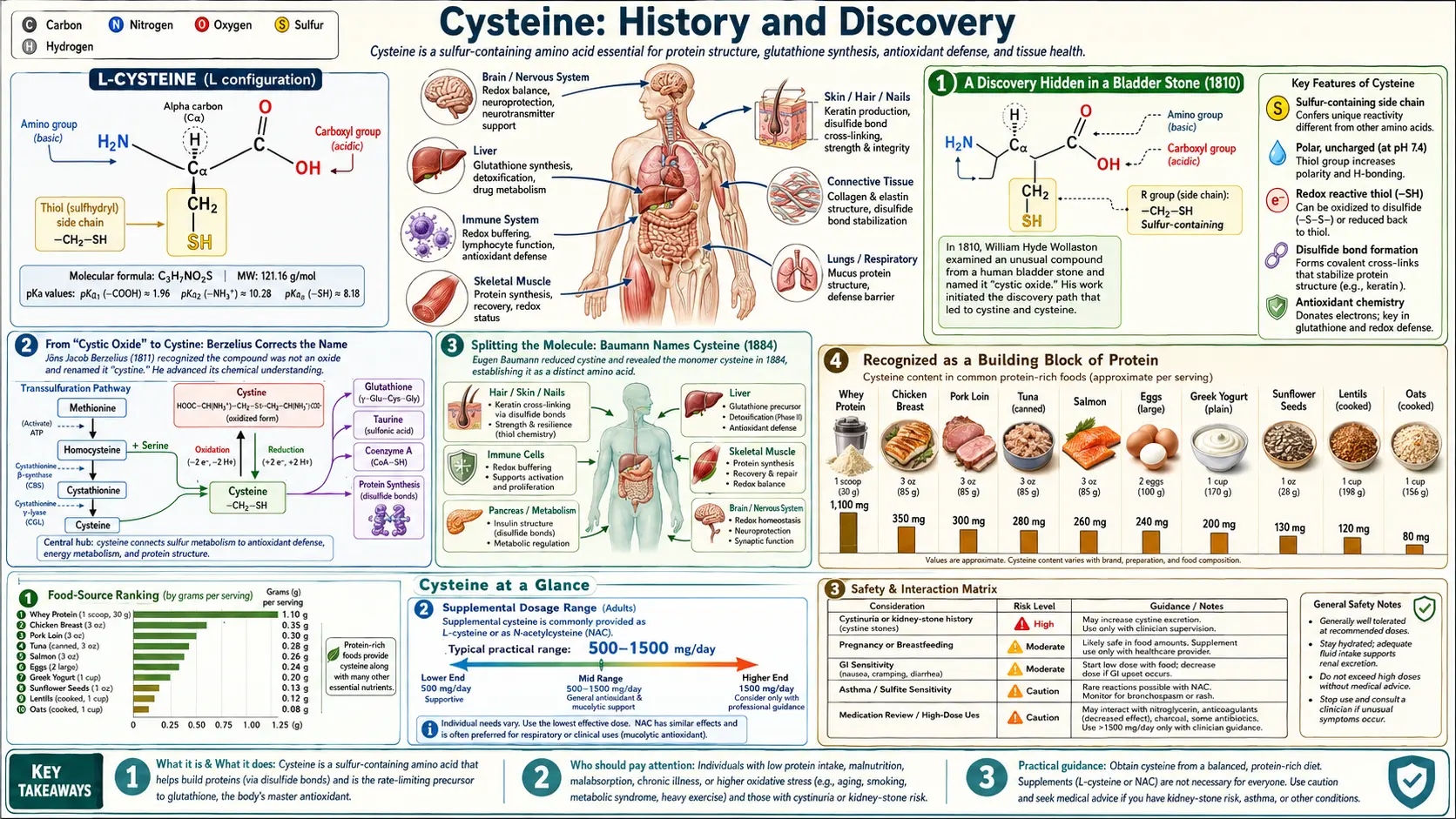
Cysteine has one of the strangest origin stories of any amino acid: it was first found not in food, not in muscle, and not in a laboratory broth, but inside a human bladder stone. In 1810 the English physician and chemist William Hyde Wollaston examined a rare kind of urinary calculus, isolated the unusual substance it was made of, and — wrongly believing it to be an oxide — named it "cystic oxide" after the Greek word for bladder. That single misnamed crystal sat at the head of a chain of discoveries that stretched across the nineteenth and twentieth centuries: a correction of its name by one of chemistry's giants, the splitting of the molecule in two to reveal cysteine itself, its recognition as a genuine building block of proteins, and finally a Nobel-Prize-winning account of how the body makes it. This article follows that chain, naming the people and dates the historical record actually supports and flagging the few places where sources still disagree.
Table of Contents
- A Discovery Hidden in a Bladder Stone (1810)
- From "Cystic Oxide" to Cystine: Berzelius Corrects the Name
- Splitting the Molecule: Baumann Names Cysteine (1884)
- Recognized as a Building Block of Protein
- Pinning Down the Structure
- The Wider Story: "Protein," Peptide Bonds, and the Amino-Acid Era
- How the Body Makes Cysteine: du Vigneaud and the Nobel Prize
- From Curiosity to Cornerstone
- References
- Connections
- Featured Videos
A Discovery Hidden in a Bladder Stone (1810)
The history of cysteine begins with a kidney-and-bladder stone, not with a meal or a muscle. In 1810, the English chemist and physician William Hyde Wollaston (1766–1828) studied a rare type of urinary calculus — a stone formed in the urinary tract — that did not match any of the known stone-forming substances of his day. He carefully isolated the material it was built from and described it in a paper read to the Royal Society of London, "On Cystic Oxide, a New Species of Urinary Calculus," published in the Philosophical Transactions of the Royal Society of London that same year.
Wollaston gave the new substance the name "cystic oxide." The first word came from the Greek kystis, meaning "bladder," because that was where the stone had formed; the second word, "oxide," reflected his honest but mistaken reasoning about its chemistry. He noticed that the substance could combine with both acids and alkalis and concluded from this behaviour that it must be a kind of oxide. It was not — but the "cyst-" root he chose has survived in the modern names of both cystine and cysteine to this day. Every time those words are written, they carry a small echo of the bladder stone where the story started.
It is worth being precise about what Wollaston actually found. The substance in that 1810 stone was not free cysteine but cystine — the paired, oxidized form in which two cysteine units are joined by a sulfur-to-sulfur (disulfide) bond. The crystals that build these unusual stones are made of cystine, and the rare inherited condition that produces them is still called cystinuria. So Wollaston's discovery is best described as the isolation of cystine; cysteine, the single "half" of that pair, would not be brought to light for another seventy-four years. This makes cysteine's history genuinely two-staged, and the sections that follow keep the two forms carefully apart.
From "Cystic Oxide" to Cystine: Berzelius Corrects the Name
Wollaston's name did not last. The substance he had called "cystic oxide" plainly was not an oxide in the mineral sense, and as chemistry matured it became clear that the term was misleading for an organic compound of this kind. The correction came from one of the most influential chemists of the age: the Swedish chemist Jöns Jacob Berzelius (1779–1848), a founder of modern chemical notation and one of the people who shaped the very vocabulary chemists still use.
Around 1833, Berzelius renamed the compound cystine, dropping the inaccurate "oxide" while keeping Wollaston's evocative bladder root. He did so with a touch of courtesy toward his predecessor, writing that he had "taken the liberty of changing the name that this distinguished man had proposed." The new name stuck, and it is the one we still use. This small episode is a good illustration of how scientific names actually settle: a first discoverer supplies a label based on the best reasoning available at the time, and a later generation, knowing more, trims the part that turned out to be wrong while preserving the part that was apt.
Berzelius's involvement is more than a footnote, because he appears again later in this story under a different hat — as the man who, a few years after renaming cystine, helped give the world the very word protein. The threads of cysteine's history and of protein chemistry as a whole run through some of the same hands.
Splitting the Molecule: Baumann Names Cysteine (1884)
For most of the nineteenth century, "cystine" was simply the name of the curious stone-forming substance, and no one had isolated cysteine as a separate compound — because no one yet realized that cystine was, in effect, two smaller molecules locked together. That realization, and the name "cysteine" itself, arrived in 1884 through the work of the German chemist Eugen Baumann (1846–1896).
Baumann showed that cystine could be chemically reduced — that the bond holding the two halves together could be broken — to yield a single, simpler molecule: the monomer. He named this reduction product cysteine (originally spelled cysteïne), explaining that he chose the name precisely "to denote the relationship of this substance to cystine." In modern terms, Baumann had demonstrated the central chemical fact about this amino acid: cysteine and cystine are two states of the same thing. Cysteine carries a free, reactive sulfur-hydrogen (thiol) group; when two cysteines are oxidized, that thiol pairs up to form the disulfide bond of cystine, and reduction splits them apart again.
This interconversion is not a chemist's curiosity — it is one of the most important reactions in all of biology. The same cysteine-to-cystine switch that Baumann performed in a flask is what lets cysteine residues stitch proteins into their proper three-dimensional shapes, what makes hair and nails strong, and what underlies cysteine's role in the body's antioxidant defenses. (Those biological roles are covered on the main Cysteine page and in the Benefits articles.) Sources describing Baumann's 1884 experiment generally agree on the year, the result, and the name; one widely cited account specifies that he used zinc as the reducing agent, though not every source names the exact reagent, so this page reports the reduction itself as the firmly established fact.
Recognized as a Building Block of Protein
There is an important difference between finding a substance inside a rare stone and recognizing it as an ordinary component of the proteins that make up living tissue. Wollaston's cystine came out of a disease; it took most of the rest of the century to show that the same substance is a normal, widespread part of healthy protein.
That step is generally credited to the Swedish chemist Karl A. H. Mörner, who in 1899 obtained cystine from horn tissue — a tough, keratin-rich material. This was a turning point, because it placed cystine (and therefore cysteine) firmly among the genuine building blocks of protein rather than treating it as a pathological oddity. It also pointed straight at one of cysteine's most familiar real-world roles: the high sulfur content of horn, hair, hooves, and nails comes precisely from their abundance of cysteine residues and the disulfide cross-links those residues form. The hard, springy quality of these tissues is, at the molecular level, a story about cysteine.
From this point on, cysteine took its place in the growing roster of the protein-forming amino acids that chemists were isolating one after another through the late nineteenth and early twentieth centuries — a roster whose broader history is sketched in a later section. What had begun as the analysis of a single unusual kidney stone had become the study of a universal ingredient of life.
Pinning Down the Structure
Knowing that a substance exists, and knowing exactly how its atoms are arranged, are two different achievements that often come decades apart. Cysteine and cystine were no exception. The empirical formula of cystine — the simple count of which elements it contains and in what ratios — was worked out in 1838 by the Norwegian chemist Christian J. Thaulow, well before anyone could draw its full structure.
The complete chemical structure took longer and was settled in the early twentieth century, the era when organic chemists finally had the tools to confirm a molecule's architecture by building it from scratch. The structure of cystine is generally credited to a synthesis carried out by Emil Erlenmeyer (the younger) in 1903, with the findings later confirmed by Emil Fischer and Karl Raske in 1908. Because the early literature on this point is technical and the precise credit is recorded slightly differently in different histories, this page names the best-documented milestones — Thaulow's formula in 1838 and the structural synthesis of the early 1900s — rather than reducing a genuinely incremental, multi-author achievement to a single name and date.
The upshot is straightforward. By the first decade of the twentieth century, chemists not only had cystine and cysteine in hand and understood that one converts into the other, they also knew exactly what the molecules looked like: a small amino acid built around a sulfur-bearing side chain, with cystine being two such units joined at the sulfur. That structural certainty set the stage for the next great question — not what cysteine is, but where the body gets it.
The Wider Story: "Protein," Peptide Bonds, and the Amino-Acid Era
Cysteine's discovery did not happen in isolation. It unfolded during the founding century of protein chemistry, and a few of the field's landmark moments give it context. The very word protein dates to 1838 — the same year as Thaulow's cystine formula. It was introduced in a paper by the Dutch chemist Gerardus Johannes Mulder, who adopted it on a suggestion from none other than Berzelius, the man who had renamed cystine five years earlier. The term derives from a Greek root for "of first importance," capturing the growing sense that these substances were fundamental to life.
If Mulder and Berzelius named the class of molecules, it was the German chemist Emil Fischer (1852–1919) who, around the turn of the twentieth century, explained how amino acids are strung together to build them. Fischer established that amino acids are linked by what he called peptide bonds, and he developed methods to join amino acids into chains — the foundational chemistry of how proteins are assembled. He had already been awarded the Nobel Prize in Chemistry in 1902, the official citation honouring his work on sugar and purine syntheses; his protein and peptide-bond studies belong to the same remarkable period of his career. His insights made it possible to think of cysteine not just as an isolated crystal but as one link in a long protein chain — and, crucially, as a link whose sulfur could reach across to another and form the disulfide bridges that hold many proteins in shape.
Cysteine was one of roughly twenty amino acids that chemists isolated and characterized across this long century of discovery, from asparagine — the very first amino acid ever isolated, obtained from asparagus juice in 1806 by Louis-Nicolas Vauquelin and Pierre-Jean Robiquet — through to the last of the dietary essentials identified in the 1930s. Within that sequence, cysteine holds a special place as one of only two common amino acids to contain sulfur (the other being methionine, to which it is closely related), and as one of the earliest to be discovered, thanks to Wollaston's 1810 stone.
How the Body Makes Cysteine: du Vigneaud and the Nobel Prize
By the early twentieth century the chemistry of cysteine was largely understood. The remaining mystery was biological: cysteine is described as a "conditionally essential" amino acid because, unlike the strictly essential amino acids, the body can manufacture it — but only by transforming another amino acid. Working out exactly how that transformation happens was a major achievement of mid-century biochemistry, and it is bound up with the career of the American biochemist Vincent du Vigneaud (1901–1978).
Du Vigneaud devoted much of his life to the chemistry and metabolism of the sulfur-containing amino acids — cysteine, methionine, and homocysteine. He helped establish the biological pathways now known as transmethylation and transsulfuration: the linked set of reactions by which the body passes sulfur from methionine, through homocysteine, to ultimately produce cysteine. This is the route that makes cysteine "conditionally" rather than strictly essential, and it explains why adequate methionine and the right B-vitamin cofactors matter for cysteine status — a connection still tracked clinically through the homocysteine blood test. Du Vigneaud's early interest in this chemistry grew, in part, out of his work on insulin, where he showed that the protein's sulfur came from its cysteine.
In 1955, du Vigneaud received the Nobel Prize in Chemistry, with the citation reading "for his work on biochemically important sulphur compounds, especially for the first synthesis of a polypeptide hormone." The hormone in question was oxytocin, which he had synthesized in 1953 — the first synthesis of any peptide hormone, and a feat that depended on precisely the sulfur-and-disulfide chemistry that cysteine makes possible. Cysteine, the molecule first glimpsed in a bladder stone, had become central to one of the defining achievements of twentieth-century biochemistry.
From Curiosity to Cornerstone
Looked at whole, cysteine's history is a small model of how scientific knowledge is built — not in one flash of insight but in stages, each correcting and extending the last. Wollaston found a substance in a stone and named it after the bladder. Berzelius fixed the name. Baumann split the molecule and named cysteine. Mörner showed it was a real part of everyday protein. Thaulow, Erlenmeyer, Fischer, and others established what it actually looked like. And du Vigneaud's school showed how the living body manufactures it. No single person "invented" cysteine; like every natural molecule, it was uncovered piece by piece by many hands across nearly a century and a half.
It is also a story with an unusually neat arc from the obscure to the essential. A rare and painful kind of kidney stone — the very thing that first revealed cystine — turned out to contain a molecule that is, in its reduced cysteine form, one of the body's most versatile and important amino acids: the sulfur-bearing unit behind the strength of hair and nails, the disulfide architecture of countless proteins, and the production of the body's master antioxidant, glutathione. The detailed modern science of those roles, along with food sources, supplement forms such as N-acetyl cysteine, and dosing, is covered on the main Cysteine page and across the Cysteine Benefits articles. This history is simply the record of how we came to know it at all — and a reminder that even the most fundamental ingredients of life were, once, an unexplained crystal that someone took the trouble to examine.
References
The sources below document the discovery history described above. Author names, titles, and journals are given as plain text; only stable DOIs, PMIDs, archive links, and curated PubMed topic searches are hyperlinked, and each opens in a new tab. Wollaston's original 1810 paper is named as a historical primary source; the linked NCBI record is a verifiable digitized reprint of that work.
- Wollaston WH. On cystic oxide, a new species of urinary calculus. Philosophical Transactions of the Royal Society of London. 1810;100:223–230. (Historical primary source; the digitized text is available as a contemporary reprint.) — JSTOR: stable/107222; reprint PMC5699749 (PMID 30493165)
- Finkelstein JD. Homocysteine: a history in progress. Nutrition Reviews. 2000;58(7):193–204. (Reviews the sulfur-amino-acid and transsulfuration story from Wollaston's 1810 isolation of cystine onward.) — Search PubMed
- The Nobel Prize in Chemistry 1955 — Vincent du Vigneaud, "for his work on biochemically important sulphur compounds, especially for the first synthesis of a polypeptide hormone." NobelPrize.org. — nobelprize.org — du Vigneaud (Chemistry 1955)
- The Nobel Prize in Chemistry 1902 — Emil Fischer, "in recognition of the extraordinary services he has rendered by his work on sugar and purine syntheses." (Fischer's related work establishing the peptide bond came in the same era and underpins modern protein chemistry.) NobelPrize.org. — nobelprize.org — Fischer (Chemistry 1902)
- Cysteine and cystine — discovery and naming history (Wollaston, Berzelius, Baumann, Mörner) PubMed: cystine and cysteine history
- Transsulfuration and the biosynthesis of cysteine from methionine PubMed: transsulfuration and cysteine biosynthesis
External Authoritative Resources
- Cystinuria — StatPearls (NCBI Bookshelf), on the cystine stones that first revealed the molecule
- PubChem — Cysteine (compound record)
- PubMed — all research on cysteine