Taurine — Benefits Deep Dive
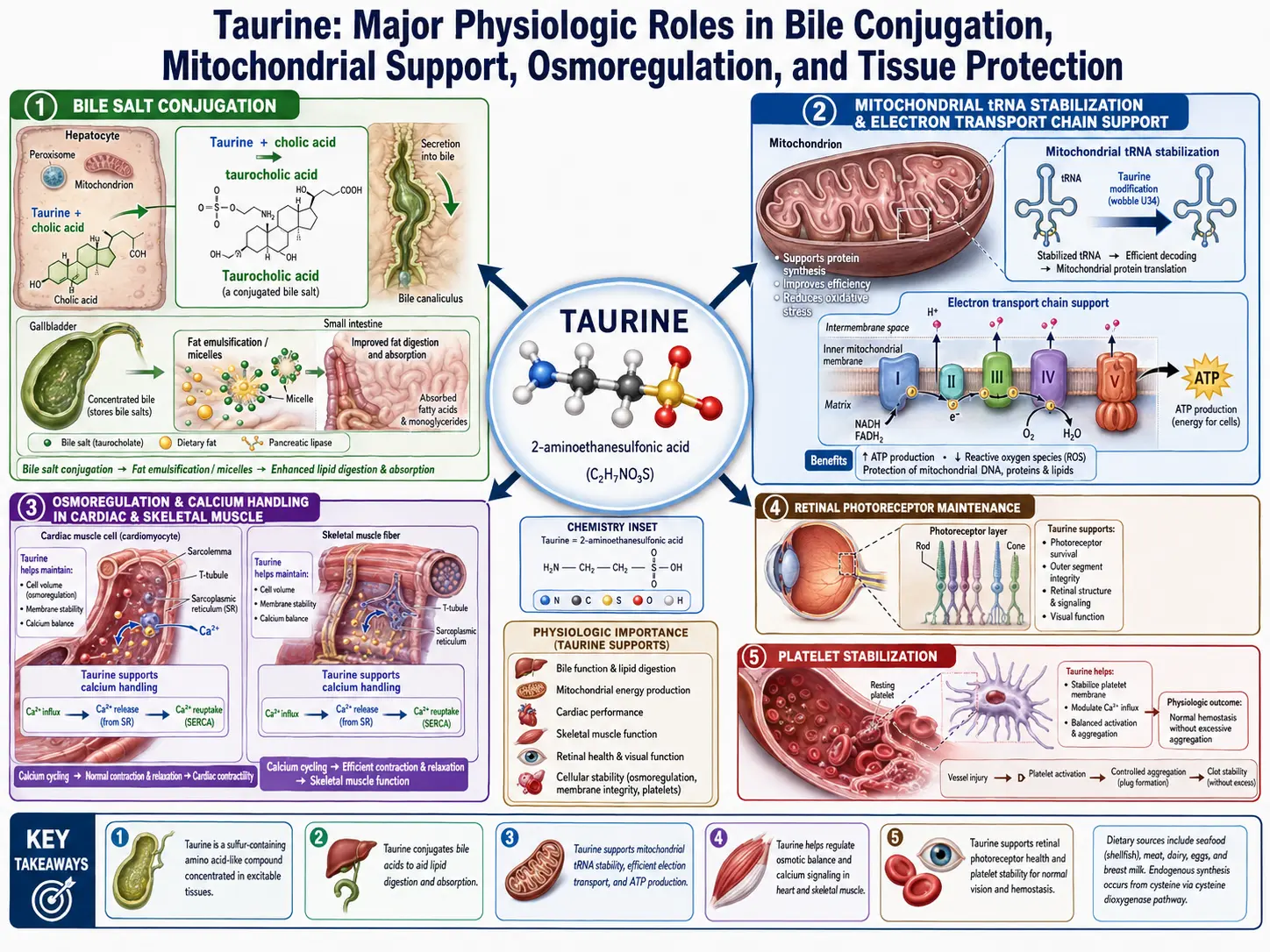
Taurine is described as the most abundant intracellular amino acid in humans (Lourenço and Camilo 2002), with very high concentrations in heart and muscle and high levels in the brain and retina. It is the only major amino acid in human biology with a sulfonic acid terminal group instead of a carboxylic acid. That single structural detail is biologically decisive: the sulfonic acid carries a permanent negative charge across the entire physiological pH range, which makes taurine biologically inert as a protein-building block (it can't form the peptide bond) but extraordinarily useful as an organic osmolyte and membrane stabilizer. Taurine is described as conditionally essential in humans (the body makes it from methionine and cysteine in the presence of vitamin B6), essential in cats, and essential for preterm newborns, who receive it from breast milk (Gaull 1989; Lourenço and Camilo 2002). The 2023 paper by Singh, Yadav and colleagues in Science reported that circulating taurine declines with age in mice, monkeys, and humans, and that taurine given to middle-aged mice increased median lifespan by 10 to 12%; a 2025 paper in Science by Fernandez and colleagues found that circulating taurine rose or stayed the same with age in three human cohorts. Four deep-dive pages below explore the main areas of taurine research — the cardiac calcium-handling and contractile function story, the bile-acid conjugation and fat-digestion story, the electrolyte and cellular-volume osmoregulation story, and the retinal photoprotection story.
Deep-Dive Articles
Cardiac Function
Taurine is found in very high concentrations in heart muscle. Pion and colleagues (1987, Science) linked low plasma taurine in cats fed commercial diets to a reversible dilated cardiomyopathy. Small trials in heart failure reported better NYHA functional class (Azuma 1985, 14 patients) and exercise capacity (Beyranvand 2011, 29 patients), and the WHO-CARDIAC study links higher urinary taurine to lower cardiovascular risk factors. Mitral valve prolapse, ischemia-reperfusion research, and population data also feature here.
Read the deep dive →Bile Acids & Fat Digestion
The original biological role for which taurine is named — Tiedemann and Gmelin first isolated the molecule from ox bile in 1827. Taurine conjugates with primary bile acids in the liver to form taurocholic and taurochenodeoxycholic acids, the principal detergents that emulsify dietary fat and enable absorption of vitamins A, D, E, and K. The deep dive compares taurine and glycine conjugation and reviews what is known about taurine in cholestasis, gallbladder removal, and fat malabsorption.
Read the deep dive →Electrolyte Balance
Taurine contributes significantly to the pool of organic osmolytes that cells use to restore their volume after osmotic stress (Lambert 2015), and it is carried into cells by the sodium-dependent taurine transporter TauT. Blood pressure, heart rhythm, muscle cramps, POTS, and magnesium taurate are explored.
Read the deep dive →Retinal & Eye Health
In the rat eye, taurine is the most abundant amino acid in the retina and other ocular tissues (Ripps and Shen 2012). In 1975, Hayes, Carey, and Schmidt reported that photoreceptor degeneration developed in cats fed casein as their protein source, associated with a selective fall in plasma and retinal taurine; taurine-deficient cats were later described as common on unfortified diets, and commercial cat food came to be fortified. Age-related macular degeneration, vigabatrin retinopathy, retinitis pigmentosa, and diabetic retinopathy each have a taurine angle.
Read the deep dive →Table of Contents
- Deep-Dive Articles
- Why Taurine Produces Effects Across Many Systems
- Research Papers: Cardiac Function
- Research Papers: Bile Acids & Fat Digestion
- Research Papers: Electrolyte Balance & Osmoregulation
- Research Papers: Retinal & Eye Health
- Research Papers: Cross-Cutting (Mechanism, Aging, Longevity)
- External Authoritative Resources
- Connections
- Featured Videos
Why Taurine Produces Effects Across Many Systems
Most amino acids in human biology do one thing well: they get incorporated into protein. Their sequence, in genetically programmed combinations, builds the enzymes, structural proteins, transporters, and signaling molecules that constitute cellular machinery. The 20 canonical proteinogenic amino acids share a common architecture — a central alpha carbon flanked by an amine group, a carboxylic acid group, and a variable side chain — that allows them to form the peptide bond at the heart of protein synthesis.
Taurine is structurally different in a single but decisive way: instead of a carboxylic acid group (−COOH), it carries a sulfonic acid group (−SO&sub3;H). The sulfonic acid is a vastly stronger acid (pKa around 1.5 versus around 4 for a typical carboxylic acid), which means taurine is fully ionized as a negatively charged sulfonate across the entire physiological pH range. Taurine is not thought to be built into proteins, as no aminoacyl-tRNA synthetase for it has been identified (Lambert and colleagues 2015); instead it serves a different family of biological functions.
Reviews group taurine's effects on the heart, eye, brain, bile, and electrolyte balance around three properties:
- Taurine is a “compatible solute” — an organic osmolyte. Its zwitterionic, fully ionized, neutral-net-charge structure allows it to accumulate in cells to high cytoplasmic concentrations (millimolar, sometimes tens of millimolar) without poisoning protein function or disturbing membrane potential. Cells use taurine to defend their volume against osmotic stress — in tissues such as the kidney medulla and the brain; in the mammalian heart, its osmoregulatory role has been questioned (Schaffer and colleagues 2010). This is the role explored in the Electrolyte Balance deep-dive.
- Taurine is a membrane stabilizer. Taurine interacts directly with membrane phospholipids, and its role in heart-muscle contraction is attributed to changes in the activity of key calcium transporters and the calcium sensitivity of the contractile fibres (Schaffer and colleagues 2010). These actions are proposed to underlie taurine's effects on cardiac contractility (the Cardiac Function deep-dive) and photoreceptor protection (the Retinal and Eye Health deep-dive).
- Taurine is one of the two amino acids used for bile acid conjugation. A single human liver enzyme conjugates bile acids with either glycine or taurine (Falany and colleagues 1994). The strongly anionic sulfonic acid group makes taurine-conjugated bile salts more fully ionized at low pH than glycine conjugates. This is the role explored in the Bile Acids and Fat Digestion deep-dive.
Beyond these three primary roles, taurine has several secondary functions that ride on the same chemistry: neuromodulation (taurine meets many of the criteria for a neurotransmitter, though no taurine-specific receptor has been identified; Ripps and Shen 2012), the taurine-containing modified uridines of human mitochondrial tRNAs, which are missing in mutant tRNAs from MELAS and MERRF cells (Suzuki and colleagues 2002), limitation of the mitochondrial permeability transition during ischemia-reperfusion in experimental studies (Schaffer and colleagues 2014), and hypochlorous acid scavenging, which converts the neutrophil oxidant into the less toxic taurine chloramine (Marcinkiewicz and Kontny 2014).
The aging story is the most recent and the most contested. In the 2023 Science paper by Singh, Yadav and colleagues, serum taurine in mice fell from about 132 ng/mL at 4 weeks to about 40 ng/mL at 56 weeks; in 15-year-old monkeys it was 85% lower than in 5-year-old monkeys; and in elderly humans it was more than 80% lower than in younger people. Mice given taurine (1,000 mg per kg of body weight daily) from 14 months of age had a 10 to 12% longer median lifespan and an 18 to 25% longer life expectancy at 28 months; treated female mice gained about 10% less weight with age and had greater bone mass. The paper did not test a human dose. In humans its evidence was associational, and it discloses that Columbia University filed provisional patent applications naming Yadav as an inventor.
In 2025, Fernandez, de Cabo and colleagues at the U.S. National Institute on Aging reported in Science that circulating taurine increased or remained unchanged with age in three geographically distinct human cohorts, as well as in nonhuman primates and mice, and concluded that a change in circulating taurine is not a universal feature of aging. The epidemiological evidence is also associational: in the WHO-CARDIAC study, people with above-average 24-hour urinary taurine and magnesium excretion had lower body mass index, blood pressure, and cholesterol (Yamori and colleagues 2010). No randomized trial has tested whether taurine supplementation affects human aging or longevity.
Research Papers: Cardiac Function
- Pion PD, Kittleson MD, Rogers QR, Morris JG. Myocardial failure in cats associated with low plasma taurine: a reversible cardiomyopathy. Science. 1987;237(4816):764-8. — doi:10.1126/science.3616607 · PubMed PMID: 3616607
- Azuma J, Sawamura A, Awata N, Ohta H, Hamaguchi T, Harada H, et al. Therapeutic effect of taurine in congestive heart failure: a double-blind crossover trial. Clinical Cardiology. 1985;8(5):276-82. — doi:10.1002/clc.4960080507 · PubMed PMID: 3888464
- Beyranvand MR, Khalafi MK, Roshan VD, Choobineh S, Parsa SA, Piranfar MA. Effect of taurine supplementation on exercise capacity of patients with heart failure. Journal of Cardiology. 2011;57(3):333-7. — doi:10.1016/j.jjcc.2011.01.007 · PubMed PMID: 21334852
- Jeejeebhoy F, Keith M, Freeman M, Barr A, McCall M, Kurian R, et al. Nutritional supplementation with MyoVive repletes essential cardiac myocyte nutrients and reduces left ventricular size in patients with left ventricular dysfunction. American Heart Journal. 2002;143(6):1092-100. — doi:10.1067/mhj.2002.121927 · PubMed PMID: 12075268
- Yamori Y, Taguchi T, Hamada A, Kunimasa K, Mori H, Mori M. Taurine in health and diseases: consistent evidence from experimental and epidemiological studies. Journal of Biomedical Science. 2010;17 Suppl 1(Suppl 1):S6. — doi:10.1186/1423-0127-17-S1-S6 · PubMed PMID: 20804626
- Schaffer SW, Jong CJ, Ramila KC, Azuma J. Physiological roles of taurine in heart and muscle. Journal of Biomedical Science. 2010;17 Suppl 1(Suppl 1):S2. — doi:10.1186/1423-0127-17-S1-S2 · PubMed PMID: 20804594
- Militante JD, Lombardini JB. Treatment of hypertension with oral taurine: experimental and clinical studies. Amino Acids. 2002;23(4):381-93. — doi:10.1007/s00726-002-0212-0 · PubMed PMID: 12436205
- Sun Q, Wang B, Li Y, Sun F, Li P, Xia W, et al. Taurine Supplementation Lowers Blood Pressure and Improves Vascular Function in Prehypertension: Randomized, Double-Blind, Placebo-Controlled Study. Hypertension. 2016;67(3):541-9. — doi:10.1161/HYPERTENSIONAHA.115.06624 · PubMed PMID: 26781281
- Suzuki T, Suzuki T, Wada T, Saigo K, Watanabe K. Taurine as a constituent of mitochondrial tRNAs: new insights into the functions of taurine and human mitochondrial diseases. EMBO Journal. 2002;21(23):6581-9. — doi:10.1093/emboj/cdf656 · PubMed PMID: 12456664
- Fujita T, Sato Y. Hypotensive effect of taurine. Possible involvement of the sympathetic nervous system and endogenous opiates. Journal of Clinical Investigation. 1988;82(3):993-7. — doi:10.1172/JCI113709 · PubMed PMID: 2971083
Research Papers: Bile Acids & Fat Digestion
- Hofmann AF, Hagey LR. Bile acids: chemistry, pathochemistry, biology, pathobiology, and therapeutics. Cellular and Molecular Life Sciences. 2008;65(16):2461-83. — doi:10.1007/s00018-008-7568-6 · PubMed PMID: 18488143
- Falany CN, Johnson MR, Barnes S, Diasio RB. Glycine and taurine conjugation of bile acids by a single enzyme. Molecular cloning and expression of human liver bile acid CoA:amino acid N-acyltransferase. Journal of Biological Chemistry. 1994;269(30):19375-9. — PubMed PMID: 8034703
- Sjövall J. Dietary glycine and taurine on bile acid conjugation in man; bile acids and steroids 75. Proceedings of the Society for Experimental Biology and Medicine. 1959;100(4):676-8. — doi:10.3181/00379727-100-24741 · PubMed PMID: 13645682
- Dawson PA, Lan T, Rao A. Bile acid transporters. Journal of Lipid Research. 2009;50(12):2340-57. — doi:10.1194/jlr.R900012-JLR200 · PubMed PMID: 19498215
- Beuers U, Trauner M, Jansen P, Poupon R. New paradigms in the treatment of hepatic cholestasis: from UDCA to FXR, PXR and beyond. Journal of Hepatology. 2015;62(1 Suppl):S25-37. — doi:10.1016/j.jhep.2015.02.023 · PubMed PMID: 25920087
- Vang S, Longley K, Steer CJ, Low WC. The Unexpected Uses of Urso- and Tauroursodeoxycholic Acid in the Treatment of Non-liver Diseases. Global Advances in Health and Medicine. 2014;3(3):58-69. — doi:10.7453/gahmj.2014.017 · PubMed PMID: 24891994
- Chiang JY. Bile acids: regulation of synthesis. Journal of Lipid Research. 2009;50(10):1955-66. — doi:10.1194/jlr.R900010-JLR200 · PubMed PMID: 19346330
- Glantz A, Marschall HU, Lammert F, Mattsson LA. Intrahepatic cholestasis of pregnancy: a randomized controlled trial comparing dexamethasone and ursodeoxycholic acid. Hepatology. 2005;42(6):1399-405. — doi:10.1002/hep.20952 · PubMed PMID: 16317669
- Vassileva G, Hu W, Hoos L, Tetzloff G, Yang S, Liu L, et al. Gender-dependent effect of Gpbar1 genetic deletion on the metabolic profiles of diet-induced obese mice. Journal of Endocrinology. 2010;205(3):225-32. — doi:10.1677/JOE-10-0009 · PubMed PMID: 20354075
- Geggel HS, Ament ME, Heckenlively JR, Martin DA, Kopple JD. Nutritional requirement for taurine in patients receiving long-term parenteral nutrition. New England Journal of Medicine. 1985;312(3):142-6. — doi:10.1056/NEJM198501173120302 · PubMed PMID: 3917547
Research Papers: Electrolyte Balance & Osmoregulation
- Huxtable RJ. Physiological actions of taurine. Physiological Reviews. 1992;72(1):101-63. — doi:10.1152/physrev.1992.72.1.101 · PubMed PMID: 1731369
- Lambert IH, Kristensen DM, Holm JB, Mortensen OH. Physiological role of taurine--from organism to organelle. Acta Physiologica. 2015;213(1):191-212. — doi:10.1111/apha.12365 · PubMed PMID: 25142161
- Han X, Patters AB, Jones DP, Zelikovic I, Chesney RW. The taurine transporter: mechanisms of regulation. Acta Physiologica. 2006;187(1-2):61-73. — doi:10.1111/j.1748-1716.2006.01573.x · PubMed PMID: 16734743
- Waldron M, Patterson SD, Tallent J, Jeffries O. The Effects of an Oral Taurine Dose and Supplementation Period on Endurance Exercise Performance in Humans: A Meta-Analysis. Sports Medicine. 2018;48(5):1247-1253. — doi:10.1007/s40279-018-0896-2 · PubMed PMID: 29546641
- Spriet LL, Whitfield J. Taurine and skeletal muscle function. Current Opinion in Clinical Nutrition and Metabolic Care. 2015;18(1):96-101. — doi:10.1097/MCO.0000000000000135 · PubMed PMID: 25415270
- Ito T, Schaffer SW, Azuma J. The potential usefulness of taurine on diabetes mellitus and its complications. Amino Acids. 2012;42(5):1529-39. — doi:10.1007/s00726-011-0883-5 · PubMed PMID: 21437784
- Murakami S. Role of taurine in the pathogenesis of obesity. Molecular Nutrition & Food Research. 2015;59(7):1353-63. — doi:10.1002/mnfr.201500067 · PubMed PMID: 25787113
- Jong CJ, Sandal P, Schaffer SW. The Role of Taurine in Mitochondria Health: More Than Just an Antioxidant. Molecules. 2021;26(16). — doi:10.3390/molecules26164913 · PubMed PMID: 34443494
- Bkaily G, Jaalouk D, Sader S, Shbaklo H, Pothier P, Jacques D, et al. Taurine indirectly increases [Ca]i by inducing Ca2+ influx through the Na(+)-Ca2+ exchanger. Molecular and Cellular Biochemistry. 1998;188(1-2):187-97. — PubMed PMID: 9823024
- Caine JJ, Geracioti TD. Taurine, energy drinks, and neuroendocrine effects. Cleveland Clinic Journal of Medicine. 2016;83(12):895-904. — doi:10.3949/ccjm.83a.15050 · PubMed PMID: 27938518
Research Papers: Retinal & Eye Health
- Hayes KC, Carey RE, Schmidt SY. Retinal degeneration associated with taurine deficiency in the cat. Science. 1975;188(4191):949-51. — doi:10.1126/science.1138364 · PubMed PMID: 1138364
- Hayes KC, Trautwein EA. Taurine deficiency syndrome in cats. Veterinary Clinics of North America. Small Animal Practice. 1989;19(3):403-13. — doi:10.1016/s0195-5616(89)50052-4 · PubMed PMID: 2658282
- Sturman JA. Taurine in development. Physiological Reviews. 1993;73(1):119-47. — doi:10.1152/physrev.1993.73.1.119 · PubMed PMID: 8419963
- Ripps H, Shen W. Review: taurine: a "very essential" amino acid. Molecular Vision. 2012;18:2673-86. — PubMed PMID: 23170060
- Jammoul F, Wang Q, Nabbout R, Coriat C, Duboc A, Simonutti M, et al. Taurine deficiency is a cause of vigabatrin-induced retinal phototoxicity. Annals of Neurology. 2009;65(1):98-107. — doi:10.1002/ana.21526 · PubMed PMID: 19194884
- Heller-Stilb B, van Roeyen C, Rascher K, Hartwig HG, Huth A, Seeliger MW, et al. Disruption of the taurine transporter gene (taut) leads to retinal degeneration in mice. FASEB Journal. 2002;16(2):231-3. — doi:10.1096/fj.01-0691fje · PubMed PMID: 11772953
- Froger N, Cadetti L, Lorach H, Martins J, Bemelmans AP, Dubus E, et al. Taurine provides neuroprotection against retinal ganglion cell degeneration. PLOS ONE. 2012;7(10):e42017. — doi:10.1371/journal.pone.0042017 · PubMed PMID: 23115615
- Lima L, Obregon F, Cubillos S, Fazzino F, Jaimes I. Taurine as a micronutrient in development and regeneration of the central nervous system. Nutritional Neuroscience. 2001;4(6):439-43. — doi:10.1080/1028415x.2001.11747379 · PubMed PMID: 11843263
- Yu X, Xu Z, Mi M, Xu H, Zhu J, Wei N, et al. Dietary taurine supplementation ameliorates diabetic retinopathy via anti-excitotoxicity of glutamate in streptozotocin-induced Sprague-Dawley rats. Neurochemical Research. 2008;33(3):500-7. — doi:10.1007/s11064-007-9465-z · PubMed PMID: 17762918
- Pasantes-Morales H, Klethi J, Ledig M, Mandel P. Free amino acids of chicken and rat retina. Brain Research. 1972;41(2):494-7. — doi:10.1016/0006-8993(72)90523-9 · PubMed PMID: 5038343
- Geggel HS, Ament ME, Heckenlively JR, Martin DA, Kopple JD. Nutritional requirement for taurine in patients receiving long-term parenteral nutrition. New England Journal of Medicine. 1985;312(3):142-6. — doi:10.1056/NEJM198501173120302 · PubMed PMID: 3917547
Research Papers: Cross-Cutting (Mechanism, Aging, Longevity)
- Singh P, Gollapalli K, Mangiola S, Schranner D, Yusuf MA, Chamoli M, et al. Taurine deficiency as a driver of aging. Science. 2023;380(6649):eabn9257. — doi:10.1126/science.abn9257 · PubMed PMID: 37289866
- Fernandez ME, Bernier M, Price NL, Camandola S, Aon MA, Vaughan K, et al. Is taurine an aging biomarker? Science. 2025;388(6751):eadl2116. — doi:10.1126/science.adl2116 · PubMed PMID: 40472098
- Yamori Y, Taguchi T, Mori H, Mori M. Low cardiovascular risks in the middle aged males and females excreting greater 24-hour urinary taurine and magnesium in 41 WHO-CARDIAC study populations in the world. Journal of Biomedical Science. 2010;17 Suppl 1(Suppl 1):S21. — doi:10.1186/1423-0127-17-S1-S21 · PubMed PMID: 20804596
- Wójcik OP, Koenig KL, Zeleniuch-Jacquotte A, Costa M, Chen Y. The potential protective effects of taurine on coronary heart disease. Atherosclerosis. 2010;208(1):19-25. — doi:10.1016/j.atherosclerosis.2009.06.002 · PubMed PMID: 19592001
- Yamori Y, Liu L, Mori M, Sagara M, Murakami S, Nara Y, et al. Taurine as the nutritional factor for the longevity of the Japanese revealed by a world-wide epidemiological survey. Advances in Experimental Medicine and Biology. 2009;643:13-25. — doi:10.1007/978-0-387-75681-3_2 · PubMed PMID: 19239132
- De Carvalho FG, Brandao CFC, Batitucci G, Souza AO, Ferrari GD, Alberici LC, et al. Taurine supplementation associated with exercise increases mitochondrial activity and fatty acid oxidation gene expression in the subcutaneous white adipose tissue of obese women. Clinical Nutrition. 2021;40(4):2180-2187. — doi:10.1016/j.clnu.2020.09.044 · PubMed PMID: 33051044
- Schaffer SW, Jong CJ, Ito T, Azuma J. Effect of taurine on ischemia-reperfusion injury. Amino Acids. 2014;46(1):21-30. — doi:10.1007/s00726-012-1378-8 · PubMed PMID: 22936072
- Kim KS, Jang MJ, Fang S, Yoon SG, Kim IY, Seong JK, et al. Anti-obesity effect of taurine through inhibition of adipogenesis in white fat tissue but not in brown fat tissue in a high-fat diet-induced obese mouse model. Amino Acids. 2019;51(2):245-254. — doi:10.1007/s00726-018-2659-7 · PubMed PMID: 30255260
- Sturman JA, Hayes KC. The biology of taurine in nutrition and development. Advances in Nutritional Research. 1980:231-299. — doi:10.1007/978-1-4757-4448-4_9
- Wright CE, Tallan HH, Lin YY, Gaull GE. Taurine: biological update. Annual Review of Biochemistry. 1986;55:427-53. — doi:10.1146/annurev.bi.55.070186.002235 · PubMed PMID: 3527049
- Gaull GE. Taurine in pediatric nutrition: review and update. Pediatrics. 1989;83(3):433-42. — PubMed PMID: 2645571
- Lourenço R, Camilo ME. Taurine: a conditionally essential amino acid in humans? An overview in health and disease. Nutrición Hospitalaria. 2002;17(6):262-70. — PubMed PMID: 12514918
- Marcinkiewicz J, Kontny E. Taurine and inflammatory diseases. Amino Acids. 2014;46(1):7-20. — doi:10.1007/s00726-012-1361-4 · PubMed PMID: 22810731
PubMed Topic Searches
External Authoritative Resources
- Linus Pauling Institute — the Micronutrient Information Center maintains a regularly updated scientific summary of taurine biology (search the LPI MIC for “taurine”)
- NIH Office of Dietary Supplements — consumer and clinical fact sheets for many nutrients (taurine does not have an individual ODS fact sheet, but is discussed in several related ones)
- European Food Safety Authority — Scientific Opinion on the Safety of Taurine in Energy Drinks (2009) — the 2009 EFSA opinion on the use of taurine and D-glucurono-γ-lactone as constituents of energy drinks
- PubMed — All research on Taurine
- Singh, Gollapalli, et al. (2023) — Taurine deficiency as a driver of aging (Science) — the landmark Yadav lab paper from Columbia University
Connections
- All Amino Acids
- Taurine (Main Page)
- Taurine for Cardiac Function
- Taurine for Bile Acids & Fat Digestion
- Taurine for Electrolyte Balance
- Taurine for Retinal & Eye Health
- Cysteine (Taurine Precursor)
- Methionine (Sulfur Pathway)
- Glycine (Alternative Bile Conjugator)
- Arginine (NO Precursor)
- Magnesium (Mg-Taurate Synergy)
- Potassium
- Calcium
- Vitamin B6 (P5P, taurine synthesis cofactor)
- Vitamin A (Retinal Pigment Substrate)
- Hypertension
- Heart Failure
- Atrial Fibrillation
- POTS
- Macular Degeneration
- Diabetes
- Insulin Resistance
- Metabolic Syndrome
- Omega-3 Fatty Acids
- Organ Meats (Taurine-Rich)
- Beef
- Liver Cleansing
- Oxidative Stress
- History
- Sources