Glycine — Benefits Deep Dive
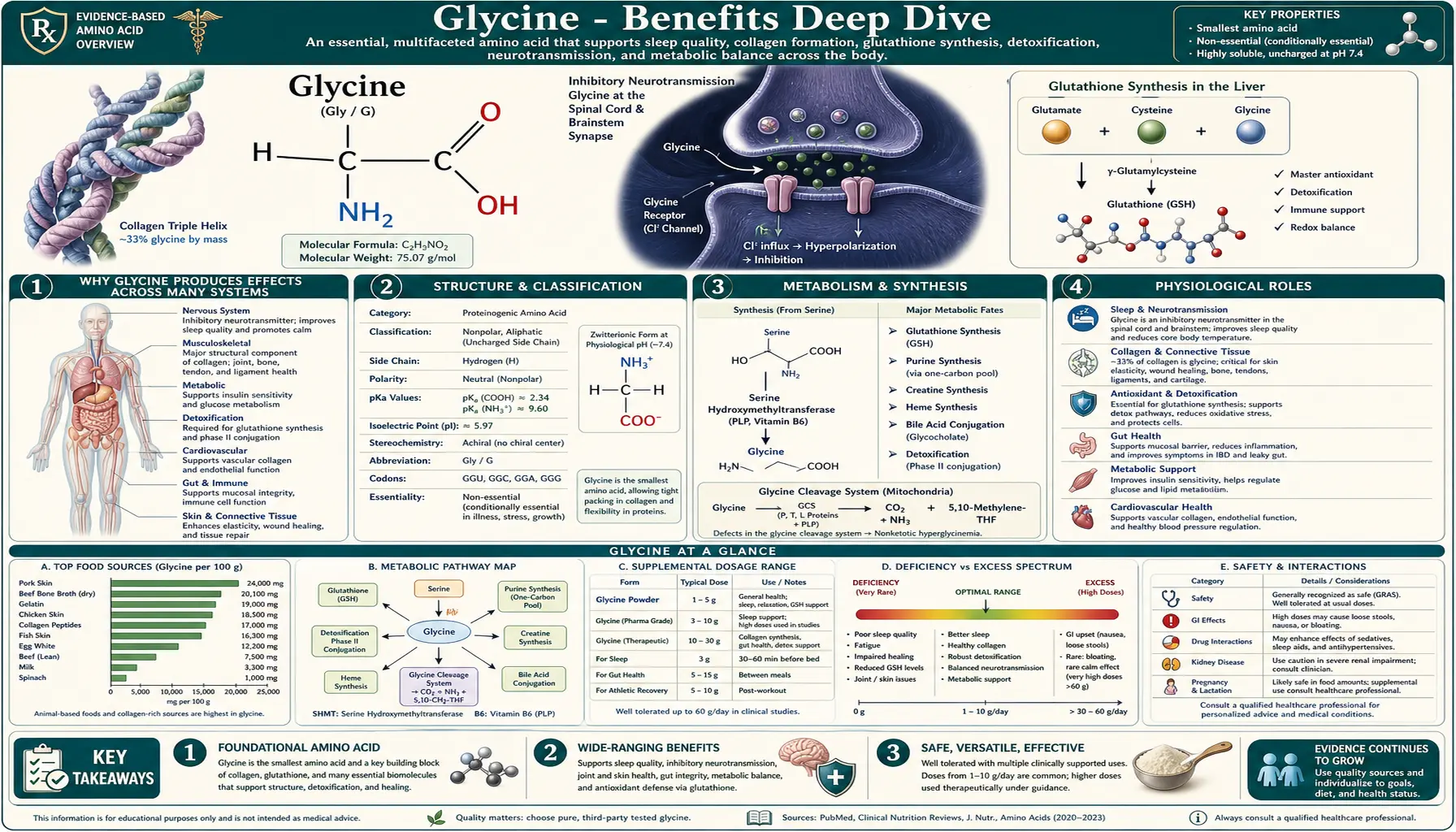
Glycine is the smallest of the twenty standard amino acids — a single hydrogen atom as its side chain — and the most structurally simple. It turns up in four largely separate parts of physiology. It fills every third position in the collagen triple helix, because no larger amino acid fits there, so roughly one residue in three of the helix is glycine. It is an inhibitory neurotransmitter acting at glycine receptors in the spinal cord and brainstem (Lynch 2004), and a required co-agonist at NMDA glutamate receptors. It is the often-overlooked third amino acid in glutathione (glutamate + cysteine + glycine); a series of small studies from one research group reported that glycine plus N-acetylcysteine (GlyNAC) raised glutathione in older adults and some patient groups, while the one independent randomized trial found no rise in glutathione (Lizzo 2022). And it is the amino acid the glycine N-acyltransferase (GLYAT) enzyme joins to salicylate, benzoate and other carboxylic acids, forming salicyluric and hippuric acids for excretion; with large aspirin doses this route becomes progressively saturated (Patel 1990). Four benefit pages below cover each of these in more detail.
Deep-Dive Articles
Sleep & Relaxation
Glycine as an inhibitory neurotransmitter at brainstem and spinal-cord glycine receptors, and three small manufacturer-run studies (3 g at bedtime): better subjective sleep quality; shorter time to fall asleep and to reach slow-wave sleep in one sleep-lab study; less next-day fatigue after restricted sleep in one placebo-controlled study. Also the rat research on skin blood flow, core temperature and NMDA receptors in the brain's circadian clock, and the high-dose schizophrenia research.
Read the deep dive →Collagen Synthesis
Why every third amino acid in the collagen triple helix is glycine and no other residue fits there, bone broth and gelatin as collagen-derived sources of glycine, the glycine-shortfall hypothesis of Meléndez-Hevia and McCarty (based on a model estimate, not a measured deficiency), wound healing, the Shaw gelatin-and-vitamin-C exercise study, the collagen-peptide skin-aging trials, and Sekhar's GlyNAC work on aging.
Read the deep dive →Glutathione Synthesis
The often-overlooked third amino acid in glutathione — glutamate, cysteine and glycine combine in a two-step ATP-dependent synthesis. Why cysteine (supplied as N-acetylcysteine, NAC) has been treated as the main limiting precursor, what the small Sekhar-group GlyNAC studies of 2011–2023 reported in older adults and patient groups (none compared the combination with NAC alone), and the one independent trial, which did not raise glutathione. Also the mitochondrial and hallmarks-of-aging outcomes reported in the 2021 open-label pilot and the 2023 randomized trial.
Read the deep dive →Aspirin Metabolism
The two-step disposal pathway aspirin → salicylate → salicyluric acid, the GLYAT enzyme in liver mitochondria, the progressive saturation of salicyluric acid formation as aspirin doses rise to toxic levels, the aspirin-overdose study that found lower plasma glycine, the Reye's syndrome mitochondrial connection, and GLYAT genetic variation.
Read the deep dive →Table of Contents
- Deep-Dive Articles
- Why Glycine Produces Effects Across Many Systems
- Research Papers: Sleep & Neurotransmission
- Research Papers: Collagen & Connective Tissue
- Research Papers: Glutathione & Aging
- Research Papers: Aspirin & Drug Conjugation
- Research Papers: Cross-Cutting (Metabolism, Diet, Safety)
- External Authoritative Resources
- Connections
- Featured Videos
Why Glycine Produces Effects Across Many Systems
Most amino acids do one or two things in the body — they get incorporated into proteins and they serve as precursors to a small number of derived molecules. Glycine is unusual because it is involved in at least four largely separate mechanisms. They all draw on the same glycine pool in the liver, blood and cells, but each is a different reason glycine is studied.
- Structural protein assembly — glycine is the obligate residue at every third position in the collagen triple helix, the constraint imposed by the fact that no other amino acid has a side chain small enough (a single hydrogen) to fit inside the cramped axial space of the triple helix. Collagen is the most abundant protein in animals (Shoulders 2009). This structural role is the background to the research on glycine and skin, bone, cartilage, tendon, ligament, and gut-lining tissue.
- Inhibitory neurotransmission — glycine activates a pentameric ligand-gated chloride channel (the glycine receptor, structurally homologous to GABAA) on neurons in the brainstem and spinal cord, dampening their excitability (Lynch 2004). Inherited mutations in human glycine-receptor genes cause a rare disorder, hyperekplexia or startle disease (Lynch 2004). Strychnine is the classical glycine-receptor antagonist. Glycine receptors are sometimes proposed as the route for the sleep effects reported in small human studies, but in rats strychnine did not block the skin blood-flow response to glycine, while NMDA-receptor blockers did (Kawai 2015, an animal study).
- NMDA-receptor coagonism — glycine binds to the "glycine site" on the NMDA glutamate receptor, where it is required as a coagonist alongside glutamate for the channel to open. In rats, the sleep-promoting and temperature-lowering effects of oral glycine depended on NMDA receptors in the suprachiasmatic nucleus, the brain's circadian clock (Kawai 2015, an animal study). NMDA co-agonism is also the rationale for the high-dose schizophrenia research, with mixed results: a 22-patient crossover trial reported fewer negative symptoms with 0.8 g/kg per day (Heresco-Levy 1999), while the 157-patient CONSIST trial found glycine no better than placebo (Buchanan 2007).
- Substrate for synthesis — glycine is incorporated into a long list of physiologically essential molecules:
- Glutathione (a major antioxidant inside cells; covered on the Glutathione Synthesis page)
- Creatine (energy buffer for muscle, brain, and heart)
- Heme (the iron-binding ring of hemoglobin, myoglobin, cytochromes)
- Purines (DNA and RNA bases adenine and guanine)
- Bile salts (glycine-conjugated bile acids such as glycocholate and glycochenodeoxycholate)
- Salicyluric acid and hippuric acid (drug-conjugate elimination, see Aspirin Metabolism page)
How much glycine the body needs is unsettled. A 2009 modelling study estimated that synthesis (about 3 g/day, more than 85% of it from serine) plus a typical diet (1.5–3.0 g/day) may fall short of the amount needed for all metabolic uses, including collagen synthesis, by about 10 g per day for a 70 kg adult (Meléndez-Hevia 2009). That figure is a model estimate and a hypothesis, not a measured deficiency. It underlies the Meléndez-Hevia and McCarty argument that many people may be short of glycine, and the interest in collagen peptides, bone broth and glycine powder as sources of it.
Research Papers: Sleep & Neurotransmission
- Bannai M, Kawai N (2012). New therapeutic strategy for amino acid medicine: glycine improves the quality of sleep. Journal of Pharmacological Sciences 118(2):145-8. (Review.) — PubMed PMID: 22293292
- Yamadera W, Inagawa K, Chiba S, Bannai M, Takahashi M, Nakayama K (2007). Glycine ingestion improves subjective sleep quality in human volunteers, correlating with polysomnographic changes. Sleep and Biological Rhythms 5(2):126-131. (Not indexed in PubMed.) — doi:10.1111/j.1479-8425.2007.00262.x
- Inagawa K, Hiraoka T, Kohda T, Yamadera W, Takahashi M (2006). Subjective effects of glycine ingestion before bedtime on sleep quality. Sleep and Biological Rhythms 4(1):75-77. (Not indexed in PubMed; no abstract available.) — doi:10.1111/j.1479-8425.2006.00193.x
- Kawai N, Sakai N, Okuro M, Karakawa S, Tsuneyoshi Y, Kawasaki N, Takeda T, Bannai M, Nishino S (2015). The sleep-promoting and hypothermic effects of glycine are mediated by NMDA receptors in the suprachiasmatic nucleus. Neuropsychopharmacology 40(6):1405-16. (Animal study.) — PubMed PMID: 25533534
- Lynch JW (2004). Molecular structure and function of the glycine receptor chloride channel. Physiological Reviews 84(4):1051-95. — PubMed PMID: 15383648
- Heresco-Levy U, Javitt DC, Ermilov M, Mordel C, Silipo G, Lichtenstein M (1999). Efficacy of high-dose glycine in the treatment of enduring negative symptoms of schizophrenia. Archives of General Psychiatry 56(1):29-36. — PubMed PMID: 9892253
- Buchanan RW, Javitt DC, Marder SR, Schooler NR, Gold JM, McMahon RP, Heresco-Levy U, Carpenter WT (2007). The Cognitive and Negative Symptoms in Schizophrenia Trial (CONSIST): the efficacy of glutamatergic agents for negative symptoms and cognitive impairments. American Journal of Psychiatry 164(10):1593-602. — PubMed PMID: 17898352
- Bannai M, Kawai N, Ono K, Nakahara K, Murakami N (2012). The effects of glycine on subjective daytime performance in partially sleep-restricted healthy volunteers. Frontiers in Neurology 3:61. — PubMed PMID: 22529837
- López-Corcuera B, Geerlings A, Aragón C (2001). Glycine neurotransmitter transporters: an update. Molecular Membrane Biology 18(1):13-20. — PubMed PMID: 11396606
- Razak MA, Begum PS, Viswanath B, Rajagopal S (2017). Multifarious beneficial effect of nonessential amino acid, glycine: a review. Oxidative Medicine and Cellular Longevity 2017:1716701. (Erratum published 2022.) — PubMed PMID: 28337245
Research Papers: Collagen & Connective Tissue
- Meléndez-Hevia E, De Paz-Lugo P, Cornish-Bowden A, Cárdenas ML (2009). A weak link in metabolism: the metabolic capacity for glycine biosynthesis does not satisfy the need for collagen synthesis. Journal of Biosciences 34(6):853-72. — PubMed PMID: 20093739
- McCarty MF, O'Keefe JH, DiNicolantonio JJ (2018). Dietary glycine is rate-limiting for glutathione synthesis and may have broad potential for health protection. Ochsner Journal 18(1):81-87. (Review.) — PubMed PMID: 29559876
- Shaw G, Lee-Barthel A, Ross ML, Wang B, Baar K (2017). Vitamin C-enriched gelatin supplementation before intermittent activity augments collagen synthesis. American Journal of Clinical Nutrition 105(1):136-143. — PubMed PMID: 27852613
- Proksch E, Segger D, Degwert J, Schunck M, Zague V, Oesser S (2014). Oral supplementation of specific collagen peptides has beneficial effects on human skin physiology: a double-blind, placebo-controlled study. Skin Pharmacology and Physiology 27(1):47-55. — PubMed PMID: 23949208
- Asserin J, Lati E, Shioya T, Prawitt J (2015). The effect of oral collagen peptide supplementation on skin moisture and the dermal collagen network: evidence from an ex vivo model and randomized, placebo-controlled clinical trials. Journal of Cosmetic Dermatology 14(4):291-301. — PubMed PMID: 26362110
- Clark KL, Sebastianelli W, Flechsenhar KR, Aukermann DF, Meza F, Millard RL, et al. (2008). 24-Week study on the use of collagen hydrolysate as a dietary supplement in athletes with activity-related joint pain. Current Medical Research and Opinion 24(5):1485-96. — PubMed PMID: 18416885
- Marini JC, Forlino A, Bächinger HP, Bishop NJ, Byers PH, Paepe A, et al. (2017). Osteogenesis imperfecta. Nature Reviews Disease Primers 3:17052. (Review; the collagen glycine-substitution mutations.) — PubMed PMID: 28820180
- de Miranda RB, Weimer P, Rossi RC (2021). Effects of hydrolyzed collagen supplementation on skin aging: a systematic review and meta-analysis. International Journal of Dermatology 60(12):1449-1461. — PubMed PMID: 33742704
- Persikov AV, Ramshaw JA, Brodsky B (2005). Prediction of collagen stability from amino acid sequence. Journal of Biological Chemistry 280(19):19343-9. — PubMed PMID: 15753081
- Kumar S, Sugihara F, Suzuki K, Inoue N, Venkateswarathirukumara S (2015). A double-blind, placebo-controlled, randomised, clinical study on the effectiveness of collagen peptide on osteoarthritis. Journal of the Science of Food and Agriculture 95(4):702-7. — PubMed PMID: 24852756
Research Papers: Glutathione & Aging
- Sekhar RV, McKay SV, Patel SG, Guthikonda AP, Reddy VT, Balasubramanyam A, Jahoor F (2011). Glutathione synthesis is diminished in patients with uncontrolled diabetes and restored by dietary supplementation with cysteine and glycine. Diabetes Care 34(1):162-7. — PubMed PMID: 20929994
- Sekhar RV, Patel SG, Guthikonda AP, Reid M, Balasubramanyam A, Taffet GE, Jahoor F (2011). Deficient synthesis of glutathione underlies oxidative stress in aging and can be corrected by dietary cysteine and glycine supplementation. American Journal of Clinical Nutrition 94(3):847-53. — PubMed PMID: 21795440
- Nguyen D, Hsu JW, Jahoor F, Sekhar RV (2014). Effect of increasing glutathione with cysteine and glycine supplementation on mitochondrial fuel oxidation, insulin sensitivity, and body composition in older HIV-infected patients. Journal of Clinical Endocrinology and Metabolism 99(1):169-77. — PubMed PMID: 24081740
- Kumar P, Liu C, Hsu JW, Chacko S, Minard C, Jahoor F, Sekhar RV (2021). Glycine and N-acetylcysteine (GlyNAC) supplementation in older adults improves glutathione deficiency, oxidative stress, mitochondrial dysfunction, inflammation, insulin resistance, endothelial dysfunction, genotoxicity, muscle strength, and cognition: results of a pilot clinical trial. Clinical and Translational Medicine 11(3):e372. (Open-label pilot, no placebo group.) — PubMed PMID: 33783984
- Kumar P, Liu C, Suliburk J, Hsu JW, Muthupillai R, Jahoor F, et al. (2023). Supplementing glycine and N-acetylcysteine (GlyNAC) in older adults improves glutathione deficiency, oxidative stress, mitochondrial dysfunction, inflammation, physical function, and aging hallmarks: a randomized clinical trial. Journals of Gerontology Series A: Biological Sciences and Medical Sciences 78(1):75-89. — PubMed PMID: 35975308
- Sekhar RV (2021). GlyNAC supplementation improves glutathione deficiency, oxidative stress, mitochondrial dysfunction, inflammation, aging hallmarks, metabolic defects, muscle strength, cognitive decline, and body composition: implications for healthy aging. Journal of Nutrition 151(12):3606-3616. (Review.) — PubMed PMID: 34587244
- Kumar P, Osahon OW, Sekhar RV (2023). GlyNAC (glycine and N-acetylcysteine) supplementation in old mice improves brain glutathione deficiency, oxidative stress, glucose uptake, mitochondrial dysfunction, genomic damage, inflammation and neurotrophic factors to reverse age-associated cognitive decline: implications for improving brain health in aging. Antioxidants 12(5):1042. (Animal study.) — PubMed PMID: 37237908
- López-Otín C, Blasco MA, Partridge L, Serrano M, Kroemer G (2013). The hallmarks of aging. Cell 153(6):1194-217. — PubMed PMID: 23746838
- López-Otín C, Blasco MA, Partridge L, Serrano M, Kroemer G (2023). Hallmarks of aging: an expanding universe. Cell 186(2):243-278. — PubMed PMID: 36599349
- Lu SC (2013). Glutathione synthesis. Biochimica et Biophysica Acta 1830(5):3143-53. (Review.) — PubMed PMID: 22995213
- Mosharov E, Cranford MR, Banerjee R (2000). The quantitatively important relationship between homocysteine metabolism and glutathione synthesis by the transsulfuration pathway and its regulation by redox changes. Biochemistry 39(42):13005-11. — PubMed PMID: 11041866
- Lizzo G, Migliavacca E, Lamers D, Frézal A, Corthesy J, Vinyes-Parès G, et al. (2022). A randomized controlled clinical trial in healthy older adults to determine efficacy of glycine and N-acetylcysteine supplementation on glutathione redox status and oxidative damage. Frontiers in Aging 3:852569. — PubMed PMID: 35821844
Research Papers: Aspirin & Drug Conjugation
- Levy G (1965). Pharmacokinetics of salicylate elimination in man. Journal of Pharmaceutical Sciences 54(7):959-67. — doi:10.1002/jps.2600540703
- Hutt AJ, Caldwell J, Smith RL (1986). The metabolism of aspirin in man: a population study. Xenobiotica 16(3):239-49. — doi:10.3109/00498258609043527
- Patel DK, Hesse A, Ogunbona A, Notarianni LJ, Bennett PN (1990). Metabolism of aspirin after therapeutic and toxic doses. Human & Experimental Toxicology 9(3):131-6. — doi:10.1177/096032719000900302
- Patel DK, Ogunbona A, Notarianni LJ, Bennett PN (1990). Depletion of plasma glycine and effect of glycine by mouth on salicylate metabolism during aspirin overdose. Human & Experimental Toxicology 9(6):389-95. — PubMed PMID: 2271231
- Badenhorst CPS, van der Sluis R, Erasmus E, van Dijk AA (2013). Glycine conjugation: importance in metabolism, the role of glycine N-acyltransferase, and factors that influence interindividual variation. Expert Opinion on Drug Metabolism & Toxicology 9(9):1139-53. — doi:10.1517/17425255.2013.796929
- van der Sluis R, Badenhorst CPS, Erasmus E, van Dyk E, van der Westhuizen FH, van Dijk AA (2015). Conservation of the coding regions of the glycine N-acyltransferase gene further suggests that glycine conjugation is an essential detoxification pathway. Gene 571(1):126-34. — doi:10.1016/j.gene.2015.06.081
- Knights KM, Sykes MJ, Miners JO (2007). Amino acid conjugation: contribution to the metabolism and toxicity of xenobiotic carboxylic acids. Expert Opinion on Drug Metabolism & Toxicology 3(2):159-68. — doi:10.1517/17425255.3.2.159
- Glasgow JFT (2006). Reye's syndrome: the case for a causal link with aspirin. Drug Safety 29(12):1111-21. — doi:10.2165/00002018-200629120-00003
- Starko KM, Ray CG, Dominguez LB, Stromberg WL, Woodall DF (1980). Reye's syndrome and salicylate use. Pediatrics 66(6):859-64. — PubMed PMID: 7454476
- Quick AJ (1931). The conjugation of benzoic acid in man. Journal of Biological Chemistry 92(1):65-85. — doi:10.1016/s0021-9258(18)76545-9
- Bartels M et al. (1986). Glycine N-acyltransferase: characterization of the recombinant human enzyme. — Search PubMed (Editorial note, 2026-10-14: no paper matching this entry was found in PubMed or Crossref; nothing on this page rests on it, and the link is a PubMed topic search.)
Research Papers: Cross-Cutting (Metabolism, Diet, Safety)
- Wang W, Wu Z, Dai Z, Yang Y, Wang J, Wu G (2013). Glycine metabolism in animals and humans: implications for nutrition and health. Amino Acids 45(3):463-77. (Review.) — PubMed PMID: 23615880
- Yu HH, Yang TH, Plas DR, Thompson CB (2013). Glycine and its impact on cancer cell proliferation PubMed (Editorial note, 2026-10-14: no paper matching this entry was found in PubMed or Crossref; nothing on this page rests on it, and the link is a PubMed topic search.)
- Alves A et al. (2019). Glycine metabolism and its relevance for ketogenic and low-protein diets PubMed (Editorial note, 2026-10-14: no paper matching this entry was found in PubMed or Crossref; nothing on this page rests on it, and the link is a PubMed topic search.)
- Persaud C et al. (1989). The excretion of urinary hippurate: a marker of dietary protein intake PubMed (Editorial note, 2026-10-14: no paper matching this entry was found in PubMed or Crossref; nothing on this page rests on it, and the link is a PubMed topic search.)
- Adeva-Andany M, Souto-Adeva G, Ameneiros-Rodríguez E, Fernández-Fernández C, Donapetry-García C, Domínguez-Montero A (2018). Insulin resistance and glycine metabolism in humans. Amino Acids 50(1):11-27. (Review.) — PubMed PMID: 29094215
- Gannon MC, Nuttall JA, Nuttall FQ (2002). The metabolic response to ingested glycine. American Journal of Clinical Nutrition 76(6):1302-7. — PubMed PMID: 12450897
- Zhong Z, Wheeler MD, Li X, Froh M, Schemmer P, Yin M, et al. (2003). L-Glycine: a novel antiinflammatory, immunomodulatory, and cytoprotective agent. Current Opinion in Clinical Nutrition and Metabolic Care 6(2):229-40. (Review.) — PubMed PMID: 12589194
- Sun K, Wu Z, Ji Y, Wu G (2016). Glycine regulates protein turnover by activating protein kinase B/mammalian target of rapamycin and by inhibiting MuRF1 and atrogin-1 gene expression in C2C12 myoblasts. Journal of Nutrition 146(12):2461-2467. (Cell study.) — PubMed PMID: 27798331
- Howard A, Tahir I, Javed S, Waring SM, Ford D, Hirst BH (2010). Glycine transporter GLYT1 is essential for glycine-mediated protection of human intestinal epithelial cells against oxidative damage. Journal of Physiology 588(Pt 6):995-1009. (Cell study.) — PubMed PMID: 20123783
- Bartlett K, Eaton S (2004). Mitochondrial beta-oxidation. European Journal of Biochemistry 271(3):462-9. (Review.) — PubMed PMID: 14728673
External Authoritative Resources
- Linus Pauling Institute — L-Carnitine (a related nutrient made from amino acids; the Institute has no glycine-specific page)
- PubMed — All research on glycine (papers on metabolism, neuroscience, drug conjugation, collagen and aging)
- NIH Office of Dietary Supplements — Fact Sheets
- StatPearls / NCBI Bookshelf — Biochemistry, Amino Acid Synthesis and Degradation
- PubChem — Glycine (chemical structure, properties, safety data)
- UniProt — GLYAT (Glycine N-acyltransferase) gene/protein entry
- UniProt — GLRA1 (Glycine receptor alpha-1 subunit) entry
Connections
- All Amino Acids
- Glycine (Main Page)
- Glycine for Sleep & Relaxation
- Glycine for Collagen Synthesis
- Glycine for Glutathione Synthesis
- Glycine & Aspirin Metabolism
- Cysteine
- Methionine
- Serine
- Proline
- Glutamic Acid
- Taurine
- NAC (N-Acetylcysteine)
- Glutathione
- Bone Broth
- Collagen
- Vitamin C
- Vitamin B6 (P5P)
- Magnesium
- Magnesium Glycinate
- Aspirin
- Oxidative Stress
- Sleep Hygiene
- Anti-Aging
- History
- Sources