Arginine for Cardiovascular Health and Nitric Oxide
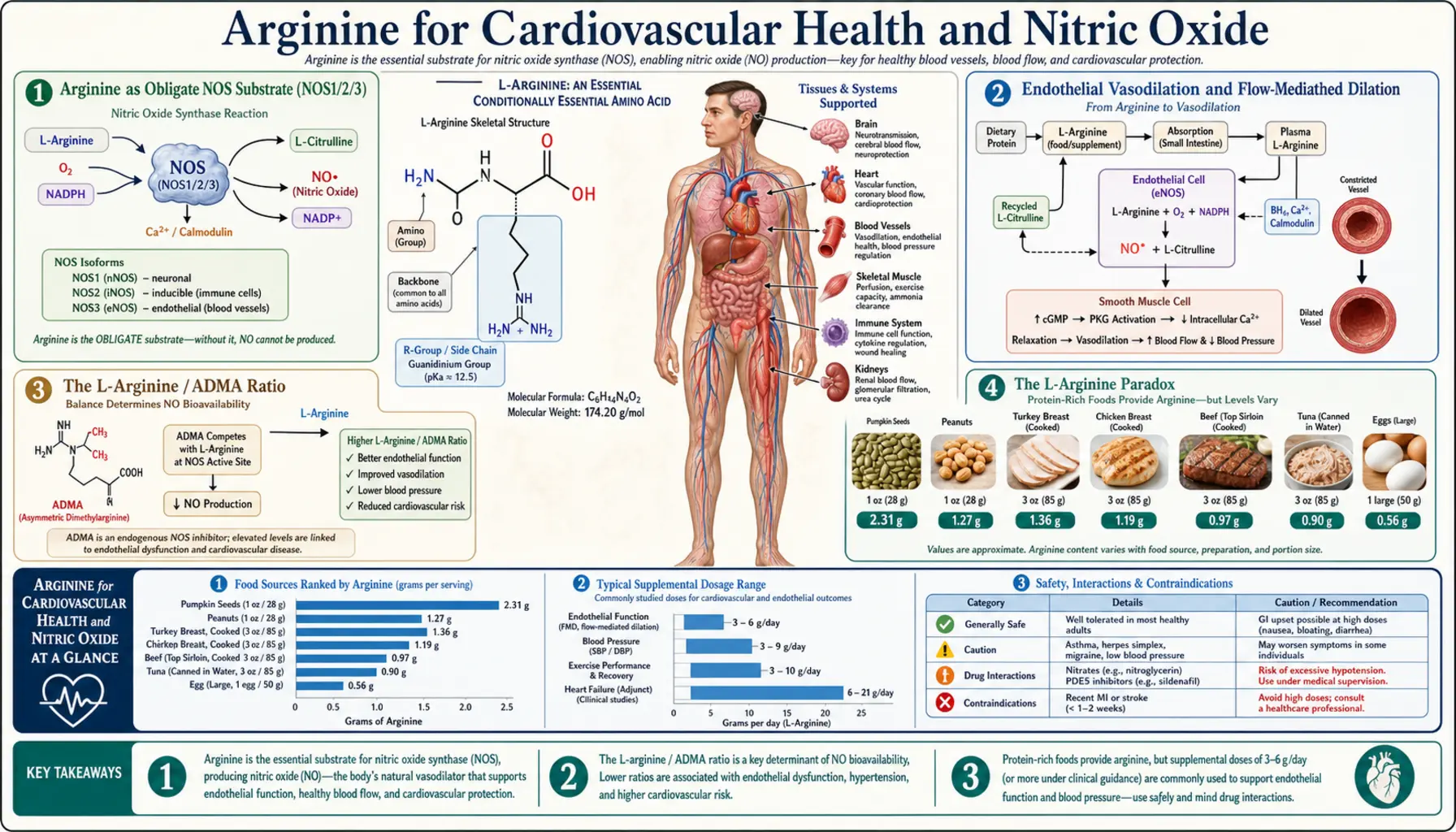
L-Arginine is the substrate of the nitric oxide synthase (NOS) family — the three isoforms NOS1 (neuronal), NOS2 (inducible) and NOS3 (endothelial) all use L-arginine and molecular oxygen to make nitric oxide (NO), the signalling molecule that keeps blood vessels dilated and has other vasoprotective effects (Förstermann 2012). Endothelial dysfunction, usually measured as impaired flow-mediated dilation, is linked to many cardiovascular risk factors. The clinical trials have not followed the biology in a straight line: short-term studies reported better endothelial function and walking distance, a 6-month trial in peripheral arterial disease found no benefit, and the VINTAGE MI trial after heart attack recorded six deaths on arginine and none on placebo, after which enrolment was closed. Oral citrulline raised plasma arginine more effectively than oral arginine in one crossover study. This page sets out the biochemistry and what the trials found in high blood pressure, endothelial dysfunction, peripheral arterial disease, stable angina and the period after a heart attack.
Table of Contents
- Arginine as the NOS Substrate (NOS1/2/3)
- Endothelial Vasodilation and Flow-Mediated Dilation
- The L-Arginine / ADMA Ratio
- The L-Arginine Paradox
- Citrulline and Plasma Arginine
- Arginase and First-Pass Loss
- Hypertension Trial Evidence
- Peripheral Arterial Disease and Stable Angina
- After a Heart Attack: the VINTAGE MI Trial
- Doses the Trials Used and What They Found
- Cautions Reported in the Research
- Key Research Papers
- Connections
- Featured Videos
Arginine as the NOS Substrate (NOS1/2/3)
Nitric oxide synthase converts L-arginine to L-citrulline and nitric oxide. All three isoforms use L-arginine and molecular oxygen as substrates, need the cofactors NADPH, FAD, FMN and tetrahydrobiopterin (BH4), bind calmodulin and contain haem (Förstermann 2012).
The three isoforms are encoded by separate genes and serve different functions (Förstermann 2012):
- NOS1 (neuronal NOS, nNOS) — constitutively expressed in central and peripheral neurons and some other cell types. Its functions include synaptic plasticity in the central nervous system, central regulation of blood pressure, smooth muscle relaxation, and vasodilation through peripheral nitrergic nerves, which matter in particular for relaxation of the corpus cavernosum and penile erection.
- NOS2 (inducible NOS, iNOS) — expressed in many cell types in response to bacterial lipopolysaccharide, cytokines and other agents. It generates large amounts of NO that have cytostatic effects on parasitic target cells, and it contributes to inflammatory disease and septic shock.
- NOS3 (endothelial NOS, eNOS) — mostly expressed in endothelial cells. It keeps blood vessels dilated, controls blood pressure and has numerous other vasoprotective and anti-atherosclerotic effects. The NO it makes diffuses into the smooth muscle underneath, activates soluble guanylate cyclase, and the rise in cyclic GMP relaxes the muscle.
Drugs such as L-NMMA (N-monomethyl-L-arginine) and L-NAME (N-omega-nitro-L-arginine methyl ester) inhibit NOS by competing with arginine at the enzyme. The body makes its own competitive inhibitor of the same kind, asymmetric dimethylarginine (ADMA), which regulates NO generation in disease states (Vallance 2004).
Endothelial Vasodilation and Flow-Mediated Dilation
The vascular endothelium is the single layer of cells lining every blood vessel. It senses the shear stress of flowing blood and circulating signals and releases mediators that control vascular tone. Nitric oxide from eNOS is one of the most studied of these. Many cardiovascular risk factors lead to oxidative stress, eNOS “uncoupling” and endothelial dysfunction (Förstermann 2012).
The usual research measure of endothelial NO function is flow-mediated dilation (FMD) of the brachial artery: a cuff briefly stops blood flow to the forearm, and when it is released the rush of blood raises shear stress on the artery wall, eNOS is activated and the artery widens. The widening is measured by ultrasound and expressed as a percent increase over the baseline diameter.
A 2009 meta-analysis of randomised, placebo-controlled trials (Bai 2009) pooled 12 short-term trials with 492 participants. Oral L-arginine raised FMD by 1.98 percentage points overall. The lower the starting FMD, the larger the effect: in trials where baseline FMD was below 7%, arginine raised it by 2.56 points, and where baseline FMD was above 7% it had no effect. Only one long-term trial was available, so the result applies to short-term use. A review by Böger (2007) describes the same pattern for ADMA: arginine appears to have no effect in people with low ADMA levels, while in people with high ADMA it restores the arginine/ADMA ratio and normalises endothelial function.
Beyond dilating vessels, endothelial NO has vasoprotective and anti-atherosclerotic effects (Förstermann 2012), and reviews describe supplemental arginine improving endothelial function in atherothrombosis (Loscalzo 2004). In an animal study, rabbits fed a high-cholesterol diet and given oral L-arginine plus L-citrulline for 12 weeks had better endothelium-dependent relaxation and regression of atheromatous lesions (Hayashi 2005); that result is from rabbits, not people.
The L-Arginine / ADMA Ratio
Asymmetric dimethylarginine (ADMA) is a methylated form of arginine released when proteins that carry methylated arginine are broken down. It binds the NOS active site but cannot be turned into NO, so it acts as a competitive inhibitor. The enzyme dimethylarginine dimethylaminohydrolase (DDAH) breaks ADMA down, and the ADMA–DDAH pathway is reviewed by Vallance and Leiper (2004). ADMA also acts as an endogenous inhibitor of angiogenesis, the growth of new blood vessels (Cooke 2003).
Two large cohorts have related ADMA to outcomes:
- AtheroGene (Schnabel 2005) — 1,874 patients with coronary artery disease followed for a mean of 2.6 years. Median ADMA was 0.70 µmol/L in those who went on to cardiovascular death or non-fatal heart attack and 0.63 µmol/L in those who did not; people in the highest third of ADMA had a hazard ratio of 2.48 compared with the lowest third.
- Framingham Offspring Study (Böger 2009) — 3,320 people from the community followed for 10.9 years. ADMA and the arginine-to-ADMA ratio were associated with death from any cause (hazard ratio 1.21 per standard deviation of ADMA), particularly in people without diabetes, but ADMA, arginine and the ratio were not associated with new cardiovascular disease.
Because NOS sees a competition between substrate (arginine) and inhibitor (ADMA), the L-arginine/ADMA ratio is proposed as the more relevant measure. Bode-Böger and colleagues (2007) suggest that large randomised trials might be needed to identify the patients most likely to benefit from arginine, and that testing ADMA and arginine to calculate the ratio might be a suitable way to do it. That remains a research proposal rather than a routine test.
The L-Arginine Paradox
The L-arginine paradox is the observation that extra arginine improves NO-mediated vascular function in living people even though the normal plasma arginine concentration is already about 25 to 30 times higher than the Michaelis constant (Km) of isolated, purified eNOS measured in the test tube (Bode-Böger 2007). By simple enzyme kinetics the enzyme would already be saturated, and adding substrate would change nothing.
Bode-Böger and colleagues (2007) name competition with ADMA as the most likely explanation. A review by Loscalzo (2004) lists several mechanisms by which supplemental arginine may raise endothelial NO bioactivity:
- Transport — increased uptake into the cell through the high-affinity cationic amino acid transporter.
- ADMA competition — substrate competition with asymmetric dimethylarginine.
- Other effects — direct antioxidant activity, histamine release from mast cells (a vasodilator response), lower norepinephrine activity, and increased insulin secretion, which itself causes vasodilation.
The same review notes a theoretical downside: through its link to methyl-group metabolism (creatine is made from guanidinoacetate in a methylation step), supplemental arginine could increase homocysteine production, which can itself impair endothelial function (Loscalzo 2004). A further proposed factor is arginase, the enzyme that competes with NOS for arginine and whose roles in vascular, pulmonary and infectious disease, immune cells and cancer are reviewed by Morris (2009).
Citrulline and Plasma Arginine
L-Citrulline, the by-product of the NOS reaction, is also a precursor of arginine. In humans arginine is made from glutamine, glutamate and proline through an intestinal–renal pathway in which the small intestine releases citrulline and the kidneys convert it to arginine (Wu 2009).
Oral arginine is subject to extensive presystemic elimination by arginase in the intestine, while oral L-citrulline is readily absorbed and at least partly converted to arginine (Schwedhelm 2008). In that double-blind, randomised, placebo-controlled crossover study in 20 healthy volunteers, citrulline raised plasma arginine (peak concentration and area under the curve) more effectively than arginine, in a dose-dependent way. The highest citrulline dose, 3 g twice daily, raised the arginine/ADMA ratio from 186 to 278 and increased urinary nitrate and cyclic GMP. No regimen improved flow-mediated dilation over baseline, although in the pooled data a larger rise in the arginine/ADMA ratio went with a larger improvement in FMD (Schwedhelm 2008).
Other studies add detail:
- Dose ranging — eight fasting healthy men took single oral doses of 2, 5, 10 or 15 g citrulline. None had side effects at any dose. Plasma arginine rose, but at the highest doses citrulline accumulated in plasma while arginine rose less than expected, which the authors attribute to saturation of the kidney’s conversion (Moinard 2008).
- Head-to-head in exercise — in a crossover study, 10 healthy adult men took placebo, arginine 6 g/day or citrulline 6 g/day for 7 days. Both raised plasma arginine by a similar amount; mean arterial blood pressure was lower only after citrulline, and only citrulline improved tolerance to severe-intensity cycling (Bailey 2015).
- Erection hardness — in a single-blind study, 24 men with mild erectile dysfunction took placebo for one month and L-citrulline 1.5 g/day for another. Erection hardness improved to normal in 2 of 24 on placebo and 12 of 24 on citrulline, with no adverse events; the authors describe it as less effective than PDE5-inhibitor drugs (Cormio 2011).
Citrulline is covered in full on the citrulline page.
Arginase and First-Pass Loss
Arginase is the last enzyme of the urea cycle. It splits arginine into ornithine and urea, which is excreted as the body’s main nitrogen waste. Mammals have two isoforms, and they play key roles in regulating most aspects of arginine metabolism in health and disease (Morris 2009):
- Arginase 1 (ARG1) — cytosolic and highly expressed in the liver, where it works in the urea cycle to dispose of ammonia from amino acid breakdown; it is also found in red blood cells and some immune cells.
- Arginase 2 (ARG2) — mitochondrial and found in tissues including the kidney and small intestine; it is associated with ornithine and polyamine production rather than the urea cycle.
Swallowed arginine passes the gut wall and the liver before it reaches the rest of the body. In stable-isotope tracer studies in healthy young men, the splanchnic region (gut and liver together) took up about 31 to 38% of dietary arginine on first pass, compared with about 10 to 15% of leucine (Castillo 1993). Schwedhelm and colleagues (2008) attribute the extensive presystemic elimination of oral arginine to arginase in the intestine.
Work on arginase has focused on its roles in vascular disease, pulmonary disease, infectious disease, immune-cell function and cancer, and on its expression in endothelial and vascular smooth muscle cells (Morris 2009). In tumours, arginine depletion by arginase-producing myeloid cells suppresses T-cell function, which is discussed on the Immune Function page. Whether oral citrulline gives a clinical advantage over arginine in any of these conditions has not been settled by trials reviewed for this page.
Hypertension Trial Evidence
The most-cited meta-analysis is Dong et al. (2011). It pooled 11 randomised, double-blind, placebo-controlled trials with 387 participants, using oral L-arginine at 4 to 24 g/day. Compared with placebo, arginine lowered systolic blood pressure by 5.39 mm Hg and diastolic blood pressure by 2.66 mm Hg, both statistically significant. Results were similar when the analysis was restricted to trials lasting 4 weeks or longer and to trials whose participants did not use blood-pressure medicines. A meta-regression suggested that the higher the starting systolic pressure, the larger the fall, but that relation was not statistically significant (P = .13). The meta-analysis did not report a dose–response limit.
Pre-eclampsia — the trial usually cited is a randomised, blinded, placebo-controlled trial in Mexico City in pregnant women at high risk of pre-eclampsia (Vadillo-Ortega 2011). It did not test arginine alone: 228 women received medical-food bars containing L-arginine plus antioxidant vitamins, 222 received the antioxidant vitamins alone and 222 received placebo bars, from weeks 14–32 of pregnancy until delivery. Pre-eclampsia was significantly less frequent with arginine plus vitamins than with placebo (absolute risk reduction 0.17) and than with vitamins alone; vitamins alone did not differ significantly from placebo. The authors write that the relative contributions of arginine and the vitamins still need to be determined, and that the result needs testing in a low-risk population.
Claims that arginine helps particular groups — salt-sensitive hypertension, hypertension with metabolic syndrome, hypertension with chronic kidney disease — were not tested in trials reviewed for this page, and no finding about them is stated here.
Peripheral Arterial Disease and Stable Angina
Peripheral arterial disease (PAD) is narrowing of the leg arteries by atherosclerosis. Its typical symptom is intermittent claudication — calf, thigh or buttock pain on walking that eases with rest.
Short-term intravenous arginine. Böger and colleagues (1998, Journal of the American College of Cardiology) randomised 39 patients with intermittent claudication to L-arginine 2 × 8 g/day, prostaglandin E1 2 × 40 µg/day, or no haemodynamically active treatment, for 3 weeks. Both active treatments were given as intermittent infusions, not by mouth. Arginine improved pain-free walking distance by 230% and absolute walking distance by 155%; prostaglandin E1 improved them by 209% and 144%; the control group did not change significantly. Arginine also improved endothelium-dependent dilation of the femoral artery, which prostaglandin E1 did not.
Six months of oral arginine. The NO-PAIN trial (Wilson 2007) randomised 133 people with claudication to oral L-arginine 3 g/day or placebo for 6 months. Arginine raised plasma arginine, but measures of NO availability, including flow-mediated dilation, were reduced or not improved compared with placebo. Absolute claudication distance improved in both groups, but significantly less in the arginine group than in the placebo group (P = 0.024). The authors concluded that, unlike short-term administration, long-term L-arginine is not useful in intermittent claudication and PAD.
An uncontrolled oral study. Jabłecka and colleagues (2012) gave oral L-arginine 3 × 2 g/day for two months to 38 patients with PAD and type 2 diabetes, with 12 healthy volunteers as a comparison group and no placebo arm. Fasting glucose and HbA1c did not change; blood NO and total antioxidant status rose. The study was not a meta-analysis, and walking distance is not reported in its abstract.
Stable angina. Two small Polish trials gave oral arginine 6 g/day for 3 days. In a randomised, double-blind, placebo-controlled study of 22 patients with stable angina and healed heart attack, arginine increased treadmill exercise capacity (Ceremuzyński 1997). In a double-blind crossover study of 25 patients with stable coronary disease, exercise duration rose from 604 to 647 seconds, with no effect on ST-segment depression or QT dispersion (Bednarz 2000). These were three-day studies; longer outcome trials in angina were not found for this page. In people after a heart attack, the VINTAGE MI trial recorded more deaths on arginine (next section).
More on these conditions is on the Cardiovascular Disease page and the related Hypertension page.
After a Heart Attack: the VINTAGE MI Trial
The VINTAGE MI trial (Schulman 2006, JAMA) was a single-centre, randomised, double-blind, placebo-controlled trial in 153 people after a first ST-elevation myocardial infarction (heart attack); 77 of them were 60 or older. Participants took L-arginine (goal dose 3 g three times a day) or a matching placebo, added to standard post-infarction treatment, for 6 months.
Arginine did not improve the measures of vascular stiffness or left ventricular ejection fraction, either in those aged 60 or older or in the whole group. Six participants (8.6%) in the arginine group died during the 6-month study, against none in the placebo group (P = .01). Because of the safety concerns, the data and safety monitoring committee closed enrolment. The investigators concluded that arginine added to standard post-infarction therapy does not improve vascular stiffness or ejection fraction and may be associated with higher post-infarction mortality, and that L-arginine should not be recommended following acute myocardial infarction.
The trial was small and the cause of the excess deaths was not established in its report. A review by Böger (2007) cites it as the study in which more people died on arginine than on placebo, alongside other trials in which arginine was not beneficial.
Doses the Trials Used and What They Found
The doses below are those the cited studies used. They are reported as study conditions, not as amounts for anyone to take; decisions about supplements belong with a clinician.
- Blood pressure — trials pooled by Dong 2011 used oral L-arginine at 4 to 24 g/day; systolic pressure fell by 5.39 mm Hg and diastolic by 2.66 mm Hg compared with placebo.
- Endothelial function — in the 12 short-term trials pooled by Bai 2009, FMD rose by 1.98 points overall, with the effect confined to people whose starting FMD was below 7%.
- Citrulline instead of arginine — citrulline up to 3 g twice daily raised plasma arginine more effectively than arginine, without an improvement in FMD (Schwedhelm 2008); 6 g/day of either for 7 days raised plasma arginine by a similar amount, with lower blood pressure only after citrulline (Bailey 2015).
- Peripheral arterial disease — 2 × 8 g/day by infusion for 3 weeks improved walking distance (Böger 1998); oral 3 g/day for 6 months did not, and walking distance improved less than on placebo (Wilson 2007).
- Stable angina — oral 6 g/day for 3 days increased exercise capacity in two small trials of 22 and 25 patients (Ceremuzyński 1997; Bednarz 2000).
- Pre-eclampsia — the trial that found fewer cases used medical-food bars combining L-arginine with antioxidant vitamins, not arginine alone (Vadillo-Ortega 2011).
- After a heart attack — goal 3 g three times a day for 6 months: no improvement in vascular stiffness or ejection fraction, 6 deaths on arginine against none on placebo, and enrolment closed for safety (Schulman 2006).
- Safety reviews — a review by Böger (2007) describes doses of 3–8 g/day as appearing safe and not causing acute pharmacological effects; a 2008 risk assessment of published trials set an “observed safe level” of 20 g/day for healthy adults, noting that data above that level are not sufficient for a confident conclusion on long-term safety (Shao 2008). Neither applies to people after a heart attack, where VINTAGE MI recorded the excess deaths.
Cautions Reported in the Research
- After a heart attack — in the VINTAGE MI trial, 6 of the people taking arginine died during the 6-month study and none on placebo, and enrolment was closed for safety; the investigators concluded that arginine should not be recommended following acute myocardial infarction (Schulman 2006).
- Nitrate medicines — nitroglycerin, isosorbide and other nitrates act through the same nitric oxide–cyclic GMP pathway. The concern about combining them with arginine is excess blood-pressure lowering; it rests on the shared mechanism, and no trial of the combination was reviewed for this page.
- PDE5 inhibitors — sildenafil, tadalafil and vardenafil act further down the same pathway and need at least some nNOS activity to work (Förstermann 2012). Arginine lowered blood pressure in the trials pooled by Dong 2011; the concern about added blood-pressure lowering again rests on the mechanism, not on a trial reviewed here.
- Herpes simplex — the idea that arginine matters for herpes comes from cell culture: herpes simplex virus did not grow in human cells in culture when arginine was withheld (Tankersley 1964), and lysine antagonised arginine’s growth-promoting effect in tissue culture (Griffith 1981). Whether arginine supplements make outbreaks more frequent has not been tested in a trial found for this page, and a 2015 Cochrane review found no evidence of efficacy for lysine in preventing cold sores (Chi 2015). See L-Lysine.
- Kidney disease — the kidneys are the main site where the body makes arginine from citrulline (Wu 2009). Studies of arginine supplements in chronic kidney disease were not reviewed for this page, and no finding about them is stated here.
- Asthma — arginase is studied in pulmonary disease (Morris 2009), and inducible NOS contributes to inflammatory disease (Förstermann 2012). No trial of arginine in asthma was reviewed for this page.
- Peripheral arterial disease — in the 6-month NO-PAIN trial, walking distance improved significantly less on arginine than on placebo (Wilson 2007).
Key Research Papers
- Böger RH, Bode-Böger SM, Thiele W, Creutzig A, Alexander K, Frölich JC (1998). Restoring vascular nitric oxide formation by L-arginine improves the symptoms of intermittent claudication in patients with peripheral arterial occlusive disease. Journal of the American College of Cardiology 32(5):1336-44. — PubMed PMID: 9809945
- Schulman SP, Becker LC, Kass DA, Champion HC, Terrin ML, Forman S et al. (2006). L-arginine therapy in acute myocardial infarction: the Vascular Interaction With Age in Myocardial Infarction (VINTAGE MI) randomized clinical trial. JAMA 295(1):58-64. — PubMed PMID: 16391217
- Dong JY, Qin LQ, Zhang Z, Zhao Y, Wang J, Arigoni F et al. (2011). Effect of oral L-arginine supplementation on blood pressure: a meta-analysis of randomized, double-blind, placebo-controlled trials. American Heart Journal 162(6):959-65. — PubMed PMID: 22137067
- Schwedhelm E, Maas R, Freese R, Jung D, Lukacs Z, Jambrecina A et al. (2008). Pharmacokinetic and pharmacodynamic properties of oral L-citrulline and L-arginine: impact on nitric oxide metabolism. British Journal of Clinical Pharmacology 65(1):51-9. — PubMed PMID: 17662090
- Moinard C, Nicolis I, Neveux N, Darquy S, Bénazeth S, Cynober L (2008). Dose-ranging effects of citrulline administration on plasma amino acids and hormonal patterns in healthy subjects: the Citrudose pharmacokinetic study. British Journal of Nutrition 99(4):855-62. — PubMed PMID: 17953788
- Böger RH (2007). The pharmacodynamics of L-arginine. Journal of Nutrition 137(6 Suppl 2):1650S-1655S. — PubMed PMID: 17513442
- Vallance P, Leiper J (2004). Cardiovascular biology of the asymmetric dimethylarginine:dimethylarginine dimethylaminohydrolase pathway. Arteriosclerosis, Thrombosis, and Vascular Biology 24(6):1023-30. — PubMed PMID: 15105281
- Cooke JP (2003). NO and angiogenesis. Atherosclerosis Supplements 4(4):53-60. — PubMed PMID: 14664903
- Förstermann U, Sessa WC (2012). Nitric oxide synthases: regulation and function. European Heart Journal 33(7):829-37, 837a-837d. — PubMed PMID: 21890489
- Hayashi T, Juliet PA, Matsui-Hirai H, Miyazaki A, Fukatsu A, Funami J et al. (2005). L-Citrulline and L-arginine supplementation retards the progression of high-cholesterol-diet-induced atherosclerosis in rabbits. PNAS 102(38):13681-6. — PubMed PMID: 16157883
- Bode-Böger SM, Scalera F, Ignarro LJ (2007). The L-arginine paradox: importance of the L-arginine/asymmetrical dimethylarginine ratio. Pharmacology & Therapeutics 114(3):295-306. — PubMed PMID: 17482266
- Jabłecka A, Bogdański P, Balcer N, Cieślewicz A, Skołuda A, Musialik K (2012). The effect of oral L-arginine supplementation on fasting glucose, HbA1c, nitric oxide and total antioxidant status in diabetic patients with atherosclerotic peripheral arterial disease of lower extremities. European Review for Medical and Pharmacological Sciences 16(3):342-50. — PubMed PMID: 22530351
- Morris SM Jr (2009). Recent advances in arginine metabolism: roles and regulation of the arginases. British Journal of Pharmacology 157(6):922-30. — PubMed PMID: 19508396
- Loscalzo J (2004). L-Arginine and atherothrombosis. Journal of Nutrition 134(10 Suppl):2798S-2800S. — PubMed PMID: 15465788
- Bai Y, Sun L, Yang T, Sun K, Chen J, Hui R (2009). Increase in fasting vascular endothelial function after short-term oral L-arginine is effective when baseline flow-mediated dilation is low: a meta-analysis of randomized controlled trials. American Journal of Clinical Nutrition 89(1):77-84. — PubMed PMID: 19056561
- Wilson AM, Harada R, Nair N, Balasubramanian N, Cooke JP (2007). L-arginine supplementation in peripheral arterial disease: no benefit and possible harm. Circulation 116(2):188-95. — PubMed PMID: 17592080
- Ceremuzyński L, Chamiec T, Herbaczyńska-Cedro K (1997). Effect of supplemental oral L-arginine on exercise capacity in patients with stable angina pectoris. American Journal of Cardiology 80(3):331-3. — PubMed PMID: 9264427
- Bednarz B, Wolk R, Chamiec T, Herbaczynska-Cedro K, Winek D, Ceremuzynski L (2000). Effects of oral L-arginine supplementation on exercise-induced QT dispersion and exercise tolerance in stable angina pectoris. International Journal of Cardiology 75(2-3):205-10. — PubMed PMID: 11077135
- Vadillo-Ortega F, Perichart-Perera O, Espino S, Avila-Vergara MA, Ibarra I, Ahued R et al. (2011). Effect of supplementation during pregnancy with L-arginine and antioxidant vitamins in medical food on pre-eclampsia in high risk population: randomised controlled trial. BMJ 342:d2901. — PubMed PMID: 21596735
- Schnabel R, Blankenberg S, Lubos E, Lackner KJ, Rupprecht HJ, Espinola-Klein C et al. (2005). Asymmetric dimethylarginine and the risk of cardiovascular events and death in patients with coronary artery disease: results from the AtheroGene Study. Circulation Research 97(5):e53-9. — PubMed PMID: 16100045
- Böger RH, Sullivan LM, Schwedhelm E, Wang TJ, Maas R, Benjamin EJ et al. (2009). Plasma asymmetric dimethylarginine and incidence of cardiovascular disease and death in the community. Circulation 119(12):1592-600. — PubMed PMID: 19289633
- Castillo L, Chapman TE, Yu YM, Ajami A, Burke JF, Young VR (1993). Dietary arginine uptake by the splanchnic region in adult humans. American Journal of Physiology 265(4 Pt 1):E532-9. — PubMed PMID: 8238326
- Wu G, Bazer FW, Davis TA, Kim SW, Li P, Rhoads JM et al. (2009). Arginine metabolism and nutrition in growth, health and disease. Amino Acids 37(1):153-68. — PubMed PMID: 19030957
- Bailey SJ, Blackwell JR, Lord T, Vanhatalo A, Winyard PG, Jones AM (2015). L-Citrulline supplementation improves O2 uptake kinetics and high-intensity exercise performance in humans. Journal of Applied Physiology 119(4):385-95. — PubMed PMID: 26023227
- Cormio L, De Siati M, Lorusso F, Selvaggio O, Mirabella L, Sanguedolce F et al. (2011). Oral L-citrulline supplementation improves erection hardness in men with mild erectile dysfunction. Urology 77(1):119-22. — PubMed PMID: 21195829
- Shao A, Hathcock JN (2008). Risk assessment for the amino acids taurine, L-glutamine and L-arginine. Regulatory Toxicology and Pharmacology 50(3):376-99. — PubMed PMID: 18325648
- Tankersley RW Jr (1964). Amino acid requirements of herpes simplex virus in human cells. Journal of Bacteriology 87(3):609-13. — PubMed PMID: 14127578
- Griffith RS, DeLong DC, Nelson JD (1981). Relation of arginine-lysine antagonism to herpes simplex growth in tissue culture. Chemotherapy 27(3):209-13. — PubMed PMID: 6262023
- Chi CC, Wang SH, Delamere FM, Wojnarowska F, Peters MC, Kanjirath PP (2015). Interventions for prevention of herpes simplex labialis (cold sores on the lips). Cochrane Database of Systematic Reviews (8):CD010095. — PubMed PMID: 26252373
PubMed Topic Searches
Connections
- All Amino Acids
- Arginine Overview
- Arginine Benefits Hub
- Arginine for Erectile Function
- Arginine for Wound Healing
- Arginine for Immune Function
- Cardiovascular Disease
- Hypertension
- Blood Pressure
- Lysine
- Lysine
- Creatine
- Kidney Function
- Metabolic Syndrome
- Diabetes
- Taurine
- Citrulline — the more bioavailable nitric-oxide precursor compared throughout this page.
- History
- Sources