Arginine — Benefits Deep Dive
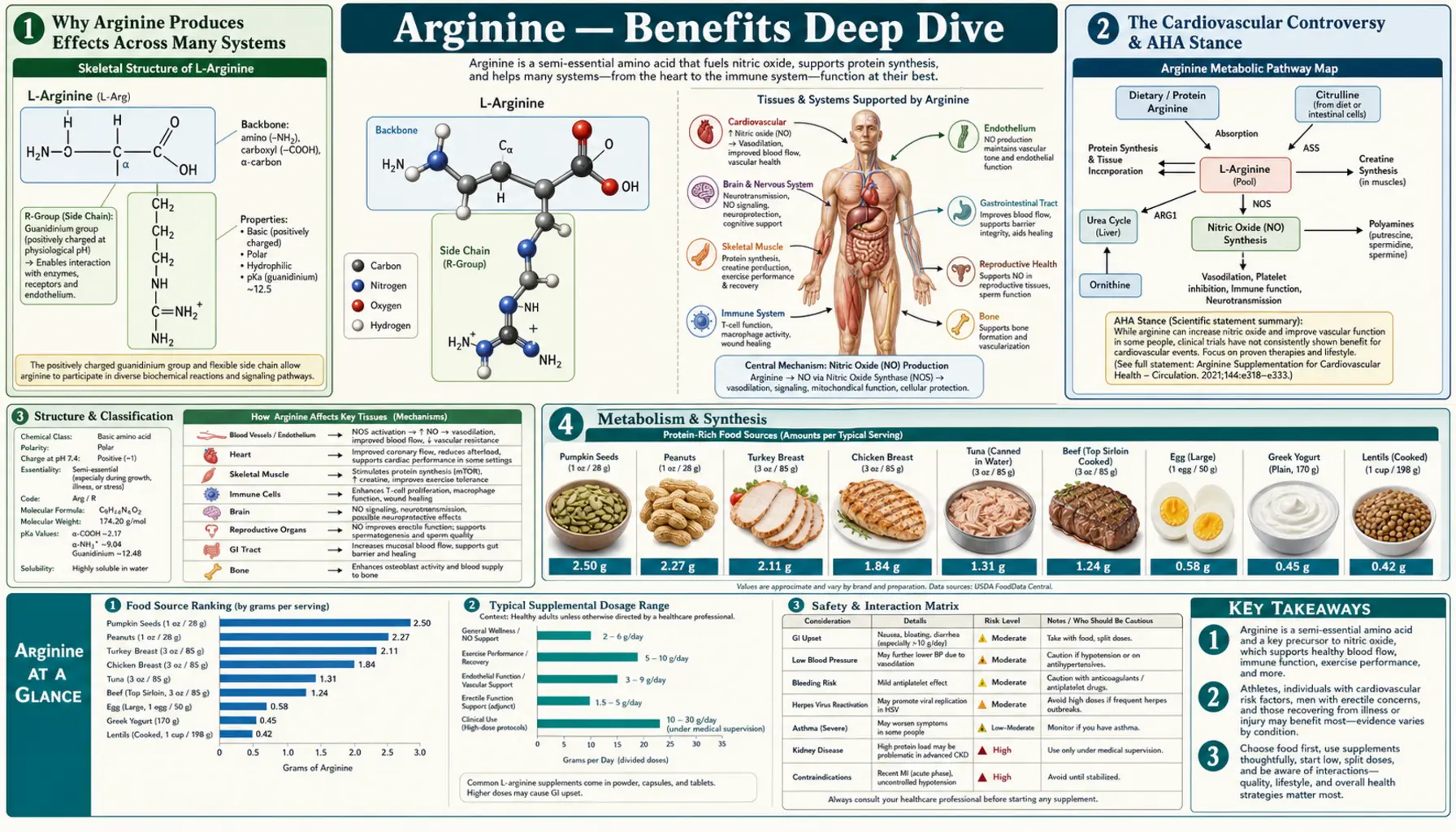
A 1998 review describes L-arginine as one of the most versatile amino acids in animal cells, a precursor not only of proteins but also of nitric oxide, urea, polyamines, proline, glutamate, creatine and agmatine (Wu and Morris 1998). It is classed as conditionally essential: adults make it from citrulline, largely in the kidneys (Wu 2009), but requirements can exceed production in situations such as pregnancy (Bronte and Zanovello 2005), and arginine can be depleted in trauma and sepsis (Rodriguez 2002). Arginine has two main competing fates: nitric oxide synthase turns it into nitric oxide (NO), a vasodilator and antimicrobial molecule, with citrulline as a by-product; arginase turns it into ornithine and urea, and ornithine feeds the proline (collagen) and polyamine (cell-proliferation) pathways (Morris 2009). The four benefit pages below cover cardiovascular biology, including endothelial function, blood pressure and peripheral arterial disease; the NO–cyclic GMP pathway behind erection, on which the PDE5-inhibitor drugs also act; wound healing, in which both the NOS and the arginase arms are involved; and immune function, including T-cell activation and the depletion of arginine by arginase-producing myeloid cells that is studied in cancer immunology.
Deep-Dive Articles
Cardiovascular Health & Nitric Oxide
Arginine as the substrate of all three nitric oxide synthase isoforms (NOS1 neuronal, NOS2 inducible, NOS3 endothelial), endothelial vasodilation, the L-arginine/ADMA ratio, the L-arginine paradox, why oral citrulline raised plasma arginine more effectively than oral arginine in a pharmacokinetic study (oral arginine is largely removed by intestinal arginase before it reaches the circulation), and the trial evidence for blood pressure, peripheral arterial disease and the VINTAGE MI trial after heart attack, which recorded more deaths on arginine than on placebo.
Read the deep dive →Erectile Function
The physiology of erection as a vascular event, the NO–cyclic GMP–PDE5 signalling pathway on which the PDE5-inhibitor drugs (sildenafil, tadalafil, vardenafil, avanafil) act, where arginine sits upstream of PDE5 in that pathway, the trial evidence for arginine and for citrulline taken alone, an uncontrolled study of arginine with a French maritime pine bark extract (no placebo group) in which 92.5% of 40 men reported a normal erection after three months, how these compare with PDE5-inhibitor drugs, and a small crossover pilot study of citrulline with trans-resveratrol in men whose erectile dysfunction persisted despite PDE5 inhibitors.
Read the deep dive →Wound Healing
Arginine's position at the NOS / arginase fork — substrate for the NO arm (the early, inflammatory phase of repair) and for the ornithine arm (proline for collagen synthesis, polyamines for cell proliferation), the phases of wound healing, the experimental-wound trials in healthy younger and older volunteers (Barbul, Kirk), the upper gastrointestinal cancer surgery trial (Daly), the pressure ulcer trial (Cereda), diabetic foot ulcer evidence, and commercial immunonutrition formulas that combine arginine with omega-3 fatty acids and nucleotides.
Read the deep dive →Immune Function
Arginine in T-cell activation — in cultured T cells, removing arginine shortened the half-life of the mRNA for the CD3-zeta chain, the main signalling element of the T-cell receptor — the M1/M2 macrophage split between the NOS and arginase pathways, the arginase made by myeloid-derived suppressor cells (MDSCs) that suppresses T cells in tumours, arginine depletion in trauma and sepsis, ICU immunonutrition (the Bertolini trial, in which an arginine-containing formula was associated with higher mortality in severe sepsis), and arginine in sickle cell disease and asthma.
Read the deep dive →Table of Contents
- Deep-Dive Articles
- Why Arginine Produces Effects Across Many Systems
- The Cardiovascular Controversy
- Research Papers: Cardiovascular & NO
- Research Papers: Erectile Function
- Research Papers: Wound Healing
- Research Papers: Immune Function
- Research Papers: Cross-Cutting (Metabolism, Safety)
- External Authoritative Resources
- Connections
- Featured Videos
Why Arginine Produces Effects Across Many Systems
Arginine is a precursor in several distinct metabolic pathways, each producing molecules with physiological effects: nitric oxide, creatine, urea, polyamines, proline, glutamate and agmatine (Morris 2009). A 1998 review describes it as one of the most versatile amino acids in animal cells (Wu and Morris 1998). Five of these pathways are listed below.
- Nitric oxide synthase substrate — the three NOS isoforms (NOS1 neuronal, NOS2 inducible, NOS3 endothelial) all use arginine as their substrate to produce NO. This pathway underlies the cardiovascular effects on endothelial vasodilation, blood pressure, and peripheral arterial perfusion, the NO-cGMP-PDE5 cascade of penile erection, the antimicrobial effector arm of inflammatory wound healing, and the macrophage-mediated component of innate immune defense.
- Urea cycle substrate (arginase pathway) — arginase converts arginine to ornithine and urea, the latter being the principal nitrogenous waste product in mammals. The ornithine generated feeds the proline pathway (essential for collagen synthesis in connective tissue and wound healing) and the polyamine pathway (essential for cell proliferation in healing wounds, immune responses, and any rapidly dividing tissue). This is the second arm of the arginine fork; arginase and nitric oxide synthase compete for arginine as a substrate (Bronte and Zanovello 2005).
- Protein synthesis — like all amino acids, arginine is incorporated into newly synthesized proteins. The arginine residues in proteins serve specific structural roles (positively charged side chain for ionic interactions, often binding to negatively charged phosphates in DNA, RNA, and ATP-binding pockets) and regulatory roles (arginine methylation is a major post-translational modification that controls protein-protein interactions and chromatin biology).
- Creatine synthesis — arginine combines with glycine via arginine:glycine amidinotransferase (AGAT) to form guanidinoacetate, which is then methylated by guanidinoacetate methyltransferase (GAMT) using methionine-derived S-adenosylmethionine to form creatine. Creatine is the principal high-energy phosphate buffer in muscle, where phosphocreatine donates its phosphate to ADP to regenerate ATP during high-intensity exercise. See Creatine.
- Agmatine and other minor pathways — arginine decarboxylase produces agmatine, a biogenic amine with effects on imidazoline receptors, NMDA receptor modulation, and several other neurological signaling pathways. The clinical significance is less well-defined than the major pathways but represents another dimension of arginine's biochemical scope.
Because the pathways compete, reviews describe arginine's effects as context-dependent. Where arginase activity is high, less arginine is available for nitric oxide synthase (Morris 2009; Munder 2009); in allergic asthma, a review proposes that raised airway arginase lowers NO production and, through extra ornithine, may promote airway remodelling (Maarsingh 2009). In severe sepsis, a planned interim analysis of a multicentre trial recorded higher intensive-care mortality with an arginine-containing enteral formula than with parenteral nutrition (Bertolini 2003). Trial results therefore differ between conditions, as the deep-dive pages describe.
The Cardiovascular Controversy
Arginine is the substrate of the enzyme that makes nitric oxide in the lining of blood vessels, and NO-mediated vasodilation is impaired in endothelial dysfunction (Förstermann and Sessa 2012). The hypothesis behind supplementation is that extra substrate restores NO production and improves vascular health.
The trial evidence is mixed:
- Positive findings — Böger and colleagues' 3-week trial in 39 people with intermittent claudication (Journal of the American College of Cardiology 1998), in which L-arginine given by intermittent infusion (2 × 8 g a day) improved walking distance; the Dong meta-analysis of 11 placebo-controlled trials with 387 participants taking 4 to 24 g a day orally, in which systolic pressure fell by 5.39 mm Hg and diastolic by 2.66 mm Hg compared with placebo (2011); and a meta-analysis of short-term trials in which oral arginine increased flow-mediated dilation when baseline values were below 7%, but not when they were higher (Bai 2009).
- Negative findings — the VINTAGE MI trial (JAMA 2006), in 153 people after a first ST-elevation heart attack: arginine did not improve vascular stiffness or ejection fraction, 6 people (8.6%) on arginine died during the 6-month study versus none on placebo, and the data and safety monitoring committee closed enrollment; the investigators concluded that L-arginine should not be recommended following acute myocardial infarction (Schulman 2006). In the 6-month NO-PAIN trial in 133 people with claudication, oral L-arginine 3 g a day did not increase nitric oxide availability, and walking distance improved significantly less than on placebo (Wilson 2007).
- Other trials — smaller studies in other groups, including stable angina, are described on the Cardiovascular and NO deep-dive.
In summary, the trials that reported benefits were short-term trials or pooled blood-pressure and endothelial-function studies, while the 6-month trials after heart attack and in peripheral arterial disease found no benefit, with more deaths on arginine in one and less improvement than on placebo in the other. Oral L-citrulline raised plasma arginine more effectively than oral arginine in a pharmacokinetic crossover study in 20 healthy volunteers, although no regimen improved flow-mediated dilation over baseline (Schwedhelm 2008). Decisions about supplements and heart medicines belong with a clinician. The full discussion is on the Cardiovascular and NO deep-dive.
A second question often raised is the herpes/lysine antagonism, and the idea comes from cell culture. In human cells in tissue culture, herpes simplex virus produced neither cell damage nor new virus when arginine was withheld, and lysine partially inhibited it (Tankersley 1964); lysine antagonised arginine's growth-promoting effect on the virus in tissue culture (Griffith, DeLong and Nelson 1981). Human trials of lysine supplements are small and mixed — one 6-month placebo-controlled trial of 1,000 mg lysine three times a day reported fewer recurrences (Griffith 1987) — and a 2015 Cochrane review of 32 randomised trials with 2,640 participants found no evidence of efficacy for lysine in preventing cold sores (Chi 2015). Whether arginine supplements make herpes outbreaks more frequent has not been tested in a trial found for this page. The L-Lysine page covers the lysine side of this antagonism.
Research Papers: Cardiovascular & NO
- Böger RH, Bode-Böger SM, Thiele W, Creutzig A, Alexander K, Frölich JC (1998). Restoring vascular nitric oxide formation by L-arginine improves the symptoms of intermittent claudication in patients with peripheral arterial occlusive disease. J Am Coll Cardiol 32(5):1336-44. — PubMed PMID: 9809945
- Schulman SP, Becker LC, Kass DA, Champion HC, Terrin ML, Forman S et al. (2006). L-arginine therapy in acute myocardial infarction: the Vascular Interaction With Age in Myocardial Infarction (VINTAGE MI) randomized clinical trial. JAMA 295(1):58-64. — PubMed PMID: 16391217
- Dong JY, Qin LQ, Zhang Z, Zhao Y, Wang J, Arigoni F et al. (2011). Effect of oral L-arginine supplementation on blood pressure: a meta-analysis of randomized, double-blind, placebo-controlled trials. Am Heart J 162(6):959-65. — PubMed PMID: 22137067
- Schwedhelm E, Maas R, Freese R, Jung D, Lukacs Z, Jambrecina A et al. (2008). Pharmacokinetic and pharmacodynamic properties of oral L-citrulline and L-arginine: impact on nitric oxide metabolism. Br J Clin Pharmacol 65(1):51-9. — PubMed PMID: 17662090
- Vallance P, Leiper J (2004). Cardiovascular biology of the asymmetric dimethylarginine:dimethylarginine dimethylaminohydrolase pathway. Arterioscler Thromb Vasc Biol 24(6):1023-30. — PubMed PMID: 15105281
- Förstermann U, Sessa WC (2012). Nitric oxide synthases: regulation and function. Eur Heart J 33(7):829-37, 837a-837d. — PubMed PMID: 21890489
- Bode-Böger SM, Scalera F, Ignarro LJ (2007). The L-arginine paradox: Importance of the L-arginine/asymmetrical dimethylarginine ratio. Pharmacol Ther 114(3):295-306. — PubMed PMID: 17482266
- Hayashi T, Juliet PA, Matsui-Hirai H, Miyazaki A, Fukatsu A, Funami J et al. (2005). l-Citrulline and l-arginine supplementation retards the progression of high-cholesterol-diet-induced atherosclerosis in rabbits. Proc Natl Acad Sci U S A 102(38):13681-6. — PubMed PMID: 16157883 — an animal study.
- Loscalzo J (2004). L-arginine and atherothrombosis. J Nutr 134(10 Suppl):2798S-2800S; discussion 2818S-2819S. — PubMed PMID: 15465788
- Moinard C, Nicolis I, Neveux N, Darquy S, Bénazeth S, Cynober L (2008). Dose-ranging effects of citrulline administration on plasma amino acids and hormonal patterns in healthy subjects: the Citrudose pharmacokinetic study. Br J Nutr 99(4):855-62. — PubMed PMID: 17953788
- Bai Y, Sun L, Yang T, Sun K, Chen J, Hui R (2009). Increase in fasting vascular endothelial function after short-term oral L-arginine is effective when baseline flow-mediated dilation is low: a meta-analysis of randomized controlled trials. Am J Clin Nutr 89(1):77-84. — PubMed PMID: 19056561
- Wilson AM, Harada R, Nair N, Balasubramanian N, Cooke JP (2007). L-arginine supplementation in peripheral arterial disease: no benefit and possible harm. Circulation 116(2):188-95. — PubMed PMID: 17592080
Research Papers: Erectile Function
- Stanislavov R, Nikolova V (2003). Treatment of erectile dysfunction with pycnogenol and L-arginine. J Sex Marital Ther 29(3):207-13. — PubMed PMID: 12851125 — an uncontrolled study: 40 men took arginine alone for one month, then arginine with a French maritime pine bark extract for two months; there was no placebo group.
- Chen J, Wollman Y, Chernichovsky T, Iaina A, Sofer M, Matzkin H (1999). Effect of oral administration of high-dose nitric oxide donor L-arginine in men with organic erectile dysfunction: results of a double-blind, randomized, placebo-controlled study. BJU Int 83(3):269-73. — PubMed PMID: 10233492
- Cormio L, De Siati M, Lorusso F, Selvaggio O, Mirabella L, Sanguedolce F et al. (2011). Oral L-citrulline supplementation improves erection hardness in men with mild erectile dysfunction. Urology 77(1):119-22. — PubMed PMID: 21195829
- Rhim HC, Kim MS, Park YJ, Choi WS, Park HK, Kim HG et al. (2019). The Potential Role of Arginine Supplements on Erectile Dysfunction: A Systemic Review and Meta-Analysis. J Sex Med 16(2):223-234. — PubMed PMID: 30770070
- Goldstein I, Lue TF, Padma-Nathan H, Rosen RC, Steers WD, Wicker PA (1998). Oral sildenafil in the treatment of erectile dysfunction. Sildenafil Study Group. N Engl J Med 338(20):1397-404. — PubMed PMID: 9580646
- Burnett AL (2006). The role of nitric oxide in erectile dysfunction: implications for medical therapy. J Clin Hypertens (Greenwich) 8(12 Suppl 4):53-62. — PubMed PMID: 17170606
- Toda N, Ayajiki K, Okamura T (2005). Nitric oxide and penile erectile function. Pharmacol Ther 106(2):233-66. — PubMed PMID: 15866322
- Aoki H, Nagao J, Ueda T, Strong JM, Schonlau F, Yu-Jing S et al. (2012). Clinical assessment of a supplement of Pycnogenol and L-arginine in Japanese patients with mild to moderate erectile dysfunction. Phytother Res 26(2):204-7. — PubMed PMID: 21618639
- Shamloul R, Ghanem H (2013). Erectile dysfunction. Lancet 381(9861):153-65. — PubMed PMID: 23040455
- Andersson KE, Wagner G (1995). Physiology of penile erection. Physiol Rev 75(1):191-236. — PubMed PMID: 7831397
- Shirai M, Hiramatsu I, Aoki Y, Shimoyama H, Mizuno T, Nozaki T et al. (2018). Oral L-citrulline and Transresveratrol Supplementation Improves Erectile Function in Men With Phosphodiesterase 5 Inhibitors: A Randomized, Double-Blind, Placebo-Controlled Crossover Pilot Study. Sex Med 6(4):291-296. — PubMed PMID: 30150102 — 20 men enrolled and 13 completed; the supplement combined citrulline with trans-resveratrol, so the effect of citrulline alone was not tested.
Research Papers: Wound Healing
- Barbul A, Lazarou SA, Efron DT, Wasserkrug HL, Efron G (1990). Arginine enhances wound healing and lymphocyte immune responses in humans. Surgery 108(2):331-6; discussion 336-7. — PubMed PMID: 2382229
- Kirk SJ, Hurson M, Regan MC, Holt DR, Wasserkrug HL, Barbul A (1993). Arginine stimulates wound healing and immune function in elderly human beings. Surgery 114(2):155-9; discussion 160. — PubMed PMID: 8342121
- Cereda E, Klersy C, Serioli M, Crespi A, D'Andrea F (2015). A nutritional formula enriched with arginine, zinc, and antioxidants for the healing of pressure ulcers: a randomized trial. Ann Intern Med 162(3):167-74. — PubMed PMID: 25643304
- Daly JM, Weintraub FN, Shou J, Rosato EF, Lucia M (1995). Enteral nutrition during multimodality therapy in upper gastrointestinal cancer patients. Ann Surg 221(4):327-38. — PubMed PMID: 7726669
- Marimuthu K, Varadhan KK, Ljungqvist O, Lobo DN (2012). A meta-analysis of the effect of combinations of immune modulating nutrients on outcome in patients undergoing major open gastrointestinal surgery. Ann Surg 255(6):1060-8. — PubMed PMID: 22549749
- Witte MB, Barbul A (2003). Arginine physiology and its implication for wound healing. Wound Repair Regen 11(6):419-23. — PubMed PMID: 14617280
- Drover JW, Dhaliwal R, Weitzel L, Wischmeyer PE, Ochoa JB, Heyland DK (2011). Perioperative use of arginine-supplemented diets: a systematic review of the evidence. J Am Coll Surg 212(3):385-99, 399.e1. — PubMed PMID: 21247782
- Stechmiller JK, Childress B, Cowan L (2005). Arginine supplementation and wound healing. Nutr Clin Pract 20(1):52-61. — PubMed PMID: 16207646
- Albina JE, Mills CD, Henry WL Jr, Caldwell MD (1990). Temporal expression of different pathways of 1-arginine metabolism in healing wounds. J Immunol 144(10):3877-80. — PubMed PMID: 2332635 — a rat wound model.
- Armstrong DG, Hanft JR, Driver VR, Smith AP, Lazaro-Martinez JL, Reyzelman AM et al. (2014). Effect of oral nutritional supplementation on wound healing in diabetic foot ulcers: a prospective randomized controlled trial. Diabet Med 31(9):1069-77. — PubMed PMID: 24867069
Research Papers: Immune Function
- Rodriguez PC, Zea AH, Culotta KS, Zabaleta J, Ochoa JB, Ochoa AC (2002). Regulation of T cell receptor CD3zeta chain expression by L-arginine. J Biol Chem 277(24):21123-9. — PubMed PMID: 11950832
- Bronte V, Zanovello P (2005). Regulation of immune responses by L-arginine metabolism. Nat Rev Immunol 5(8):641-54. — PubMed PMID: 16056256
- Rodríguez PC, Ochoa AC (2008). Arginine regulation by myeloid derived suppressor cells and tolerance in cancer: mechanisms and therapeutic perspectives. Immunol Rev 222:180-91. — PubMed PMID: 18364002
- Geiger R, Rieckmann JC, Wolf T, Basso C, Feng Y, Fuhrer T et al. (2016). L-Arginine Modulates T Cell Metabolism and Enhances Survival and Anti-tumor Activity. Cell 167(3):829-842.e13. — PubMed PMID: 27745970
- Bertolini G, Iapichino G, Radrizzani D, Facchini R, Simini B, Bruzzone P et al. (2003). Early enteral immunonutrition in patients with severe sepsis: results of an interim analysis of a randomized multicentre clinical trial. Intensive Care Med 29(5):834-40. — PubMed PMID: 12684745
- Morris CR, Kuypers FA, Lavrisha L, Ansari M, Sweeters N, Stewart M et al. (2013). A randomized, placebo-controlled trial of arginine therapy for the treatment of children with sickle cell disease hospitalized with vaso-occlusive pain episodes. Haematologica 98(9):1375-82. — PubMed PMID: 23645695
- Steggerda SM, Bennett MK, Chen J, Emberley E, Huang T, Janes JR et al. (2017). Inhibition of arginase by CB-1158 blocks myeloid cell-mediated immune suppression in the tumor microenvironment. J Immunother Cancer 5(1):101. — PubMed PMID: 29254508
- Maarsingh H, Zaagsma J, Meurs H (2009). Arginase: a key enzyme in the pathophysiology of allergic asthma opening novel therapeutic perspectives. Br J Pharmacol 158(3):652-64. — PubMed PMID: 19703164
- Munder M (2009). Arginase: an emerging key player in the mammalian immune system. Br J Pharmacol 158(3):638-51. — PubMed PMID: 19764983
- Calder PC (2007). Immunonutrition in surgical and critically ill patients. Br J Nutr 98 Suppl 1:S133-9. — PubMed PMID: 17922951
Research Papers: Cross-Cutting (Metabolism, Safety)
- Morris SM Jr (2009). Recent advances in arginine metabolism: roles and regulation of the arginases. Br J Pharmacol 157(6):922-30. — PubMed PMID: 19508396
- Wu G, Morris SM Jr (1998). Arginine metabolism: nitric oxide and beyond. Biochem J 336 ( Pt 1)(Pt 1):1-17. — PubMed PMID: 9806879
- Luiking YC, Ten Have GA, Wolfe RR, Deutz NE (2012). Arginine de novo and nitric oxide production in disease states. Am J Physiol Endocrinol Metab 303(10):E1177-89. — PubMed PMID: 23011059
- Böger RH (2007). The pharmacodynamics of L-arginine. J Nutr 137(6 Suppl 2):1650S-1655S. — PubMed PMID: 17513442
- Husson A, Brasse-Lagnel C, Fairand A, Renouf S, Lavoinne A (2003). Argininosuccinate synthetase from the urea cycle to the citrulline-NO cycle. Eur J Biochem 270(9):1887-99. — PubMed PMID: 12709047
- Castillo L, Chapman TE, Yu YM, Ajami A, Burke JF, Young VR (1993). Dietary arginine uptake by the splanchnic region in adult humans. Am J Physiol 265(4 Pt 1):E532-9. — PubMed PMID: 8238326
- Curis E, Nicolis I, Moinard C, Osowska S, Zerrouk N, Bénazeth S et al. (2005). Almost all about citrulline in mammals. Amino Acids 29(3):177-205. — PubMed PMID: 16082501
- Wu G, Bazer FW, Davis TA, Kim SW, Li P, Rhoads JM et al. (2009). Arginine metabolism and nutrition in growth, health and disease. Amino Acids 37(1):153-68. — PubMed PMID: 19030957
- Shao A, Hathcock JN (2008). Risk assessment for the amino acids taurine, L-glutamine and L-arginine. Regul Toxicol Pharmacol 50(3):376-99. — PubMed PMID: 18325648
- Griffith RS, Walsh DE, Myrmel KH, Thompson RW, Behforooz A (1987). Success of L-lysine therapy in frequently recurrent herpes simplex infection. Treatment and prophylaxis. Dermatologica 175(4):183-90. — PubMed PMID: 3115841 — a placebo-controlled lysine trial (27 people on lysine and 25 on placebo completed it).
- Griffith RS, DeLong DC, Nelson JD (1981). Relation of arginine-lysine antagonism to herpes simplex growth in tissue culture. Chemotherapy 27(3):209-13. — PubMed PMID: 6262023
- Tankersley RW Jr (1964). Amino acid requirements of herpes simplex virus in human cells. J Bacteriol 87(3):609-13. — PubMed PMID: 14127578
- Chi CC, Wang SH, Delamere FM, Wojnarowska F, Peters MC, Kanjirath PP (2015). Interventions for prevention of herpes simplex labialis (cold sores on the lips). Cochrane Database Syst Rev (8):CD010095. — PubMed PMID: 26252373
External Authoritative Resources
- NIH Office of Dietary Supplements — Dietary Supplements for Exercise and Athletic Performance — includes a section on arginine
- NIH Office of Dietary Supplements — Fact Sheets
- MedlinePlus — L-Arginine (consumer-oriented summary of uses, evidence, and interactions)
- American Heart Association — the association's public website
- PubMed — All research on L-arginine
- PubMed — All research on L-citrulline
Connections
- All Amino Acids
- Arginine (Main Page)
- Arginine for Cardiovascular Health & NO
- Arginine for Erectile Function
- Arginine for Wound Healing
- Arginine for Immune Function
- Lysine
- Taurine
- Glutamine
- Glycine
- Proline
- Methionine
- Cardiovascular Disease
- Hypertension
- Erectile Dysfunction
- Diabetes
- Metabolic Syndrome
- Lysine (HSV Counterbalance)
- Creatine
- Collagen
- Zinc
- Vitamin C
- Kidney Function
- Immune Boosting
- History
- Sources