Asparagine: Food Sources & Daily Intake
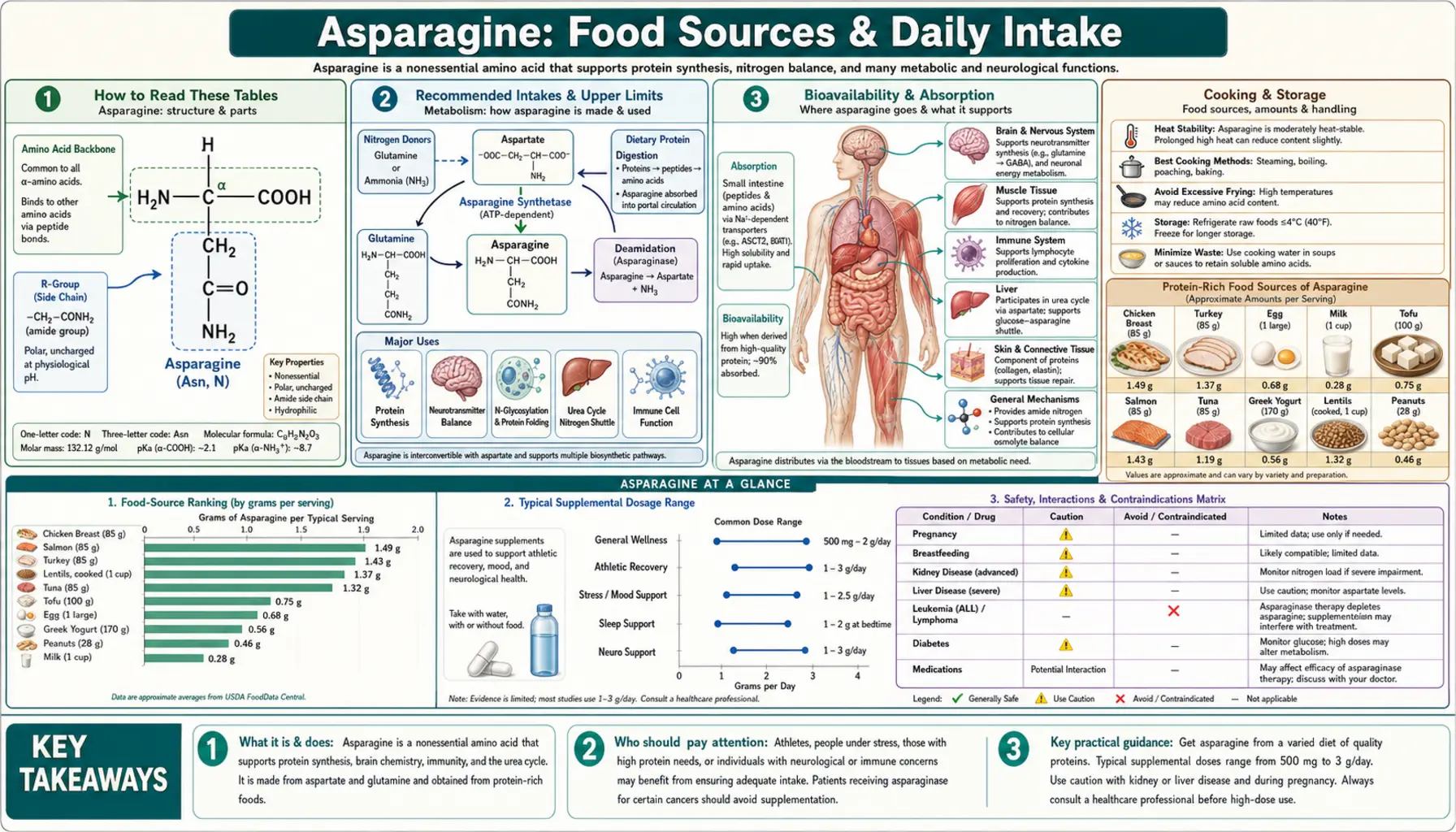
Asparagine was the first amino acid ever isolated — discovered in asparagus juice in 1806, which is where it gets its name. It is a non-essential amino acid, meaning the body can build it itself, so there is no dietary requirement. Its main jobs are acting as a nitrogen shuttle that moves nitrogen safely between tissues, supporting normal brain and nervous-system function, and helping attach sugar chains to proteins (glycosylation). One important measurement note: standard amino-acid analysis converts asparagine into aspartate, so the table below reports the combined aspartate + asparagine content — grams per 100 g of food. There is no FDA Daily Value for individual amino acids, so amounts are absolute.
| Asparagine: Food Sources & Daily Intake | |||||
|---|---|---|---|---|---|
| Rank | Food (serving) | Per 100 g | Glucose | Fructose | Notes |
| 1 | Pumpkin Seeds 1 oz / 28 g | 🟢 2.9 g | 0.1 | 0.1 | |
| 2 | Beef Meat 3 oz / 85 g | 🟢 2.7 g | 0 | 0 | Concentrated complete protein. |
| 3 | Salmon 3 oz / 85 g | 🟢 2.7 g | 0 | 0 | |
| 4 | Almonds 1 oz / 28 g | 🟢 2.6 g | 0.2 | 0.1 | |
| 5 | Tuna 3 oz / 85 g | 🟢 2.6 g | 0 | 0 | |
| 6 | Pork 3 oz / 85 g | 🟢 2.6 g | 0 | 0 | |
| 7 | Chicken Organ Meats 3 oz / 85 g | 🟢 2.5 g | — | — | Nutrient-dense organ meat (giblets). |
| 8 | Pork Organ Meats 3 oz / 85 g | 🟢 2.4 g | — | — | Nutrient-dense organ meat. |
| 9 | Cod 3 oz / 85 g | 🟢 2.3 g | 0 | 0 | |
| 10 | Parmesan Cheese 1 oz / 28 g | 🟢 2.2 g | — | — | Concentrated protein. |
| 11 | Shrimp 3 oz / 85 g | 🟢 2.1 g | — | — | |
| 12 | Beef Organ Meats 3 oz / 85 g | 🟢 2.0 g | — | — | Nutrient-dense organ meat. |
| 13 | Cheddar Cheese 1 oz / 28 g | 🟢 2.0 g | 0 | 0 | |
| 14 | Chicken Breast 3 oz / 85 g | 🟡 1.3 g | — | — | |
| 15 | Egg 1 large / 50 g | 🟡 1.3 g | — | — | |
| 16 | White Beans 1 cup / 179 g | 🟡 1.2 g | — | — | |
| 17 | Brown Rice 1 cup / 195 g | ⚪ 0.2 g | 0 | 0 | Common staple. |
Table of Contents
- How to Read These Tables
- Recommended Intakes & Upper Limits
- Bioavailability & Absorption
- Cooking & Storage
- Vegetarian & Vegan Sources
- Who Needs to Pay Attention
- Data Sources & References
- Connections
- Featured Videos
How to Read These Tables
- Combined with aspartic acid. The acid step used to break protein into its amino acids turns asparagine into aspartate, so labs cannot tell the two apart afterward. Every figure in this table is therefore the aspartate + asparagine total, not asparagine on its own — asparagine-rich foods are still asparagine-rich, but the number includes both.
- Grams per 100 g, not %DV. There is no FDA Daily Value for individual amino acids, so this table reports the absolute grams per 100 g of food and ranks foods by that. A typical serving is shown beside each food.
- Non-essential amino acid. Because the body can make asparagine on its own, you do not need to seek it out. Any diet with enough total protein supplies far more than the body could ever need.
Recommended Intakes & Upper Limits
Your personal target depends on age, sex and pregnancy. The Daily Value used for the %DV column above is a single label figure; the table below is the age-specific guidance.
| Reference | Adult value | Notes |
|---|---|---|
| Status | Non-essential | The body can make asparagine itself (from aspartate via asparagine synthetase), so there is no dietary requirement. |
| Adult requirement | None set | No recommended intake exists; deficiency does not occur on any normal diet. |
| Main roles | Nitrogen transport & nervous system | Acts as a nitrogen shuttle between tissues and is important for normal brain and nervous-system development and for attaching sugar chains to proteins (glycosylation). |
| How it is measured | Reported together with aspartic acid | Routine amino-acid analysis converts asparagine to aspartate, so food tables list the combined aspartate + asparagine figure rather than asparagine alone. |
Bioavailability & Absorption
Asparagine from food is well absorbed as part of dietary protein, and because the body can also synthesize it, supply is never a limiting factor. What matters is simply adequate total protein. Animal proteins (meat, fish, eggs, dairy) are complete and protein-dense; plant proteins (legumes, seeds, nuts) contribute well too. No special effort is needed to get enough asparagine from any reasonable diet.
Cooking & Storage
Asparagine itself is stable to ordinary cooking and is not destroyed by normal heat. There is one well-known wrinkle, however: in starchy plant foods — potatoes, bread, and other grain or root foods — the asparagine they contain reacts with natural sugars at high, dry temperatures (frying, roasting, baking above ~120 °C) to form acrylamide, a compound food-safety agencies suggest minimizing. This is a feature of high-heat starchy cooking, not of the high-protein foods in this table; cooking meat, fish, eggs and dairy poses no such concern. Practical tips for starchy foods: cook to golden rather than dark brown, and avoid charring.
Vegetarian & Vegan Sources
Plant-based eaters get asparagine very easily — it is a non-essential amino acid and is widespread in plants. The standout sources are its namesake asparagus, plus lentils, white and other beans, chickpeas, pumpkin and other seeds, and nuts such as almonds. Eating a normal variety of legumes, vegetables, seeds and nuts supplies plenty, and the body tops up any shortfall by making its own.
Who Needs to Pay Attention
Asparagine deficiency essentially never occurs: it is non-essential, so the body manufactures whatever it needs from aspartate, and food supplies more on top. There is no recognized deficiency state and no need for supplements. (In a very different medical context, some leukemia treatments use the enzyme asparaginase to deliberately deplete asparagine in cancer cells — but that is a prescription cancer therapy, unrelated to diet.)
Data Sources & References
- NIH MedlinePlus — Amino acids
- Linus Pauling Institute — protein and amino acids
- PubMed — asparagine metabolism and nitrogen transport
- PubMed — acrylamide formation from asparagine in foods
Connections
- All Amino Acids
- Asparagine (Main Page)
- Asparagine Benefits
- Asparagine History
- Aspartic Acid
- Glutamine
- Eggs