Arginine: Food Sources & Daily Intake
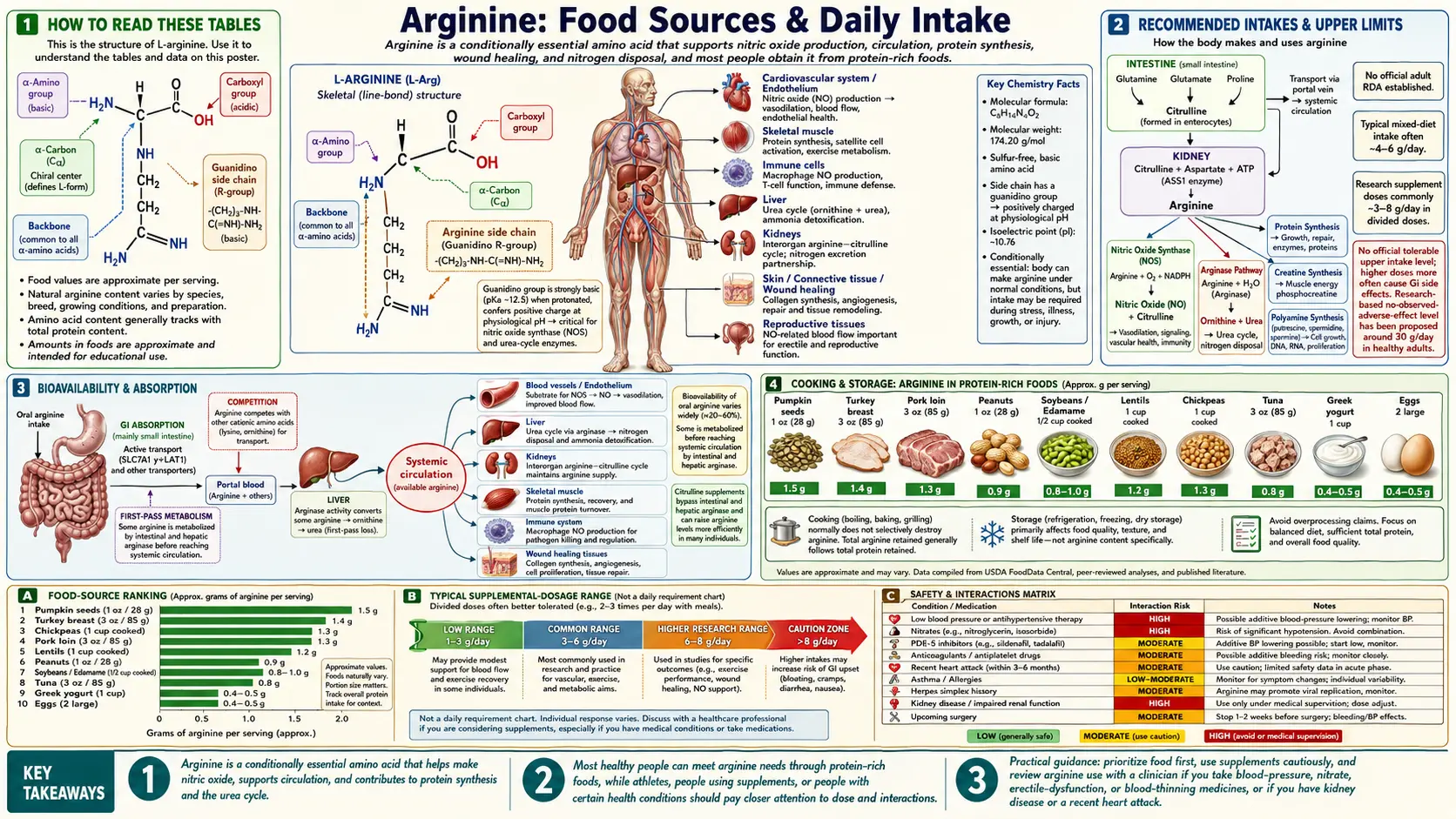
Arginine is best known as the body’s raw material for nitric oxide — a tiny signaling molecule that tells the smooth muscle lining your blood vessels to relax, so the vessels widen and blood flows more easily. That single job links arginine to circulation, blood pressure and exercise “pump.” It also drives the urea cycle (how the body clears toxic ammonia from protein breakdown), supports immune cells, and is essential for wound healing and the synthesis of creatine. Arginine is conditionally essential: healthy adults make enough on their own, but the body needs extra from food during rapid growth, serious illness, or injury. The richest dietary sources are notably seeds and nuts, followed by poultry, pork and legumes. The table below shows grams of arginine per 100 g of food; there is no FDA Daily Value for individual amino acids, so amounts are absolute.
| Arginine: Food Sources & Daily Intake | |||||
|---|---|---|---|---|---|
| Rank | Food (serving) | Per 100 g | Glucose | Fructose | Notes |
| 1 | Pumpkin Seeds 1 oz / 28 g | 🟢 5.3 g | 0.1 | 0.1 | Among the richest sources. |
| 2 | Peanuts 1 oz / 28 g | 🟢 3.1 g | — | — | Top legume source. |
| 3 | Sesame Seeds 1 oz / 28 g | 🟡 2.6 g | — | — | |
| 4 | Almonds 1 oz / 28 g | 🟡 2.5 g | 0.2 | 0.1 | |
| 5 | Pine Nuts 1 oz / 28 g | 🟡 2.4 g | 0.1 | 0.1 | |
| 6 | Sunflower Seeds 1 oz / 28 g | 🟡 2.4 g | — | — | |
| 7 | Walnuts 1 oz / 28 g | 🟡 2.3 g | 0.1 | 0.1 | |
| 8 | Cashews 1 oz / 28 g | 🟡 2.1 g | 0.1 | 0.1 | |
| 9 | Beef Meat 3 oz / 85 g | 🟡 1.9 g | 0 | 0 | |
| 10 | Shrimp 3 oz / 85 g | 🟡 1.8 g | — | — | |
| 11 | Pork 3 oz / 85 g | 🟡 1.8 g | 0 | 0 | |
| 12 | Chicken Organ Meats 3 oz / 85 g | 🟡 1.7 g | — | — | Nutrient-dense organ meat (giblets). |
| 13 | Salmon 3 oz / 85 g | 🟡 1.7 g | 0 | 0 | |
| 14 | Pork Organ Meats 3 oz / 85 g | 🟡 1.6 g | — | — | Nutrient-dense organ meat. |
| 15 | Turkey 3 oz / 85 g | 🟡 1.5 g | 0 | 0 | |
| 16 | Beef Organ Meats 3 oz / 85 g | 🟡 1.4 g | — | — | Nutrient-dense organ meat. |
| 17 | Brown Rice 1 cup / 195 g | ⚪ 0.2 g | 0 | 0 | Common staple. |
Table of Contents
- How to Read These Tables
- Recommended Intakes & Upper Limits
- Bioavailability & Absorption
- Cooking & Storage
- Vegetarian & Vegan Sources
- Who Needs to Pay Attention
- Data Sources & References
- Connections
- Featured Videos
How to Read These Tables
- Conditionally essential. Healthy adults can make arginine from other amino acids, so it is not strictly “essential” the way the nine essential amino acids are. But during periods of high demand — infancy and growth, recovery from surgery, burns, infection or major injury — the body cannot make enough and a dietary supply becomes important. That dual nature is why it is called conditionally (or semi-) essential.
- Grams per 100 g, not %DV. There is no FDA Daily Value for individual amino acids, so this table reports the absolute grams per 100 g of food and ranks foods by that. A typical serving is shown beside each food so you can scale the number to a real plate.
- Seeds and nuts lead. Unlike most amino acids, where animal protein dominates, arginine is unusually concentrated in seeds and nuts — pumpkin, sesame and sunflower seeds, peanuts, almonds and walnuts all rank near the top. Poultry, pork and legumes follow. This makes arginine one of the easier amino acids to get from plants.
Recommended Intakes & Upper Limits
Your personal target depends on age, sex and pregnancy. The Daily Value used for the %DV column above is a single label figure; the table below is the age-specific guidance.
| Reference | Adult value | Notes |
|---|---|---|
| Status | Conditionally essential | Body makes it, but needs more during growth, illness, or injury. |
| Adult requirement | None set | Made from other amino acids; no fixed daily need for healthy adults. |
| Key role | Nitric oxide & blood flow | Raw material for nitric oxide, which relaxes blood vessels and supports circulation. |
| Richest in | Seeds & nuts, then poultry & pork | Pumpkin, sesame and sunflower seeds, peanuts, almonds, walnuts; turkey, chicken, pork. |
Bioavailability & Absorption
Arginine from food is well absorbed as part of dietary protein. The body also makes its own supply: the gut produces citrulline, which the kidneys convert into arginine, so blood levels are buffered and rarely depend on any single meal. What matters most is adequate total protein from a variety of sources. Interestingly, oral arginine supplements are partly broken down in the gut and liver before reaching the bloodstream, which is why dietary arginine across whole foods is a steady, reliable way to support the body’s needs.
Cooking & Storage
Amino acids are stable to ordinary cooking — arginine is not destroyed by normal heat, and cooking generally makes protein easier to digest. Roasting nuts and seeds causes only minimal loss. The one thing to know is that arginine reacts readily in the Maillard (browning) reaction, so very high, prolonged dry heat (heavy charring or deep browning) can tie up a small fraction of it. Normal home cooking has no meaningful effect.
Vegetarian & Vegan Sources
Arginine is one of the easiest amino acids for plant-based eaters to get, because the very richest sources are already plant foods. Pumpkin, sesame and sunflower seeds, peanuts, almonds, walnuts, pine nuts and cashews are all arginine powerhouses, and lentils, chickpeas and white beans add more. A daily handful of seeds or nuts plus regular legumes easily covers the body’s needs — no animal protein and no supplement required.
Who Needs to Pay Attention
True arginine deficiency is rare in anyone eating enough total protein, since the body also makes its own. A few specific points are worth knowing. First, arginine and lysine compete, and the balance between them matters for people prone to cold sores / genital herpes (the herpes simplex virus uses arginine to replicate); those individuals sometimes favor higher-lysine, lower-arginine foods during outbreaks — though this is about food balance, not avoiding arginine entirely. Second, high-dose arginine supplements (not food) can lower blood pressure and may interact with blood-pressure medications and erectile-dysfunction drugs (such as nitrates and PDE5 inhibitors), so supplements should be discussed with a clinician. For the rare urea-cycle disorders, arginine intake is managed under medical supervision. For almost everyone else, arginine from whole foods is safe and beneficial.
Data Sources & References
- NIH MedlinePlus — Amino acids
- Linus Pauling Institute — protein and amino acids
- PubMed — arginine, nitric oxide and cardiovascular function
- PubMed — arginine and wound healing