⚠ Evidence warning: Clinical trials or other evidence do not support the claims that collagen speeds recovery from hair shedding after illness or childbirth, slows age-related hair thinning, and improves hair shedding and density. This page keeps it as a report of what people, websites or other media say.
Collagen for Hair and Nails
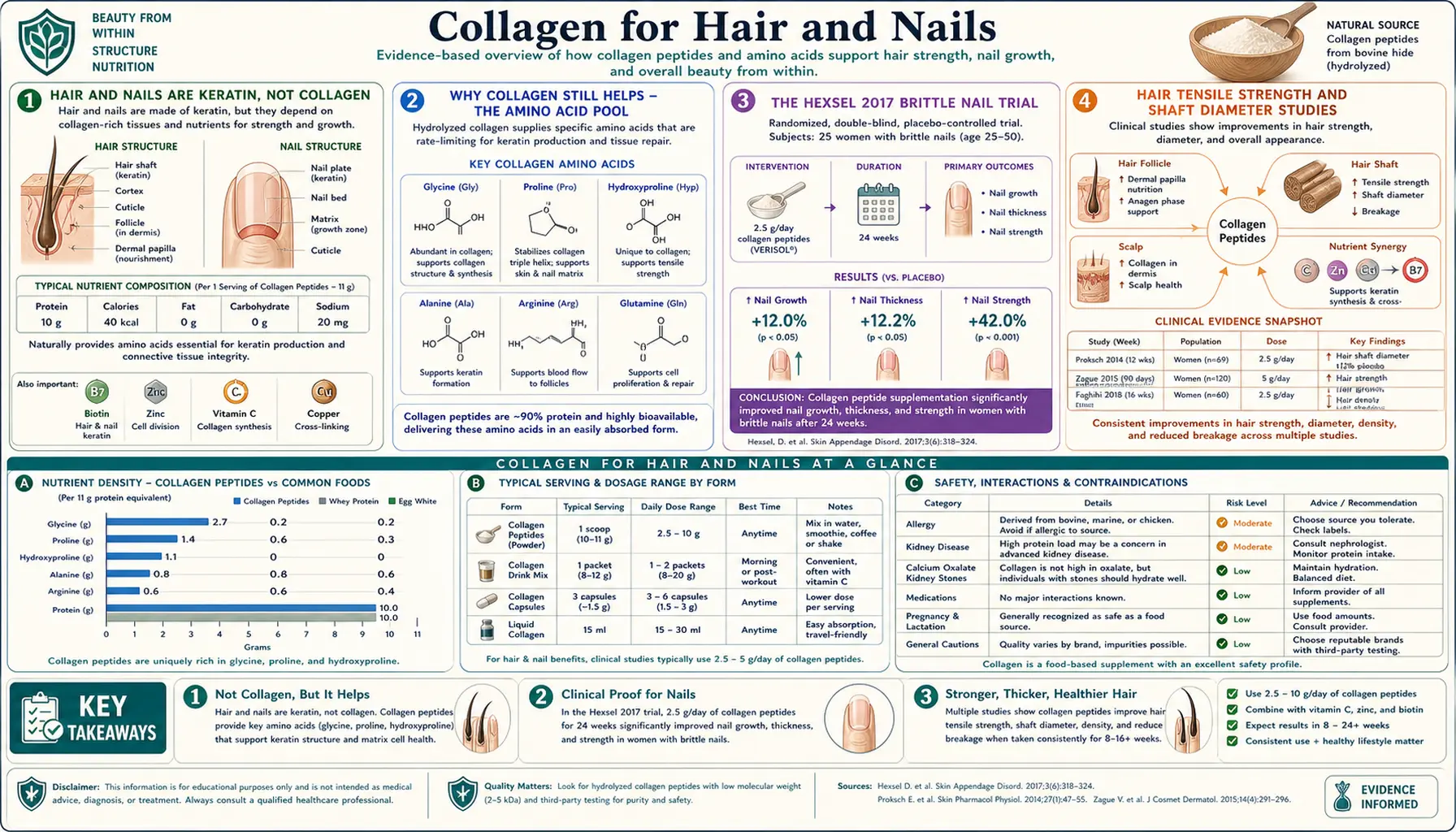
Hair and nails are not actually made of collagen — they are made of keratin, a different fibrous structural protein. The link between oral collagen supplementation and improved hair and nail outcomes is one of substrate provision rather than direct incorporation: collagen peptides supply a rich pool of glycine, proline, and methionine that the body uses to build new keratin, alongside indirect benefits via the dermal collagen surrounding hair follicles and the nail matrix bed. The most-cited evidence is the Doris Hexsel 2017 study in Journal of Cosmetic Dermatology, an open-label study with no comparison group, which enrolled 25 subjects with brittle nail syndrome and gave them 2.5 g/day of specific bioactive collagen peptides for 24 weeks: nail growth rate increased 12%, the frequency of chipped, cracked, or broken nails dropped 42%, and 64% of subjects achieved global clinical improvement. Hair tensile strength and shaft diameter studies show parallel effects. This deep dive walks through the keratin biology, why collagen helps despite the chemical mismatch, the realistic timeline, the comparison to biotin (the dominant alternative), and what to expect.
Interactive Visualization Vitamin C, Collagen & Why Sailors Fell Apart Zip three protein chains into the strongest rope in biology — then take the vitamin C away and watch the helix unravel, and old healed scars split back open. Launch →
Table of Contents
- Hair and Nails Are Keratin, Not Collagen
- Why Collagen Still Helps — The Amino Acid Pool
- The Hexsel 2017 Brittle Nail Trial
- Hair Tensile Strength and Shaft Diameter Studies
- The Dermal Follicle Environment
- How Collagen and Biotin Compare
- Brittle Nail Syndrome — Clinical Background
- Hair Thinning and Telogen Effluvium
- The Realistic Timeline (8-24 Weeks)
- What Collagen Cannot Treat
- Key Research Papers
- Connections
- Featured Videos
Hair and Nails Are Keratin, Not Collagen
An important correction up front: despite the popular marketing of "collagen for hair and nails," hair and nails are not made of collagen. They are made of keratin, a completely different fibrous structural protein produced by a specialized cell type (the keratinocyte) at the bottom of hair follicles and underneath the nail bed. Keratin shares some superficial features with collagen — both are fibrous proteins built for mechanical strength — but the underlying chemistry is distinct:
- Collagen is built from a triple-helix of three peptide chains with the signature Gly-X-Y repeating motif (where X is often proline and Y is often hydroxyproline). Cross-linked into long fibrils. Found in skin dermis, tendon, bone, cartilage, blood vessel walls. Synthesized by fibroblasts, osteoblasts, chondrocytes
- Keratin is built from alpha-helical or beta-sheet peptide chains rich in cysteine, with extensive disulfide bond cross-linking between cysteine residues providing exceptional mechanical strength and water resistance. Found in hair, nails, hooves, horns, the outermost layer of the epidermis (stratum corneum). Synthesized by keratinocytes
The keratin amino acid composition is approximately:
- Cysteine 10-17% (the disulfide cross-linker)
- Glycine 6-8%
- Glutamic acid 12-14%
- Arginine 8-10%
- Serine 8-10%
- Proline 4-6%
- Plus smaller amounts of all other amino acids
Comparing to collagen composition (33% glycine, 12% proline, 10% hydroxyproline, almost no cysteine), there is partial overlap (glycine and proline) but also striking divergence (keratin is rich in cysteine; collagen has essentially none). This is why oral collagen is not directly incorporated into hair and nails — the body must disassemble dietary collagen into free amino acids and reassemble those amino acids into a quite different keratin sequence.
So why does collagen still produce measurable hair and nail benefits? Because of the substrate pool effect, the dermal follicle environment effect, and the global protein nutrition effect — explored in the next section.
Why Collagen Still Helps — The Amino Acid Pool
Three plausible mechanisms link oral collagen supplementation to improved hair and nail outcomes:
- Substrate pool for keratin synthesis — While collagen is not keratin, the digestion of 5-10 g/day of oral collagen provides a substantial bolus of glycine, proline, and other amino acids that the body uses for protein synthesis generally, including keratin in hair follicles and nail matrix. Glycine and proline are both used in keratin assembly. The amino acid bolus is meaningful for individuals whose underlying protein intake is suboptimal, which is common in dieters, older adults, and those with poor appetite
- Dermal follicle environment — Each hair follicle is embedded in dermal connective tissue. The follicle's dermal papilla (the cluster of fibroblasts at the base that signals to the keratin-producing matrix cells) is suspended in a collagen-rich matrix that provides nutritional and signaling support. Improving dermal collagen content (the same effect explored in the skin deep dive) plausibly improves the local environment in which the follicle operates, supporting more vigorous hair growth and reduced shedding
- Nail bed and nail matrix support — Similarly, the nail matrix (the proliferating cell layer at the base of the nail that produces new nail plate material) sits atop a collagen-rich dermis. Supporting that dermal foundation may improve nail matrix function and resulting nail quality
The mechanisms are indirect compared to collagen's direct skin and bone effects, but the clinical trial evidence (especially Hexsel 2017 for nails) demonstrates that the indirect mechanisms produce measurable, reproducible improvements. The effect size for hair and nails is generally smaller than for skin, but the trial signal is clearly positive.
An additional consideration: many adults seeking "hair and nail support" supplements have undiagnosed micronutrient inadequacies (iron, zinc, biotin, Vitamin D) that are limiting hair and nail health. Collagen peptide supplements are usually fortified with these micronutrients or co-administered with multivitamins. Disentangling the collagen-specific effect from the co-formulated nutrient effects is methodologically difficult, but the Hexsel study used specific bioactive collagen peptides alone (not co-formulated) and still showed clear nail benefit.
The Hexsel 2017 Brittle Nail Trial
Doris Hexsel and colleagues at the Brazilian Center for Studies in Dermatology published an open-label, single-group study of collagen peptides for brittle nail syndrome in Journal of Cosmetic Dermatology in 2017. The trial was an open-label single-arm study (not double-blind placebo-controlled), but with a well-defined symptomatic population and rigorous objective endpoints.
Subjects were 25 women with self-reported brittle nail syndrome. The intervention was 2.5 g/day of specific bioactive collagen peptides (a branded bovine collagen peptide, the same product used in the Proksch skin trials) for 24 weeks, followed by a 4-week post-treatment observation period.
Outcomes assessed at baseline, week 12, week 24, and week 28:
- Nail growth rate: measured by marking the nail proximal to the cuticle and measuring distal displacement over time
- Frequency of cracked, chipped, peeling, or broken nails: subject-reported quantitative
- Global clinical improvement: standardized photo and dermatologist assessment
- Subject-reported satisfaction
Results at 24 weeks (end of treatment):
- Nail growth rate increased by approximately 12% from baseline (statistically significant, p<0.05)
- Frequency of broken nails decreased by 42%
- 64% of subjects achieved global clinical improvement of their nail condition
- 88% of subjects showed improvement 4 weeks after stopping (week 28)
- 80% of subjects agreed that the peptides improved their nails' appearance and were completely satisfied with the result
- Excellent tolerability; no significant adverse events
The Hexsel trial is the most-cited published evidence for oral collagen peptide supplementation for nails. The methodological limitations (open-label, single-arm, modest sample size) are real but not fatal — the nail growth rate measurement is objective, and the subject-reported endpoints with photo verification provide additional confirmation. Larger and placebo-controlled trials in this area would be welcome but the Hexsel signal is solid as a starting point.
What the study cannot show: with no placebo group, it cannot separate the effect of the peptides from changes that would have happened anyway (for example, from the season or from paying more attention to nail care), and two of its six authors worked at a collagen research institute in Germany.
A 2026 review of human collagen studies by researchers at a medical university in Poland found that collagen peptides were linked to thicker, stronger hair and modestly faster nail growth, but it says the evidence is limited by short studies, mixed study designs, multi-ingredient products and industry funding, and that independently funded long-term trials are still needed to confirm these findings (Biełach-Bazyluk 2026).
The Hexsel study used 2.5 g a day for 24 weeks. Nail growth at the typical rate of 3 mm/month means a fresh nail needs 4-6 months to grow out from the cuticle to the tip, so changes take months to show.
Hair Tensile Strength and Shaft Diameter Studies
The published evidence for collagen and hair endpoints is somewhat thinner than for nails, but several studies have measured objective hair parameters:
- Hair tensile strength studies — ex vivo tests pull individual hair shafts to breaking and measure force required. Several small trials have shown improved hair tensile strength after 12-24 weeks of oral collagen supplementation, suggesting the hair shafts produced during the supplementation period are mechanically stronger than baseline hairs. The effect is consistent with the substrate-pool mechanism: more amino acid availability supports more robust keratin synthesis
- Hair shaft diameter studies — trichoscopy (a magnified scalp imaging modality) can measure individual hair shaft diameters. A few small trials have suggested modest increases in average shaft diameter after collagen supplementation. Thicker hair shafts produce the visible "fuller hair" appearance that consumers seek
- Hair shedding count studies — daily collection and counting of shed hairs (or photographic assessment of pillow / shower drain shed) have shown reductions in shedding rate after several months of collagen supplementation in some studies. The mechanism may relate to extension of the anagen (growth) phase of the hair cycle
- Hair density studies — long-term studies have suggested modest improvements in hair density (hairs per square centimeter) with sustained collagen supplementation in some populations, though the effect size is generally modest and inconsistent across studies
A 2026 randomized, double-blind, placebo-controlled trial in Korea tested a low-molecular-weight collagen peptide (3 g a day for 24 weeks) in adults aged 19 to 60 with mild to moderate hair damage and no hair loss. Compared with placebo, hair gloss and hair elasticity (measured by tensile strength and hair diameter) improved, scalp elasticity rose, and no treatment-related side effects were seen (Kim 2026). One of its authors worked in a company research and development department.
The aggregate hair-endpoint signal is positive but more modest than the nail-endpoint signal. Hexsel-quality evidence specifically for hair loss does not yet exist, so the expected effect is smaller. Collagen is used as an adjunct for hair concerns but is not a hair-loss treatment in the pharmacologic sense — for that, minoxidil, finasteride, low-level laser therapy, platelet-rich plasma injection, and dermatologist-supervised topical anti-androgens are the evidence-based options.
The Dermal Follicle Environment
One mechanism worth emphasizing because it bridges the skin and hair literatures: each hair follicle is anatomically embedded in dermal connective tissue. The hair shaft we see protruding from the scalp is the visible tip of a much longer follicular structure that extends down through the dermis. At the bottom of the follicle is the dermal papilla, a small cluster of specialized fibroblasts that orchestrates hair growth by signaling to the surrounding matrix keratinocytes through Wnt, FGF, and BMP pathways.
The dermal papilla is suspended in a collagen-rich extracellular matrix that:
- Provides mechanical anchoring of the follicle in the dermis
- Houses the capillary loop that delivers nutrients and removes waste
- Forms the niche in which dermal papilla fibroblasts maintain their stem-cell-like signaling function
- Mediates the cyclic remodeling that occurs at each anagen-catagen-telogen transition
Improving dermal collagen content and quality — the same effect oral collagen supplementation produces for skin elasticity — plausibly creates a healthier microenvironment for the dermal papilla, supporting more vigorous and sustained hair growth. This is a substantial part of the explanation for why a treatment that does not directly provide keratin substrate can still produce visible hair benefits.
The same logic applies to nails: the nail matrix (the cell layer at the base of the nail that produces new nail plate) sits atop a collagen-rich nail bed dermis. Healthier dermis equals better-functioning matrix.
How Collagen and Biotin Compare
Biotin (Vitamin B7) has dominated the "hair, skin, and nails" supplement category for decades. The story is uncomplicated: a confirmed biotin deficiency produces a syndrome of brittle hair, brittle nails, scaly dermatitis, and other features, all of which resolve completely with biotin repletion. The case reports of severe biotin deficiency in patients with rare genetic conditions or after chronic raw egg white consumption (which contains avidin, a biotin-binding protein) firmly establish biotin as essential for hair and nail integrity.
The translation to supplement marketing has been overdone. Biotin deficiency is genuinely rare in adults eating a normal diet — the recommended daily intake is just 30 micrograms, and biotin is widely distributed in eggs, liver, nuts, seeds, and gut bacterial synthesis. The vast majority of adults taking biotin supplements at 5000-10000 microgram doses (over 100x the Recommended Dietary Allowance, RDA) are repleting nothing because they were not deficient.
The clinical trial evidence for biotin in non-deficient adults with brittle nails or thinning hair is correspondingly weak. Several small trials have shown modest nail improvements in subgroups, but rigorous large placebo-controlled trials are lacking, and pooled meta-analyses do not strongly support biotin supplementation for nail or hair complaints in non-deficient adults.
Both supplements' nail evidence rests on studies without a comparison group. For collagen, the Hexsel study of 25 people with brittle nail syndrome and no documented biotin deficiency measured faster nail growth and fewer broken nails. For biotin, a 1989 study gave 2.5 mg a day; of the 45 people who could be evaluated, 41 (91%) showed definite improvement with firmer and harder fingernails after an average of 5.5 months (Floersheim 1989). The mechanism — substrate provision and dermal environment support — is biologically plausible and applies to most adults regardless of their micronutrient status.
An important biotin caveat: biotin at supplement doses interferes with several common laboratory assays, particularly thyroid function tests and cardiac troponin assays. Biotin can make troponin results falsely low and thyroid results wrong; a pause of at least 48 hours between the last biotin dose and a blood draw is the interval commonly cited. There are documented cases of biotin-supplement interference leading to missed myocardial infarction diagnoses (falsely low troponin). This is a real safety issue with high-dose biotin supplementation that does not apply to collagen.
Low levels of biotin, iron, zinc, Vitamin D or B12 can also affect hair and nails, and blood tests measure each of them. These deficiencies are more common in vegetarians, people on restrictive diets and people with chronic gastrointestinal (GI) conditions.
Brittle Nail Syndrome — Clinical Background
Brittle nail syndrome (BNS) affects roughly 20% of the adult population, predominantly women, and increases with age. Clinical features include:
- Onychoschizia — horizontal splitting and peeling of the nail plate from the free edge inward
- Onychorrhexis — vertical ridges running longitudinally along the nail plate, with brittleness along the ridge lines
- Distal cracking — chips and breaks at the free edge of the nail
- Hardness combined with brittleness — the nails feel both hard and easily damaged, an oddly paradoxical combination
Underlying causes of BNS:
- Aging — the most common single factor; nail matrix function declines from the 50s onward
- Hormonal changes — postmenopausal estrogen withdrawal affects nail matrix and the surrounding dermis
- Repeated wetting / drying cycles — the largest single environmental factor; dishwashing without gloves, frequent handwashing, and similar exposures dehydrate and crack the nail plate
- Chemical exposure — nail polish removers (especially acetone), gel manicure removal, harsh cleaning products
- Hypothyroidism, iron deficiency, low Vitamin D, zinc deficiency — all can contribute, though screening labs are often normal in primary BNS
- Trauma — repeated minor trauma from typing, gardening, athletics
The therapeutic approach to BNS combines:
- Environmental factors — protective gloves for wet work, less chemical exposure, filing in one direction only, and less frequent nail polish removal
- Topical hydration — emollient creams applied to cuticles and nail plate daily
- Oral supplementation — this is where collagen comes in. The Hexsel study used 2.5 g/day of collagen peptides for 24 weeks; 64% of its participants achieved global clinical improvement
- Underlying deficiencies — ferritin, Vitamin D, thyroid-stimulating hormone (TSH) and zinc are the blood tests used to look for a contributing deficiency
Hair Thinning and Telogen Effluvium
Hair thinning in adults comes in several distinct forms, each with different optimal management:
- Androgenetic alopecia (male-pattern and female-pattern hair loss) — genetically programmed, dihydrotestosterone-mediated miniaturization of hair follicles in characteristic patterns. Treated with minoxidil (topical), finasteride or dutasteride (oral, male), spironolactone (oral, female), platelet-rich plasma injection, and low-level laser therapy. Collagen supplementation is a reasonable adjunct but does not address the underlying hormonal mechanism
- Telogen effluvium — diffuse shedding triggered by physiologic stress (illness, surgery, postpartum, severe weight loss, emotional crisis, new medication, severe nutritional deficiency). Onset is typically 2-4 months after the trigger event. Usually self-limiting and resolves over 6-12 months as the hair cycle normalizes. Collagen supplementation may shorten the recovery period and support fuller regrowth
- Alopecia areata — autoimmune attack on hair follicles producing distinct patches of complete hair loss. Treated by dermatology with corticosteroid injection, topical immunotherapy, and (for severe cases) JAK inhibitors. Collagen supplementation does not address the autoimmune mechanism
- Nutritional deficiency-driven hair loss — iron deficiency (most common, especially in menstruating and postpartum women), zinc deficiency, Vitamin D deficiency, severe protein malnutrition. Address the underlying deficiency. Collagen supplementation alone is insufficient but contributes to overall protein nutrition
- Postpartum hair loss — a specific form of telogen effluvium driven by the dramatic postpartum drop in estrogen. Usually resolves over 6-12 months. Collagen supplementation may speed recovery
- Aging hair thinning — progressive reduction in hair follicle activity from the 40s onward, often combined with reduced melanin production (graying). Diffuse rather than patchy. Collagen supplementation may support the dermal follicle environment and slow the progression modestly
The realistic role of oral collagen in hair thinning is as a supportive adjunct, not a primary treatment. Androgenetic alopecia is treated with anti-androgen drugs and minoxidil, and alopecia areata with immune-modulating drugs; collagen does not act on either mechanism. For telogen effluvium and nutritional/postpartum hair loss, collagen supplementation alongside correcting the underlying trigger may modestly speed recovery.
The Realistic Timeline (8-24 Weeks)
The biology of nail and hair growth dictates a slow timeline that cannot be circumvented by any intervention:
- Fingernail growth rate: approximately 3 mm/month, so a fresh nail takes 4-6 months to grow out from cuticle to tip
- Toenail growth rate: approximately 1 mm/month, so a fresh toenail takes 12-18 months to grow out
- Hair growth rate: approximately 1 cm/month on the scalp; the visible hair shaft has been produced over the preceding months
- Hair cycle: each follicle goes through anagen (active growth, 2-7 years), catagen (transition, 2-3 weeks), and telogen (resting, 2-4 months) before shedding and starting over
This means:
- Weeks 1-8: any improvement is invisible. The currently visible nail and hair was produced before supplementation began
- Weeks 8-16: new nail growth produced during supplementation starts to emerge from under the cuticle and become visible. Early objective changes in growth rate and quality can be measured
- Weeks 16-24: substantial portion of the visible nail now reflects supplementation-era growth. The Hexsel trial endpoint at 24 weeks captured visible improvement for the majority of subjects
- Beyond 24 weeks: maintenance phase. Continued daily intake sustains the benefit; discontinuation results in gradual regression as the older non-supplemented nail / hair tissue cycles back in
In the Hexsel study, results were measured after 24 weeks of 2.5 g a day, and 88% of participants still showed improvement 4 weeks after stopping; longer use was not studied. Iron deficiency and an underactive thyroid (hypothyroidism) are other common contributors to brittle nails.
What Collagen Cannot Treat
Setting realistic expectations matters:
- Onychomycosis (nail fungus) — chronic dermatophyte infection of the nail plate producing thickening, discoloration, and crumbling. Requires antifungal treatment (terbinafine, itraconazole) for cure. Collagen supplementation does not treat fungal infection
- Psoriatic nail disease — pitting, oil-drop discoloration, onycholysis, and thickening associated with psoriasis. Requires psoriasis management (topical, biologics). Collagen does not address the autoimmune mechanism
- Established androgenetic alopecia — the genetic-hormonal mechanism is not addressed by amino acid substrate. Minoxidil, finasteride, and other targeted therapies are needed for hair regrowth in male-pattern or female-pattern loss
- Alopecia areata — autoimmune; requires dermatologist-managed immunomodulation
- Trauma-induced nail loss — nail will regrow over months regardless of supplementation; no shortcut
- Severe iron-deficiency anemia — the hair and nail manifestations resolve only with iron repletion. Collagen supplementation in the absence of iron repletion will not help
These conditions are treated with antifungal drugs (nail fungus), psoriasis treatments, anti-androgen drugs and minoxidil (pattern hair loss), immune-modulating drugs (alopecia areata) and iron (iron-deficiency anemia); collagen does not act on these causes and is not a substitute for those treatments.
Key Research Papers
- Hexsel D et al. (2017). Oral supplementation with specific bioactive collagen peptides improves nail growth and reduces symptoms of brittle nails. Journal of Cosmetic Dermatology. — PubMed PMID: 28786550
- Floersheim GL (1989). Treatment of brittle fingernails with biotin. Zeitschrift für Hautkrankheiten. — PubMed PMID: 2648686
- Iorizzo M et al. (2007). Nail cosmetics in nail disorders. Journal of Cosmetic Dermatology. — PubMed PMID: 17348997
- Glynis A (2012). A double-blind, placebo-controlled study evaluating the efficacy of an oral supplement in women with self-perceived thinning hair. Journal of Clinical and Aesthetic Dermatology. — PubMed PMID: 23198010 (Note: this study tested an unnamed oral supplement that its abstract does not identify as collagen.)
- Ablon G (2015). A 6-month, randomized, double-blind, placebo-controlled study evaluating the safety and efficacy of a nutraceutical supplement for promoting hair growth in women with self-perceived thinning hair. Journal of Drugs in Dermatology. — PubMed
- Le Floc'h C et al. (2015). Effect of a nutritional supplement on hair loss in women. Journal of Cosmetic Dermatology. — PubMed PMID: 25573272
- Patel DP et al. (2017). A review of the use of biotin for hair loss. Skin Appendage Disorders. — PubMed PMID: 28879195
- Rajput RJ (2018). Influence of nutrition, food supplements and lifestyle in hair disorders. Indian Dermatology Online Journal. — PubMed
- Almohanna HM et al. (2019). The role of vitamins and minerals in hair loss: a review. Dermatology and Therapy. — PubMed PMID: 30547302
- Choi FD et al. (2019). Oral collagen supplementation: a systematic review of dermatological applications. Journal of Drugs in Dermatology. — PubMed PMID: 30681787
- Trueb RM (2016). Serum biotin levels in women complaining of hair loss. International Journal of Trichology. — PubMed PMID: 27601860
- Kim TK, Oh J, Ha YS, et al. (2026). Efficacy and Safety of Low-Molecular-Weight Collagen Peptide GT for Improving Hair Condition in Individuals with Damaged Hair: A Randomized, Double-Blind, Placebo-Controlled Trial. International Journal of Stem Cells. — PubMed PMID: 42624827
- Biełach-Bazyluk A, Jurga M, Flisiak I, Zbroch E (2026). Dietary Collagen Supplementation as a Strategy for Skin Health: A Narrative Review of Clinical Effects on Skin, Hair, Nails, and Wound Healing. Nutrients;18(13):2141. — PubMed PMID: 42451143
PubMed Topic Searches
Connections
- All Amino Acids
- Vitamin C, Collagen & Why Sailors Fell Apart — interactive animation
- Collagen Overview
- Collagen Benefits Hub
- Collagen for Skin
- Collagen for Joint Health
- Collagen for Bone Density
- Cysteine (Keratin Cross-Linker)
- Methionine
- Glycine
- Proline
- Vitamin C
- Vitamin D3
- Zinc
- Iron
- Bone Broth
- History
- Sources