Collagen for Bone Density
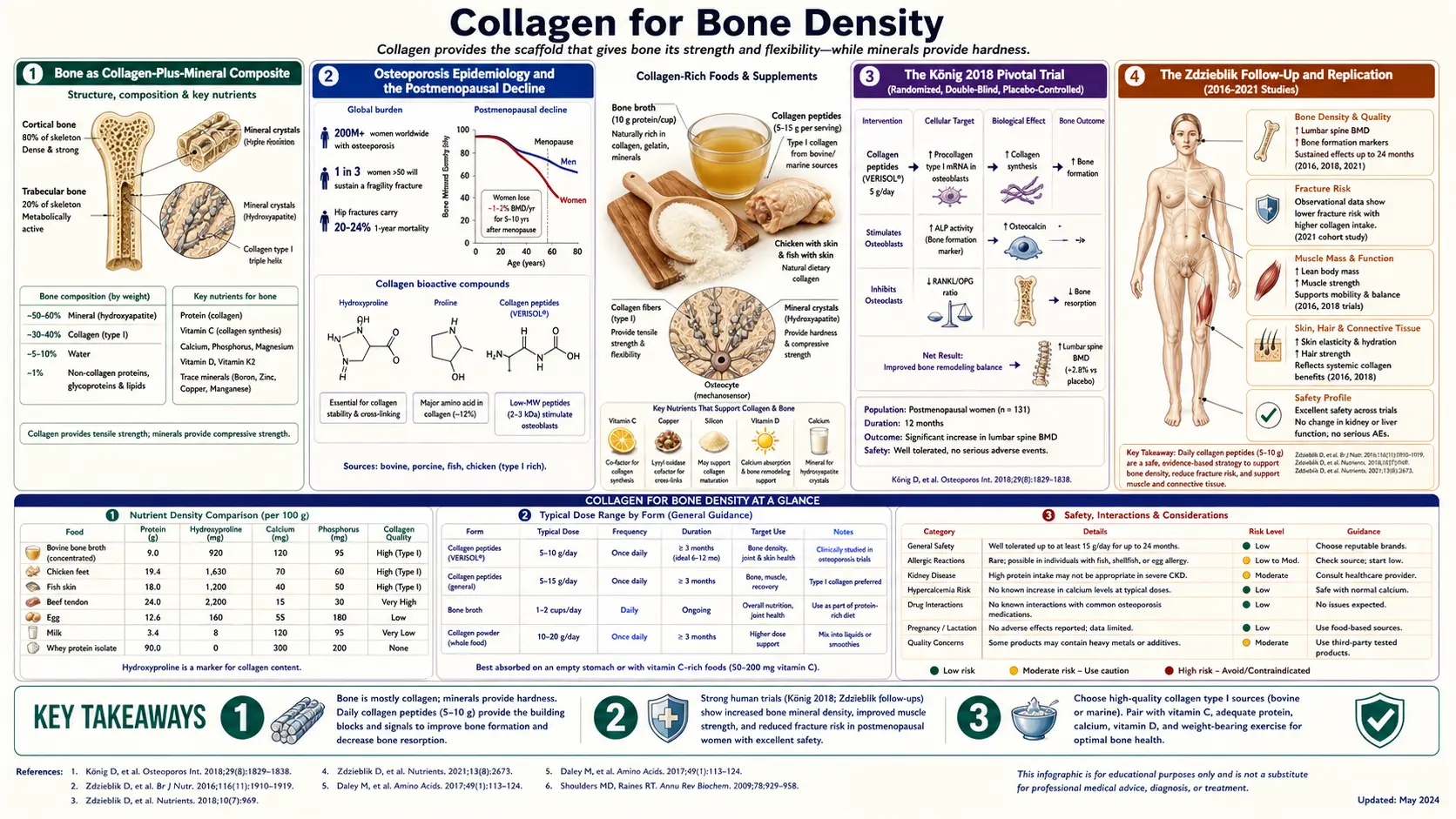
Bone combines a type I collagen framework with mineral, and its strength depends on the quality of that collagen as well as on the quantity of bone tissue (Viguet-Carrin 2006). The main controlled trial of collagen peptides for bone is König 2018: 131 postmenopausal women with an age-related reduction in bone mineral density took 5 g of collagen peptides or placebo daily for 12 months, and bone mineral density of the spine and femoral neck rose compared with placebo. Part of the study was funded by a collagen peptide manufacturer, and one of its five authors listed a collagen research institute (König 2018). No collagen trial has used fractures as its outcome. This deep dive covers the bone biology, the König trial and its open-label follow-up, the smaller trials, the blood, cell and animal studies behind the proposed mechanism, and the osteoporosis drug trials the collagen results can be read against.
Interactive Visualization Vitamin C, Collagen & Why Sailors Fell Apart Zip three protein chains into the strongest rope in biology — then take the vitamin C away and watch the helix unravel, and old healed scars split back open. Launch →
Table of Contents
- Bone as Collagen-Plus-Mineral Composite
- Osteoporosis and the Postmenopausal Years
- The König 2018 Trial
- The Zdzieblik 2021 Follow-Up and Other Trials
- Proposed Mechanism: Blood, Cell and Animal Studies
- Spine and Femoral Neck Results
- Bone Turnover Markers (CTX, P1NP)
- Osteoporosis Drug Trials for Comparison
- Calcium, Vitamin D and Other Factors in the Trial Reports
- Fracture Evidence
- Key Research Papers
- Connections
- Featured Videos
Bone as Collagen-Plus-Mineral Composite
A review of collagen's role in bone describes bone as a complex tissue whose main function is to resist mechanical forces and fractures. Its strength depends not only on the quantity of bone tissue but also on its quality — the geometry and shape of bones, the microarchitecture of trabecular bone, bone turnover, the mineral and the collagen. Type I collagen and the mineral interact, and the orientation of the collagen fibers contributes when bone is put under mechanical load (Viguet-Carrin 2006).
The same review describes how bone collagen matures. The enzyme lysyl oxidase forms crosslinks that stabilize the collagen fibrils. Non-enzymatic changes — advanced glycation end products from sugars accumulating in bone tissue, and racemization and isomerization in the collagen telopeptide — are age-related and may impair the mechanical properties of bone (Viguet-Carrin 2006).
Osteogenesis imperfecta, the brittle bone disorder, shows what happens when bone collagen itself is faulty. Skeletal deformity and bone fragility are its hallmarks; it is caused by dominant mutations in the genes coding for type I collagen, and by defects in a range of genes for proteins involved in type I collagen synthesis, processing, secretion and modification and in the activity of bone-forming cells (Marini 2017).
The human trials on this page measured bone mineral density by DXA (dual-energy X-ray absorptiometry) scans, plus blood markers of bone turnover (König 2018).
Osteoporosis and the Postmenopausal Years
A review of hydrolyzed collagen and bone describes osteoporosis as a chronic disease without symptoms, marked by low bone mass and deterioration of the skeleton's microarchitecture, with an increased risk of fracture, and most prevalent in older people (Daneault 2017).
The König trial report opens with an estimate that, worldwide, one in three women and one in five men over the age of 50 will sustain an osteoporotic fracture, and notes that these fractures cause chronic pain, inactivity and disability in older people (König 2018).
The same report describes bisphosphonates as the most widely used osteoporosis medication. It lists side effects described in the literature — osteonecrosis of the jaw, gastrointestinal disorders, mucosal ulcers, low blood calcium and kidney failure in predisposed people — and cites figures that about 40% of people taking oral bisphosphonates stop during the first year and about 75% by 5 years (König 2018).
König and colleagues enrolled postmenopausal women with an age-related reduction in bone mineral density, described below (König 2018).
The König 2018 Trial
König and colleagues at the University of Freiburg published a 12-month randomized, placebo-controlled, double-blind trial in Nutrients in 2018. They enrolled 131 postmenopausal women aged 46–80 with reduced bone mineral density, defined as a DXA T-score of −1 or lower at the femoral neck or the lumbar spine. The women took a daily sachet of either:
- 5 g of collagen peptides (n = 66) — a mixture of specific collagen peptides with a mean molecular weight of about 5 kDa
- 5 g of maltodextrin as placebo (n = 65) — the sachets were identical in appearance, flavor and texture
The two primary endpoints were the change in bone mineral density of the femoral neck and of the lumbar spine (L1–L4) after 12 months. The blood markers P1NP and CTX 1 were also analysed (König 2018).
Results reported by the trial:
- Completion: 102 women completed the study, and all 131 were included in the intention-to-treat analysis. None of the drop-outs was related to side effects, and no adverse events were noted
- Baseline: the average spine T-score was −2.4 and the average femoral neck T-score −1.4. The collagen group started with significantly lower spine bone density than the placebo group, so the authors used an analysis of covariance (ANCOVA) to account for the imbalance
- Spine: T-score +0.10 with collagen vs −0.03 with placebo (p = 0.030)
- Femoral neck: T-score +0.09 with collagen vs −0.01 with placebo (p = 0.003)
- In percentages: the full text reports that bone mineral density rose by almost 3.0% in the spine and 6.7% in the femoral neck in the collagen group, while it fell in the placebo group (−1.3% spine, −1.0% femoral neck)
- P1NP (bone formation marker): rose in the collagen group (p = 0.007); no change in the placebo group
- CTX 1 (bone breakdown marker): rose in the placebo group (p = 0.011); no change in the collagen group
The authors concluded that the collagen peptides increased bone mineral density in these women and were associated with a favorable shift in bone markers. They declared no conflict of interest; one of the five authors listed a collagen research institute, and the report states that part of the study was financially supported by a collagen peptide manufacturer, with planning, organization and data analysis carried out by the investigators (König 2018).
The trial measured bone mineral density and blood markers, not fractures. It tested one specific collagen peptide preparation, so its results may not carry over to other collagen products.
The Zdzieblik 2021 Follow-Up and Other Trials
Beyond the König trial, the human bone studies on this page are one uncontrolled follow-up, two small trials of collagen added to calcium and vitamin D, and a 1996 study of collagen added to an osteoporosis drug:
- Zdzieblik 2021 (open-label follow-up, no placebo group) — 31 women from the König trial (13 from the former collagen group and 18 from the former placebo group, who began collagen peptides at the start of the follow-up) continued taking the same collagen peptides, for a total intervention time of 4 years. The abstract states that 31 completed the follow-up, while the full text reports that 23 completed it. The authors reported a clinically relevant increase in spine bone mineral density and consistent results at the femoral neck; in the full text, most of the relative changes did not reach statistical significance. No participant had an osteoporotic fracture during the follow-up. Two of the three authors were at a collagen research institute, and one has given lectures partly supported by a collagen peptide manufacturer and is a co-inventor on collagen peptide patents (Zdzieblik 2021)
- Elam 2015 — 39 postmenopausal women with osteopenia were randomized to 5 g a day of a calcium-collagen chelate (with 500 mg of calcium and 200 IU of vitamin D) or a control of 500 mg of calcium and 200 IU of vitamin D, for 12 months. Whole-body bone mineral density fell less in the chelate group (−1.33% vs −3.75% in those who completed; −0.33% vs −2.17% in the intention-to-treat analysis; P = .026 and .035). At 6 months the chelate group had lower sclerostin and TRAP5b, a bone-resorption marker (Elam 2015). A comment on the trial was published in Climacteric (Castelo-Branco 2015)
- Argyrou 2020 — 51 postmenopausal women with osteopenia took either a sachet of 5 g of collagen peptides with 500 mg of calcium and 400 IU of vitamin D3, or a tablet of 500 mg of calcium and 400 IU of vitamin D3, daily for 3 months. The outcomes were the bone markers P1NP and CTX. In the collagen group P1NP fell by 13.1% (p < 0.001) and CTX by 11.4% (p = 0.058, not statistically significant); neither changed in the comparison group. The collagen group had better compliance and no adverse events, unlike the comparison group. The study was supported by a supplement distributor, which also supplied the collagen sachets (Argyrou 2020)
- Adam 1996 — 108 women with postmenopausal osteoporosis received injections of calcitonin, an osteoporosis drug, twice a week for 24 weeks; 49 of them also took 10 g of collagen hydrolysate a day. Urinary markers of bone collagen breakdown (pyridinoline and deoxypyridinoline) fell more when collagen was added, and stayed low three months after treatment ended; bone mineral density rose only insignificantly, by 1.8%, with treatment. The report is in Czech with an English abstract (Adam 1996)
A second 2021 trial from the same research group, in International Journal of Environmental Research and Public Health, gave 15 g a day of collagen peptides with 12 weeks of resistance training to middle-aged, untrained men and measured body composition and leg strength, not bone (Zdzieblik 2021, men's trial).
Proposed Mechanism: Blood, Cell and Animal Studies
How collagen peptides might affect bone has been studied in people's blood, in cultured cells and in animals:
- Peptides in human blood — in healthy volunteers who ingested 9.4–23 g of gelatin hydrolysates after a 12-hour fast, the peptide form of hydroxyproline in plasma rose from negligible levels to a peak of 20–60 nmol/mL after 1–2 hours and fell to half of that by 4 hours; the main peptide was prolyl-hydroxyproline (Pro-Hyp) (Iwai 2005)
- Distribution in rats — radiolabelled Pro-Hyp given by mouth to rats spread widely through tissues including skin and cartilage, and radioactivity was taken up by cells including osteoblasts and osteoclasts. In cartilage only 5% of the radioactivity was intact Pro-Hyp; most of the Pro-Hyp in plasma had been modified in a first-pass effect (Kawaguchi 2012)
- Osteoblast cells — in a cultured osteoblastic cell line (MC3T3-E1), Pro-Hyp did not change cell proliferation or matrix mineralization, but it increased alkaline phosphatase activity and the expression of the genes Runx2, Osterix and Col1α1, which the authors interpreted as promoting osteoblast differentiation (Kimira 2014)
- Mice — in ovariectomized mice (a model of estrogen loss), a diet containing 25 g/kg of hydrolyzed collagen for 12 weeks gave higher bone mineral density and bone strength than in ovariectomized controls, and the bone-resorption marker CTX fell with diets containing 10 or 25 g/kg. In cultured mouse bone cells, 2 kDa hydrolyzed collagens raised alkaline phosphatase activity in a dose-dependent way and lowered osteoclast activity, without affecting cell growth (Guillerminet 2010)
A 2017 review, two of whose five authors listed a company affiliation, reasoned that because orally administered collagen can be digested, cross the intestinal barrier, enter the circulation and reach target tissues, one may speculate that a collagen-enriched diet benefits the skeleton, and reviewed the evidence on hydrolyzed collagen and bone (Daneault 2017). The blood studies are also covered in the skin deep dive.
These are cell and animal findings. How much they explain the results of the human trials has not been established.
Spine and Femoral Neck Results
In König 2018, both primary endpoints improved compared with placebo. Measured in T-score units the changes were similar (spine +0.10, femoral neck +0.09). Measured in percentages, the collagen group's bone mineral density rose by almost 3.0% in the spine and 6.7% in the femoral neck. Allowing for the fall in the placebo group, the authors describe the collagen group as having 4.2% higher bone mineral density in the spine and 7.7% higher in the femoral neck, which they called a clinically relevant effect (König 2018).
The collagen group began with significantly lower spine bone density than the placebo group, which the authors handled statistically (König 2018).
In the open-label follow-up, the full text reports relative changes over the follow-up of 5.79% (spine) and 4.21% (femoral neck) in the women who had been in the collagen group, and 8.16% (spine) and 1.23% (femoral neck) in those who had been in the placebo group; most of these relative changes did not reach statistical significance (Zdzieblik 2021).
Bone Turnover Markers (CTX, P1NP)
Two blood markers recur in these trials. P1NP (amino-terminal propeptide of type I collagen) was used as a marker of bone formation, and CTX 1 (C-telopeptide of type I collagen) as a marker of bone breakdown (König 2018).
- König 2018 — P1NP rose in the collagen group; CTX 1 rose in the placebo group and did not change in the collagen group. The authors read this as increased bone formation and reduced bone degradation
- Argyrou 2020 — with collagen added to calcium and vitamin D, P1NP fell by 13.1% and CTX by 11.4% (the CTX change was not statistically significant). The authors read this as a reduction of the increased bone turnover of postmenopausal women
- Elam 2015 — at 6 months the calcium-collagen chelate group had lower sclerostin and TRAP5b and a higher ratio of bone-specific alkaline phosphatase to TRAP5b than the control group
- Mice (Guillerminet 2010) — CTX fell with hydrolyzed collagen diets
The direction of P1NP differed between the two human trials that measured it: it rose in König 2018 and fell in Argyrou 2020.
Osteoporosis Drug Trials for Comparison
Two osteoporosis drug trials, both in women who already had vertebral fractures, measured fractures directly:
- Alendronate, a bisphosphonate (Black 1996, Fracture Intervention Trial) — 2,027 women aged 55–81 with low femoral-neck bone mineral density and at least one vertebral fracture took alendronate (5 mg daily, raised to 10 mg at 24 months) or placebo for 36 months. New vertebral fractures seen on X-ray occurred in 8.0% of the alendronate group and 15.0% of the placebo group, and any clinical fracture in 13.6% vs 18.2% (relative hazard 0.72). The relative hazards for hip and wrist fracture were 0.49 and 0.52. The numbers of adverse experiences, including upper-gastrointestinal disorders, did not differ significantly between the groups
- Parathyroid hormone (1-34), an anabolic drug (Neer 2001) — 1,637 postmenopausal women with prior vertebral fractures injected 20 or 40 µg a day or placebo, with a median observation of 21 months. New vertebral fractures occurred in 14% of the placebo group and in 5% and 4% of the two hormone groups, and new nonvertebral fragility fractures in 6% vs 3%. Compared with placebo, bone mineral density rose by 9 and 13 more percentage points in the lumbar spine and 3 and 6 more in the femoral neck. Side effects were minor (occasional nausea and headache)
These drug trials enrolled women with existing vertebral fractures and measured fractures; the collagen trials enrolled women with reduced bone mineral density and measured bone density and blood markers. The populations, durations and outcomes differ, so the numbers are not directly comparable. No trial on this page compared collagen peptides with an osteoporosis drug head to head. Decisions about osteoporosis treatment belong with a clinician; the condition is covered on the Osteoporosis page.
Calcium, Vitamin D and Other Factors in the Trial Reports
- Lifestyle factors — the König authors describe daily physical activity, smoking cessation and reduced alcohol consumption as important cofactors in maintaining bone health (König 2018)
- Calcium and vitamin D — the same authors write that calcium and vitamin D supplementation is recommended in osteoporosis management but has not been shown to significantly reduce fracture risk (König 2018)
- Diet in the König trial — calcium and vitamin D intake did not differ between the groups at baseline; vitamin D intake from food was below the recommended 20 µg a day in both groups before and after the trial (supplements were not counted in that analysis). Physical activity tended to rise during the study, without reaching significance (König 2018)
- Collagen on top of calcium and vitamin D — in Elam 2015 and Argyrou 2020 both groups received calcium and vitamin D, so those trials tested collagen added to calcium and vitamin D
Related nutrients are covered on their own pages: Vitamin D3, Vitamin K2, Calcium and Magnesium.
Fracture Evidence
None of the collagen trials on this page used fractures as an outcome. König 2018 measured bone mineral density and blood markers over 12 months (König 2018). The open-label follow-up recorded fractures and reported none among its participants, in a small group with no placebo comparison (Zdzieblik 2021).
Bone strength depends on bone quality as well as on the quantity of bone tissue (Viguet-Carrin 2006). Whether the bone mineral density changes seen with collagen peptides translate into fewer fractures has not been tested in a trial. The alendronate and parathyroid hormone trials described above measured fracture rates directly (Black 1996; Neer 2001).
Key Research Papers
- König D, Oesser S, Scharla S, Zdzieblik D, Gollhofer A (2018). Specific collagen peptides improve bone mineral density and bone markers in postmenopausal women — a randomized controlled study. Nutrients. 10(1):97. — PubMed PMID: 29337906
- Zdzieblik D, Jendricke P, Oesser S, Gollhofer A, König D (2021). The influence of specific bioactive collagen peptides on body composition and muscle strength in middle-aged, untrained men: a randomized controlled trial. International Journal of Environmental Research and Public Health. 18(9):4837. (A muscle and body-composition trial, not a bone study.) — PubMed PMID: 33946565
- Daneault A, Prawitt J, Fabien Soulé V, Coxam V, Wittrant Y (2017). Biological effect of hydrolyzed collagen on bone metabolism. Critical Reviews in Food Science and Nutrition. 57(9):1922-1937. — PubMed PMID: 25976422
- Guillerminet F, Beaupied H, Fabien-Soulé V, Tomé D, Benhamou CL, Roux C, Blais A (2010). Hydrolyzed collagen improves bone metabolism and biomechanical parameters in ovariectomized mice: an in vitro and in vivo study. Bone. 46(3):827-34. — PubMed PMID: 19895915
- Elam ML, Johnson SA, Hooshmand S, Feresin RG, Payton ME, Gu J, Arjmandi BH (2015). A calcium-collagen chelate dietary supplement attenuates bone loss in postmenopausal women with osteopenia: a randomized controlled trial. Journal of Medicinal Food. 18(3):324-31. — PubMed PMID: 25314004
- Hooper L, Ryder JJ, Kurzer MS, Lampe JW, Messina MJ, Phipps WR, Cassidy A (2009). Effects of soy protein and isoflavones on circulating hormone concentrations in pre- and post-menopausal women: a systematic review and meta-analysis. Human Reproduction Update. 15(4):423-40. (Hormone outcomes; not a collagen or bone study.) — PubMed PMID: 19299447
- Castelo-Branco C (2015). Calcium-collagen chelate supplementation reduces bone loss in osteopenic postmenopausal women. Climacteric. 18(1):105-6. (Comment on Elam 2015.) — PubMed PMID: 25734209
- Adam M, Spacek P, Hulejová H, Galiánová A, Blahos J (1996). [Postmenopausal osteoporosis. Treatment with calcitonin and a diet rich in collagen proteins]. Casopis Lekaru Ceskych. 135(3):74-8. (In Czech, English abstract.) — PubMed PMID: 8625373
- Argyrou C, Karlafti E, Lampropoulou-Adamidou K, Tournis S, Makris K, Trovas G, Dontas I, Triantafyllopoulos IK (2020). Effect of calcium and vitamin D supplementation with and without collagen peptides on bone turnover in postmenopausal women with osteopenia. Journal of Musculoskeletal & Neuronal Interactions. 20(1):12-17. — PubMed PMID: 32131366
- Black DM, Cummings SR, Karpf DB, et al. (1996). Randomised trial of effect of alendronate on risk of fracture in women with existing vertebral fractures. Fracture Intervention Trial Research Group. Lancet. 348(9041):1535-41. — PubMed PMID: 8950879
- Neer RM, Arnaud CD, Zanchetta JR, et al. (2001). Effect of parathyroid hormone (1-34) on fractures and bone mineral density in postmenopausal women with osteoporosis. New England Journal of Medicine. 344(19):1434-41. — PubMed PMID: 11346808
- Zdzieblik D, Oesser S, König D (2021). Specific bioactive collagen peptides in osteopenia and osteoporosis: long-term observation in postmenopausal women. Journal of Bone Metabolism. 28(3):207-213. (Open-label follow-up.) — PubMed PMID: 34520654
- Viguet-Carrin S, Garnero P, Delmas PD (2006). The role of collagen in bone strength. Osteoporosis International. 17(3):319-36. — PubMed PMID: 16341622
- Marini JC, Forlino A, Bächinger HP, et al. (2017). Osteogenesis imperfecta. Nature Reviews Disease Primers. 3:17052. — PubMed PMID: 28820180
- Iwai K, Hasegawa T, Taguchi Y, et al. (2005). Identification of food-derived collagen peptides in human blood after oral ingestion of gelatin hydrolysates. Journal of Agricultural and Food Chemistry. 53(16):6531-6. — PubMed PMID: 16076145
- Kawaguchi T, Nanbu PN, Kurokawa M (2012). Distribution of prolylhydroxyproline and its metabolites after oral administration in rats. Biological and Pharmaceutical Bulletin. 35(3):422-7. — PubMed PMID: 22382331
- Kimira Y, Ogura K, Taniuchi Y, et al. (2014). Collagen-derived dipeptide prolyl-hydroxyproline promotes differentiation of MC3T3-E1 osteoblastic cells. Biochemical and Biophysical Research Communications. 453(3):498-501. — PubMed PMID: 25285626
PubMed Topic Searches
Connections
- All Amino Acids
- Vitamin C, Collagen & Why Sailors Fell Apart — interactive animation
- Collagen Overview
- Collagen Benefits Hub
- Collagen for Skin
- Collagen for Joint Health
- Collagen for Hair & Nails
- Osteoporosis
- Arthritis
- Vitamin D3
- Vitamin K2
- Vitamin C (Cofactor)
- Calcium
- Magnesium
- Phosphorus
- Bone Broth
- History
- Sources