Collagen for Skin Elasticity and Anti-Aging
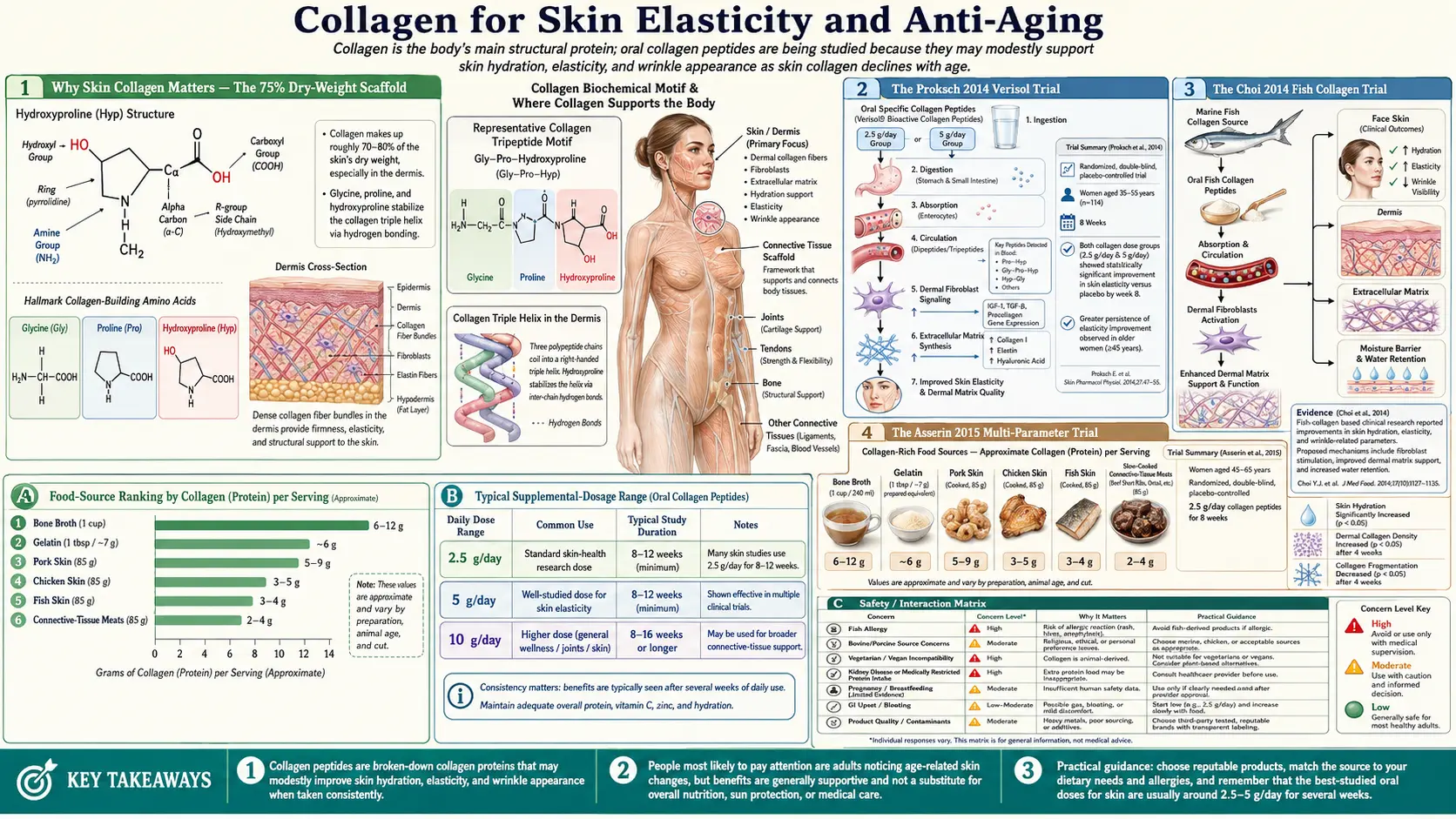
Collagen accounts for about three-quarters of the dry weight of skin (Shoulders 2009). Placebo-controlled trials of collagen peptides taken by mouth — among them two 8-week trials by Proksch and colleagues (2014) at 2.5 g or 5 g a day, and the Asserin 2015 trials — reported improvements in skin elasticity, eye-wrinkle volume, hydration and dermal collagen density. Reviews of the trials disagree: a 2025 meta-analysis of 23 trials found no effect in the trials not funded by pharmaceutical companies and no significant effect in the high-quality trials (Myung 2025). Pro-Hyp, the main collagen peptide found in blood after ingestion (Iwai 2005), stimulated skin fibroblasts in laboratory studies (Shigemura 2009; Ohara 2010) — cell findings, not human results. This deep dive sets out the trials, the laboratory evidence, the reviews and their limits.
Interactive Visualization Vitamin C, Collagen & Why Sailors Fell Apart Zip three protein chains into the strongest rope in biology — then take the vitamin C away and watch the helix unravel, and old healed scars split back open. Launch →
Table of Contents
- Why Skin Collagen Matters — Three-Quarters of Skin’s Dry Weight
- The Proksch 2014 Trials
- The Choi 2014 Collagen Tripeptide Trial
- The Asserin 2015 Trials
- The Pro-Hyp Mechanism: Blood and Cell Studies
- Trial Doses and Timelines
- The Vitamin C Cofactor Requirement
- Reviews and Meta-Analyses (2019, 2021, 2023, 2025)
- How the Trial Products Differed
- What the Trials Did Not Show
- Key Research Papers
- Connections
- Featured Videos
Why Skin Collagen Matters — Three-Quarters of Skin’s Dry Weight
Collagen is the most abundant protein in animals. In humans it makes up about one-third of total protein and three-quarters of the dry weight of skin, and it is the most prevalent component of the extracellular matrix, the material that surrounds and supports cells. Type I collagen forms the prototypical collagen fibril (Shoulders 2009).
In a study that measured forearm skin in a large number of healthy people, skin collagen decreased with age and was lower in women than in men at all ages, and dermal thickness tracked skin collagen (Shuster 1975). Studies have also measured outside influences on skin collagen:
- Ultraviolet light — in human skin, ultraviolet-B exposure induced matrix-degrading metalloproteinases (enzymes that break down the matrix) within hours, at doses well below those that redden the skin. The authors proposed that these enzymes degrade skin collagen and elastin and that, repeated over a lifetime and imperfectly repaired, the damage leads to premature skin ageing (photoageing) (Fisher 1996)
- Smoking — in a comparison of 47 current smokers with 51 people who had never smoked, the synthesis rates of type I and type III collagen in skin were 18% and 22% lower in the smokers, and levels of the collagen-degrading enzyme MMP-8 were 100% higher (Knuutinen 2002)
- Menopause — a review described a strong correlation between skin collagen loss and the oestrogen deficiency of menopause, and reported that oestrogen use after menopause increases collagen content, dermal thickness and elasticity (Calleja-Agius 2012)
The trials below asked whether collagen peptides taken by mouth change measurable skin properties.
The Proksch 2014 Trials
Proksch and colleagues (first author at the Department of Dermatology, University of Kiel) published two double-blind, placebo-controlled trials of collagen peptides in Skin Pharmacology and Physiology in 2014. Both tested a specific collagen peptide preparation taken once a day for 8 weeks.
Elasticity trial (Proksch 2014a). 69 women aged 35–55 were randomized to 2.5 g or 5.0 g of collagen hydrolysate or placebo, 23 per group. Skin elasticity, skin moisture, transepidermal water loss and skin roughness were measured at the start and after 4 and 8 weeks; elasticity, the primary interest, was also measured 4 weeks after the last intake. The findings:
- At the end of the study, skin elasticity in both collagen groups had improved significantly compared with placebo
- Four weeks after the last intake, elasticity was significantly higher in the elderly women
- For skin moisture and skin evaporation, a positive influence was seen in a subgroup analysis, but the data did not reach statistical significance
- No side effects were noted
Wrinkle trial (Proksch 2014b). 114 women aged 45–65 were randomized to 2.5 g of collagen peptides or placebo, 57 per group. Eye-wrinkle volume fell significantly compared with placebo after 4 and 8 weeks (20% at 8 weeks, p < 0.05), and the difference was still present 4 weeks after the last intake. In a subgroup that had suction-blister biopsies, procollagen type I was 65% and elastin 18% higher than with placebo after 8 weeks; a 6% increase in fibrillin did not reach statistical significance.
The two abstracts do not state how the trials were funded.
The Choi 2014 Collagen Tripeptide Trial
Choi and colleagues at the Department of Dermatology, Chung-Ang University College of Medicine, Seoul, published a 12-week randomized, controlled trial in the Journal of Cosmetic and Laser Therapy in 2014. Thirty-two healthy volunteers were randomized to one of four groups: no supplement, 3 g of collagen peptide a day, 3 g of collagen peptide plus 500 mg of vitamin C a day, or 500 mg of vitamin C a day. The control group took no supplement, not a placebo.
- Skin hydration (corneometer) changed significantly more than in the no-supplement group in both collagen groups (p = 0.011 and p = 0.004)
- Skin elasticity (cutometer) also changed significantly more than in the no-supplement group in both collagen groups (p = 0.005 and p = 0.015)
- There was no significant difference between collagen alone and collagen plus vitamin C; the authors concluded that concomitant low-dose vitamin C did not enhance the effect
A 2019 systematic review counted two trials of collagen tripeptide at 3 g a day for 4 to 12 weeks, with notable improvement in skin elasticity and hydration (Choi 2019).
The Asserin 2015 Trials
Asserin and colleagues reported two placebo-controlled clinical trials and a laboratory study in the Journal of Cosmetic Dermatology in 2015. The trials measured skin hydration by corneometry, collagen density in the dermis by high-resolution ultrasound, and fragmentation of the dermal collagen network by reflectance confocal microscopy. The four authors’ listed affiliations include two companies. The abstract reports:
- Skin hydration increased significantly after 8 weeks of collagen peptide intake
- Dermal collagen density increased significantly, and fragmentation of the dermal collagen network decreased significantly, after 4 weeks
- Both effects persisted after 12 weeks
- In human skin explants (skin samples kept alive in the laboratory), collagen peptides induced collagen and glycosaminoglycan production
The abstract does not give the number of participants, their ages, the daily amount or the collagen source; the full text was not available for this review.
The Pro-Hyp Mechanism: Blood and Cell Studies
Hydroxyproline (Hyp) is a characteristic amino acid of collagen. In a 2005 study from Kyoto Prefectural University, healthy volunteers ingested 9.4–23 g of gelatin hydrolysates made from pork skin, chicken feet and cartilage after a 12-hour fast. The peptide form of hydroxyproline in their blood rose from negligible levels to a peak of 20–60 nmol/mL of plasma after 1–2 hours and fell to half of that peak by 4 hours. The main collagen peptide identified was prolyl-hydroxyproline (Pro-Hyp), with small amounts of others including Pro-Hyp-Gly (Iwai 2005).
Laboratory studies then tested Pro-Hyp on cells:
- Mouse skin fibroblasts — Pro-Hyp (200 nmol/mL) increased the number of fibroblasts migrating out of cultured mouse skin discs, and Pro-Hyp at 0–1000 nmol/mL enhanced fibroblast growth on collagen gel in a dose-dependent manner (Shigemura 2009)
- Human dermal fibroblasts — in culture, Pro-Hyp increased cell proliferation 1.5-fold and increased hyaluronic acid synthesis through higher hyaluronan synthase 2 (HAS2) gene activity (Ohara 2010)
- Cartilage — in mice and cultured cartilage cells, Pro-Hyp limited cartilage thinning and increased glycosaminoglycan staining and aggrecan gene activity (Nakatani 2009), covered in the joint health deep dive; the bone trials are covered in the bone density deep dive
These are animal and cell findings, not human results. It has not been shown that the same happens in human skin after a supplement. In a trial that compared two collagen hydrolysates with different amounts of Pro-Hyp and Hyp-Gly, the one with more of these peptides improved facial skin moisture, elasticity, wrinkles and roughness more than the other and more than placebo over 8 weeks; two of its three authors were from a gelatin company (Inoue 2016).
Trial Doses and Timelines
The amounts and durations used in the skin trials on this page were:
- 2.5 g or 5 g a day for 8 weeks — Proksch 2014a (elasticity); 2.5 g a day for 8 weeks in Proksch 2014b (wrinkles)
- 3 g a day for 12 weeks — Choi 2014 (collagen peptide, with and without vitamin C)
- 1,000 mg a day for 12 weeks — Kim 2018, a low-molecular-weight collagen peptide, in 64 people; skin hydration was higher than with placebo at 6 and 12 weeks, and wrinkle measures and two of three elasticity measures were better than with placebo at 12 weeks
- 2.5 g of collagen peptides in a multi-ingredient drink for 12 weeks — Bolke 2019 (see below)
- 2.5 g to 10 g a day for 8 to 24 weeks — the range of the eight collagen hydrolysate trials in the 2019 systematic review (Choi 2019)
When the trials measured changes:
- 4 weeks — Proksch 2014b reported a lower eye-wrinkle volume than placebo, and Asserin 2015 reported higher dermal collagen density and less fragmentation
- 8 weeks — the end point of both Proksch trials; Asserin 2015 reported higher skin hydration
- 12 weeks — the end point of Choi 2014, Kim 2018 and Bolke 2019; the Asserin 2015 effects persisted
- After stopping — 4 weeks after the last intake, Proksch 2014b still found a difference in eye-wrinkle volume and Proksch 2014a found higher elasticity in the elderly women; in Bolke 2019 the effects were substantially retained during 4 weeks without the product
These figures describe the research, not a regimen. Decisions about supplements belong with a clinician.
The Vitamin C Cofactor Requirement
Ascorbate (vitamin C) is required for the hydroxylation of proline residues in procollagen, and hydroxyproline stabilizes the collagen triple helix; consequently, ascorbate stimulates procollagen secretion (Peterkofsky 1991). The same review reported that in vitamin C–deficient guinea pigs collagen synthesis fell with only moderate effects on proline hydroxylation, and linked the fall to weight loss and to inhibitors induced during deficiency and starvation (Peterkofsky 1991).
Humans, unlike most animals, cannot make vitamin C and need it from the diet, mainly from fruits and vegetables. In adult scurvy, the earliest symptom, after many weeks of deficient intake, is fatigue; common skin findings include perifollicular hemorrhages, bruising, dry skin, leg swelling, poor wound healing and coiled body hairs; people with teeth develop swollen, bleeding gums; pain in the back and joints is common. Treatment with vitamin C brings rapid, often dramatic, improvement (Hirschmann 1999). More is on the Vitamin C page.
In the one skin trial on this page that tested it, adding 500 mg of vitamin C a day to 3 g of collagen peptide did not enhance the effect on skin hydration or elasticity (Choi 2014).
A related cofactor is copper. Lysyl oxidase, the enzyme that cross-links collagen and elastin, is a copper-containing enzyme essential for stabilizing the extracellular matrix, and dietary copper directly influences its functional activity (Rucker 1998).
Reviews and Meta-Analyses (2019, 2021, 2023, 2025)
Reviews of the skin trials reach different conclusions:
- Choi 2019 systematic review (Journal of Drugs in Dermatology) — included 11 randomized, placebo-controlled trials with 805 patients, on pressure ulcers, dry skin, skin aging and cellulite. It was a review without a pooled analysis. The authors described preliminary results as promising, reported increased skin elasticity, hydration and dermal collagen density, and called for further studies on skin barrier diseases such as atopic dermatitis and on optimal dosing
- de Miranda 2021 meta-analysis (International Journal of Dermatology) — 19 randomized, double-blind, controlled trials with 1,125 participants aged 20–70 (95% women). The pooled analysis reported favorable results for skin hydration, elasticity and wrinkles compared with placebo
- Pu 2023 meta-analysis (Nutrients) — 26 randomized controlled trials with 1,721 patients. Hydrolyzed collagen significantly improved skin hydration and elasticity compared with placebo; the effect on hydration varied with the collagen source and the duration of supplementation, while the effect on elasticity did not differ significantly by source. The authors identified several biases in the included trials and called for further large-scale trials
- Myung 2025 meta-analysis (American Journal of Medicine) — 23 randomized controlled trials with 1,474 participants. Across all 23 trials, collagen supplements significantly improved skin hydration, elasticity and wrinkles. But the trials not funded by pharmaceutical companies showed no effect on hydration, elasticity or wrinkles, while the company-funded trials did; the high-quality trials showed no significant effect in any category, while the low-quality trials showed a significant improvement in elasticity. The authors concluded that there is currently no clinical evidence to support the use of collagen supplements to prevent or treat skin aging
The 2025 authors wrote that no earlier meta-analysis of randomized trials had examined the effects by funding source and study quality (Myung 2025).
How the Trial Products Differed
The skin trials did not all test the same thing, which matters when reading their results together:
- Collagen hydrolysate or collagen peptides — the Proksch trials tested a specific collagen peptide preparation; the 2019 review counted eight trials of collagen hydrolysate, two of collagen tripeptide and one of a collagen dipeptide preparation, and reported that the dipeptide study suggested an effect proportional to dipeptide content (Choi 2019)
- Peptide content — Inoue 2016 found that a hydrolysate with more Pro-Hyp and Hyp-Gly did better than one with less; Kim 2018 tested a low-molecular-weight peptide with a tripeptide content above 15%
- Collagen source — in the 2023 meta-analysis the effect on hydration varied with the collagen source, while elasticity did not differ significantly by source (Pu 2023). None of the trials on this page compared animal sources directly
- Multi-ingredient products — Bolke 2019 tested a drink combining 2.5 g of collagen peptides with acerola fruit extract, vitamin C, zinc, biotin and vitamin E in 72 women aged 35 or older for 12 weeks; the product significantly improved skin hydration, elasticity, roughness and density compared with placebo. The paper states that its sponsor had no influence on execution, analysis and interpretation of the data. A 2014 open-label study with no placebo group tested 50 mL a day of a liquid product containing hydrolyzed collagen, hyaluronic acid, vitamins and minerals, run by authors from a research company; it reported less dryness and wrinkling and higher collagen density (Borumand 2014). With several ingredients, the effect cannot be attributed to collagen alone
- Funding — authors listed company affiliations in several of these trials (Asserin 2015, Inoue 2016, Kim 2018, Borumand 2014), and in the 2025 meta-analysis the benefits were seen only in company-funded trials (Myung 2025)
What the Trials Did Not Show
The limits of the evidence, as the papers state them:
- Short durations and measured endpoints — the trials ran 8 to 24 weeks (Choi 2019) and measured elasticity, hydration, wrinkle volume, roughness and dermal density with instruments. None of the trials on this page measured outcomes beyond 24 weeks
- Independent and high-quality trials — trials without pharmaceutical-company funding, and high-quality trials, found no significant effect (Myung 2025)
- Skin diseases — the 2019 review called for further studies before any medical use in skin barrier diseases such as atopic dermatitis (Choi 2019)
- Ultraviolet damage — Fisher 1996 proposed that photoageing results from ultraviolet-induced breakdown of skin collagen and elastin; in that study, all-trans retinoic acid applied to skin before ultraviolet-B exposure substantially reduced the induction of the enzymes involved (Fisher 1996). No trial on this page compared oral collagen with sun protection or with retinoids. Topical retinoids are covered in the Vitamin A skin deep dive
- Mechanism in people — the Pro-Hyp effects on fibroblasts come from cell and animal studies (Shigemura 2009; Ohara 2010; Nakatani 2009), not from human skin
Side effects were uncommon in these trials: no side effects were noted in Proksch 2014a, no adverse events occurred in Inoue 2016, and the 2019 review reported no adverse events (Choi 2019).
Key Research Papers
- Proksch E et al. (2014). Oral supplementation of specific collagen peptides has beneficial effects on human skin physiology: a double-blind, placebo-controlled study. Skin Pharmacology and Physiology. 27(1):47-55. (Editorial note: this entry previously linked PMID 24401291, the same group’s wrinkle trial, listed separately below.) — PubMed PMID: 23949208
- Proksch E et al. (2014). Oral intake of specific bioactive collagen peptides reduces skin wrinkles and increases dermal matrix synthesis. Skin Pharmacology and Physiology. 27(3):113-119. — PubMed PMID: 24401291
- Choi FD et al. (2019). Oral collagen supplementation: a systematic review of dermatological applications. Journal of Drugs in Dermatology. 18(1):9-16. — PubMed PMID: 30681787
- Asserin J et al. (2015). The effect of oral collagen peptide supplementation on skin moisture and the dermal collagen network: evidence from an ex vivo model and randomized, placebo-controlled clinical trials. Journal of Cosmetic Dermatology. 14(4):291-301. — PubMed PMID: 26362110
- Shigemura Y et al. (2009). Effect of Prolyl-hydroxyproline (Pro-Hyp), a food-derived collagen peptide in human blood, on growth of fibroblasts from mouse skin. Journal of Agricultural and Food Chemistry. 57(2):444-449. (Mouse cell study.) — PubMed PMID: 19128041
- Iwai K et al. (2005). Identification of food-derived collagen peptides in human blood after oral ingestion of gelatin hydrolysates. Journal of Agricultural and Food Chemistry. 53(16):6531-6536. — PubMed PMID: 16076145
- Borumand M, Sibilla S (2014). Daily consumption of the collagen supplement Pure Gold Collagen reduces visible signs of aging. Clinical Interventions in Aging. 9:1747-1758. (Open-label study without a placebo group; an erratum was published in 2020, PMID 32103914.) — PubMed PMID: 25342893
- Inoue N et al. (2016). Ingestion of bioactive collagen hydrolysates enhance facial skin moisture and elasticity and reduce facial ageing signs in a randomised double-blind placebo-controlled clinical study. Journal of the Science of Food and Agriculture. 96(12):4077-4081. — PubMed PMID: 26840887
- Kim DU et al. (2018). Oral intake of low-molecular-weight collagen peptide improves hydration, elasticity, and wrinkling in human skin: a randomized, double-blind, placebo-controlled study. Nutrients. 10(7):826. (Editorial note: this entry was previously linked as a search.) — PubMed PMID: 29949889
- Bolke L et al. (2019). A collagen supplement improves skin hydration, elasticity, roughness, and density: results of a randomized, placebo-controlled, blind study. Nutrients. 11(10):2494. — PubMed PMID: 31627309
- de Miranda RB et al. (2021). Effects of hydrolyzed collagen supplementation on skin aging: a systematic review and meta-analysis. International Journal of Dermatology. 60(12):1449-1461. (Editorial note: this entry previously gave the year as 2022 and was linked as a search.) — PubMed PMID: 33742704
- Pu SY et al. (2023). Effects of oral collagen for skin anti-aging: a systematic review and meta-analysis. Nutrients. 15(9):2080. — PubMed PMID: 37432180
- Myung SK, Park Y (2025). Effects of collagen supplements on skin aging: a systematic review and meta-analysis of randomized controlled trials. American Journal of Medicine. 138(9):1264-1277. — PubMed PMID: 40324552
- Choi SY et al. (2014). Effects of collagen tripeptide supplement on skin properties: a prospective, randomized, controlled study. Journal of Cosmetic and Laser Therapy. 16(3):132-137. — PubMed PMID: 24131075
- Ohara H et al. (2010). Collagen-derived dipeptide, proline-hydroxyproline, stimulates cell proliferation and hyaluronic acid synthesis in cultured human dermal fibroblasts. Journal of Dermatology. 37(4):330-338. (Cell study.) — PubMed PMID: 20507402
- Nakatani S et al. (2009). Chondroprotective effect of the bioactive peptide prolyl-hydroxyproline in mouse articular cartilage in vitro and in vivo. Osteoarthritis and Cartilage. 17(12):1620-1627. (Animal and cell study.) — PubMed PMID: 19615963
- Shoulders MD, Raines RT (2009). Collagen structure and stability. Annual Review of Biochemistry. 78:929-958. (Review.) — PubMed PMID: 19344236
- Shuster S, Black MM, McVitie E (1975). The influence of age and sex on skin thickness, skin collagen and density. British Journal of Dermatology. 93(6):639-643. — PubMed PMID: 1220811
- Fisher GJ et al. (1996). Molecular basis of sun-induced premature skin ageing and retinoid antagonism. Nature. 379(6563):335-339. — PubMed PMID: 8552187
- Knuutinen A et al. (2002). Smoking affects collagen synthesis and extracellular matrix turnover in human skin. British Journal of Dermatology. 146(4):588-594. — PubMed PMID: 11966688
- Calleja-Agius J, Brincat M (2012). The effect of menopause on the skin and other connective tissues. Gynecological Endocrinology. 28:273-277. (Review.) — PubMed PMID: 21970508
- Peterkofsky B (1991). Ascorbate requirement for hydroxylation and secretion of procollagen: relationship to inhibition of collagen synthesis in scurvy. American Journal of Clinical Nutrition. 54(6 Suppl):1135S-1140S. (Review.) — PubMed PMID: 1720597
- Rucker RB et al. (1998). Copper, lysyl oxidase, and extracellular matrix protein cross-linking. American Journal of Clinical Nutrition. 67(5 Suppl):996S-1002S. (Review.) — PubMed PMID: 9587142
- Hirschmann JV, Raugi GJ (1999). Adult scurvy. Journal of the American Academy of Dermatology. 41(6):895-906. (Review.) — PubMed PMID: 10570371
PubMed Topic Searches
Connections
- All Amino Acids
- Vitamin C, Collagen & Why Sailors Fell Apart — interactive animation
- Collagen Overview
- Collagen Benefits Hub
- Collagen for Joint Health
- Collagen for Bone Density
- Collagen for Hair & Nails
- Vitamin C (Collagen Synthesis Cofactor)
- Vitamin A for Skin (Retinoids)
- Copper (Lysyl Oxidase Cofactor)
- Zinc
- Glycine (33% of Collagen)
- Proline (12% of Collagen)
- Lysine
- Bone Broth
- Organ Meats
- History
- Sources