Niacin (Vitamin B3) Toxicity: Liver Damage
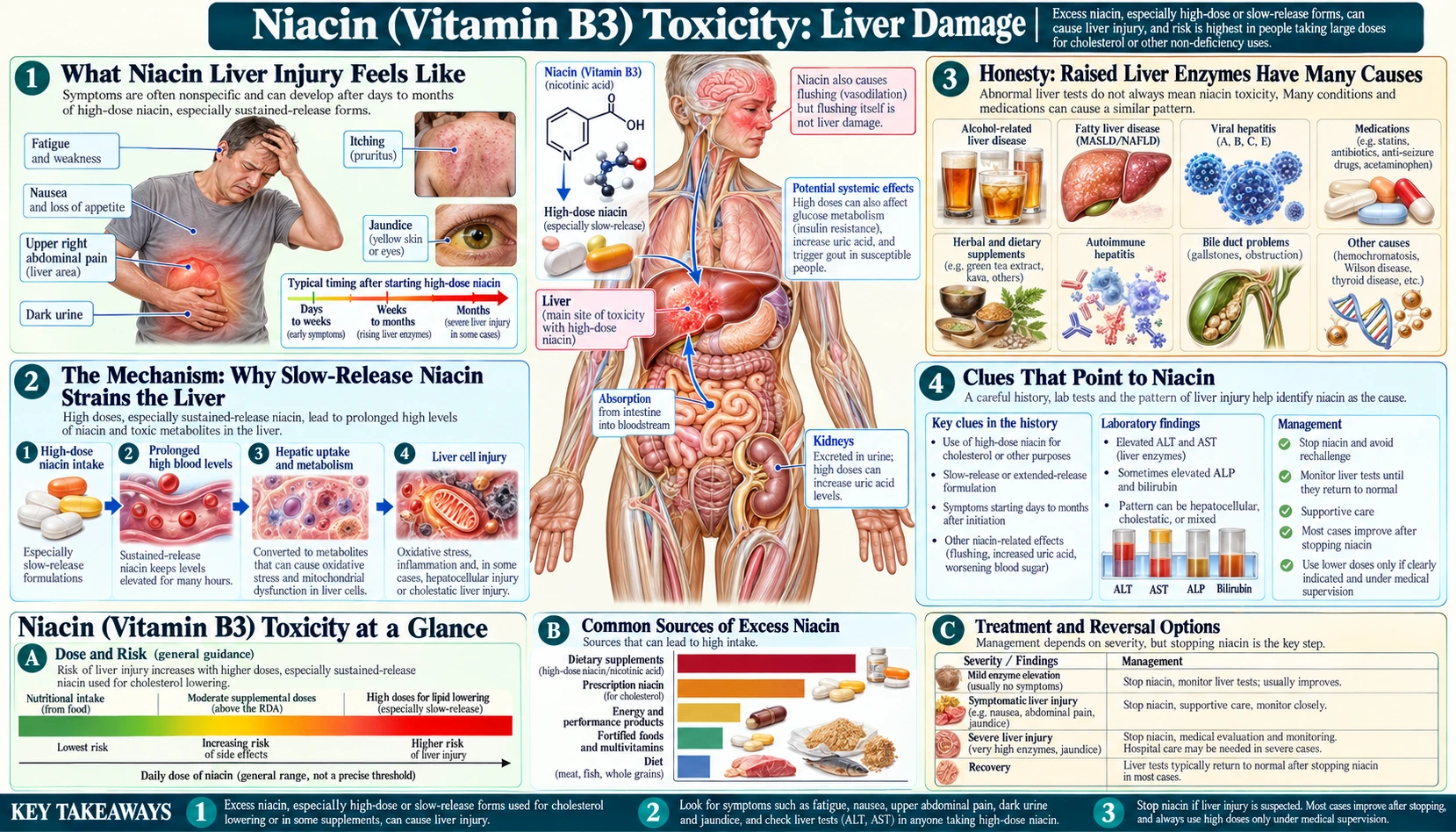
At the very high doses once used to lower cholesterol — not the tiny amounts found in food — niacin (vitamin B3) can injure the liver. The damage ranges from a quiet rise in liver enzymes on a blood test to, rarely, full-blown hepatitis and even liver failure. The single most important fact is this: the harm is far more likely with sustained-, extended-, or timed-release niacin than with the plain immediate-release form, and the classic disaster is a patient who switches from one to the other at the same milligram dose, not realizing they are not interchangeable. This is a real, well-documented side effect of high-dose niacin therapy — it is not something the niacin in your dinner or a basic B-complex will do. This page explains how the injury feels, why the slow-release pills are riskier, the many other things that raise liver enzymes, how it is found and reversed, and the warning signs of serious liver injury.
Table of Contents
- What Niacin Liver Injury Feels Like
- The Mechanism: Why Slow-Release Niacin Strains the Liver
- Honesty: Raised Liver Enzymes Have Many Causes
- Clues That Point to Niacin
- Who Gets It and How Much It Takes
- Getting Checked
- How Niacin Liver Injury Is Treated
- When to Seek Care / Red Flags
- Key Research Papers
- Connections
- Featured Videos
What Niacin Liver Injury Feels Like
The most unsettling thing about niacin liver injury is how often it begins with no feeling at all. In the early stage there is usually nothing to notice: the only sign is a rise in liver enzymes on a routine blood test, picked up precisely because doctors know to watch for it in anyone taking high-dose niacin. Many people never progress beyond this silent, reversible stage. So the absence of symptoms is no guarantee the liver is unbothered — which is exactly why blood monitoring, not how you feel, is the safeguard.
When symptoms do appear, they tend to arrive in a recognizable sequence as the injury deepens:
- Vague unwellness first. Unusual fatigue, loss of appetite, mild nausea, or a queasy stomach — easy to shrug off as a passing bug or simple tiredness.
- Right-upper-belly discomfort. A dull ache or fullness under the right ribcage, where the liver sits, sometimes with tenderness if you press there.
- Flu-like malaise. Low-grade aches and a worn-down feeling that lingers rather than resolving.
- Jaundice — the serious turn. Yellowing of the skin and the whites of the eyes, dark “tea-colored” urine, and pale, clay-colored stools. Itching can accompany it. Jaundice means the injury is significant, and hospitals treat it as urgent.
- Rare, severe progression. In a small number of cases the injury advances to true hepatitis or, at the extreme, fulminant hepatic failure — confusion or drowsiness, easy bruising or bleeding, and deepening jaundice. This is a medical emergency.
A particular pattern is worth naming because it has tripped up so many people: symptoms that begin within days to a few weeks after switching to, or starting, a sustained-release niacin product — especially after changing from the immediate-release form to a slow-release one at the same dose. That timing is one of the strongest clues that the liver, not a stomach virus, is the problem.
This injury is distinct from the other things high-dose niacin commonly does. The intense warmth and redness of niacin flushing is harmless and almost universal; the effects of niacin on blood sugar and uric acid (gout) are metabolic, not hepatic. Liver injury is the one that can become dangerous quietly, which is why it earns its own page.
The Mechanism: Why Slow-Release Niacin Strains the Liver
To understand why niacin can hurt the liver — and why the slow-release versions are the dangerous ones — it helps to know that the body handles niacin by two different chemical routes, and that the form of the pill decides which route dominates.
Once absorbed, niacin (nicotinic acid) is cleared by the liver along two pathways that work like a fast lane and a slow lane:
- A high-capacity conjugation pathway that quickly hitches niacin to glycine and excretes it. This is the “fast lane.” It is also the pathway responsible for the harmless flushing, because one of its byproducts triggers the skin's blood vessels to open.
- A low-capacity amidation pathway that converts niacin into nicotinamide and related compounds (the nicotinamide adenine dinucleotide (NAD) family). This is the “slow lane,” and it is the route linked to liver toxicity.
Here is the crux. When you take immediate-release niacin, a large dose floods the body all at once. The fast conjugation lane handles the bulk of it and the niacin is gone quickly — you get a strong flush, but relatively little is pushed down the toxic slow lane. When you take a sustained- or extended-release product, the same milligram dose is fed into the body slowly over many hours. That trickle keeps the fast lane from ever being the main route; instead, a much larger share of the niacin is steered into the low-capacity amidation pathway — the one associated with liver injury. The slow drip trades less flushing for more hepatic stress.
An analogy. Picture two doors out of a crowded room: a wide main exit (the fast lane) and a narrow side door (the slow lane). Immediate-release niacin is like opening the main exit and letting everyone rush out at once — noisy and dramatic (the flush), but the room clears fast and few people are forced through the narrow door. Sustained-release niacin keeps the main exit mostly shut and lets people leave only a trickle at a time, so a far larger fraction ends up squeezing through the narrow side door — quiet, but it overworks that fragile passage. Inside liver cells, that “overworked narrow passage” shows up as stressed, injured hepatocytes that leak their enzymes into the blood and, if pushed far enough, begin to die.
This is not a fringe theory; it is the explanation behind one of the most important findings in the niacin literature. In a randomized double-blind comparison of 46 adults, 12 of the 23 people (52%) given sustained-release niacin developed liver toxicity, and none of the 23 given immediate-release niacin did; the slow-release form lowered low-density lipoprotein (LDL) cholesterol more at 1500 mg a day and above, and the authors concluded that it is hepatotoxic and that its use should be restricted (McKenney 1994). The doses were raised step by step from 500 to 3000 mg a day, six weeks at each step. Eighteen of the 23 people (78%) on the slow-release form dropped out before reaching 3000 mg, most often because of stomach and bowel symptoms, tiredness and rising liver enzymes; 9 of the 23 (39%) on the immediate-release form dropped out, most often because of flushing and other blood-vessel symptoms, tiredness and darkened skin patches (acanthosis nigricans). The deadliest real-world scenario follows directly: a person tolerating, say, immediate-release niacin substitutes the same number of milligrams of a sustained-release product — assuming they are equivalent — and unknowingly redirects that dose down the toxic pathway. A published case report describes exactly this substitution: a patient developed severe liver dysfunction, with low body temperature, low blood pressure and acid build-up in the blood, two days after a sustained-release product replaced a crystalline (immediate-release) niacin the patient had tolerated well (Dalton 1992). In another report, three patients who had developed hepatitis on sustained-release niacin were later given equal or higher doses of crystalline niacin with no return of liver damage (Henkin 1990) — three cases only.
Honesty: Raised Liver Enzymes Have Many Causes
It would be misleading to suggest that abnormal liver tests or right-sided belly pain in a niacin user must be the niacin. Elevated liver enzymes are one of the most common abnormal blood results in all of medicine, and the great majority of the time the cause is something other than a vitamin. Honesty here matters, because chasing the wrong cause — or blaming niacin and missing a more serious disease — can be harmful. Among the far more frequent reasons liver enzymes climb:
- Fatty liver. Non-alcoholic fatty liver disease is now the single most common cause of mildly elevated liver enzymes in much of the world, tied to excess weight, type 2 diabetes, and metabolic syndrome — the very conditions that often prompt cholesterol treatment in the first place.
- Alcohol. Regular or heavy drinking is a leading cause of liver enzyme elevation and of liver disease generally.
- Other medications and supplements. Many common drugs raise liver enzymes — statins (frequently taken alongside niacin), acetaminophen (paracetamol), certain antibiotics and antifungals, anti-seizure drugs, and a long list of herbal and bodybuilding supplements. The pattern can look much like niacin injury.
- Viral hepatitis. Hepatitis A, B, and C, and other viral infections, are classic causes.
- Other liver and bile conditions. Gallstones and bile-duct blockage, autoimmune hepatitis, and inherited conditions such as hemochromatosis can all push enzymes up.
- Muscle, not liver. One enzyme often grouped with “liver tests,” aspartate aminotransferase (AST), also leaks from muscle, so vigorous exercise or muscle injury can raise it without the liver being involved at all.
The honest bottom line: niacin can injure the liver, and in someone on high-dose slow-release niacin it deserves serious consideration — but it is one cause among many. A good evaluation does not assume; it weighs the dose and form of niacin against the person's drinking, weight, other medicines, and risk for viral and other liver disease. The big-picture view of liver disease is on the Liver Disease page.
Clues That Point to Niacin
Given how many things raise liver enzymes, what tilts the picture toward niacin? A few features make the vitamin a much more likely culprit:
- A high, deliberate dose. Niacin liver injury is a problem of therapeutic doses — typically hundreds of milligrams to a few grams a day taken to lower cholesterol or raise high-density lipoprotein (HDL). The 14–18 mg in food or a daily multivitamin does not cause it. If the person is not taking pharmacologic doses, niacin is essentially off the list.
- A sustained-, extended-, or timed-release product. This is the strongest single clue. The slow-release forms — including some over-the-counter “no-flush”–style timed-release products — carry far more hepatic risk than plain immediate-release niacin at the same dose.
- A recent switch or dose increase. Symptoms or enzyme rises that begin within days to weeks of changing to a slow-release product, substituting one brand for another, or stepping the dose up. The classic story is swapping immediate-release for sustained-release at an equal milligram dose.
- Loss of the flush. Paradoxically, a slow-release niacin that stops causing flushing can be the more dangerous one, because little drug is going down the harmless flushing pathway — more is going down the route tied to liver injury.
- Improvement after stopping. The most telling clue of all comes in hindsight: niacin-related liver enzyme elevations typically fall back toward normal within days to a few weeks once the niacin is stopped (this is called dechallenge). A clear improvement off the drug strongly supports niacin as the cause.
None of these proves it on its own, and a clinician will still rule out the common alternatives above. But the combination of a high-dose slow-release product, a recent switch, and enzymes that settle after stopping is a compelling case for niacin.
Who Gets It and How Much It Takes
Niacin liver injury is overwhelmingly a story about dose and formulation, with a few personal factors layered on top.
- The dose is pharmacologic, not nutritional. The Recommended Dietary Allowance for niacin is roughly 14–16 mg per day for adults. Cholesterol-lowering doses are in a completely different league — commonly 1–3 grams a day, hundreds of times the nutritional amount. Liver injury is tied to this high-dose range; the Tolerable Upper Intake Level for supplemental niacin (35 mg/day for adults) is set far below it. That limit was based on skin flushing, which appears at much lower doses than liver injury.
- Formulation is the pivotal factor. Sustained-, extended-, and timed-release products are the main offenders. Immediate-release niacin can still raise enzymes, but serious hepatotoxicity is far more strongly associated with the slow-release forms. A prescription extended-release product (niacin formulated and dosed under medical supervision) sits between the two and is still monitored carefully. In a 122-patient randomized double-blind trial of a once-daily extended-release niacin at 1000 or 2000 mg a day against placebo, liver enzymes stayed within clinically accepted limits in every group, but aspartate aminotransferase (AST) rose significantly at 2000 mg a day compared with baseline and placebo (Morgan 1998) — so the in-between form still nudges liver enzymes up at the higher dose.
- Self-substitution and unsupervised use. Buying high-dose niacin over the counter and switching products without medical guidance — or treating slow-release and immediate-release as interchangeable — is a recurring path to trouble. Niacin's availability as an inexpensive supplement can create a false sense that any dose or form is safe.
- A liver already under load. Pre-existing liver disease, regular alcohol use, fatty liver, or other liver-stressing medications lower the margin for harm. High-dose niacin in someone whose liver is already coping with one of these is a higher-risk combination.
- The cholesterol context. Because niacin is used to treat lipid disorders, the people taking it often also have obesity, diabetes, or metabolic syndrome — conditions that independently stress the liver — and they are frequently on a statin as well. The result is a population in whom liver enzymes need watching for several reasons at once.
A note on niacin's place in treatment today: large cardiovascular outcome trials — AIM-HIGH and HPS2-THRIVE — found that adding niacin to good statin therapy did not reduce heart attacks or strokes and added side effects, which is why niacin is now used much less often for cholesterol than it once was. It still has selective uses, but its decline means fewer people are exposed to its hepatic risk than in past decades.
Liver failure from niacin is not only a cholesterol-clinic story. A 2024 report from an intensive care unit in Perth, Australia describes acute fulminant liver failure in a 24-year-old woman caused by overdosing on vitamin B3 from dietary supplements (Duffy 2024).
Getting Checked
Finding and confirming niacin liver injury rests on blood tests, an honest medication-and-supplement history, and ruling out the common alternatives — not on imaging or anything invasive in most cases.
The core test is a panel of liver function tests (often part of a comprehensive metabolic panel). The key numbers are the transaminases alanine aminotransferase (ALT) and aspartate aminotransferase, which leak from injured liver cells; alkaline phosphatase, which points to the bile ducts; and bilirubin, the pigment that causes jaundice when it builds up. A drug-injury pattern from niacin is usually hepatocellular — alanine aminotransferase and aspartate aminotransferase rise disproportionately to alkaline phosphatase — and a rising bilirubin signals more serious injury. Doctors also check the international normalized ratio (INR) (a clotting measure), because a liver too injured to make clotting proteins is a sign of severe disease.
This is one of the few situations in which monitoring is built into treatment from the start. Standard practice for anyone on high-dose niacin is to check liver enzymes before starting and periodically afterward — particularly after any dose increase or change of product — so that a rise is caught at the silent, reversible stage rather than after jaundice appears. If enzymes climb, the niacin is typically held and the tests repeated to see whether they fall (the dechallenge described earlier). Alongside this, a clinician will take a careful history of alcohol, every other prescription and over-the-counter drug and supplement, and risk factors for viral hepatitis, and will usually order hepatitis screening and sometimes a liver ultrasound to exclude fatty liver, gallstones, or bile-duct obstruction before settling on niacin as the cause.
How Niacin Liver Injury Is Treated
The good news is that, caught in time, niacin liver injury is usually reversible, and the central treatment is straightforward: stop the niacin.
- Stopping the niacin is the main treatment. The offending product is stopped, not just lowered. In the great majority of cases, liver enzymes begin falling within days and return toward normal over days to a few weeks. The cholesterol problem the niacin was treating remains and is managed another way.
- Confirm recovery with repeat blood tests. Liver enzymes and bilirubin are rechecked to confirm they are heading back to normal. A clear fall after stopping both treats the problem and confirms the diagnosis.
- Switching forms after an injury carries uncertain risk. Immediate-release niacin is generally less hepatotoxic: in one report, three patients who had hepatitis on sustained-release niacin took equal or higher doses of crystalline niacin with no return of liver damage (Henkin 1990), but that is three cases. Any form of niacin can raise liver enzymes again, and niacin is often abandoned altogether after a liver injury.
- Supportive and emergency care for severe injury. The rare cases that progress to severe hepatitis or liver failure are managed in hospital, with monitoring of clotting and mental status and, at the extreme, evaluation at a liver transplant center. These outcomes are uncommon and are part of why the slow-release forms are treated with such caution.
- What stopping means for heart protection. In the AIM-HIGH and HPS2-THRIVE trials, adding niacin to statin therapy did not reduce heart attacks or strokes, so stopping it does not remove a proven heart benefit for people already on a statin. Other approaches are described on the cholesterol management page.
For people who take niacin and tolerate it, the facts that matter most are these: slow-release and immediate-release niacin are not interchangeable at the same milligram dose; liver injury is silent at first and is found by a liver-enzyme blood test; alcohol adds to the liver's load; and new fatigue, nausea, belly pain or any yellowing are the early signs of liver injury.
When to Seek Care / Red Flags
Because the early stage is silent and the serious stage can move quickly, certain signs in anyone taking high-dose niacin are signs of liver injury that hospitals treat as urgent:
- Yellowing of the skin or the whites of the eyes (jaundice) — together with dark, tea-colored urine and pale stools. This means the injury is significant and warrants prompt evaluation.
- Persistent nausea, vomiting, or right-upper-belly pain — especially if it began after starting or switching to a slow-release niacin product.
- Unusual, lasting fatigue or loss of appetite in someone on high-dose niacin — vague, but a real early warning when paired with the niacin context.
- Confusion, drowsiness, easy bruising or bleeding — signs that point to severe liver injury or failure. This is a medical emergency that hospitals treat immediately.
- Any of the above shortly after substituting one niacin product for another at the same dose, or after a dose increase — the timing itself is a warning sign.
The facts behind the monitoring: the Tolerable Upper Intake Level for supplemental niacin is 35 mg a day for adults, while cholesterol-lowering doses are 1–3 grams a day. At those doses liver injury can be present with no symptoms at all, and only a liver-enzyme blood test (alanine aminotransferase and aspartate aminotransferase) shows it before symptoms start.
Key Research Papers
- McKenney JM, Proctor JD, Harris S, Chinchili VM (1994). A Comparison of the Efficacy and Toxic Effects of Sustained- vs Immediate-Release Niacin in Hypercholesterolemic Patients. JAMA;271(9):672-677. — DOI: 10.1001/jama.1994.03510330050033. — doi:10.1001/jama.1994.03510330050033
- Henkin Y, Johnson KC, Segrest JP (1990). Rechallenge With Crystalline Niacin After Drug-Induced Hepatitis From Sustained-Release Niacin. JAMA;264(2):241-243. — DOI: 10.1001/jama.1990.03450020093033. — doi:10.1001/jama.1990.03450020093033
- Etchason JA, Miller TD, Squires RW, et al. (1991). Niacin-Induced Hepatitis: A Potential Side Effect With Low-Dose Time-Release Niacin. Mayo Clinic Proceedings;66(1):23-28. — DOI: 10.1016/s0025-6196(12)61171-9. — doi:10.1016/s0025-6196(12)61171-9
- Dalton TA, Berry RS (1992). Hepatotoxicity associated with sustained-release niacin. The American Journal of Medicine;93(1):102-104. — DOI: 10.1016/0002-9343(92)90689-9. — doi:10.1016/0002-9343(92)90689-9
- Guyton JR, Simmons PD (2009). Flushing and other dermatologic adverse events associated with extended-release niacin therapy. Journal of Clinical Lipidology;3(2):101-108. — DOI: 10.1016/j.jacl.2009.02.003. — doi:10.1016/j.jacl.2009.02.003
- Kei A, Elisaf MS (2012). Nicotinic acid: clinical considerations. Expert Opinion on Drug Safety;11(4):551-564. — DOI: 10.1517/14740338.2012.682981. — doi:10.1517/14740338.2012.682981
- Morgan JM, Capuzzi DM, Guyton JR (1998). A new extended-release niacin (Niaspan): efficacy, tolerability, and safety in hypercholesterolemic patients. The American Journal of Cardiology;82(12A):29U-34U. — DOI: 10.1016/s0002-9149(98)00732-2. — doi:10.1016/s0002-9149(98)00732-2
- AIM-HIGH Investigators; Boden WE, Probstfield JL, Anderson T, et al. (2011). Niacin in Patients with Low HDL Cholesterol Levels Receiving Intensive Statin Therapy. New England Journal of Medicine;365(24):2255-2267. — DOI: 10.1056/nejmoa1107579. — doi:10.1056/nejmoa1107579
- HPS2-THRIVE Collaborative Group; Landray MJ, Haynes R, Hopewell JC, et al. (2014). Effects of Extended-Release Niacin with Laropiprant in High-Risk Patients. New England Journal of Medicine;371(3):203-212. — DOI: 10.1056/nejmoa1300955. — doi:10.1056/nejmoa1300955
- Boden WE, Probstfield JL, Anderson T, et al. (2011). The role of niacin in raising high-density lipoprotein cholesterol to reduce cardiovascular events in patients with atherosclerotic cardiovascular disease and optimally treated low-density lipoprotein cholesterol: rationale and study design (AIM-HIGH). American Heart Journal;161(3):471-477.e2. — DOI: 10.1016/j.ahj.2010.11.017. — doi:10.1016/j.ahj.2010.11.017
- Hoofnagle JH, Serrano J, Knoben JE, Navarro VJ (2013). LiverTox: A website on drug-induced liver injury. Hepatology;57(3):873-874. — DOI: 10.1002/hep.26175. — doi:10.1002/hep.26175
- Duffy M, Zhang G, Ariyawansa C, Anstey MH (2024). Niacin (Vitamin B3)-Induced Acute Fulminant Hepatic Failure in a 24-Year-Old Female. Cureus;16(9):e69518. — DOI: 10.7759/cureus.69518. — PubMed PMID: 39416578
PubMed Topic Searches
Connections
- All Vitamins
- Niacin Toxicity Hub
- Niacin Toxicity and Skin Flushing
- Niacin Toxicity and Blood Sugar & Gout
- Niacin Deficiency Hub
- Vitamin B3 (Niacin) Overview
- Niacin and Cholesterol
- Vitamin B3 Benefits
- Liver Disease
- Non-Alcoholic Fatty Liver Disease
- Cholesterol Management
- Liver Function Tests
- Comprehensive Metabolic Panel