The 2003 Israeli Soy-Formula Thiamine-Deficiency Outbreak
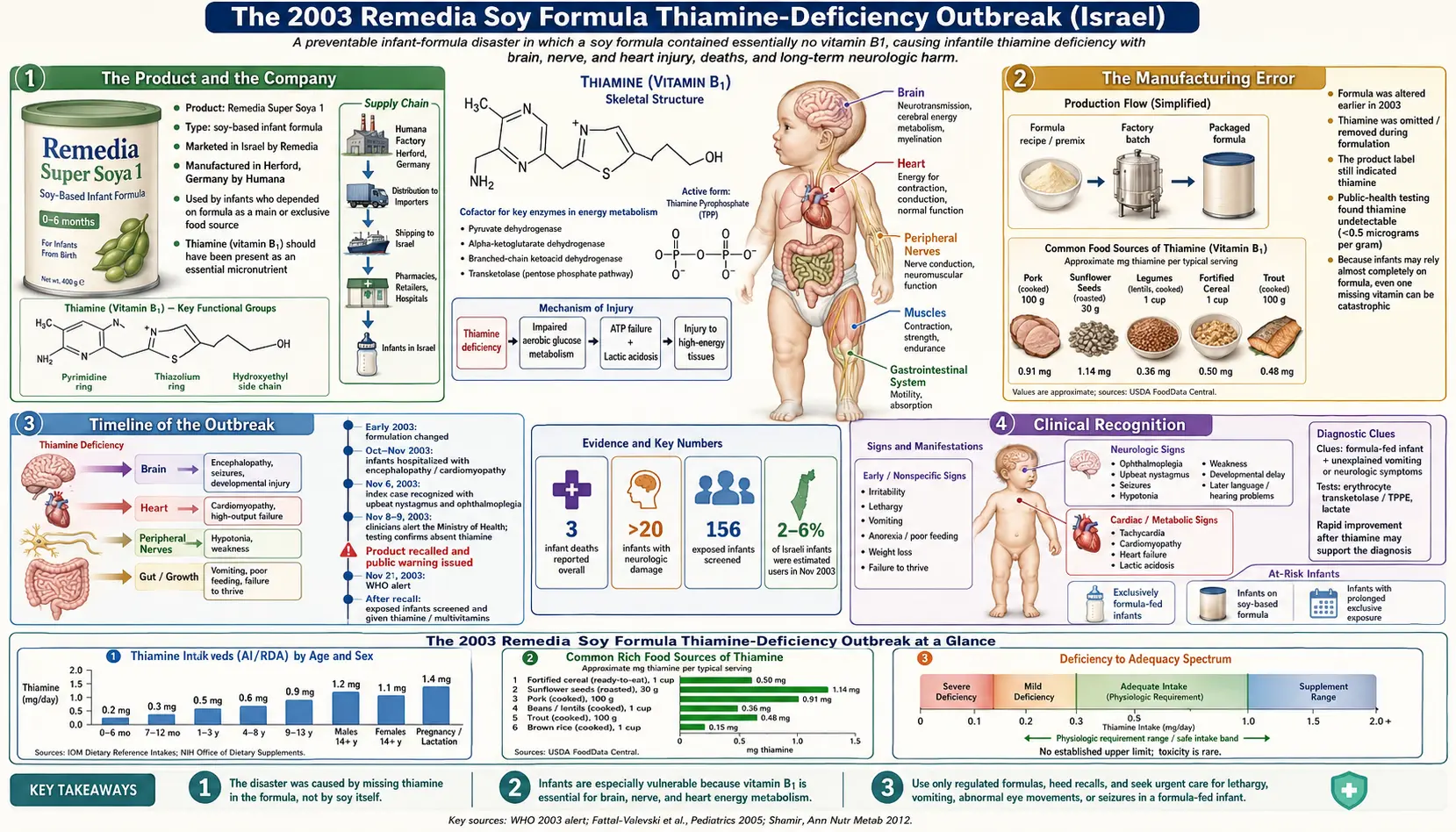
In October and November of 2003, paediatric intensive-care units across Israel began admitting previously healthy infants with an unfamiliar pattern of acute heart failure, hypotonia, aphonia, and ophthalmoplegia. Three died in the acute illness, and a fourth child, left in a chronic vegetative state, died six years later (Mimouni-Bloch 2014). The source was identified on November 6, 2003, when a 5.5-month-old boy was admitted to Tel Aviv Sourasky Medical Center with upbeat nystagmus, eye-movement paralysis (ophthalmoplegia) and vomiting. The team there, which included paediatric neurologist Aviva Fattal-Valevski, suspected Wernicke's encephalopathy, started thiamine, and saw him improve within hours; his feeding history connected the cases to a single common exposure: a soy-based infant formula made in Germany for the Israeli market. Testing by the Israeli public health authorities found the formula's thiamine undetectable (below 0.5 µg per gram), and the product was pulled from the shelves (Fattal-Valevski 2005). The 2003 outbreak remains the largest and best-documented modern incident of formula-induced infantile thiamine deficiency, and it permanently changed how infant formula is regulated worldwide. Long-term follow-up of the surviving cohort has shown that even children clinically "recovered" from acute thiamine deficiency frequently carry lifelong neurodevelopmental sequelae — particularly expressive language impairment, refractory epilepsy, motor deficits, and visual abnormalities.
Table of Contents
- The Product and the Company
- The Manufacturing Error
- Timeline of the Outbreak
- Clinical Recognition
- Clinical Presentations
- The Three Deaths
- Regulatory and Public-Health Response
- Legal Aftermath
- Long-Term Follow-Up of Survivors
- Global Impact on Infant Formula Regulation
- Lessons for Clinicians
- Key Research Papers
- Connections
- Featured Videos
1. The Product and the Company
The formula was sold by an Israeli infant-formula distributor, which did not manufacture its own product; a German manufacturer made it under the distributor's label. A 2012 review describes it as produced in Germany and marketed exclusively in Israel (Shamir 2012).
- The soy formula was marketed for infants with cow's-milk protein allergy or lactose intolerance, and as a kosher option for observant Jewish families seeking a parve (non-dairy) formula.
- Distribution share. In November 2003, 2–6% of infants in Israel were consuming this formula (Shamir 2012); a 2005 report estimated that about 3,500 infants had been fed it (Kesler 2005).
- Manufacturing geography. The fact that the offending product was made in Germany, distributed by an Israeli company, and consumed by Israeli infants spread regulatory responsibility across two countries' food-safety systems — a structural problem that recurs in every modern infant-formula incident.
2. The Manufacturing Error
The formula's maker had recently reformulated the vitamin and mineral premix used in the product. The reformulation reduced the thiamine content of the premix to a level so low that the finished formula contained essentially no detectable thiamine. The error was a single-point failure in the vitamin premix specification, compounded by inadequate end-product analytical testing.
- Specified content. Regulatory minimums at the time required at least 40 μg thiamine per 100 kcal of formula (the European standard then in force); the Codex Alimentarius standard is similar. A normal soy infant formula contains in the range of 60–100 μg thiamine per 100 kcal.
- Measured content. Testing of the formula by the Israeli public health authorities found its thiamine level undetectable (below 0.5 μg per gram of formula) (Fattal-Valevski 2005) — effectively zero relative to an infant's daily requirement.
- Why end-product testing failed. The manufacturer relied on the vitamin-premix specification rather than independently assaying thiamine in the finished, retort-sterilised product. This is exactly the failure mode the Codex now requires manufacturers to guard against with mandatory finished-product analytical confirmation of each labelled vitamin.
- Why no early alert from infant intake. Infants consume between 600 and 800 mL of formula per day in the first six months. A soy formula at near-zero thiamine and used as a sole feed produces no warning sign until total-body thiamine stores deplete — a process taking days to several weeks depending on the infant's birth reserves and growth rate.
3. Timeline of the Outbreak
- Mid-2003. The formula's maker introduces the reformulated vitamin premix into production batches of the soy formula.
- October–November 2003. Paediatric intensive-care units in Israel admit infants with encephalopathy and unusual neurological signs; two die of cardiomyopathy (Fattal-Valevski 2005). On October 10 a 5-month-old girl is admitted with vomiting, fever and ophthalmoplegia, well before the outbreak is recognised.
- November 6, 2003. A 5.5-month-old boy is admitted to Tel Aviv Sourasky Medical Center with upbeat nystagmus, ophthalmoplegia and vomiting. Wernicke's encephalopathy is suspected, thiamine is started, and he improves within hours. His detailed feeding history reveals the same soy formula as the other sick infants.
- November 2003. The Israeli public health authorities test the formula and find thiamine undetectable (below 0.5 µg per gram); the product is pulled from the shelves and the public is alerted (Fattal-Valevski 2005). In the same month Israeli police open an investigation into the infants' deaths (BMJ news report, 15 November 2003).
- Case-finding. Approximately 20 infants were seriously affected out of an estimated 3,500 fed the formula, and three of them died (Kesler 2005; Mimouni-Bloch 2014). The Ministry of Health screened 156 infants who had been fed the formula and found abnormal thiamine tests in 8 more.
- 2004–2005. The first peer-reviewed reports appear, anchored by Fattal-Valevski's series in Pediatrics and Kornreich's neuroradiology paper in AJNR.
- 2005–present. Long-term follow-up of survivors continues, with major reports in 2009 (epilepsy and language), 2014 (long-term follow-up cohort), and subsequent updates.
4. Clinical Recognition
The recognition of the 2003 outbreak is a model of pattern-recognition clinical epidemiology. None of the individual cases would have raised the alarm on its own — each looked like a sporadic case of unexplained cardiomyopathy or encephalopathy. The signal came from a single index case: the finding of gaze abnormalities in one infant by neuro-ophthalmologists led to the unravelling of the epidemic (Kesler 2005), and one clinical team's willingness to entertain a common nutritional cause.
The first signs were vague. Among the 9 infants in the outbreak team's series, the early symptoms were vomiting (8 infants), lethargy (7), irritability (5), a swollen belly (abdominal distension, 4), diarrhoea (4), breathing symptoms (4), developmental delay (3) and failure to thrive (2). Every one of the 9 also had an infection, most of them mild. When the Ministry of Health screened 156 infants who had been fed the formula, 8 more had abnormal thiamine tests; their parents had noticed no symptoms, although the examining doctors documented irritability, lethargy, vomiting, poor appetite, failure to thrive and developmental delay (Fattal-Valevski 2005).
- The aphonic infant. Several admitted infants had been brought in for "lost voice" or "silent cry" weeks before more serious symptoms. In hindsight, aphonia was the earliest and most specific sign of evolving thiamine deficiency in the cohort.
- The cross-eyed infant. Multiple parents reported the new appearance of esotropia (cross-eyes) in their previously normally aligned infants. Abducens (CN VI) palsy in an otherwise well infant is rare; its appearance in clusters was a major clue.
- Lactic acidosis without sepsis. The cardiac-form infants presented with severe lactic acidosis, often >10 mmol/L, in the absence of obvious infection or hypoperfusion. Unexplained lactic acidosis was one of the two diagnostic criteria the outbreak team used, alongside abnormal red-cell transketolase activity (Fattal-Valevski 2005).
- Common feeding history. Once two or three cases were linked, the shared feeding history of the same soy formula was conspicuous and led directly to the analytical investigation of the product itself.
5. Clinical Presentations
Fattal-Valevski's 2005 Pediatrics report described 9 infants in the team's care (6 boys and 3 girls, aged 2 to 12 months): 3 had neurological signs and 6 did not. The 6 without neurological signs recovered completely within 2 to 3 weeks of thiamine treatment, and longer feeding with the formula was linked to failure to thrive. The 2014 follow-up report described acute brain illness (encephalopathy) in 11 children: 6 had bulbar signs (weakness of the brainstem-controlled muscles of voice, swallowing and breathing), 5 had eye signs, 2 had paralysis of the nerve to the diaphragm (phrenic neuropathy) and 5 had heart involvement (Mimouni-Bloch 2014). Across these reports the illness took overlapping forms that mirror the classical descriptions of beriberi and Wernicke encephalopathy, with infant-specific features.
- Cardiac form (Shoshin beriberi). Acute, often fulminant cardiomyopathy with high-output heart failure, severe lactic acidosis, cyanosis, and tachypnoea. All three deaths were in this group: of the 5 children with heart involvement in the 2014 report, 3 had cardiomyopathy and died in the acute phase, and one had complete atrioventricular block (the heart's electrical signal blocked between its upper and lower chambers). Surviving cardiac-form infants typically responded dramatically to intravenous thiamine, with echocardiographic recovery within days.
- Neurological / aphonic form. Subacute onset over days to weeks. Earliest sign was aphonia — a silent, hoarse, or weak cry. Hypotonia, poor feeding, vomiting, and lethargy followed. Without thiamine, this form progressed toward the encephalopathic picture; with thiamine, the recovery trajectory was slower than for the cardiac form but generally good in the short term.
- Encephalopathic / Wernicke form. Bilateral CN VI palsy with esotropia, horizontal and rotary nystagmus, reduced consciousness, seizures, and in severe cases coma. Magnetic resonance imaging (MRI) findings of bilateral symmetric basal ganglia, periaqueductal grey, and frontal white matter lesions were characteristic and helped confirm the diagnosis on admission for several patients. In the Pediatrics series, the 3 infants with eye-movement paralysis (with or without upbeat nystagmus) had all been fed only the formula for 2 to 3.5 months; two recovered completely, while the girl admitted on October 10 was left with eye-movement and motor problems. In Kornreich's MRI study of 6 infants, 5 showed matching changes on both sides in the periaqueductal area, basal ganglia and thalami, 5 in the mammillary bodies and 3 in the brain stem; the frontal region (cortex and white matter) was involved in all 6, and MR spectroscopy showed a lactate peak (Kornreich 2005).
6. The Three Deaths
Three Israeli infants died in the acute illness after being fed the thiamine-deficient formula. In the 2014 follow-up report all three had cardiomyopathy (Shoshin beriberi); a fourth child, left in a chronic vegetative state, died six years later (Mimouni-Bloch 2014). Their ages ranged from about three to seven months. Several additional infants survived initial cardiac arrest with cardiopulmonary resuscitation and progressed to long-term neurodevelopmental sequelae attributable to anoxic and metabolic brain injury combined with primary thiamine deficiency.
- Hyperacute trajectory. In two of the three fatal cases, the interval from first clear symptom to death was less than 24 hours. The cardiac form of infantile thiamine deficiency, when missed, is a true paediatric emergency on the timescale of hours.
- Misclassification risk. Without the recognition of the index case at Sourasky Medical Center, additional cardiac-form deaths could plausibly have been ascribed to viral myocarditis, sudden infant death, or undiagnosed metabolic disease. Pattern recognition saved lives.
- The lasting moral weight. The deaths and the permanent sequelae in surviving children turned the 2003 outbreak from a regulatory failure into a national trauma. Annual commemorations and the long-term cohort follow-up have kept the case in Israeli paediatric consciousness for over two decades.
7. Regulatory and Public-Health Response
- Recall. After the source was identified on November 6, 2003, and the formula was tested, the product was pulled from the shelves and the public was alerted (Fattal-Valevski 2005); families were urged to return unused product.
- Active case-finding. Health Ministry staff working with paediatricians traced infants exposed to the product through pharmacy purchase records and physician registries. The Ministry screened 156 infants who had been fed the formula; by then most were already on other formulas and had begun oral thiamine, and 8 had abnormal thiamine tests (Fattal-Valevski 2005).
- Empirical thiamine for exposed infants. All exposed infants, regardless of symptoms, were offered empirical thiamine supplementation and clinical assessment.
- Hotline and clinic capacity. A national clinical hotline coordinated questions from worried families. Tertiary paediatric centres expanded outpatient capacity to triage exposed infants.
- Regulatory reform. Israel updated its infant-formula regulations to require end-product analytical testing of every labelled micronutrient on every production batch and stricter manufacturer-of-record accountability for products distributed under a national brand.
- Codex review. The Codex Alimentarius Commission and the European Food Safety Authority both reviewed infant-formula composition standards in the years following the outbreak, contributing to tightened global rules on micronutrient verification.
8. Legal Aftermath
- Police investigation. In November 2003, police in Israel launched an investigation into the deaths of the infants who had been given the formula (BMJ news report, 15 November 2003).
- Admission of error. The same month, the maker of the vitamin B1-deficient formula admitted the error (Lancet news report, 22 November 2003).
- Manufacturer–importer responsibility. A 2012 review of the outbreak concluded that infant formulae can be produced or imported only under stringent criteria, with the manufacturer or importer having total responsibility for the product (Shamir 2012).
9. Long-Term Follow-Up of Survivors
The 2003 outbreak cohort has been followed by Fattal-Valevski and colleagues for more than a decade, producing the largest single body of evidence on the long-term neurodevelopmental consequences of acute infantile thiamine deficiency. The findings are sobering: even infants who appeared to recover completely in the acute phase have shown persistent and often progressive deficits as they aged into school years.
- Severe acute illness. Of 8 children who survived the severe acute illness, 7 had intellectual disability and motor problems, 6 developed severe epilepsy, 2 developed early spinal curvature (kyphoscoliosis) and one kept a complete atrioventricular (heart) block; one child who remained in a chronic vegetative state died 6 years later (Mimouni-Bloch 2014).
- Language impairment. In a 2009 case-control study, 20 children who had been fed the thiamine-deficient formula in infancy, tested at 24 to 39 months, scored significantly lower than 20 matched children on both expressive communication and understanding of spoken language (auditory comprehension); they also had lower mental-development scores and walked independently later (Fattal-Valevski 2009, Dev Med Child Neurol).
- Epilepsy. Six of the 8 children who survived the severe acute illness developed severe epilepsy (Mimouni-Bloch 2014). In a 2009 report on 7 such children, all had seizures when first ill; after a seizure-free period of 1 to 9 months the seizures returned as myoclonic or complex partial seizures, 3 children's brain-wave tracings (EEG) evolved into hypsarrhythmia, the seizures were refractory to most antiepileptic drugs, and 4 children still had uncontrolled seizures (Fattal-Valevski 2009, Neurology).
- Motor deficits. Ranging from subtle fine-motor and coordination problems to spastic diplegia and quadriplegia in the most severely affected.
- Children who never showed clear illness. In a 2017 study, 39 children aged 5 to 6 who had been fed the thiamine-deficient formula in infancy had motor difficulties far more often than 30 unexposed children of the same age: 56% vs 10% on one movement test (the Movement Assessment Battery for Children) and 59% vs 3% on another (the Zuk Assessment), with the largest differences in balance and fine motor skills (Harel 2017).
- Visual deficits. Persistent strabismus and optic atrophy in a meaningful subset of survivors. Several required surgical correction of esotropia.
- Autistic-like features. Reported in several survivors, plausibly reflecting early thalamic, basal ganglia, and frontal white matter injury.
- Cognitive variability. The cohort shows striking heterogeneity. The most important predictor of long-term outcome is the speed with which thiamine was given after symptom onset.
10. Global Impact on Infant Formula Regulation
- End-product testing now standard. Since the outbreak, the European and Codex frameworks require analytical confirmation of each labelled micronutrient in finished product, not merely in the input premix. The U.S. Food and Drug Administration's Infant Formula Act enforcement was also strengthened.
- Mandatory adverse-event reporting. The infant-formula industry now operates under mandatory adverse-event surveillance similar to that of pharmaceuticals in most developed regulatory jurisdictions.
- Multi-country supply-chain accountability. Regulators now insist on chain-of-custody transparency between original manufacturer, distributor, and retailer for any formula sold under a national brand.
- Clinician awareness. The 2003 outbreak is on the syllabus for paediatric and emergency-medicine training globally. The image of an infant with new esotropia and aphonia now triggers the question: thiamine?
- Recurrence elsewhere. Smaller-scale formula-related thiamine incidents have been reported subsequently in Australia (2007) and other countries; the Israeli template for rapid recognition, recall, and follow-up has shaped each response.
11. Lessons for Clinicians
- Treatment before confirmation. The outbreak team concluded that therapy with large doses of thiamine should be started at the earliest suspicion of vitamin depletion, even before laboratory evidence is available and before neurologic or cardiologic symptoms appear (Fattal-Valevski 2005). The signs at stake were unexplained acute cardiomyopathy, lactic acidosis, aphonia, new strabismus and encephalopathy; the outbreak infants received intramuscular thiamine 50 mg a day for 14 days with a switch to another formula, and no side effects were seen. Delay carried the cost: in one infant, delayed diagnosis may have been responsible for severe lingering deficits (Kesler 2005).
- Glucose and thiamine. Glucose loading in a thiamine-deficient infant accelerates the metabolic crisis, which is why thiamine is given before, or at the same time as, any carbohydrate-rich infusion.
- Formula brand and batch. A feeding history that records not only the type of formula but the brand and, where possible, the batch / lot number becomes critical evidence in any cluster investigation.
- Cluster awareness. Two or three unusual paediatric presentations in a short time window from the same catchment area are the kind of cluster local health departments investigate. The 2003 outbreak was solved because clinicians compared notes.
- Long-term follow-up matters. Acute clinical recovery from thiamine deficiency does not equal full neurodevelopmental recovery. The follow-up studies tracked language, motor, visual and cognitive outcomes into school age.
Key Research Papers
- Fattal-Valevski A, Kesler A, Sela BA, Nitzan-Kaluski D, Rotstein M, Mesterman R, Toledano-Alhadef H, Stolovitch C, Hoffmann C, Globus O, Eshel G. Outbreak of life-threatening thiamine deficiency in infants in Israel caused by a defective soy-based formula. Pediatrics. 2005;115(2):e233–e238. — doi:10.1542/peds.2004-1255 · PubMed PMID: 15687431
- Kornreich L, Bron-Harlev E, Hoffmann C, Schwarz M, Konen O, Schoenfeld T, Straussberg R, Nahum E, Ibrahim AK, Eshel G, Horev G. Thiamine deficiency in infants: MR findings in the brain. AJNR Am J Neuroradiol. 2005;26(7):1668–1674. — PubMed PMID: 16091511
- Fattal-Valevski A, Azouri-Fattal I, Greenstein YJ, Guindy M, Blau A, Zelnik N. Delayed language development due to infantile thiamine deficiency. Dev Med Child Neurol. 2009;51(8):629–634. — doi:10.1111/j.1469-8749.2008.03161.x · PubMed PMID: 19191836
- Fattal-Valevski A, Bloch-Mimouni A, Kivity S, Heyman E, Brezner A, Strausberg R, Inbar D, Kramer U, Goldberg-Stern H. Epilepsy in children with infantile thiamine deficiency. Neurology. 2009;73(11):828–833. — doi:10.1212/WNL.0b013e3181b121f5 · PubMed PMID: 19571254
- Mimouni-Bloch A, Goldberg-Stern H, Strausberg R, Brezner A, Heyman E, Inbar D, Kivity S, Zvulunov A, Sztarkier I, Fogelman R, Fattal-Valevski A. Thiamine deficiency in infancy: long-term follow-up. Pediatr Neurol. 2014;51(3):311–316. — doi:10.1016/j.pediatrneurol.2014.05.010 · PubMed PMID: 25160536
- Kesler A, Stolovitch C, Hoffmann C, Avni I, Morad Y. Acute ophthalmoplegia and nystagmus in infants fed a thiamine-deficient formula: an epidemic of Wernicke encephalopathy. J Neuroophthalmol. 2005;25(3):169–172. — doi:10.1097/01.wno.0000177293.06727.d5 · PubMed PMID: 16148620
- Shamir R. Thiamine-deficient infant formula: what happened and what have we learned? Ann Nutr Metab. 2012;60(3):185–187. — doi:10.1159/000338211 · PubMed PMID: 22699764
- Siegel-Itzkovich J. Police in Israel launch investigation into deaths of babies given formula milk. BMJ. 2003;327(7424):1128. — doi:10.1136/bmj.327.7424.1128-i · PubMed PMID: 14615325
- Aris B. Maker of vitamin B1-deficient baby milk admits error. Lancet. 2003;362(9397):1730. — doi:10.1016/S0140-6736(03)14890-8 · PubMed PMID: 14655665
- Harel Y, Zuk L, Guindy M, Nakar O, Lotan D, Fattal-Valevski A. The effect of subclinical infantile thiamine deficiency on motor function in preschool children. Matern Child Nutr. 2017;13(4):e12397. — doi:10.1111/mcn.12397 · PubMed PMID: 28133900
- Sechi G, Serra A. Wernicke's encephalopathy: new clinical settings and recent advances in diagnosis and management. Lancet Neurol. 2007;6(5):442–455. — doi:10.1016/S1474-4422(07)70104-7 · PubMed PMID: 17434099
- Vasconcelos MM, Silva KP, Vidal G, Silva AF, Domingues RC, Berditchevsky CR. Early diagnosis of pediatric Wernicke's encephalopathy. Pediatr Neurol. 1999;20(4):289–294. — doi:10.1016/S0887-8994(98)00153-2 · PubMed PMID: 10328278
- Whitfield KC, Bourassa MW, Adamolekun B, Bergeron G, Bettendorff L, Brown KH, Cox L, Fattal-Valevski A, Fischer PR, Frank EL, Hiffler L, Hlaing LM, Jefferds ME, Kapner H, Kounnavong S, Mousavi MPS, Roth DE, Tsaloglou MN, Wieringa F, Combs GF Jr. Thiamine deficiency disorders: diagnosis, prevalence, and a roadmap for global control programs. Ann N Y Acad Sci. 2018;1430(1):3–43. — doi:10.1111/nyas.13919 · PubMed PMID: 30151974
- Marcé-Grau A, Martí-Sánchez L, Baide-Mairena H, Ortigoza-Escobar JD, Pérez-Dueñas B. Genetic defects of thiamine transport and metabolism: a review of clinical phenotypes, genetics, and functional studies. J Inherit Metab Dis. 2019;42(4):581–597. — doi:10.1002/jimd.12125 · PubMed PMID: 31095747
PubMed Topic Searches
- PubMed: Thiamine-deficient soy formula Israel
- PubMed: Fattal-Valevski thiamine
- PubMed: Soy formula thiamine deficiency
- PubMed: Infant formula vitamin deficiency outbreak
- PubMed: Shoshin beriberi infant
- PubMed: Israel thiamine outbreak
- PubMed: Infantile Wernicke encephalopathy
- PubMed: Infant formula regulation vitamin
Connections
- All Vitamins
- Infantile Thiamine Deficiency
- Vitamin B1 (Thiamine) Main
- Thiamine and Beriberi (Adult)
- Thiamine and Brain Health
- Wernicke-Korsakoff Syndrome
- Beriberi and Cardiac
- Cognitive Function and Alzheimer's
- Benfotiamine
- Magnesium
- Vitamin B12
- Neurology
- Epilepsy
- Heart Failure
- Toxins (Regulatory Context)
- Lab Tests