Vitamin B6: Food Sources & Daily Intake
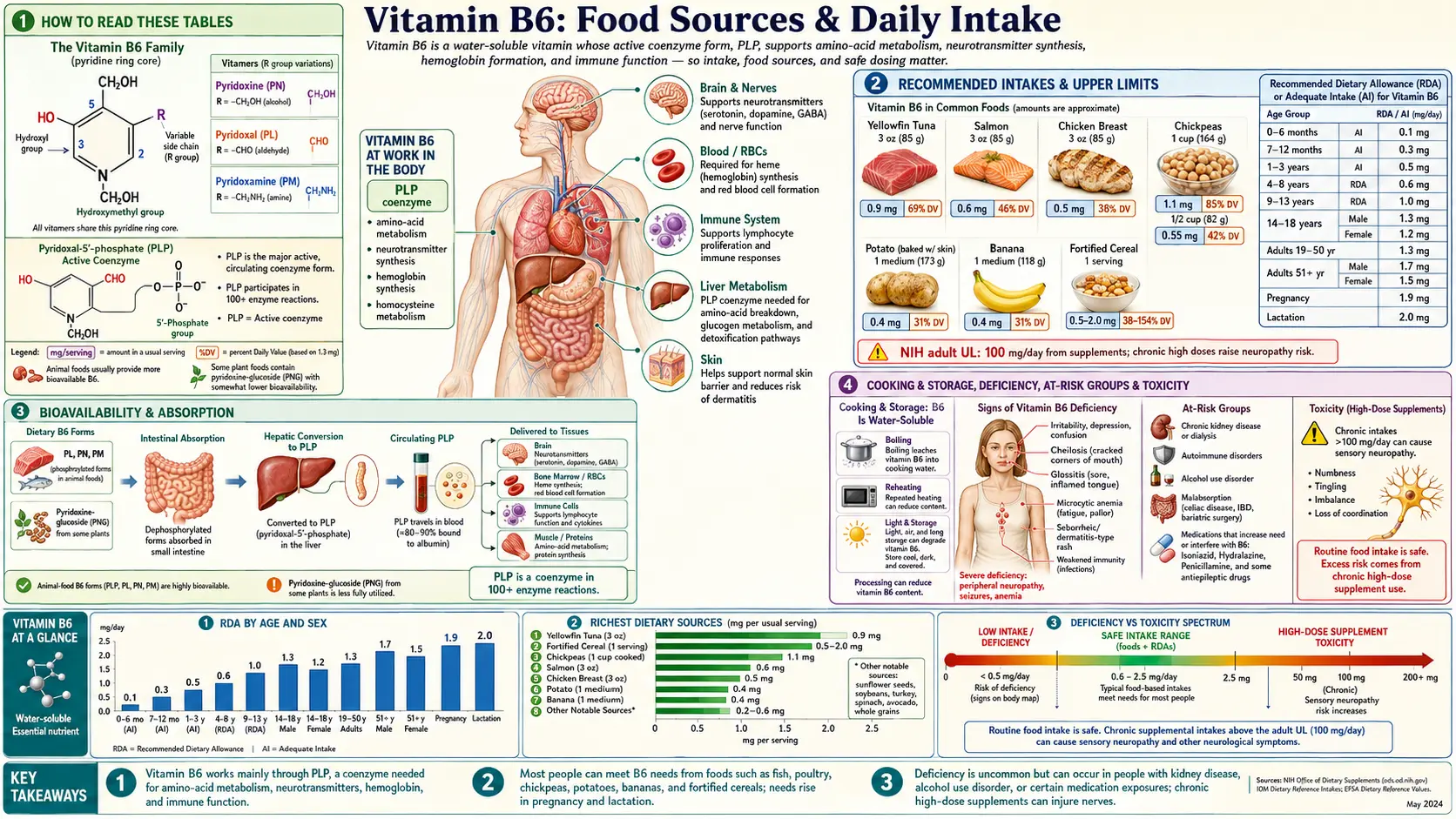
Vitamin B6 is a family of six related compounds — the form your body actually puts to work is pyridoxal 5’-phosphate (PLP). It is a busy coenzyme, helping run more than a hundred reactions, most of them tied to protein and amino-acid metabolism, the making of neurotransmitters, and healthy red blood cells. Because it is water-soluble and not stored in any large amount, a steady supply from food matters. The good news is that B6 is widely spread across the diet: poultry, fish and organ meats on the animal side, and chickpeas, potatoes, bananas, seeds and whole grains on the plant side.
| Vitamin B6: Food Sources & Daily Intake | ||||||
|---|---|---|---|---|---|---|
| Rank | Food (serving) | Per 100 g | %DV / 100g | Glucose | Fructose | Notes |
| 1 | Pistachios, Dry 1 oz / 28 g | 1.1 mg | 🟢 66% | 0.2 | 0.2 | |
| 2 | Beef Liver 3 oz / 85 g | 1.0 mg | 🟢 60% | 0 | 0 | Exceptionally dense; a small portion is plenty. |
| 3 | Salmon, Sockeye 3 oz / 85 g | 0.8 mg | 🟡 49% | 0 | 0 | |
| 4 | Turkey Breast 3 oz / 85 g | 0.8 mg | 🟡 47% | 0 | 0 | |
| 5 | Sunflower Seeds, Dry 1 oz / 28 g | 0.8 mg | 🟡 47% | 0.0 | 0 | |
| 6 | Pork Loin 3 oz / 85 g | 0.7 mg | 🟡 41% | 0 | 0 | |
| 7 | Beef Meat 3 oz / 85 g | 0.5 mg | 🟡 32% | 0 | 0 | |
| 8 | Pork Organ Meats 3 oz / 85 g | 0.5 mg | 🟡 27% | — | — | Nutrient-dense organ meat. |
| 9 | Beef Organ Meats 3 oz / 85 g | 0.4 mg | 🟡 23% | 0 | 0 | Nutrient-dense organ meat. |
| 10 | Chicken Organ Meats 3 oz / 85 g | 0.4 mg | 🟡 22% | — | — | Nutrient-dense organ meat (giblets). |
| 11 | Banana 1 medium / 118 g | 0.4 mg | 🟡 22% | 5.0 | 4.8 | |
| 12 | Tuna, Light, Canned In Water 3 oz / 85 g | 0.3 mg | 🟡 21% | 0 | 0 | |
| 13 | Potato (With Skin) 1 medium / 173 g | 0.3 mg | 🟡 18% | 0.4 | 0.3 | A staple that quietly adds up over a day. |
| 14 | Chicken Breast 3 oz / 85 g | 0.3 mg | 🟡 18% | — | — | |
| 15 | Avocado 1 cup / 150 g | 0.3 mg | 🟡 17% | 0.1 | 0.1 | |
| 16 | Spinach ½ cup / 90 g | 0.2 mg | 🟡 14% | — | — | |
| 17 | Brown Rice 1 cup / 195 g | 0.1 mg | ⚪ 7% | 0 | 0 | Common staple. |
Table of Contents
- How to Read These Tables
- Recommended Intakes & Upper Limits
- Bioavailability & Absorption
- Cooking & Storage
- Vegetarian & Vegan Sources
- Who Needs to Pay Attention
- Data Sources & References
- Connections
- Featured Videos
How to Read These Tables
- Water-soluble — little is stored. Like the other B vitamins, vitamin B6 is not stockpiled the way fat-soluble vitamins are, so a regular daily intake matters more than any single large dose. Surplus is cleared in the urine.
- %DV vs RDA. The %DV column compares a serving against the FDA Daily Value of 1.7 mg. Your personal target (the RDA) is 1.3 mg for most adults, but it actually rises to 1.7 mg for men and 1.5 mg for women after age 50, and to 1.9–2.0 mg in pregnancy and lactation — see the second table.
- Per 100 g vs per serving. Per-100 g lets you compare foods fairly; the serving size shown beside each food is what you actually eat. No single food has to carry the whole day — a piece of chicken or fish, a banana, and some chickpeas or a potato together get most people there.
Recommended Intakes & Upper Limits
Your personal target depends on age, sex and pregnancy. The Daily Value used for the %DV column above is a single label figure; the table below is the age-specific guidance.
| Life stage | RDA / AI (mg/day) | Upper limit (mg/day) |
|---|---|---|
| Infants 0–6 mo | 0.1* (AI) | Not set |
| Infants 7–12 mo | 0.3* (AI) | Not set |
| Children 1–3 y | 0.5 | 30 |
| Children 4–8 y | 0.6 | 40 |
| Children 9–13 y | 1.0 | 60 |
| Males 14–18 y | 1.3 | 80 |
| Males 19–50 y | 1.3 | 100 |
| Males 51+ y | 1.7 | 100 |
| Females 14–18 y | 1.2 | 80 |
| Females 19–50 y | 1.3 | 100 |
| Females 51+ y | 1.5 | 100 |
| Pregnancy | 1.9 | 100 |
| Lactation | 2.0 | 100 |
Bioavailability & Absorption
Vitamin B6 from a mixed diet is reasonably well absorbed, but the form matters. In animal foods it arrives mostly as the active PLP and pyridoxal, which the gut handles readily. In plants a sizeable share is bound up as pyridoxine glucoside, a form the body absorbs less efficiently — so the “usable” B6 from some vegetables and grains is lower than the raw number suggests. This is one reason the official requirement already builds in a cushion. Whatever the source, the liver converts the various forms into PLP, the single coenzyme your enzymes actually use.
Cooking & Storage
Because it is water-soluble, vitamin B6 takes a real hit from processing, heat and water. Milling whole grains into white flour strips much of it out (and it is not always added back), and boiling lets it leach into the cooking water. Canning and long storage also cost some. To keep the most: favour whole grains over refined, steam, microwave or roast rather than boil in lots of water, and eat fruit and some vegetables raw where it makes sense. Reusing cooking liquid (in a soup or sauce) recovers what would otherwise be poured away.
Vegetarian & Vegan Sources
Plant-based eaters can meet their B6 target comfortably — this is not a vitamin like B12 that requires special planning. Chickpeas, potatoes (with skin), bananas, pistachios, sunflower seeds, bulgur and winter squash are all strong sources, and they make the math easy without any animal foods. The one nuance is that some plant B6 is in the less-absorbable glucoside form, so it is worth eating a variety of these across the day rather than leaning on a single food.
Who Needs to Pay Attention
Outright deficiency is uncommon on a normal diet, but some groups are more exposed: people with kidney disease or on dialysis, those with autoimmune or malabsorptive conditions, heavy alcohol use (alcohol both lowers absorption and speeds breakdown of PLP), and users of certain medications. Low B6 shows up as a sore, cracked mouth, a scaly rash, irritability or depression, a weakened immune response, and in severe cases anemia. Toxicity does not come from food — you cannot over-do it at the dinner table. It comes from supplements: very high doses taken over months or years (well above the 100 mg/day adult upper limit) can cause sensory nerve damage (peripheral neuropathy) — numbness, tingling and unsteady walking — which is why the UL exists and why mega-dose B6 pills deserve caution.
Data Sources & References
- NIH Office of Dietary Supplements — Vitamin B6 Fact Sheet (DV, RDA, UL)
- Linus Pauling Institute — Vitamin B6 Micronutrient Information Center
- PubMed — vitamin B6 pyridoxine bioavailability, status and requirements
Connections
- All Vitamins
- Vitamin B6 (Main Page)
- Vitamin B6 Benefits
- Vitamin B6 History
- Vitamin B9 (Folate)
- Vitamin B12
- Bananas