Pangamic Acid ("Vitamin B15"): The Vitamin That Never Was
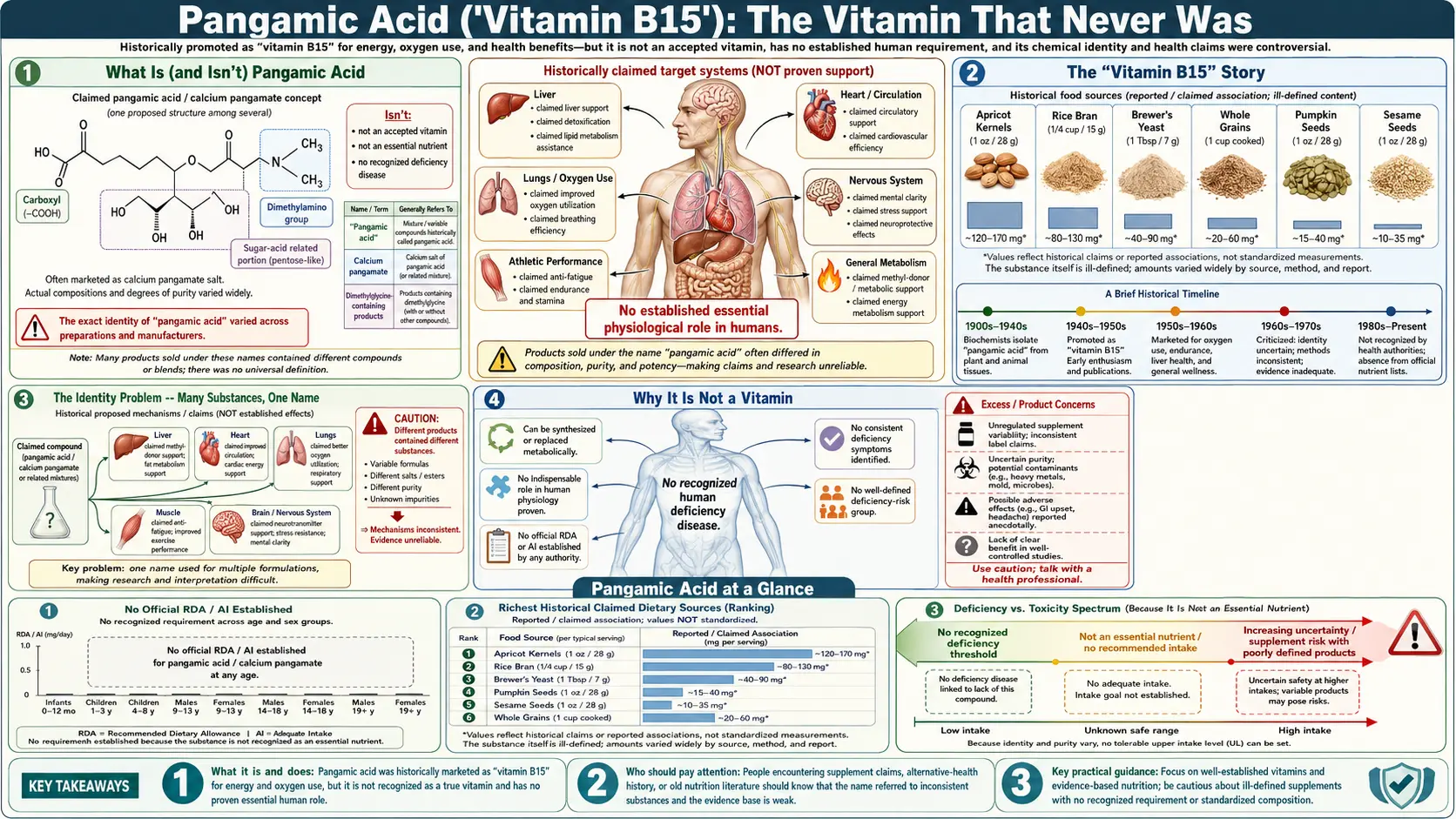
"Pangamic acid," widely marketed as vitamin B15, is not a vitamin. It has no deficiency disease, no established function the body requires it for, and no Recommended Dietary Allowance or Daily Value. The name was coined in the 1950s by Ernst T. Krebs Sr. and Jr. — the same father-and-son team behind the discredited cancer remedy laetrile ("B17") — and the single most important fact about it is that there has never been an agreed chemical identity behind the label. Products sold as "B15" have been found to contain wildly different substances. The U.S. Food and Drug Administration concluded the products have no defined identity, are unsafe and misbranded, and seized them. This page explains, honestly, what people are actually being sold under this name.
Table of Contents
- What Is (and Isn't) Pangamic Acid
- The "Vitamin B15" Story
- The Identity Problem — Many Substances, One Name
- Why It Is Not a Vitamin
- The Claims vs the Evidence
- Dimethylglycine (DMG) — the Related Real Compound
- FDA Regulatory Action (CPG 457.100, Seizures)
- Safety Concerns (DCA, Mutagenicity Questions)
- Bottom Line
- References
- Connections
- Featured Videos
1. What Is (and Isn't) Pangamic Acid
"Pangamic acid" is a marketing name, not a defined chemical. The term was attached to a substance the Krebs family claimed to have extracted from apricot kernels and later rice bran, and they assigned it the empirical formula C10H19O8N — describing it as an ester of D-gluconic acid and dimethylglycine. The crucial problem, which we return to in detail below, is that when independent chemists tried to reproduce that compound from the Krebs's own descriptions, they could not. There is no single, verifiable molecule that all products labeled "pangamic acid" or "vitamin B15" actually contain.
So the honest starting point is a negative definition: pangamic acid is not a vitamin, not a single chemical, and not a recognized nutrient. A vitamin is, by definition, an organic compound that the body cannot make in sufficient amounts and must obtain from food, whose absence produces a specific deficiency disease. "Pangamic acid" meets none of these criteria. No human deficiency state has ever been described. No essential biochemical role has ever been established. Major reference works and reviews have consistently classified it as a pseudovitamin — and, more bluntly, as a quack remedy with no demonstrated nutritional value.
What people are buying when they purchase a bottle labeled "B15" is therefore not a defined nutrient at all. Depending on the brand, era, and country, the capsule might contain a calcium salt, an amino-acid derivative, an inert sugar, or an industrial chemical. The label tells you almost nothing about the contents.
2. The "Vitamin B15" Story
The "pangamic acid" story begins in the late 1930s and 1940s with Ernst T. Krebs Sr., a physician, and his son Ernst T. Krebs Jr. The Krebses filed patents on extraction (filed 1943, granted 1949) and later synthesis (1955) of a substance they called pangamic acid, derived first from apricot kernels and then from rice bran. They named it "vitamin B15" — the number was a marketing choice, not a scientific classification by any vitamin-naming body — and promoted it as beneficial for an expansive and shifting list of conditions, including heart disease, fatigue, aging, and more.
It is impossible to understand B15 without noting who created it. The same Krebs father-and-son team also promoted laetrile, which they branded "vitamin B17" and sold as a cancer cure. Laetrile was later thoroughly investigated and found ineffective and potentially dangerous (it can release cyanide). The "vitamin B-number" branding of both substances was a pattern: take an unproven compound, give it a B-vitamin label to imply it is an essential nutrient your diet might lack, and market it widely. Neither B15 nor B17 was ever recognized as a vitamin by the scientific or regulatory community.
B15 found its largest audience in the former Soviet Union and Eastern Bloc, where it was promoted heavily for athletes and physical performance under the banner of "anti-hypoxia" — the idea that it helped tissues use oxygen and resist the effects of strenuous exertion or high altitude. Much of the early enthusiastic literature was Soviet and was not held to the standards of controlled, blinded clinical trials. When Western researchers later tested the performance claims under proper conditions, as discussed below, the benefits did not hold up.
3. The Identity Problem — Many Substances, One Name
This is the central, citeable fact of the entire topic, and it is the reason every other claim about B15 collapses: there is no agreed chemical identity for "pangamic acid." You cannot meaningfully study, regulate, or recommend a substance when nobody can say what is in the bottle.
When analytical chemists actually examined products and samples sold under the name, they found a moving target. Over the decades, materials labeled "pangamic acid" or "vitamin B15" have been documented to contain a startling variety of different ingredients, including:
- D-gluconodimethylaminoacetic acid — the ester the Krebses originally described (the formula C10H19O8N), but which independent labs found could not be reproducibly synthesized from their stated methods.
- Calcium gluconate — often combined with other materials and sold as "calcium pangamate."
- Glycine and other simple amino acids.
- Dimethylglycine (DMG) — a real, harmless compound (see Section 6) that some manufacturers used as the "active" ingredient.
- Diisopropylamine dichloroacetate (DIPA-DCA) — an industrial-type chemical that, when sold as B15, raised genuine toxicity and mutagenicity concerns (see Section 8).
- Inert fillers — in at least one historical instance, analysis of a "pangamic acid" sample supplied by a Krebs co-worker showed it to be nothing but lactose (milk sugar).
A 1966 analytical study published in the Canadian Medical Association Journal examined commercial products and concluded plainly that "pangamic acid is shown to be a mixture of variable composition," and that the composition of the products tested did not conform to their label claims. In other words, what was on the label and what was in the bottle did not match — and the contents differed from product to product. Decades of later analysis only reinforced the conclusion: no product sold as "pangamate" or "B15" was ever established in a scientifically verifiable way to match the formula the Krebses originally described.
This is why "Does vitamin B15 work?" is not even a well-posed question. Different bottles contain different things. A study of one manufacturer's product tells you nothing reliable about another's.
4. Why It Is Not a Vitamin
The word "vitamin" carries a specific scientific meaning, and "pangamic acid" fails every part of the test. To qualify as a vitamin, a substance must satisfy several criteria, and it is worth walking through each one:
1. It must be essential — the body cannot make enough of it. No evidence shows that humans require any intake of "pangamic acid" from food. There is no metabolic pathway known to depend on it as an irreplaceable input.
2. Its absence must cause a specific deficiency disease. No deficiency disease for "B15" has ever been identified or described. With genuine vitamins, withholding the nutrient reliably produces a recognizable illness (scurvy for vitamin C, beriberi for thiamine, pellagra for niacin) that the nutrient then cures. Nothing comparable exists for B15.
3. It must have a defined, consistent chemical identity. As Section 3 establishes, this fails outright. You cannot define a recommended intake for a substance that is not a single chemical.
4. It should have an established essential function. No required biochemical role has been demonstrated. Marketing language about "active methyl groups," "oxygen utilization," or "detoxification" describes effects that, where any underlying chemistry exists at all, belong to ordinary compounds like DMG or to the body's normal one-carbon metabolism — not to a unique essential nutrient called pangamic acid.
Because it meets none of these standards, no national or international nutrition authority assigns "B15" an RDA, a Dietary Reference Intake, or an FDA Daily Value. The "B15" designation is a name, not a classification. When a source lists it among the "B-complex vitamins," that reflects historical marketing, not nutritional science.
5. The Claims vs the Evidence
The promotional claims for B15 have always been broad: improved endurance and athletic performance, better oxygen use ("anti-hypoxia"), "detoxification," cardiovascular benefit, slowed aging, and relief of fatigue. The breadth itself is a warning sign — genuine nutrients have specific, mechanism-linked effects, not a catch-all list. More importantly, when the testable claims were actually tested, they did not hold up.
The most carefully studied claim is athletic performance, because that was B15's main selling point. In a double-blind, placebo-controlled trial published in Medicine & Science in Sports & Exercise in 1982, Gray and Titlow gave 16 male track athletes either a "pangamic acid" product (in that product, a combination of calcium gluconate and DMG) or placebo for three weeks and measured maximal treadmill performance. The supplement produced no significant improvement in treadmill time, maximal heart rate, recovery, blood glucose, or lactate compared with placebo. An earlier controlled study by Girandola and colleagues, published in Biochemical Medicine in 1980, similarly examined the metabolic response to exercise after pangamic acid ingestion and found no meaningful ergogenic benefit.
The pattern across the better-controlled Western literature is consistent: where blinding and placebo controls were used, the supposed endurance and anti-hypoxia benefits disappeared. The favorable early reports came largely from uncontrolled or methodologically weak studies, many from the former USSR, that do not meet modern evidence standards. There is, in short, no sound clinical evidence that "pangamic acid"/B15 improves endurance, oxygenation, longevity, or any of the other advertised outcomes. And given the identity problem, even a "positive" study would only describe whatever was in that one bottle.
6. Dimethylglycine (DMG) — the Related Real Compound
One reason "B15" persists is that it became entangled with a genuine, well-characterized chemical: dimethylglycine (N,N-dimethylglycine, or DMG). Some products sold as "B15," and even occasionally as "B16," contained DMG as their "active" ingredient, and marketers sometimes use the two names interchangeably. It is worth being clear about what DMG actually is — and isn't.
DMG is a real, naturally occurring compound. Your own body produces it as a normal intermediate in one-carbon (methyl-group) metabolism: betaine (trimethylglycine), derived from choline, donates a methyl group to homocysteine and in the process becomes dimethylglycine. DMG is then further metabolized in the liver. It is found in small amounts in foods such as meats, beans, and grains. At ordinary doses it is considered harmless and is generally well tolerated.
But "real and harmless" is not the same as "a vitamin" or "effective." DMG is not a vitamin either: the body makes it, there is no DMG deficiency disease, and no essential dietary requirement exists. And the endurance/performance claims attached to DMG fare no better than those for B15. Controlled trials — for example, a 1987 double-blind study by Bishop, Smith and Young in trained runners published in the Journal of Sports Medicine and Physical Fitness — found no ergogenic benefit of DMG on physiological response or performance. So while DMG is a legitimate molecule (unlike the phantom "pangamic acid ester"), the supplement claims built on it remain unsupported.
The practical takeaway: if a "B15" product happens to contain DMG, you are taking a harmless but non-essential compound with no proven performance benefit. If it contains something else (see Section 8), the calculus can be very different.
7. FDA Regulatory Action (CPG 457.100, Seizures)
The U.S. Food and Drug Administration addressed "pangamic acid" directly and unambiguously. Its Compliance Policy Guide, Sec. 457.100, "Pangamic Acid and Pangamic Acid Products Unsafe for Food and Drug Use," sets out the agency's position. The core findings are exactly the points made above: pangamic acid has no defined chemical identity, products bearing the name vary in composition, and there is no recognized food or drug use for which they are safe.
On that basis, the FDA treated products labeled "pangamic acid," "calcium pangamate," or "vitamin B15" as unsafe and misbranded, and as unapproved new drugs when sold with disease claims. The agency moved to restrain their distribution and to seize such products. A frequently cited illustration of the underlying problem: after enforcement against a "calcium pangamate" product, the same retailer was reported to have continued selling materials of different composition in similar packaging — precisely the kind of shifting-contents behavior that makes the category impossible to regulate as a defined substance and impossible for a consumer to trust.
The regulatory bottom line is therefore not ambiguous. In the United States, "pangamic acid"/B15 is not an approved food additive, not an approved drug, and not a recognized supplement ingredient with a defined identity. The FDA's conclusion that it is unsafe and misbranded for food and drug use still stands.
8. Safety Concerns (DCA, Mutagenicity Questions)
"Not a vitamin and not proven to work" would be reason enough to skip B15. But some formulations raised more serious concerns than mere ineffectiveness, and these are worth understanding because they depend entirely on which substance a given product actually contained.
Dichloroacetate (DCA) and diisopropylamine dichloroacetate (DIPA-DCA). Certain "B15" formulations contained dichloroacetate compounds. DCA is a real pharmacologically active chemical with its own toxicity profile; it is studied medically (for example, in lactic acidosis), but it is associated with adverse effects including peripheral neuropathy, and animal data have raised carcinogenicity questions. A "vitamin" you take freely is a fundamentally different thing from a chlorinated industrial chemical with dose-dependent toxicity — yet under the B15 label, consumers could not tell which they were getting.
Mutagenicity findings. In the early 1980s, researchers led by Victor Herbert tested some B15 ingredients in the standard Ames Salmonella/microsome assay. Dichloroacetate, "an ingredient of some formulations of pangamic acid," showed low-grade mutagenicity (Herbert, Gardner & Colman, 1980), and a separate study found that diisopropylamine dichloroacetate — promoted as the "active constituent" of vitamin B15 — and diisopropylamine were also mutagenic in the Ames test (Gelernt & Herbert, 1981). Because a large fraction of mutagens prove to be carcinogens, the authors flagged these results as a cancer-risk signal that should be weighed before anyone used such preparations. Separately, mixtures of DMG with sodium nitrite (conditions meant to mimic the stomach) have tested positive for mutagenicity, raising the theoretical concern of nitrosamine formation.
None of this means every B15 product is dangerous — a bottle that is mostly calcium gluconate, lactose, or DMG is unlikely to harm you. The point is the reverse: because the contents are unpredictable, a consumer cannot know whether their "B15" is inert sugar or a mutagenic chlorinated compound. That uncertainty, layered on top of zero proven benefit, is the safety case in a nutshell.
9. Bottom Line
Stripped of the marketing, the facts about "pangamic acid"/"vitamin B15" are straightforward and consistent across the scientific and regulatory record:
- It is not a vitamin. No deficiency disease, no essential function, no RDA or Daily Value. The "B15" label is marketing, coined by the same people behind laetrile.
- It has no agreed identity. Products sold under the name have contained different substances — from calcium gluconate, glycine, DMG, and inert lactose to dichloroacetate. The label does not tell you what is inside.
- The claims are unproven. Properly controlled trials of the headline endurance/anti-hypoxia claims found no benefit. The favorable reports came from weak or uncontrolled studies.
- It was banned and seized. The FDA concluded pangamic acid products are unsafe and misbranded (CPG Sec. 457.100) and acted to seize them.
- Some formulations raised real safety flags (dichloroacetate toxicity; mutagenicity signals), and you cannot tell which formulation you have.
The honest recommendation is the simple one: there is no good reason to take "vitamin B15," and we are not telling anyone to. If your goal is healthy methyl-group metabolism, that is supported by genuine, well-characterized nutrients — choline, folate, vitamin B12, and betaine — not by an undefined product wearing a fake vitamin number. If your goal is athletic performance, the controlled evidence points to training, sleep, and real nutrition, not to B15 or DMG. Spend your money and trust on substances that are what they say they are.
References
- Herbert, V. "Pangamic acid ('vitamin B15')." American Journal of Clinical Nutrition, vol. 32, no. 7, 1979, pp. 1534-1540.
- Stacpoole, P.W. — Search PubMed World Review of Nutrition and Dietetics, vol. 27, 1977, pp. 145-163.
- French, W.N., and Levi, L. "Pangamic acid (vitamin B15, Pangametin, Sopangamine): its composition and determination in pharmaceutical dosage forms." Canadian Medical Association Journal, vol. 94, no. 22, 1966, pp. 1185-1187.
- Gray, M.E., and Titlow, L.W. "The effect of pangamic acid on maximal treadmill performance." Medicine & Science in Sports & Exercise, vol. 14, no. 6, 1982, pp. 424-427.
- Girandola, R.N., Wiswell, R.A., and Bulbulian, R. "Effects of pangamic acid (B-15) ingestion on metabolic response to exercise." Biochemical Medicine, vol. 24, no. 2, 1980, pp. 218-222.
- Bishop, P.A., Smith, J.F., and Young, B. "Effects of N,N-dimethylglycine on physiological response and performance in trained runners." Journal of Sports Medicine and Physical Fitness, vol. 27, no. 1, 1987, pp. 53-56.
- Herbert, V., Gardner, A., and Colman, N. "Mutagenicity of dichloroacetate, an ingredient of some formulations of pangamic acid (trade-named 'vitamin B15')." American Journal of Clinical Nutrition, vol. 33, no. 6, 1980, pp. 1179-1182.
- Gelernt, M.D., and Herbert, V. "Mutagenicity of diisopropylamine dichloroacetate, the 'active constituent' of vitamin B15 (pangamic acid)." Nutrition and Cancer, vol. 3, no. 3, 1981, pp. 129-133.
- Stacpoole, P.W., Henderson, G.N., Yan, Z., and James, M.O. "Clinical pharmacology and toxicology of dichloroacetate." Environmental Health Perspectives, vol. 106, suppl. 4, 1998, pp. 989-994.
- U.S. Food and Drug Administration. "CPG Sec. 457.100 — Pangamic Acid and Pangamic Acid Products Unsafe for Food and Drug Use." FDA Compliance Policy Guide.
- Topical literature on the history and composition of "vitamin B15." PubMed search: pangamic acid / vitamin B15 composition.
Connections
- All Vitamins
- Former & Deprecated Vitamins
- Laetrile (B17)
- PABA (B10)
- Orotic Acid (B13)
- Choline
- Inositol (B8)
- Vitamin B12
- Folate (B9)
- Toxins
- Remedies (Overview)