Laetrile and Amygdalin ("Vitamin B17"): Claims, Cyanide Risk, and the Evidence
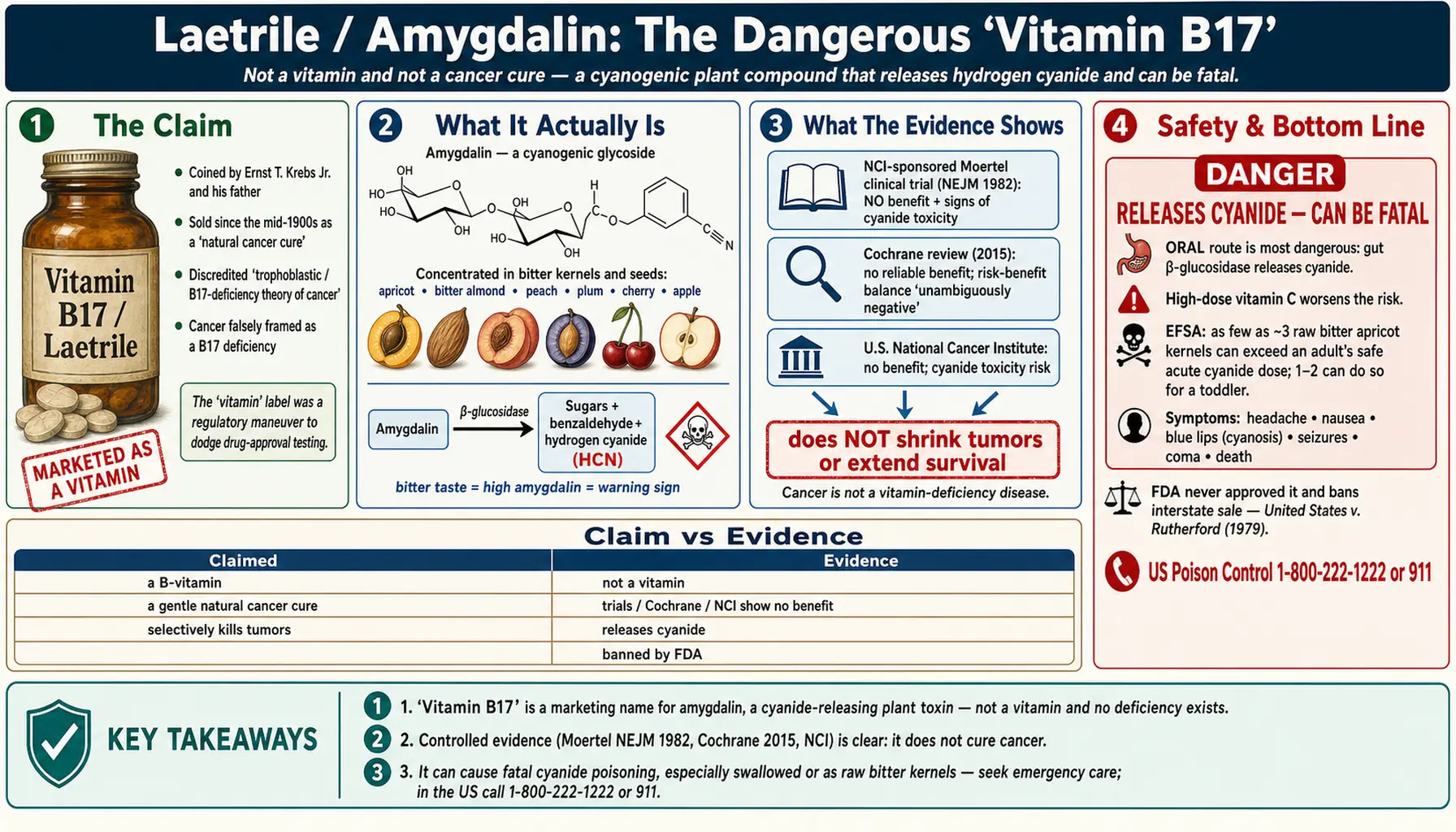
Safety warning: Laetrile, amygdalin, and so-called "vitamin B17" are not a proven treatment for cancer or any other disease, and they can cause fatal cyanide poisoning, especially when taken by mouth or as raw apricot or bitter-almond kernels. There is no safe established dose. If you or someone else has swallowed laetrile, amygdalin, or bitter kernels and feels unwell — headache, nausea, vomiting, dizziness, confusion, bluish lips or skin, fainting, or seizures — treat it as a medical emergency: call your local poison center or emergency number (in the United States, Poison Control at 1-800-222-1222, or 911) right away.
"Vitamin B17" is a marketing name, not a real vitamin. The compound behind it — amygdalin, and its semi-synthetic cousin laetrile — is a plant chemical from apricot, bitter-almond, peach, and apple seeds that the body breaks down into hydrogen cyanide. Promoted since the mid-twentieth century as a "natural cancer cure," it has been tested in controlled clinical trials and reviewed by the world's leading cancer authorities, and the verdict is consistent and clear: it does not shrink tumors, it does not help people live longer, and it poses a real risk of poisoning. This page lays out where the "B17" idea came from, why amygdalin is not a vitamin, what the strongest evidence actually shows, and how cyanide toxicity happens — so you can make a safe, informed decision.
Table of Contents
- What Is Amygdalin and Laetrile
- The "Vitamin B17" Myth
- Why It Is Not a Vitamin
- The Cancer Theory and Why It Is Wrong
- What the Evidence Actually Shows
- How Cyanide Is Released
- Documented Harm and Poisoning Cases
- Apricot Kernels and Food Safety
- Legal and Regulatory Status
- For Patients and Families Considering It
- Bottom Line
- References
- Connections
- Featured Videos
1. What Is Amygdalin and Laetrile
Amygdalin is a naturally occurring plant compound called a cyanogenic glycoside — a sugar-linked molecule that releases hydrogen cyanide when it is broken down. It is concentrated in the kernels and seeds of bitter almonds, apricots, peaches, plums, cherries, and apples, where it forms part of the plant's chemical defense against being eaten. The bitter taste of these kernels is itself a warning sign of high amygdalin content.
Laetrile is a related, partly man-made product. The name is a contraction of "laevorotatory" and "mandelonitrile," and it usually refers to a semi-synthetic form of amygdalin developed for sale as a cancer remedy. In everyday use, the words laetrile and amygdalin are often treated as interchangeable, although the purified pharmaceutical preparations and the crude kernel material can differ in concentration and purity. Both share the same fundamental hazard: under the right conditions in the body, they liberate cyanide.
Importantly, the chemistry here is not controversial. That amygdalin contains a cyanide group, and that enzymes can cleave it to release hydrogen cyanide, is established, textbook biochemistry agreed upon by supporters and critics alike. The disagreement has only ever been about the marketing claims attached to it — claims that, as the sections below explain, the evidence does not support.
2. The "Vitamin B17" Myth
The label "vitamin B17" was coined in the mid-twentieth century by Ernst T. Krebs Jr. and his father, the same figures associated with "vitamin B15" (pangamic acid). The choice of the word "vitamin" was deliberate and strategic, not scientific. In the United States, a drug must go through rigorous approval to prove it is safe and effective before it can be sold to treat a disease. A dietary supplement faces a far lower bar. By rebranding amygdalin as a "vitamin," its promoters could attempt to market it widely while sidestepping the testing required of an actual cancer drug.
This is the heart of the "B17" story: it is a commercial and regulatory maneuver dressed up in the language of nutrition. There is no entry for "B17" in any authoritative list of vitamins maintained by nutrition scientists or health agencies. The number was invented to lend an air of legitimacy — to make a cyanide-bearing plant extract sound like a wholesome nutrient your body might be "missing." Recognizing this naming trick is the single most useful thing a reader can take away: the "vitamin" framing exists to sell the product, not to describe biology.
3. Why It Is Not a Vitamin
A vitamin, by definition, is an essential organic micronutrient: a compound the body cannot make in sufficient amounts on its own, which must be obtained from food, and whose absence causes a specific deficiency disease. Vitamin C deficiency causes scurvy; vitamin D deficiency causes rickets; thiamine (B1) deficiency causes beriberi. Each true vitamin has a defined biochemical job, and removing it from the diet produces a recognizable illness that the vitamin reverses.
Amygdalin meets none of these criteria:
- No deficiency disease. No one becomes ill from a lack of amygdalin. There is no "amygdalin-deficiency syndrome," and no condition is caused by not eating apricot kernels.
- No essential function. Amygdalin performs no required role in human metabolism. The body runs perfectly well — in fact, more safely — with none of it at all.
- No Recommended Dietary Allowance or Daily Value. Because it is not a nutrient, there is no established intake target, no RDA, and no FDA Daily Value. (For the same reason, you will never see an accurate "% Daily Value" for "B17" on any product, because no such value exists.)
In short, "vitamin B17" fails the basic test of what a vitamin is. It is more accurately described as a cyanogenic plant toxin that was given a vitamin-style name for marketing purposes.
4. The Cancer Theory and Why It Is Wrong
The marketing of laetrile rested on a now-discredited idea sometimes called the "trophoblastic theory of cancer" or the "B17-deficiency theory." In simplified form, it claimed that cancer is caused by a dietary deficiency of "vitamin B17," and that amygdalin works as a kind of smart bomb: cancer cells were said to contain high levels of an enzyme (beta-glucosidase) that releases cyanide from amygdalin precisely inside the tumor, killing it, while healthy cells were said to be protected by a different enzyme (rhodanese) that detoxifies the cyanide.
This story is appealing because it sounds mechanistic and selective. But it does not hold up to scrutiny. Cancer is not a vitamin-deficiency disease; it is a disease of accumulated genetic and cellular changes that drive uncontrolled growth. The supposed enzyme distribution that would make amygdalin selectively toxic to tumors has not been borne out — the enzymes involved are distributed in ways that do not spare normal tissue, and there is no reliable evidence that amygdalin concentrates its cyanide release inside tumors. The theory was, in effect, a plausible-sounding rationale constructed around a product, rather than a conclusion drawn from sound experiments. When the actual product was finally put to a fair clinical test, as the next section describes, the predicted anticancer effect simply did not appear.
5. What the Evidence Actually Shows
Unlike many fringe remedies, laetrile was eventually subjected to serious, high-quality scientific evaluation. The results are remarkably consistent across decades and across the most respected sources in oncology.
The Moertel clinical trial (New England Journal of Medicine, 1982). Under pressure from public demand, the U.S. National Cancer Institute sponsored a formal clinical trial of amygdalin in cancer patients, led by Charles G. Moertel and colleagues at the Mayo Clinic and other centers. Patients with advanced cancer received amygdalin along with the "metabolic therapy" diet typically recommended by laetrile practitioners. The findings were unambiguous: there was no substantial benefit in terms of cure, improvement, stabilization, or extended survival. Tumors grew; patients deteriorated on the same timeline expected without treatment. Crucially, the investigators also observed signs of cyanide toxicity, including elevated blood cyanide levels, confirming that the danger was real and not theoretical.
The Cochrane systematic review (2015). Cochrane reviews are widely regarded as the gold standard for impartially summarizing medical evidence. The review titled "Laetrile treatment for cancer," by Milazzo, Horneber, and Ernst, searched the world's medical literature for any controlled studies showing benefit. It found no reliable evidence that laetrile or amygdalin has any beneficial effect on cancer, while documenting a considerable risk of serious harm from cyanide poisoning. The authors concluded that the balance of benefit versus risk is "unambiguously negative" — about as strong and direct a statement as such reviews ever make.
The U.S. National Cancer Institute (NCI). The NCI's own expert summary on Laetrile/Amygdalin reaches the same conclusion: the available evidence does not support laetrile as a treatment for cancer, and it carries a risk of cyanide toxicity. When the trial data, the systematic review, and the national cancer authority all converge on the same answer, the scientific question is settled. Laetrile does not work as a cancer treatment.
6. How Cyanide Is Released
Understanding how amygdalin becomes poison makes clear why the oral route is the most dangerous. Amygdalin itself is relatively inert until an enzyme called beta-glucosidase breaks it apart. When that happens, the molecule splits into sugars and an unstable intermediate that decomposes into benzaldehyde and hydrogen cyanide (HCN) — one of the fastest-acting poisons known.
The problem is that beta-glucosidase is abundant in the human gut, produced both by the bacteria of the intestinal microbiome and present in some plant foods. So when amygdalin is swallowed, it is delivered straight into the body's richest source of the very enzyme that unlocks its cyanide. This is why oral laetrile has repeatedly proven more toxic than the same compound given by injection: eating it maximizes cyanide release. Several everyday factors make this worse:
- Raw, bitter kernels. Chewing raw bitter apricot kernels or bitter almonds exposes the amygdalin to plant enzymes and gut bacteria at once, releasing cyanide quickly.
- High-dose vitamin C. Large doses of vitamin C, often recommended alongside laetrile in "metabolic" protocols, can deplete the body's cysteine stores needed to detoxify cyanide and may increase amygdalin's conversion to cyanide — a genuinely dangerous combination.
- Certain foods and gut conditions that raise beta-glucosidase activity can further accelerate release.
Once cyanide is freed in the bloodstream, it blocks the enzyme cytochrome c oxidase, the final step cells use to make energy from oxygen. Cells effectively suffocate even though oxygen is present. The body can neutralize small amounts using the enzyme rhodanese, but that capacity is easily overwhelmed by a meaningful dose — which is exactly why poisoning occurs.
7. Documented Harm and Poisoning Cases
The danger of laetrile and apricot kernels is not hypothetical. The medical literature contains numerous case reports of acute cyanide poisoning following ingestion of amygdalin tablets or bitter kernels, including episodes severe enough to require intensive care and antidote treatment, and cases that have ended in death. Poison-control centers in multiple countries continue to receive calls about apricot-kernel and "B17" products.
The typical symptoms of cyanide toxicity from these products appear within minutes to a few hours and can include:
- Headache, dizziness, and confusion
- Nausea and vomiting
- Bluish discoloration of the skin and lips (cyanosis)
- Rapid breathing followed by difficulty breathing
- Dangerously low blood pressure (hypotension)
- Seizures, loss of consciousness, coma, and death in severe cases
A recurring and tragic theme in these reports is that the people affected often believed they were doing something gentle and "natural" for their health. Some had switched away from effective conventional cancer treatment in favor of laetrile, losing not only safety but also valuable time during which standard therapy might have helped. The harm from laetrile is therefore twofold: the direct toxicity of the cyanide it releases, and the indirect harm of replacing treatments that actually work. Emergency physicians treat amygdalin and apricot-kernel ingestion as potential cyanide exposures, sometimes administering cyanide antidotes such as hydroxocobalamin.
8. Apricot Kernels and Food Safety
Because "B17" promotion encourages people to eat raw bitter apricot kernels directly, food-safety regulators have had to weigh in. The European Food Safety Authority (EFSA) assessed the risks of cyanide exposure from apricot kernels and concluded that eating even a small number of raw bitter kernels can exceed the safe acute exposure level for cyanide. EFSA's analysis indicated that as few as roughly three small raw bitter apricot kernels could push an adult past the acute reference dose, and that even one or two could do so for a toddler — a sobering figure given that some "B17" regimens recommend eating many kernels per day.
It is worth distinguishing types of kernels and nuts. Sweet almonds — the ordinary almonds sold as food — contain only trace amygdalin and are safe to eat normally. The hazard lies specifically with bitter apricot kernels and bitter almonds, whose intense bitterness reflects their high amygdalin content. Several national food agencies advise consumers not to eat raw bitter apricot kernels at all, and some restrict how they may be sold. The bitterness itself is the body's built-in warning: foods that taste strongly of bitter almond should not be eaten in quantity.
9. Legal and Regulatory Status
Reflecting the lack of evidence and the documented danger, laetrile is tightly restricted in major jurisdictions:
- United States. The U.S. Food and Drug Administration (FDA) has never approved laetrile or amygdalin as a treatment for cancer or any other condition. It is not a recognized drug, and its interstate shipment and sale are banned. Federal courts, including the U.S. Supreme Court in the case United States v. Rutherford (1979), upheld the FDA's authority to bar laetrile from interstate commerce, rejecting the argument that terminally ill patients had a right to access an unproven remedy.
- European Union. Laetrile is not approved as a medicine, and the marketing of amygdalin or "B17" products for treating disease is restricted. EFSA's safety findings have prompted warnings and limits on apricot-kernel products sold to the public.
- Elsewhere. Many other countries similarly prohibit or restrict laetrile as an unlicensed and unsafe product, and warn against apricot-kernel "cancer cures."
These restrictions are not bureaucratic obstacles to a working cure; they are the predictable response of regulators to a product that has been tested, found ineffective, and shown to be capable of poisoning the people who take it.
10. For Patients and Families Considering It
If you have searched for "vitamin B17 cancer cure," you are very likely facing something frightening — a diagnosis, a relapse, or a loved one who is suffering. That fear is completely understandable, and the wish to find a gentler, natural answer is human and reasonable. Many thoughtful, intelligent people have been drawn to laetrile for exactly these reasons, and there is no shame in having hoped it might help.
But honesty is the most caring thing we can offer here: laetrile does not cure cancer, and it can cause life-threatening cyanide poisoning. Choosing it in place of proven treatment can cost both safety and precious time. The good news is that there are real, evidence-based options worth your hope and energy — from modern oncology to legitimate supportive and integrative care that helps with nutrition, pain, and quality of life without the risk of poisoning. If cost, side effects, or distrust of the medical system are part of why alternatives appealed to you, those are real concerns worth raising directly with an oncologist, a patient navigator, or a cancer-support organization, many of which offer free guidance. You deserve treatments that are both safe and genuinely effective.
11. Bottom Line
- "Vitamin B17" is not a vitamin. It is a marketing name invented for amygdalin, a cyanide-releasing plant compound. There is no deficiency disease, no essential function, and no Daily Value.
- It does not cure cancer. A controlled clinical trial (Moertel, NEJM 1982), the Cochrane systematic review (2015), and the U.S. National Cancer Institute all find no reliable anticancer benefit.
- It can poison you. Amygdalin releases hydrogen cyanide — most dangerously when swallowed, when bitter kernels are eaten raw, and when combined with high-dose vitamin C. Symptoms range from headache and nausea to seizures, coma, and death.
- It is restricted by law. The FDA has not approved it and bans interstate shipment; the EU and many countries restrict it; apricot-kernel products carry safety warnings.
- Seek emergency care for anyone who has ingested laetrile, amygdalin, or bitter kernels and feels unwell. In the U.S., call Poison Control at 1-800-222-1222 or 911.
References
- Moertel, C.G., Fleming, T.R., Rubin, J., et al. "A Clinical Trial of Amygdalin (Laetrile) in the Treatment of Human Cancer." New England Journal of Medicine, vol. 306, no. 4, 1982, pp. 201-206.
- Milazzo, S., Horneber, M. "Laetrile treatment for cancer." Cochrane Database of Systematic Reviews, no. 4, Article CD005476, 2015.
- National Cancer Institute (NCI). "Laetrile/Amygdalin (PDQ®) — Health Professional Version." U.S. National Institutes of Health. cancer.gov/about-cancer/treatment/cam/hp/laetrile-pdq (accessed 2026).
- EFSA Panel on Contaminants in the Food Chain (CONTAM). "Acute health risks related to the presence of cyanogenic glycosides in raw apricot kernels and products derived from raw apricot kernels." EFSA Journal, vol. 14, no. 4, Article 4424, 2016.
- Moertel, C.G., Ames, M.M., Kovach, J.S., et al. "A pharmacologic and toxicological study of amygdalin." JAMA, 1981.
- Newton, G.W., Schmidt, E.S., Lewis, J.P., et al. "Amygdalin toxicity studies in rats predict chronic cyanide poisoning in humans." Western Journal of Medicine, 1981.
- Bromley, J., Hughes, B.G.M., Leong, D.C.S., et al. "Life-threatening interaction between complementary medicines: cyanide toxicity following ingestion of amygdalin and vitamin C." Annals of Pharmacotherapy, 2005.
- Sauer, H., Wollny, C., Oster, I., et al. "Severe cyanide poisoning from an alternative medicine treatment with amygdalin and apricot kernels." Case report literature, 2015.
- Milazzo, S., Ernst, E., Lejeune, S., et al. "Laetrile treatment for cancer (earlier Cochrane versions and related systematic reviews)." Cochrane Database / European Journal of Cancer.
- U.S. Supreme Court. United States v. Rutherford, 442 U.S. 544 (1979) — on FDA authority to bar interstate shipment of laetrile.
- Greenberg, D.M. "The case against laetrile: the fraudulent cancer remedy." Cancer, 1980.
- Bolarinwa, I.F., Orfila, C., Morgan, M.R.A. "Amygdalin content of seeds, kernels and food products commercially available." Food Chemistry, 2014.
Connections
- All Vitamins
- Former & Deprecated Vitamins
- Pangamic Acid (B15)
- PABA (B10)
- Orotic Acid (B13)
- Inositol (B8)
- Choline
- Vitamin C (dangerous high-dose interaction)
- Toxins (cyanide and food contaminants)
- Heavy Metals and Other Toxins