Volatile Organic Compounds (VOCs)
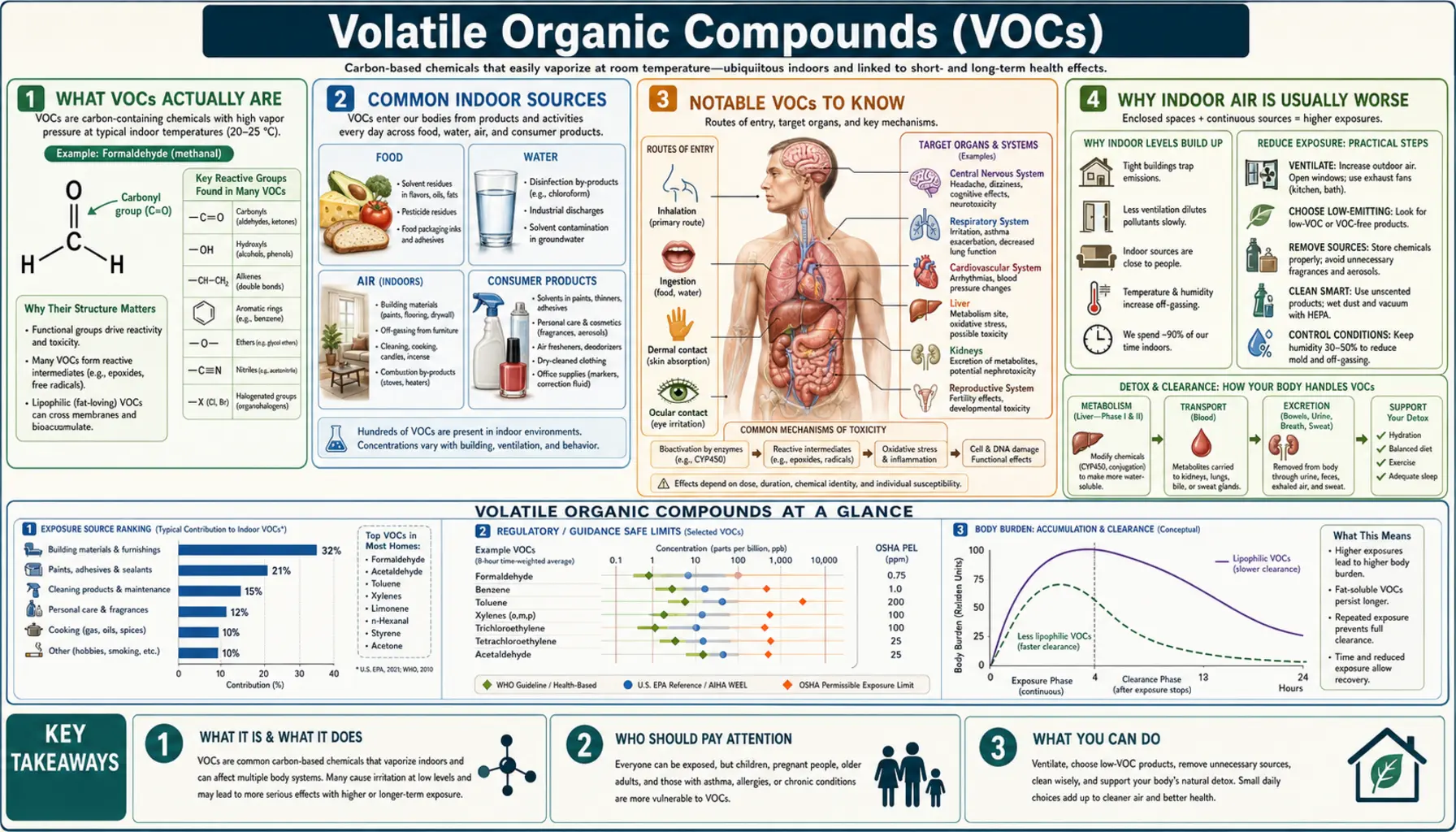
Volatile organic compounds — VOCs for short — are the everyday chemicals responsible for the smell of fresh paint, a new sofa, a permanent marker, or a just-dry-cleaned shirt. "Volatile" means they evaporate easily at ordinary room temperature; "organic" here is the chemistry sense (carbon-based), not the grocery-store sense. Hundreds of different VOCs drift through the air of a typical home, and because we spend most of our lives indoors, indoor air is usually where our exposure adds up. The good news is that most VOCs, at the low levels found in ordinary homes, cause nothing worse than temporary irritation — and the honest bad news is that a few of them (benzene and formaldehyde among them) are genuine carcinogens worth minimizing. This page explains what VOCs are, where they come from indoors, who is most affected, how you can measure them, and the cheap, practical steps that actually lower your exposure. The aim is to be accurate without being alarming: you do not need to panic, and you do not need expensive gadgets.
Table of Contents
- What VOCs Actually Are
- Common Indoor Sources
- Notable VOCs to Know
- Why Indoor Air Is Usually Worse
- Health Effects: Short and Long Term
- Sick Building Syndrome & Off-Gassing
- Who Is Most Vulnerable
- How to Test Indoor VOCs
- How to Reduce Your Exposure
- The Honest Bottom Line
- Research Papers
- Connections
- Featured Videos
What VOCs Actually Are
A volatile organic compound is a carbon-based chemical that readily turns into a gas at the temperatures we live in. That is really all "volatile organic compound" means: volatile (it evaporates without needing to be heated) plus organic (its molecules are built around carbon). Because they evaporate so easily, VOCs leave their source — a can of paint, a slab of particleboard, a scented candle — and mix into the air you breathe.
There are thousands of them. Some announce themselves with a strong odor: the sharp bite of nail-polish remover (acetone), the solvent smell of a marker (from alcohols and other carriers), the piney or citrusy note of a cleaning spray. Many others have no smell at all, so you cannot rely on your nose to tell you they are present. Common examples you will see named on product labels and lab reports include formaldehyde, benzene, toluene, xylene, ethanol, acetone, acetaldehyde, and the fragrance terpenes limonene and pinene.
When a monitor or a product label refers to TVOC, it means "total VOCs" — a single lumped number that adds up everything in the air rather than measuring any one chemical. That distinction matters later, because a high TVOC reading tells you something is off-gassing but not what, or whether it is harmful.
Common Indoor Sources
VOCs come from an enormous range of ordinary products and activities. You will never remove them all, and you do not need to — but knowing the big emitters helps you decide where ventilation and better choices pay off most. Common indoor sources include:
- Paints, stains, varnishes, and finishes — among the most intense short-term emitters, especially while wet and drying.
- Adhesives, glues, caulks, and sealants — used during renovations and in flooring and cabinetry.
- New furniture and pressed-wood products — particleboard, MDF, and some plywood are bonded with formaldehyde-based resins that off-gas for weeks to months.
- New carpet, vinyl flooring, and building materials — that "new construction" smell is largely VOCs.
- Cleaning products and disinfectants — solvents, bleach, ammonia, and fragrances.
- Air fresheners, scented candles, plug-ins, and incense — these add chemicals to the air by design; a "fresh" scent is not the same as clean air.
- Personal-care products — nail polish, hairspray, perfume, and aerosols.
- Dry-cleaned clothing — a source of perchloroethylene ("perc"); airing garments before bringing them inside helps.
- Cooking — especially high-heat frying, and gas stoves, which release VOCs and other combustion products.
- Tobacco smoke — one of the largest indoor VOC sources, carrying benzene, formaldehyde, and hundreds of other compounds.
- Hobby and craft supplies, and attached garages — markers, solvents, stored gasoline, paint cans, and car exhaust that seeps from an attached garage into the living space.
Notable VOCs to Know
Most VOCs are relatively benign at household levels, but a handful are worth recognizing by name because the science on them is clearer or the concern is greater:
- Formaldehyde — released by pressed-wood furniture, some resins, insulation, and fabrics. It is both a strong irritant and a recognized human carcinogen, which is why it gets its own page.
- Benzene — found in tobacco smoke, stored fuels, attached-garage air, and some paints and adhesives. Benzene is an established cause of leukemia, so minimizing indoor sources is worthwhile.
- Toluene and xylene — solvents in many paints, adhesives, and markers; high exposures affect the nervous system (headache, dizziness, coordination).
- Perchloroethylene ("perc," PCE) — the classic dry-cleaning solvent; freshly cleaned clothes can off-gas it indoors.
- Acetaldehyde — a product of combustion, cooking, and smoke; an irritant and a probable carcinogen.
- Limonene and pinene (fragrance terpenes) — the citrus and pine scents in many cleaners and air fresheners. They are fairly harmless on their own, but they can react with indoor ozone to form secondary pollutants such as formaldehyde and ultrafine particles. In other words, a "natural" scent is not automatically a clean one.
Why Indoor Air Is Usually Worse
People are often surprised to learn that indoor air typically holds more VOCs than the air outside, frequently several times more. There are three reasons, and together they explain most of the difference.
The sources are concentrated indoors. Paint, furniture, flooring, cleaners, and scented products all sit inside a relatively small enclosed volume, releasing VOCs continuously into the same air you keep breathing. Outdoors, the same emissions would disperse into a nearly limitless volume.
Modern buildings breathe less. Energy-efficient homes are deliberately sealed tight to save on heating and cooling. That is good for utility bills but it also means less fresh outdoor air comes in to dilute and carry away indoor pollutants, so VOCs accumulate. Researchers have documented how the shift toward new synthetic materials and tighter construction over the past several decades reshaped the mix of chemicals in indoor air.
We are almost always indoors. Most people spend the large majority of their time inside — at home, at work, in the car — so indoor air, not outdoor air, is where the bulk of our real-world VOC exposure happens. This is exactly why simple indoor steps like opening a window can matter more than you would guess.
Health Effects: Short and Long Term
How VOCs affect you depends on which compound, how much is in the air, how long you breathe it, and how sensitive you are. It helps to separate the everyday short-term effects from the concerns tied to heavy or long-term exposure.
Short-term effects
At the levels people meet during painting, cleaning, or living with a lot of new furnishings, the common complaints are irritation of the eyes, nose, and throat; headaches; dizziness; nausea; and fatigue. Some people notice worse asthma symptoms or a vague "stuffy, off" feeling in a poorly ventilated room. These effects usually ease once you get fresh air or leave the space.
Long-term and high-level effects
At high or prolonged exposures — more typical of certain workplaces than ordinary homes — some VOCs can damage the liver, kidneys, or nervous system, and a few are carcinogens. Benzene is a well-established cause of leukemia, and formaldehyde is linked to nasopharyngeal cancer. It is worth being honest about the size of the everyday risk, though: for the low, mixed exposures found in most homes, the individual cancer risk from any single VOC is small and hard to quantify precisely. The best-documented real-world effects of ordinary indoor VOC exposure are irritation and respiratory associations — particularly links to asthma and allergy in children — rather than dramatic acute harm. The sensible takeaway is to reduce the clear-cut carcinogens where you easily can, and to keep everyday exposure low, without treating your living room as a hazardous-waste site.
Sick Building Syndrome & Off-Gassing
"Sick building syndrome" describes a cluster of symptoms — headache; irritated eyes, nose, or throat; fatigue; and trouble concentrating — that a group of people notice while they are in a particular building and that eases after they leave. VOCs are one suspected contributor, but they are rarely the whole story: poor ventilation, humidity, mold, lighting, noise, and stress all play a part, and it is often difficult to pin the symptoms on any single cause.
Off-gassing is the process behind a lot of this. A new mattress, sofa, carpet, laminate floor, or car interior releases the most VOCs when it is brand new — the familiar "new" smell — and the emissions taper off over days to months as the volatile chemicals gradually escape. This is why a newly renovated or freshly furnished room can feel stuffy or headache-inducing at first and improve on its own with time and ventilation. Knowing that off-gassing is front-loaded is genuinely useful: airing new items out early, when they release the most, captures most of the benefit.
Who Is Most Vulnerable
VOCs affect everyone to some degree, but some people feel the effects sooner or more strongly:
- Infants and children — they breathe more air relative to their body weight, their lungs are still developing, and they spend time close to the floor and to off-gassing furniture. Studies link higher home VOC levels to more asthma and allergy symptoms in children.
- People with asthma, COPD, or allergies — irritant VOCs can trigger flare-ups and tighten already-sensitive airways.
- People with chemical sensitivity — some individuals react to fragrances and solvents at levels most people do not notice.
- Pregnant people — a reasonable group to keep exposure low as a precaution.
- Older adults and anyone with existing heart or lung disease — less physiological reserve to buffer added irritation.
If someone in your home falls into one of these groups, the exposure-reduction steps below are worth a little extra attention.
How to Test Indoor VOCs
You can measure indoor VOCs, but it pays to understand what each option really tells you — and, honestly, most homes do not need testing at all.
Low-cost consumer monitors
Inexpensive home "air quality" monitors usually report a single TVOC number. They are handy for spotting trends and relative changes — did the reading fall after you opened the windows? did it spike when you sprayed a cleaner? — but they have real limits. Most use low-cost metal-oxide sensors that lump all VOCs together, so they cannot identify a specific chemical or tell you whether a level is actually harmful. They also drift over time and cross-react with things like cooking fumes, alcohol, and hand sanitizer, which can send the number soaring for reasons that have nothing to do with a health hazard. Treat their readings as a rough relative gauge, not a precise or medical measurement.
Professional testing
For a specific concern — a persistent odor after a renovation, a suspected contamination problem — a professional can collect an air sample (in a canister or on a sorbent tube) and send it to a laboratory for analysis by gas chromatography–mass spectrometry. This accurately identifies and quantifies individual VOCs, but it costs money and captures only a snapshot of one moment in time. It is the right tool when you need to know exactly what is present, and overkill for general peace of mind.
The practical reality
For the vast majority of homes, you do not need to test. Source control and ventilation — the steps in the next section — lower your exposure whether or not you ever put a number on it. Testing is worth it mainly when you have a specific, persistent problem you are trying to track down.
How to Reduce Your Exposure
The most effective steps are also the cheapest and least technical. In rough order of value:
- Ventilate. Open windows, and run kitchen and bathroom exhaust fans. Ventilation matters most while painting or cleaning and right after installing new products, when off-gassing peaks. Fresh outdoor air dilutes and removes indoor VOCs better than almost anything else.
- Control the source (the biggest lever). Choose low-VOC or "no-VOC" paints, finishes, and adhesives, and look for low-emitting certifications such as GREENGUARD Gold or Green Seal. Be honest with yourself, though: "no-VOC" paint can still contain some VOCs, and colorant added at the store can raise the total. Lower is better; zero is marketing.
- Let new items off-gas. Unwrap new furniture, mattresses, and rugs and air them out in a well-ventilated space — a garage or spare room — before heavy use, since the worst emissions come early.
- Store solvents, paints, and fuels outside the living space. A detached shed or a sealed cabinet is best; keep the door between an attached garage and the house closed so exhaust and fumes do not drift in.
- Do not smoke indoors, and use the range hood when cooking. Both remove major, avoidable sources at once.
- Manage humidity. Keeping indoor humidity moderate limits some VOC-forming chemistry and discourages mold.
- Do not rely on houseplants. The popular idea that a few potted plants purify indoor air traces to a 1989 NASA chamber experiment. In a sealed laboratory box plants do remove some VOCs, but careful reviews of real rooms find the effect on actual indoor air is negligible — you would need dozens to hundreds of plants per room to match cracking a window. Keep plants because you enjoy them, not as an air purifier.
- Understand what air cleaners can and cannot do. A standard HEPA filter captures particles but does not remove VOC gases. Activated-carbon (charcoal) filters can adsorb some VOCs, but they saturate and need regular replacement to keep working.
The Honest Bottom Line
VOCs are a normal, unavoidable part of indoor air, and completely eliminating them is neither realistic nor necessary. The goal is sensible reduction, not zero. The biggest wins are cheap and low-tech: let fresh air in, control the strongest sources, air out new products while they off-gas the most, and never smoke indoors. A couple of specific VOCs — benzene and formaldehyde — are genuine carcinogens worth minimizing wherever it is easy to do so; the great majority of everyday exposures mainly cause temporary irritation, headaches, or that stuffy-room feeling. You do not need to panic, and you do not need to spend money on gadgets or air-purifying houseplants. Children and people with asthma or other lung conditions gain the most from cleaner indoor air, so if they share your home, a few open windows and low-VOC choices are a small effort with a real payoff.
Research Papers
- Wolkoff P. Indoor air pollutants in office environments: assessment of comfort, health, and performance. International Journal of Hygiene and Environmental Health. 2013;216(4):371-394. doi:10.1016/j.ijheh.2012.08.001 — review linking office VOCs and other pollutants to comfort, irritation, and work performance.
- Cincinelli A, Martellini T. Indoor air quality and health. International Journal of Environmental Research and Public Health. 2017;14(11):1286. doi:10.3390/ijerph14111286 — overview of the major indoor pollutants, VOCs among them, and their documented health links.
- Sarigiannis DA, Karakitsios SP, Gotti A, et al. Exposure to major volatile organic compounds and carbonyls in European indoor environments and associated health risk. Environment International. 2011;37(4):743-765. doi:10.1016/j.envint.2011.01.005 — quantifies indoor exposure to benzene, formaldehyde, and related compounds and estimates the resulting health burden.
- Weschler CJ. Changes in indoor pollutants since the 1950s. Atmospheric Environment. 2009;43(1):153-169. doi:10.1016/j.atmosenv.2008.09.044 — explains how new synthetic materials and tighter buildings reshaped indoor VOC exposure.
- Rumchev K, Spickett J, Bulsara M, et al. Association of domestic exposure to volatile organic compounds with asthma in young children. Thorax. 2004;59(9):746-751. doi:10.1136/thx.2003.013680 — higher home VOC levels were associated with greater asthma risk in young children.
- Nurmatov UB, Tagiyeva N, Semple S, et al. Volatile organic compounds and risk of asthma and allergy: a systematic review. European Respiratory Review. 2015;24(135):92-101. doi:10.1183/09059180.00000714 — systematic review weighing the evidence linking VOC exposure to asthma and allergic disease.
- Mendell MJ. Indoor residential chemical emissions as risk factors for respiratory and allergic effects in children: a review. Indoor Air. 2007;17(4):259-277. doi:10.1111/j.1600-0668.2007.00478.x — reviews how emissions from home materials relate to respiratory and allergic effects in children.
- Bernstein JA, Alexis N, Bacchus H, et al. The health effects of nonindustrial indoor air pollution. Journal of Allergy and Clinical Immunology. 2008;121(3):585-591. doi:10.1016/j.jaci.2007.10.045 — clinical review of health effects from everyday indoor pollutants, including VOCs.
- Redlich CA, Sparer J, Cullen MR. Sick-building syndrome. The Lancet. 1997;349(9057):1013-1016. doi:10.1016/S0140-6736(96)07220-0 — classic review defining sick-building syndrome and its suspected contributors.
- Salthammer T, Mentese S, Marutzky R. Formaldehyde in the indoor environment. Chemical Reviews. 2010;110(4):2536-2572. doi:10.1021/cr800399g — comprehensive review of a key indoor VOC: sources, levels, chemistry, and health.
- Steinemann A. Volatile emissions from common consumer products. Air Quality, Atmosphere & Health. 2015;8(3):273-281. doi:10.1007/s11869-015-0327-6 — measured the VOCs emitted by air fresheners, cleaners, and other everyday products.
- Cummings BE, Waring MS. Potted plants do not improve indoor air quality: a review and analysis of reported VOC removal efficiencies. Journal of Exposure Science & Environmental Epidemiology. 2020;30(2):253-261. doi:10.1038/s41370-019-0175-9 — shows the real-world air-cleaning effect of houseplants is negligible compared with normal ventilation.
Connections
- All Toxins
- Formaldehyde
- Benzene
- Household Chemicals
- Air Pollution (PM2.5)
- Radon
- Mold & Mycotoxins
- Carbon Monoxide
- Asthma
- COPD
- Lung Cancer
- Pulmonology