Sassafras Oil
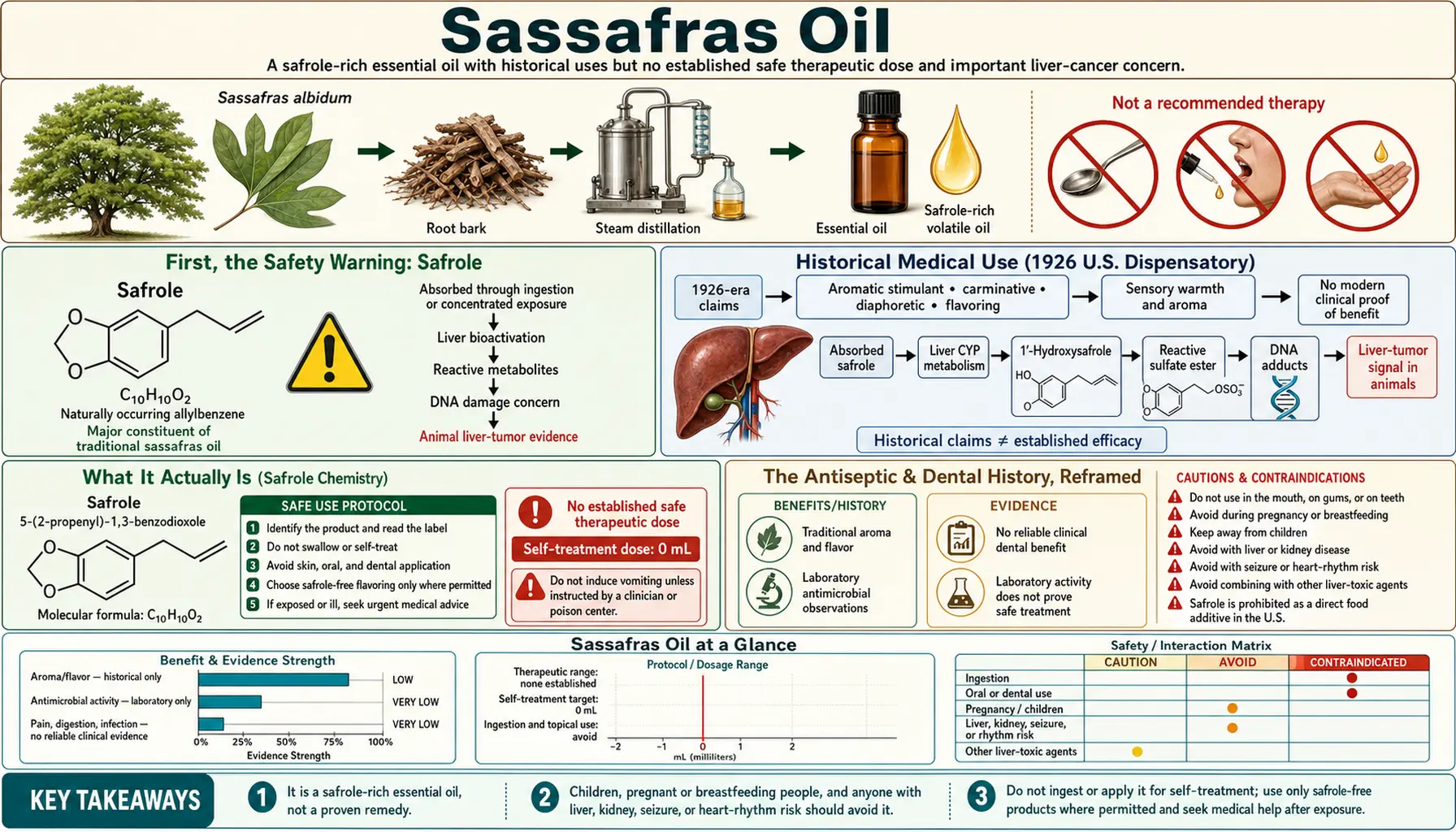
Sassafras oil is the fragrant essential oil pressed and distilled from the root bark of the North American sassafras tree (Sassafras albidum). For generations it was the smell and taste of classic root beer, and a century ago American doctors kept it on the shelf as a flavoring and a "very good antiseptic." There is, however, one fact that overrides everything else you might read about it, and it belongs at the very top of the page: sassafras oil is roughly 80–90% safrole, a compound that the U.S. Food and Drug Administration banned from food in 1960 and that international cancer agencies classify as a carcinogen — it causes liver tumors in laboratory animals. The honest bottom line is simple and unambiguous: do not swallow sassafras oil, and do not drink homemade "real sassafras" tea or root beer made with the whole root. Today's commercial root beer is safrole-free and perfectly safe; the danger is the concentrated oil and the unprocessed root, not the soda on the shelf. This page tells the true history, explains the chemistry plainly, and keeps the safety warning where it belongs — front and center.
Table of Contents
- First, the Safety Warning: Safrole
- Historical Medical Use (1926 U.S. Dispensatory)
- What It Actually Is (Safrole Chemistry)
- The Antiseptic & Dental History, Reframed
- Root Beer: Why the Safrole Came Out
- How Safrole Causes Cancer (the Mechanism)
- How It's (Not) Used Today & Regulatory Status
- Safety, Cautions & Myths
- Key Research Papers
- Connections
- Featured Videos
First, the Safety Warning: Safrole
Before any of the history, the single most important thing to understand: the active ingredient that makes up most of sassafras oil is a chemical called safrole, and safrole is a known animal carcinogen. This is not a fringe claim or a modern overreaction — it is the considered position of the major regulatory and cancer-research bodies:
- The U.S. FDA banned safrole as a food additive in 1960 after animal studies linked it to liver cancer. Sassafras oil and safrole-containing sassafras root were removed from the list of substances permitted in food and drink.
- The International Agency for Research on Cancer (IARC), part of the World Health Organization, classifies safrole as a Group 2B carcinogen — "possibly carcinogenic to humans" — based on sufficient evidence of cancer in experimental animals.
- The U.S. National Toxicology Program (NTP) lists safrole as "reasonably anticipated to be a human carcinogen."
- In 2018 the FDA went further and revoked the food-additive approvals for several synthetic flavoring substances, but safrole had already been gone from the food supply for decades — it was one of the earliest natural flavorings pulled specifically over a cancer concern.
So while the rest of this page is genuinely interesting as history, please carry this fact through all of it: concentrated sassafras oil is unsafe to ingest. Steeping the actual sassafras root for tea, or brewing "old-fashioned real" root beer from the root, delivers safrole too. The flavor you remember from a can of root beer today is made without it.
Historical Medical Use (1926 U.S. Dispensatory)
To understand why sassafras oil was ever taken internally, you have to go back to a time when nobody knew what safrole did. In the era of the United States Dispensatory, 21st edition (1926) — the authoritative American drug reference of its day — natural products still made up the majority of the pharmacopeia, and sassafras was a familiar entry. Physicians and pharmacists of that period valued sassafras and its oil for two main purposes:
- As a flavoring and "corrective." Sassafras oil's warm, sweet, slightly spicy aroma was prized for masking the harsh taste of medicines and for flavoring tonics, teas, and especially root beer. This is the role most people remember it for, and it was entirely mainstream.
- As an antiseptic, particularly in dentistry. Sassafras oil was regarded as a "very good antiseptic" and was used in dental work, including root-canal procedures, where its antibacterial and aromatic properties were thought to help disinfect and deodorize. It was also folded into traditional preparations aimed at "purifying the blood," easing skin complaints, and treating a grab-bag of minor ailments — the kind of broad, hopeful indications common to plant remedies of the time.
Read that the honest way: in 1926, doctors used sassafras oil as a flavoring agent and a dental antiseptic, and believed it to be safe. That framing is factually true. What they did not know — what nobody would establish until laboratory cancer testing matured in the 1950s and early 1960s — is that the very compound responsible for the oil's smell and antiseptic punch is also responsible for tumors in the liver. The 1926 use was sincere and standard for its time. It is simply not advice anyone should follow now.
What It Actually Is (Safrole Chemistry)
Sassafras oil is a steam-distilled essential oil obtained mainly from the root bark of Sassafras albidum, a tree native to eastern North America. (A separate "Brazilian sassafras oil" comes from Ocotea species and is even richer in safrole; it has been the main industrial source.) The oil is a pale-yellow, intensely aromatic liquid, and a single chemical dominates it: safrole typically makes up about 80–90% of sassafras oil. The rest is a mix of minor terpenes and related aromatics.
Chemically, safrole is 1-allyl-3,4-methylenedioxybenzene — a benzene ring carrying a "methylenedioxy" bridge (the same structural feature found in several other plant aromatics) and an allyl side chain. That side chain is the troublemaker. On its own, safrole is relatively inert; the problem is what the body does to it. Human and animal liver enzymes (cytochrome P450s, principally CYP2A6 and CYP2E1) hydroxylate the side chain to form 1'-hydroxysafrole, and a second enzyme (a sulfotransferase) then attaches a sulfate group. The resulting sulfate ester is highly reactive and breaks down to a carbocation that attacks DNA — this is the step that turns a pleasant-smelling flavoring molecule into a genotoxin. Researchers have mapped exactly which human enzymes carry out this "bioactivation," confirming that human liver can perform the dangerous first step (Jeurissen 2004).
The practical takeaway from the chemistry is this: you cannot separate the aroma from the hazard by ordinary kitchen or herbal means. The safrole that gives sassafras oil its character is the same safrole the liver converts into a DNA-damaging metabolite. There is no "safe home preparation" of the whole root or the oil that removes it.
The Antiseptic & Dental History, Reframed
The 1926 reputation of sassafras oil as an antiseptic was not pulled from thin air. Many aromatic plant oils — clove, thyme, cinnamon, sassafras — do show antibacterial activity in the laboratory, because their volatile phenolic and terpene components can disrupt microbial membranes. In a Petri dish, sassafras oil and safrole can indeed inhibit the growth of various bacteria and fungi. That is the kernel of truth behind its use as a dental and wound antiseptic a century ago, and it is why early dentists reached for it during procedures like root-canal disinfection.
Here is the reframe, though, and it is the whole point: "kills bacteria in a dish" is not the same as "safe and appropriate to use in the human body." Modern dentistry has far better, far safer antiseptics and irrigants — sodium hypochlorite, chlorhexidine, calcium hydroxide, and others — that are effective without being carcinogenic. Sassafras oil's antibacterial property is real but it is also entirely beside the point, because the molecule responsible for that property is the same one that damages DNA and causes liver tumors. We do not use a carcinogen as a mouth or wound disinfectant when non-carcinogenic options work better. So the antiseptic history is honest history — and a closed chapter. If you are looking after your mouth, the relevant, safe science lives on our Oral Microbiome page, not in a bottle of sassafras oil.
Root Beer: Why the Safrole Came Out
For most Americans, sassafras is root beer — the two are inseparable in memory. Traditional root beer was flavored with sassafras root (and often sarsaparilla, wintergreen, and other botanicals), and that classic flavor genuinely came in part from safrole. So a fair question is: if root beer was made with sassafras, was old root beer dangerous, and is the root beer in the store today still risky?
The answer is reassuring. After the 1960 FDA ban on safrole in food, manufacturers reformulated. Commercial root beer is now made with safrole-free sassafras flavoring (the oil can be processed to remove safrole), with sarsaparilla and other botanicals, or with artificial and natural flavor blends engineered to taste like the original. Modern root beer contains essentially no safrole and is safe to drink. You did not give yourself liver cancer by enjoying root beer floats — the soda you buy has had the hazardous component removed for over sixty years.
The risk today is not the can on the shelf. It is the do-it-yourself revival: brewing "authentic old-fashioned root beer" from whole sassafras root, or steeping sassafras root for tea. Those preparations reintroduce safrole in meaningful amounts. The FDA specifically prohibits sassafras root bark for use as a flavoring or food because of this. If you want the nostalgia, buy the commercial soda or use a safrole-free sassafras extract — do not boil up the raw root.
How Safrole Causes Cancer (the Mechanism)
It is worth understanding why scientists are confident about the cancer risk, because the evidence is unusually thorough for a natural product. The story unfolds in well-documented steps:
- Animal tumors. Feeding safrole to rats and mice produces liver tumors (hepatocellular carcinomas). This was the original finding behind the 1960 ban and has been reproduced many times.
- Metabolic activation. The liver converts safrole to 1'-hydroxysafrole, the "proximate" carcinogen, and then to a reactive sulfate ester. Boberg and colleagues (1986) showed that it is specifically this 1'-hydroxy/sulfonation pathway that drives the cancer — a related compound that cannot follow the same route is not a hepatocarcinogen. Jeurissen (2004) identified the human enzymes that perform the first activation step.
- DNA adducts. The reactive metabolite binds covalently to DNA, forming "safrole-DNA adducts" — chemical scars on the genetic code that can cause mutations when cells divide. These adducts have been measured in the livers of treated mice and rats across an enormous dose range, and they persist over time (Gupta 1993; Daimon 1998; Lu 1986). Pinpointing which reactive species matters has been part of the work too: a candidate epoxide metabolite was tested and found not to form adducts in living animals, helping confirm that the sulfate-ester route is the real culprit (Qato 1995).
- A human signal. The most sobering evidence comes from oral cancer in people who chew betel quid (a habit common in parts of Asia), because Piper betle and areca preparations can contain safrole. Researchers detected safrole-like DNA adducts directly in the oral tumor tissue of these patients (Chen 1999) — a real-world demonstration that safrole reaches and damages human DNA, not just rodent DNA.
Put together — animal tumors, a defined activation pathway, DNA adducts in animals, and DNA adducts in human tumor tissue — this is a coherent, multi-layered case. It is exactly the kind of evidence that justifies IARC's Group 2B listing and the FDA's decision to keep safrole out of food.
How It's (Not) Used Today & Regulatory Status
Given all of the above, what legitimate role does sassafras oil have now? Honestly, very little for ordinary people:
- Not a food, flavoring, tea, or supplement. Safrole and safrole-containing sassafras oil and root bark are prohibited as food additives and as flavorings in the United States. There is no approved internal medicinal use.
- Aromatherapy and fragrance — with strong caution. Safrole-rich essential oils are restricted in fragrances and cosmetics by industry safety bodies precisely because of the carcinogen concern, and the International Fragrance Association (IFRA) limits safrole levels. Reputable aromatherapy guidance treats sassafras oil as one to avoid, not to diffuse casually, and certainly never to apply heavily to skin or take by mouth.
- Industrial chemistry. Safrole's main modern legitimate footprint is industrial — it is a feedstock for certain fragrance and chemical syntheses (for example, the heliotropin/piperonal fragrance pathway). It is also, notoriously, a precursor in the illicit manufacture of MDMA, which is why bulk safrole and safrole-rich oils are controlled substances / watch-listed chemicals in the U.S. and many other countries. That regulatory control is about drug-precursor diversion, but it is one more reason the oil is not an everyday item.
If you have a bottle of "sassafras oil" or "sassafras root" sold for craft brewing or herbal use, the safe move is straightforward: do not ingest it. For the root-beer flavor, commercial safrole-free products exist. For the dental/antiseptic uses of a century ago, modern dentistry has thoroughly superseded it.
Safety, Cautions & Myths
This is the section the old root-beer nostalgia tends to skip, so here it is plainly.
- Do not swallow sassafras oil. It is concentrated safrole. Beyond the long-term cancer risk, acute ingestion of the oil can cause vomiting, a dangerously fast heartbeat, hypertension, hallucinations, and in large amounts has been reported to be life-threatening. As little as a teaspoon of the oil has been described as potentially fatal in adults — and far less in children. Keep it away from kids entirely.
- "Real" sassafras tea and homemade root root beer are not safe. A popular myth holds that steeping the actual root is a wholesome, old-timey tonic. It delivers safrole. The FDA banned sassafras root bark as a food/flavoring for exactly this reason. "Natural" does not mean "harmless" — safrole is 100% natural and 100% the problem.
- The "safrole-free" label matters. Some sassafras flavorings and extracts have had safrole removed and are legal and safe. Plain "sassafras oil" or whole "sassafras root" has not. Read what you're buying.
- Topical/aromatic use is still risky. Because the skin and lungs can absorb it, even external or diffused use of safrole-rich oil is discouraged by fragrance-safety authorities. This is not an oil to experiment with for massage or diffusing.
- Pregnancy and children: avoid completely. Carcinogens and reproductive caution aside, the acute toxicity risk alone makes this a hard no.
- Myth: "the dose in old root beer was tiny, so a little can't hurt." The reframe is that regulators do not set a tolerated dose for a genotoxic carcinogen the way they might for a simple irritant — for DNA-damaging compounds the conservative default is to minimize exposure, which is why safrole was removed from food entirely rather than merely limited. The fact that modern root beer reproduces the flavor without safrole shows you never needed the hazardous molecule for the experience.
- Myth: "antiseptic in 1926 means it's medicine now." Lab antibacterial activity is real but irrelevant when the same molecule is carcinogenic and safer antiseptics exist. Historical use is not an endorsement.
The honest summary: enjoy your root beer, skip the oil and the raw root, and treat any product that still contains safrole as something to keep out of your body.
Key Research Papers
- Jeurissen SMF, Bogaards JJP, Awad HM, et al. (2004). Human Cytochrome P450 Enzyme Specificity for Bioactivation of Safrole to the Proximate Carcinogen 1'-Hydroxysafrole. Chemical Research in Toxicology, 17(9):1245–1250. — Identifies the specific human liver enzymes (chiefly CYP2A6 and CYP2E1) that convert safrole into its proximate carcinogen, confirming that human metabolism performs the dangerous activation step. (VERIFIED)
- Chen CL, Chi CW, Chang KW, Liu TY. (1999). Safrole-like DNA adducts in oral tissue from oral cancer patients with a betel quid chewing history. Carcinogenesis, 20(12):2331–2334. — Detected safrole-derived DNA adducts directly in human oral cancer tissue, real-world evidence that safrole reaches and damages human DNA. (VERIFIED)
- Gupta KP, van Golen KL, Putman KL, Randerath K. (1993). Formation and persistence of safrole-DNA adducts over a 10,000-fold dose range in mouse liver. Carcinogenesis, 14(8):1517–1521. — Showed safrole forms persistent DNA adducts in liver across an enormous dose range, central to the genotoxic mechanism. (VERIFIED)
- Daimon H, Sawada S, Asakura S, Sagami F. (1998). In vivo genotoxicity and DNA adduct levels in the liver of rats treated with safrole. Carcinogenesis, 19(1):141–146. — Linked measured liver DNA-adduct levels to genotoxic effects in rats given safrole. (VERIFIED)
- Boberg EW, Miller EC, Miller JA. (1986). The metabolic sulfonation and side-chain oxidation of 3'-hydroxyisosafrole in the mouse and its inactivity as a hepatocarcinogen relative to 1'-hydroxysafrole. Chemico-Biological Interactions, 59(1):73–97. — Demonstrates that the 1'-hydroxysafrole / sulfate-ester pathway, not a related metabolite, is what drives safrole's liver carcinogenicity. (VERIFIED)
- Lu LJW, Disher RM, Randerath K. (1986). Differences in the covalent binding of benzo[a]pyrene, safrole, 1'-hydroxysafrole, and 4-aminobiphenyl to DNA of pregnant and non-pregnant mice. Cancer Letters, 31(1):43–52. — Confirms covalent DNA binding by safrole and its active metabolite, comparing it with other established carcinogens. (VERIFIED)
- Qato MK, Guenthner TM. (1995). 32P-postlabeling analysis of adducts formed between DNA and safrole 2',3'-epoxide: absence of adduct formation in vivo. Toxicology Letters, 75(1–3):201–207. — Tests a candidate epoxide metabolite and finds it does not form DNA adducts in living animals, helping pinpoint the sulfate-ester route as the true carcinogenic pathway. (VERIFIED)
Live PubMed & Regulatory Searches
- PubMed: safrole carcinogenicity (liver)
- PubMed: safrole DNA adducts
- PubMed: sassafras oil antimicrobial activity
- IARC Monographs: classification of safrole (Group 2B)
- NTP Report on Carcinogens: safrole listing
- FDA 21 CFR Part 189: substances prohibited from use in food (safrole)
Connections
- All Remedies
- Banned Additives
- Food Additives
- Food Dyes
- All Toxins
- Oral Microbiome
- Detox Protocols
- Oncology
- Cancer