Qigong
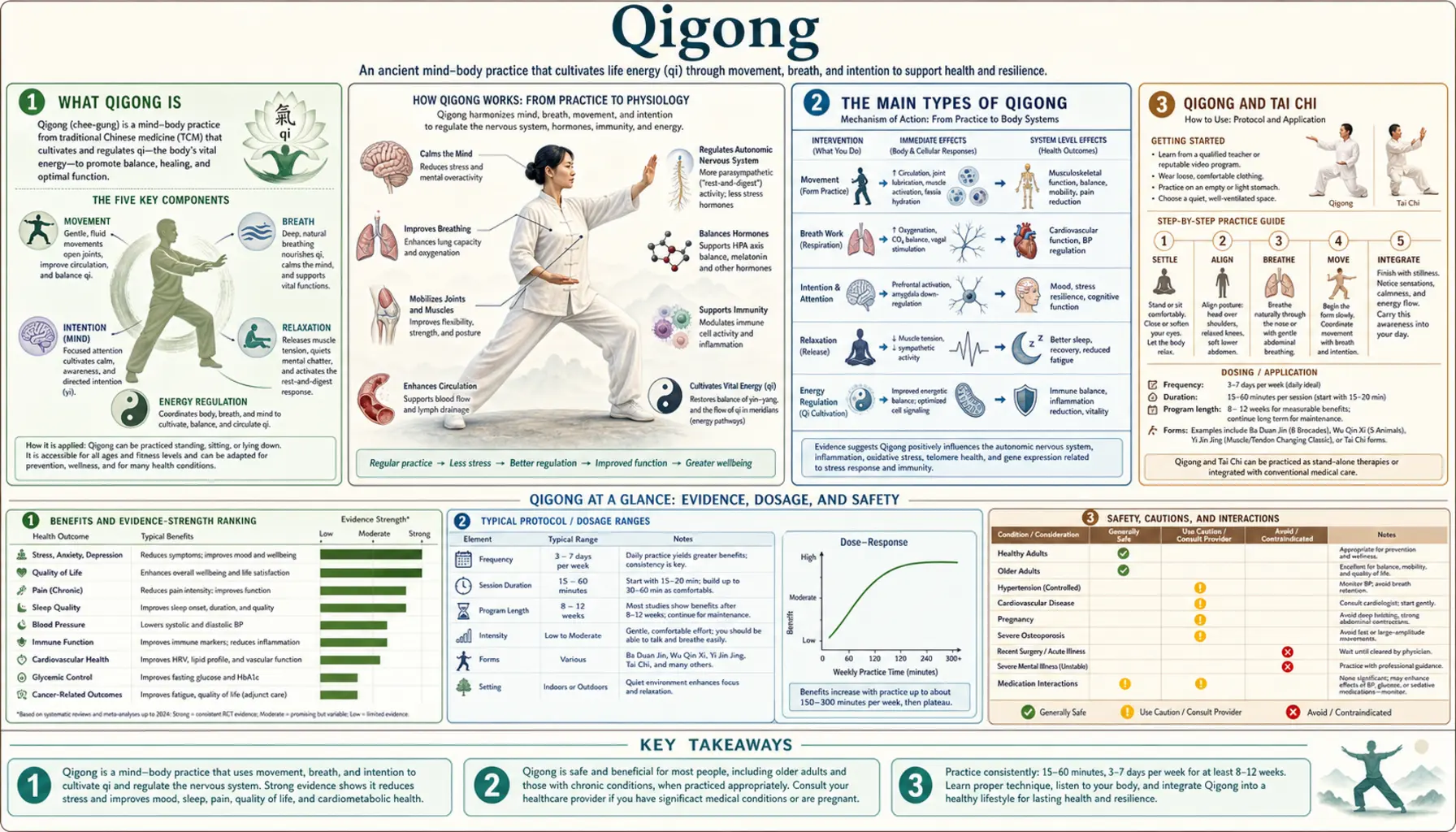
Qigong (pronounced chee-gong) is a family of gentle Chinese practices that weave together slow, flowing movement, careful breathing, and a calm, focused mind. If you have ever seen a group of people in a park moving in unhurried unison, arms drifting like they are pushing through water, you have very likely seen qigong or its close cousin, Tai Chi. People take it up for many reasons: to feel calmer, to move more easily as they age, to steady their balance, or simply because it feels good.
This page explains what qigong is, where it comes from, and what modern research actually shows. We take the tradition seriously and describe it on its own terms — but we are also honest about the science. Some of qigong's benefits are backed by reasonably consistent evidence; others rest on small studies that are easy to over-read. Our goal is to help you decide whether it is worth trying, with clear eyes about what it can and cannot do.
Table of Contents
- What Qigong Is
- The Main Types of Qigong
- Qigong and Tai Chi
- Stress, Mood, and Wellbeing
- Blood Pressure and Heart Health
- Balance and Fall Prevention
- Chronic Illness and Cancer Support
- Bone Density and Fibromyalgia
- A Word About Evidence Quality
- How to Start, and Is It Safe?
- Research Papers
- Connections
- Featured Videos
What Qigong Is
The name itself tells you a lot. Qi (also spelled chi) is the traditional Chinese idea of a life force or vital energy that flows through the body. Gong means skill, work, or cultivation earned through steady practice — the same word used for the discipline behind kung fu. Put together, qigong means something like "the skill of cultivating life energy." For thousands of years, practitioners have described their aim as guiding and nourishing qi so that it flows smoothly, which in the traditional framework supports health, vitality, and a peaceful mind.
It is worth being clear and respectful about this idea. Within Chinese medicine and philosophy, qi is a rich and meaningful concept that organizes how the body, breath, and emotions are understood, and it has guided a living tradition for a very long time. At the same time, honesty matters: qi is not a measurable physical quantity in the scientific sense. No instrument detects it the way a thermometer measures heat or a meter measures voltage. So when we look at whether qigong helps people, we do not need to prove or disprove qi. Instead, we can ask a simpler, testable question: when people practice these slow movements, breathing, and focused attention, do they tend to feel and function better? That is a question research can actually answer, and it is the question the rest of this page explores.
In practical terms, a qigong session usually combines three ingredients: gentle movement or posture, slow regulated breathing, and a settled, attentive mind. Many of the plausible benefits come from that familiar combination — light physical activity, slower breathing, and a form of moving meditation — rather than from anything mysterious.
The Main Types of Qigong
Qigong is not one single routine but a broad umbrella covering hundreds of styles. Most fall into a few overlapping categories.
Dynamic (moving) qigong
This is the flowing, moving style most people picture. You perform slow, repeated sequences of gestures — stepping, reaching, turning, and shifting your weight — while coordinating each movement with your breath. Popular examples include Baduanjin ("Eight Pieces of Brocade"), a set of eight simple movements often used in research, and Wuqinxi ("Five Animal Frolics"), which imitates the movements of animals. Dynamic qigong is essentially gentle, low-impact exercise, which is part of why it is accessible to older adults and people who are unwell.
Static (meditative) qigong
Here the body is mostly still — standing, sitting, or lying down — while attention turns inward to the breath, to relaxation, or to imagined sensations of warmth or flow. This overlaps heavily with meditation and breathing practice, and it is often used for calming the mind and easing tension.
Medical qigong
In China, "medical qigong" refers to sets of exercises prescribed with the intention of supporting recovery from specific conditions, sometimes as a complement to conventional care. It is important to set expectations honestly here: medical qigong is best understood as a supportive, quality-of-life practice, not a replacement for medical treatment. Claims that qigong (or an external practitioner's "emitted qi") can cure serious disease are not supported by good evidence, and you should be cautious of anyone who makes them.
Qigong and Tai Chi
Qigong and Tai Chi are close relatives, and the two are easy to confuse — even researchers often study them together. Tai Chi (more fully, Taijiquan) grew out of the Chinese martial arts and is built from longer, choreographed sequences of connected postures, historically rooted in self-defense. Qigong is broader and usually simpler: shorter, repeated movements or still postures aimed directly at breathing, relaxation, and cultivating qi, without the martial choreography.
A helpful way to think about it: Tai Chi is one particular branch of the wider qigong family tree. Tai Chi practice is, in a sense, qigong done in the form of a flowing martial-arts routine. Because they share so much — the slow tempo, the breath work, the weight-shifting that trains balance — their health effects overlap a great deal, and many studies pool them or use their findings interchangeably. Throughout this page you will see the two mentioned side by side for exactly that reason. If you enjoy the idea of a longer, more choreographed sequence, look toward Tai Chi; if you want something shorter and simpler to learn, qigong is often the easier place to begin. For a related gentle movement-and-breath practice with strong research support, see our Yoga page.
Stress, Mood, and Wellbeing
This is where qigong's evidence is most encouraging. Because the practice blends light exercise, slow breathing, and meditative focus — each of which independently tends to calm the nervous system — it is plausible that it would help people feel less stressed and more at ease, and the research broadly agrees.
Systematic reviews that pooled randomized trials have found that qigong is associated with reduced symptoms of anxiety and depression and improved general psychological wellbeing. Reviews looking at qigong and Tai Chi together for depressive symptoms have reported moderate improvements. Many practitioners also describe better sleep and a greater sense of calm after regular practice.
Two honest caveats belong here. First, most of these trials are small and vary in quality, so the size of the benefit is uncertain even where the direction is consistent. Second, some of the effect likely comes from things qigong shares with any pleasant group activity — gentle movement, time set aside for yourself, social contact, and the simple expectation of feeling better. That does not make the benefit fake; feeling calmer and less anxious is real and valuable. It just means qigong is one good option among several, rather than a uniquely powerful one. If mood and stress are your main goals, you might also explore Meditation, Breathwork, and our broader Stress Management guide.
Blood Pressure and Heart Health
Several studies have examined whether qigong can help with high blood pressure, and a meta-analysis of randomized trials reported that qigong practice was associated with reductions in blood pressure. On its face that is a welcome finding, and it fits what we know about slow breathing and light activity, both of which can gently lower blood pressure.
The important qualifier is how these studies were designed. Many compared qigong against doing nothing (a waitlist or usual care) rather than against another active practice like walking or relaxation. When you compare an engaging activity to no activity, the activity almost always looks good — but that does not tell you qigong is better than ordinary exercise. Reviews of qigong for various chronic conditions have measured cardiovascular and respiratory outcomes and found promising but inconsistent results, again limited by study quality.
A sensible reading: qigong is a reasonable, low-risk complement to a heart-healthy lifestyle, and gentle activity of any kind tends to help. But it is not a substitute for prescribed blood-pressure medication or for the advice of your clinician. If you live with high blood pressure, keep taking your treatment and see our page on High Blood Pressure (Hypertension) for the fuller picture.
Balance and Fall Prevention
One of qigong's most practical benefits shows up in older adults. Because the movements involve slow, deliberate weight-shifting and controlled posture, they train exactly the muscles and reflexes that keep you steady on your feet. Reviews of qigong (and Tai Chi) in older adults have reported improvements in balance and physical function, and this is an area where the two practices' effects clearly overlap.
Falls are a serious matter as we age, and anything that safely improves steadiness is worth attention. Tai Chi in particular has a strong track record for fall prevention, and qigong shares many of its balance-training ingredients. If staying steady and mobile is your priority, gentle movement practices like these — alongside general strength and exercise — are a genuinely useful tool, and they are safe enough for most people to try.
Chronic Illness and Cancer Support
Qigong is increasingly offered as a supportive, quality-of-life practice for people living with cancer and other chronic illnesses. Here it is essential to be precise about the claim. The evidence does not suggest that qigong treats or cures cancer. What studies do suggest is that, used alongside standard medical care, it may help people cope better and feel better.
A randomized trial of medical qigong in cancer patients found improvements in quality of life and mood, less fatigue, and lower levels of an inflammation marker (C-reactive protein) compared with usual care. Systematic reviews of qigong or Tai Chi for cancer patients have similarly reported benefits for quality of life and fatigue. Broader reviews across chronic conditions echo this theme: the gains tend to be in how people feel and function day to day, rather than in curing the underlying disease.
Read honestly, this is a modest but meaningful role. For someone going through demanding treatment, a gentle practice that eases fatigue, lifts mood, and gives a sense of doing something active for their own wellbeing can matter a great deal — provided it is added to, and never substituted for, evidence-based medical care.
Bone Density and Fibromyalgia
Two areas people often ask about deserve a candid, mixed report.
Bone density. Because weight-bearing activity can support bone health, qigong and Tai Chi have been studied for slowing bone loss, and some reviews have counted bone health among their possible benefits. But the evidence here is thin and inconsistent, and the movements are quite gentle — likely too light to build bone the way heavier resistance or impact exercise can. It is fair to call qigong a pleasant, low-risk part of a bone-friendly lifestyle, but not a proven treatment for osteoporosis.
Fibromyalgia. For the chronic-pain condition fibromyalgia, a systematic review and meta-analysis found modest, mostly short-term improvements in pain, sleep, and quality of life — but rated the overall evidence as weak. Gentle movement often helps fibromyalgia symptoms, and qigong is a reasonable low-impact option to try, with realistic expectations: helpful for some, modest in effect, and best judged by whether it makes your days a little easier.
A Word About Evidence Quality
Because we have quoted a lot of encouraging findings, it is only fair to be blunt about their limits — this is central to how we try to serve you honestly.
- Many trials are small. A study of a few dozen people can easily show a result by chance, and small studies tend to overstate benefits.
- A lot of research comes from a handful of groups. Much of the qigong literature originates from a relatively small number of research teams, often in the countries where the practice is most popular. Findings are more trustworthy when many independent teams reproduce them.
- Blinding is hard. You cannot hide from someone that they are doing slow movements and breathing, so expectation and enthusiasm inevitably color the results, especially for self-reported outcomes like mood and pain.
- Comparison groups are often weak. Comparing qigong to doing nothing stacks the deck. The tougher, more informative test — qigong versus another active practice like walking or stretching — is done less often.
Reviewers themselves repeatedly flag these issues and call for larger, better-designed trials. None of this means qigong "doesn't work." It means the honest summary is: promising and low-risk, with real signals for mood, balance, and quality of life, but built on evidence that is often modest in quality. That is a perfectly good reason to try it — while keeping your expectations grounded.
How to Start, and Is It Safe?
The best news about qigong is how safe and accessible it is. The movements are slow, low-impact, and adaptable, which makes qigong suitable for a very wide range of people, including older adults, beginners, and those who are unwell or recovering. Serious injuries are rare, and most sessions can be scaled to whatever your body allows — many forms can even be done seated.
A few gentle pointers for getting started:
- Begin simple. A short, well-known set like Baduanjin is beginner-friendly and easy to find in free instructional videos.
- Go slowly and breathe. There is no rush and nothing to "win." Comfort and relaxation are the point; let the breath stay easy.
- Be consistent. A little most days tends to help more than an occasional long session. Even ten to fifteen minutes is a fine start.
- Never strain. Movements should feel gentle. Mild stiffness at first is normal; sharp pain is not — ease off if anything hurts.
- Keep your medical care. If you have a heart condition, are pregnant, have had recent surgery, or manage any serious illness, check with your clinician first, and treat qigong as a complement to — never a replacement for — your treatment.
Approached this way, qigong is a calming, low-cost habit with very little downside. For most people the honest question is not "is it safe?" — it almost always is — but "do I enjoy it enough to keep doing it?" If the answer is yes, that consistency is where the real benefit lives. You might pair it with good sleep habits and other calming practices for a gentle, sustainable routine.
Research Papers
- Jahnke R, Larkey L, Rogers C, Etnier J, Lin F. A comprehensive review of health benefits of qigong and tai chi. American Journal of Health Promotion. 2010;24(6):e1-e25. doi:10.4278/ajhp.081013-LIT-248 — Landmark review pooling dozens of studies; found consistent signals for bone health, cardiopulmonary fitness, balance, and quality of life while calling for stronger trials.
- Wang CW, Chan CLW, Ho RTH, Tsang HWH, Chan CHY, Ng SM. The effect of qigong on depressive and anxiety symptoms: a systematic review and meta-analysis of randomized controlled trials. Evidence-Based Complementary and Alternative Medicine. 2013;2013:716094. doi:10.1155/2013/716094 — Pooled RCTs suggested qigong reduces depressive and anxiety symptoms, while rating most trials as small and at risk of bias.
- Wang F, Man JKM, Lee EKO, Wu T, Benson H, Fricchione GL, et al. The effects of qigong on anxiety, depression, and psychological well-being: a systematic review and meta-analysis. Evidence-Based Complementary and Alternative Medicine. 2013;2013:152738. doi:10.1155/2013/152738 — Found improvements in anxiety, depression, and general wellbeing across trials of varied quality.
- Liu X, Clark J, Siskind D, Williams GM, Byrne G, Yang JL, et al. A systematic review and meta-analysis of the effects of Qigong and Tai Chi for depressive symptoms. Complementary Therapies in Medicine. 2015;23(4):516-534. doi:10.1016/j.ctim.2015.05.001 — Combining qigong and Tai Chi trials showed a moderate reduction in depressive symptoms.
- Guo X, Zhou B, Nishimura T, Teramukai S, Fukushima M. Clinical effect of qigong practice on essential hypertension: a meta-analysis of randomized controlled trials. Journal of Alternative and Complementary Medicine. 2008;14(1):27-37. doi:10.1089/acm.2007.7213 — Meta-analysis found qigong lowered blood pressure, though often compared against no treatment rather than an active control.
- Zou L, Sasaki JE, Wang H, Xiao Z, Fang Q, Zhang M. A systematic review and meta-analysis of Baduanjin qigong for health benefits: randomized controlled trials. Evidence-Based Complementary and Alternative Medicine. 2017;2017:4548706. doi:10.1155/2017/4548706 — Focused on the popular eight-movement form; reported benefits for quality of life and some physiological measures.
- Chang PS, Knobf T, Oh B, Funk M. Physical and psychological health outcomes of qigong exercise in older adults: a systematic review and meta-analysis. American Journal of Chinese Medicine. 2019;47(2):301-322. doi:10.1142/S0192415X19500149 — In older adults, qigong improved balance and several wellbeing measures.
- Rogers CE, Larkey LK, Keller C. A review of clinical trials of tai chi and qigong in older adults. Western Journal of Nursing Research. 2009;31(2):245-279. doi:10.1177/0193945908327529 — Reviewed falls, balance, and psychological outcomes, highlighting promise alongside methodological weaknesses.
- Ng BHP, Tsang HWH. Psychophysiological outcomes of health qigong for chronic conditions: a systematic review. Psychophysiology. 2009;46(2):257-269. doi:10.1111/j.1469-8986.2008.00763.x — Surveyed cardiovascular, respiratory, and immune measures across chronic-illness trials.
- Oh B, Butow P, Mullan B, Clarke S, Beale P, Pavlakis N, et al. Impact of medical qigong on quality of life, fatigue, mood and inflammation in cancer patients: a randomized controlled trial. Annals of Oncology. 2010;21(3):608-614. doi:10.1093/annonc/mdp479 — RCT in cancer patients found improved quality of life and mood and lower inflammation (CRP) versus usual care.
- Zeng Y, Luo T, Xie H, Huang M, Cheng ASK. Health benefits of qigong or tai chi for cancer patients: a systematic review and meta-analyses. Complementary Therapies in Medicine. 2014;22(1):173-186. doi:10.1016/j.ctim.2013.11.010 — Found benefits for quality of life and fatigue in cancer care, mainly as an adjunct to standard treatment.
- Lauche R, Cramer H, Häuser W, Dobos G, Langhorst J. A systematic review and meta-analysis of qigong for the fibromyalgia syndrome. Evidence-Based Complementary and Alternative Medicine. 2013;2013:635182. doi:10.1155/2013/635182 — Found modest short-term improvements in pain, sleep, and quality of life, with weak evidence overall.
Connections
- All Remedies
- Yoga
- Meditation
- Breathwork
- Stress Management
- Exercise
- Natural Anxiety Relief
- Sleep Hygiene
- High Blood Pressure (Hypertension)
- Fibromyalgia
- Osteoporosis
- Anxiety
- Depression