Morley Robbins: History and Origins
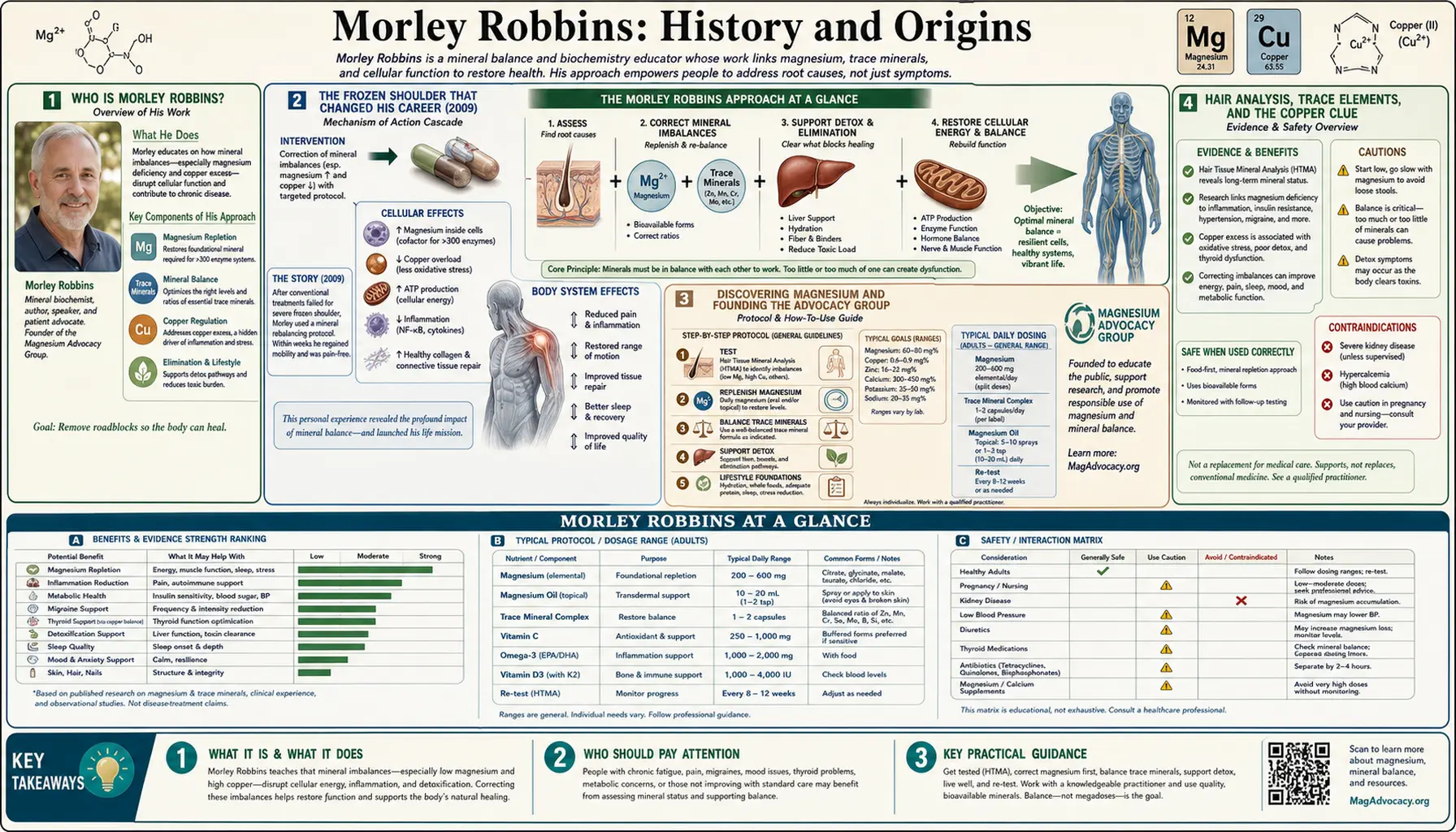
The Root Cause Protocol (RCP) is unusual among the practices on this site in having a single, clearly identifiable originator: Morley Robbins, an American former hospital executive who came to mineral metabolism not through medical training but through a personal health crisis in his late fifties. This article tells that story straight: who Robbins is, the frozen-shoulder episode and the book that redirected his life in 2009, how he built the Magnesium Advocacy Group and then the broader Root Cause Protocol around a copper–iron–magnesium thesis, and the 2021 book that summarised it. It also states plainly what the evidence does and does not support. Robbins is a health coach and self-taught researcher, not a physician or a credentialed scientist, and the RCP as a whole protocol has not been tested in clinical trials — even though several of the individual biochemical facts it rests on are well established. Where the record is firm we say so; where a claim is Robbins's own interpretation, or is disputed by mainstream medicine, we name it as such.
Table of Contents
- Who Is Morley Robbins?
- The Frozen Shoulder That Changed His Career (2009)
- Discovering Magnesium and Founding the Advocacy Group
- Hair Analysis, Trace Elements, and the Copper Clue
- From Magnesium to the Root Cause Protocol
- Cu-RE Your Fatigue: The 2021 Book
- Growth, Community, and How the Protocol Spread
- Evidence and Reception: An Honest Assessment
- Research Papers and References
- Connections
- Featured Videos
Who Is Morley Robbins?
Morley M. Robbins is an American health coach and self-taught mineral-metabolism researcher, best known by the nickname "the Magnesium Man." By his own account — given on his Root Cause Protocol website and repeated across many podcast appearances — he earned a BA in biology from Denison University in Ohio and an MBA from George Washington University in healthcare administration. He then spent roughly thirty-two years working in mainstream medicine as a hospital and physician-practice executive and consultant before changing course in midlife. He is commonly listed with the credentials MBA, CHC (Certified Health Coach).
It is worth being clear about what these credentials are, because they matter for how his work should be weighed. Robbins is not a physician, not a registered dietitian, and not a research scientist. His degree is in business and healthcare administration, and his later certifications are in health coaching, nutritional counselling, and functional diagnostic nutrition — practitioner trainings, not medical or doctoral degrees. This is not a criticism of the man so much as an essential piece of context: the Root Cause Protocol is the work of an unusually persistent autodidact who read deeply in the biochemical literature, not the product of formal clinical research. That background shapes both the appeal of his work (he writes for ordinary frustrated patients, in plain language) and its main limitation (his conclusions are his own synthesis, not peer-reviewed findings).
Today Robbins is the founder of two linked enterprises: the Magnesium Advocacy Group, a large online community, and The Root Cause Protocol, the mineral-balancing framework and consultant-training program that grew out of it. The sections below trace how a hospital administrator with a sore shoulder became the public face of a worldwide mineral-balancing movement.
The Frozen Shoulder That Changed His Career (2009)
The turning point in Robbins's story — the origin event he himself returns to in nearly every interview — came in 2009, when he developed a painful, immobilising frozen shoulder (adhesive capsulitis). According to his telling, a conventional physician recommended surgery as the realistic path back to full range of motion. Reluctant to operate, Robbins instead tried a gentle, non-surgical bodywork approach — a light-touch chiropractic method he identifies as Network Spinal Analysis — and reports that within a few weeks his shoulder regained full movement.
For a man who had spent three decades inside the hospital system, the experience landed hard. The recovery itself is a single anecdote and, like any individual case, proves nothing about the method in general — frozen shoulder is well known to resolve on its own over time, often within months to a couple of years, which is an important caveat to keep in mind. But the effect on Robbins was real and decisive: it shook his confidence in the model of medicine he had worked within and sent him into the research literature to ask why his own body had behaved so differently from what he expected. That literature dive, not the shoulder itself, is what actually launched the rest of the story.
This is the genuine "origin story" of the Root Cause Protocol, and it is fair to present it as such — provided we keep the honest framing Robbins's own account requires: a personal health scare prompted a career change and a self-directed study of minerals. It was a catalyst for inquiry, not a clinical proof of anything.
Discovering Magnesium and Founding the Advocacy Group
The first thread Robbins pulled was magnesium. By his account, in July 2009 he read The Magnesium Miracle by the physician Carolyn Dean, MD, ND — a popular book arguing that magnesium deficiency is widespread and underlies many common complaints. Robbins has described this book as the piece that reframed his whole understanding of health, convincing him that a mineral most clinicians barely discussed might be central to chronic fatigue, anxiety, cramping, poor sleep, and more.
Out of that conviction he founded the Magnesium Advocacy Group (MAG), which he runs at the web address gotmag.org. What began as a way to spread a single message — that modern diets, soils, and stress leave most people magnesium-depleted — grew into one of the larger lay health communities on the subject, and it is the platform on which Robbins first built his public following and his "Magnesium Man" reputation.
Two honest notes belong here. First, the general claim that magnesium intake is often inadequate is not fringe: U.S. national survey data (NHANES) do show that a large share of Americans consume less magnesium than recommended, and magnesium's role as a cofactor in hundreds of enzymes is textbook biochemistry. Second, the stronger framing — that magnesium deficiency is the hidden cause of a long list of named diseases — goes well beyond what controlled evidence establishes, and the popular books Robbins drew on are advocacy works, not clinical guidelines. The advocacy group amplified a real public-health point and, at the same time, a set of claims broader than the data support.
Hair Analysis, Trace Elements, and the Copper Clue
The second thread — the one that gave the Root Cause Protocol its distinctive copper-and-iron character — came through Hair Tissue Mineral Analysis (HTMA). HTMA is a laboratory technique that measures mineral and metal concentrations in a hair sample. As an analytical method it was developed and popularised from the 1970s onward by figures including Dr. Paul Eck and Dr. David L. Watts, the latter the founder of the testing laboratory Trace Elements, Inc. Robbins trained in interpreting HTMA and made it a routine part of his consulting practice.
It was through this mineral-pattern lens that Robbins arrived at the idea that sets his protocol apart from a simple "take more magnesium" message: the conviction that functional copper deficiency, not iron deficiency, sits at the root of much chronic fatigue and inflammation — and that the body's copper-dependent protein ceruloplasmin is the true master regulator of iron. In his framework, magnesium, copper, retinol (vitamin A), and ceruloplasmin work together, and the modern epidemic of tiredness reflects their depletion combined with hidden iron overload rather than a lack of iron to be corrected with supplements.
Here the honesty has to cut two ways. The underlying physiology Robbins points to is real and well documented: ceruloplasmin genuinely is the major copper-containing ferroxidase in blood, and it genuinely is required to load iron safely onto transferrin (Hellman & Gitlin, 2002). The rare genetic disease aceruloplasminemia — in which ceruloplasmin is absent — really does cause iron to accumulate in the brain and other organs (Harris and colleagues, 1995), which confirms the copper–iron link in the extreme case. What is not established is the leap from these facts to Robbins's population-wide claim that most people are functionally copper-deficient and iron-overloaded, or that HTMA is a reliable way to diagnose it. Mainstream laboratory medicine regards hair mineral analysis as an unreliable stand-alone diagnostic, and the broad clinical conclusions Robbins draws from it remain his interpretation rather than a validated method.
From Magnesium to the Root Cause Protocol
Over the years after 2009, Robbins expanded his single-mineral message into a structured program he named the Root Cause Protocol. The name captures his governing idea: rather than chase individual symptoms or disease labels, the protocol aims to correct what he sees as the underlying mineral dysregulation driving them. In Robbins's own shorthand it comes down to three minerals and one protein — copper, magnesium, and (properly regulated) iron, all hinging on the copper protein ceruloplasmin.
In practice the RCP is organised as a set of "Stops" and "Starts." The "Stops" discourage things Robbins believes deplete these minerals or worsen iron dysregulation — among them supplemental industrial iron, synthetic ascorbic acid, calcium supplements, and high-dose vitamin D. The "Starts" emphasise whole-food sources he favours: whole-food vitamin C, real cod-liver oil, magnesium, bee pollen, and especially beef liver as a copper source, along with an "Adrenal Cocktail" drink. The protocol is built to be implemented through food and lifestyle rather than isolated mineral pills, and Robbins trains certified consultants to guide people through it.
The detailed mechanics, the lab-reading method, and the point-by-point comparison with mainstream physiology are covered in the companion Morley Robbins hub and the Benefits articles; this history is concerned with how the protocol came to exist. The key historical point is that the RCP was not handed down from a research institution or a medical society — it was assembled, piece by piece, by one self-taught investigator turning his own recovery and his reading into a system. Several of its individual planks (Stop high-dose iron without cause; address magnesium status) overlap with cautious mainstream thinking; others (the blanket suspicion of vitamin D and ascorbic acid) do not, as the evidence section explains.
Cu-RE Your Fatigue: The 2021 Book
Robbins set out his framework at book length in 2021, with a title that puts copper's chemical symbol front and centre: Cu-RE Your Fatigue: The Root Cause and How To Fix It On Your Own (the "Cu" is the periodic-table symbol for copper). The book lays out the four-part diagnostic logic, the "iron paradox," the magnesium crisis, the case against routine iron and high-dose vitamin D supplementation, and the Stops-and-Starts protocol itself, written for a general reader rather than a clinician.
A small point of accuracy is worth getting right, because secondary descriptions of the book vary. The work has appeared under closely related cover wordings — some editions and listings carry the subtitle How Balancing 3 Minerals and 1 Protein Is the Solution You're Looking For, others The Root Cause and How To Fix It On Your Own — and it has been issued by more than one imprint, with a substantially revised second edition released in 2025. We name the book, its author, its core 2021 release, and its "three minerals and one protein" thesis with confidence; we do not assert a single definitive publisher or subtitle for the first printing, because the public record is not consistent on those finer details, and accuracy matters more than a tidy citation.
However its cover is worded, the book is best understood for what it is: a popular self-help and advocacy book presenting one researcher's mineral-balancing theory, not a textbook or a peer-reviewed monograph. It is the most complete single statement of the Root Cause Protocol, and it is the document most responsible for carrying Robbins's ideas beyond his online community.
Growth, Community, and How the Protocol Spread
The Root Cause Protocol spread the way many modern alternative-health movements do: not through journals or clinics, but through online community, podcasts, and word of mouth. The Magnesium Advocacy Group gathered a large lay following; Robbins built a website and consultant-training program around the RCP; and he became a frequent guest on health, nutrition, and "functional medicine" podcasts, where his copper–iron message found an audience of people frustrated by unresolved fatigue and by anemia that had not improved with iron.
By his own account, Robbins has personally conducted thousands of one-on-one consultations — figures in the several-thousand range, across dozens of countries, are cited on his own materials — and has trained a worldwide network of RCP consultants to deliver the protocol. These are self-reported numbers describing the reach of a coaching practice and an online community; they are a measure of popularity and adoption, not of clinical effectiveness, and should be read that way. A protocol can be widely followed and still be unproven; the two questions are separate.
What the growth does demonstrate is a real demand. Robbins reached people who felt unheard by conventional care, and he offered them a single, intelligible story — minerals out of balance, copper at the centre — that made sense of a confusing cluster of symptoms. Understanding that appeal is part of understanding the history; evaluating whether the story is correct is the job of the next section.
Evidence and Reception: An Honest Assessment
Because this site values truth over promotion, the reception of Robbins's work has to be stated plainly, separating what is solid from what is not.
What is genuinely well established (and where Robbins is pointing at real science):
- Ceruloplasmin is the major plasma ferroxidase and is required to load iron onto transferrin — mainstream biochemistry, documented by Hellman & Gitlin (2002) and others.
- Aceruloplasminemia, the rare genetic loss of ceruloplasmin, causes iron to build up in the brain and pancreas — confirming the copper–iron connection in the extreme case (Harris et al., 1995).
- Free, unbound iron drives oxidative damage through Fenton chemistry — uncontroversial and a recognised contributor to several diseases.
- Magnesium is required to metabolise vitamin D, and magnesium intake is widely inadequate — the first documented by Uwitonze & Razzaque (2018), the second by national survey data.
What is not established (and where Robbins's framework diverges from mainstream medicine):
- The Root Cause Protocol as a whole has never been tested in a clinical trial. It is a synthesis of biochemical papers assembled by Robbins, not a validated intervention. Individual facts being true does not make the combined protocol proven.
- The population-wide claim — that most people are functionally copper-deficient and iron-overloaded — is not supported by the evidence, and hair tissue mineral analysis is not considered a reliable diagnostic for it by mainstream laboratory medicine.
- The blanket case against iron supplementation is potentially harmful. Genuine iron-deficiency anemia — common in menstruating women, in pregnancy, and after blood loss — is real and is treated effectively with iron under medical guidance. Advising people broadly to stop iron, or to donate blood as "therapy," can hurt those who actually need iron.
- The suspicion of vitamin D and of synthetic vitamin C is not supported by the large body of evidence on either. Major guidelines recommend vitamin D for documented deficiency, and large trials have not found the harms Robbins attributes to ordinary doses; most vitamin C research uses ascorbic acid without the dangers he describes.
- Robbins is a health coach, not a physician or scientist, and his conclusions are not peer-reviewed.
The fair summary is this: Robbins has done a real service in drawing public attention to copper, ceruloplasmin, and magnesium — underappreciated pieces of mineral physiology — and some of his cautions (don't take iron you don't need; mind your magnesium) align with careful clinical thinking. But the Root Cause Protocol as a sweeping explanation of chronic disease, and especially its advice to abandon iron and vitamin D supplementation, runs ahead of the evidence and in places contradicts it. Anyone considering changes to their iron, copper, or vitamin D regimen on the basis of RCP teaching should do so only in consultation with a qualified physician familiar with mineral metabolism — particularly before stopping a supplement a doctor has prescribed.
Research Papers and References
The list below pairs the key peer-reviewed papers behind the physiology Robbins invokes with curated PubMed topic-search links. These citations support the underlying biochemistry of copper, ceruloplasmin, iron, and magnesium — they do not evaluate the Root Cause Protocol itself, which has not been the subject of clinical trials. Robbins's own book and the popular book that influenced him (Carolyn Dean's The Magnesium Miracle) are named in the article as the historical primary sources they are, not as peer-reviewed evidence. Author names, titles, and journals are given as plain text; only the stable DOI, PMID, or archive link is hyperlinked, and each opens in a new tab.
- Hellman NE, Gitlin JD. Ceruloplasmin metabolism and function. Annual Review of Nutrition. 2002;22:439-458. — doi:10.1146/annurev.nutr.22.012502.114457
- Harris ZL, Takahashi Y, Miyajima H, Serizawa M, MacGillivray RT, Gitlin JD. Aceruloplasminemia: molecular characterization of this disorder of iron metabolism. Proceedings of the National Academy of Sciences. 1995;92(7):2539-2543. — PMID: 7708681
- Harris ZL, Durley AP, Man TK, Gitlin JD. Targeted gene disruption reveals an essential role for ceruloplasmin in cellular iron efflux. Proceedings of the National Academy of Sciences. 1999;96(19):10812-10817. — PMID: 10485908
- Uwitonze AM, Razzaque MS. Role of magnesium in vitamin D activation and function. Journal of the American Osteopathic Association. 2018;118(3):181-189. — doi:10.7556/jaoa.2018.037
- Collins JF, Prohaska JR, Knutson MD. Metabolic crossroads of iron and copper. Nutrition Reviews. 2010;68(3):133-147. — PMID: 20384844
- Copper, ceruloplasmin, and iron metabolism — PubMed: ceruloplasmin, ferroxidase, and iron metabolism
- Magnesium status and deficiency in human health — PubMed: magnesium deficiency and human health
External Authoritative Resources
- NIH Office of Dietary Supplements — Copper
- NIH Office of Dietary Supplements — Magnesium
- NCCIH — Dietary and Herbal Supplements
Connections
- All Remedies
- Morley Robbins
- Morley Robbins Benefits
- Copper
- Iron
- Magnesium
- Hemoglobin and Ceruloplasmin
- Vitamin D3