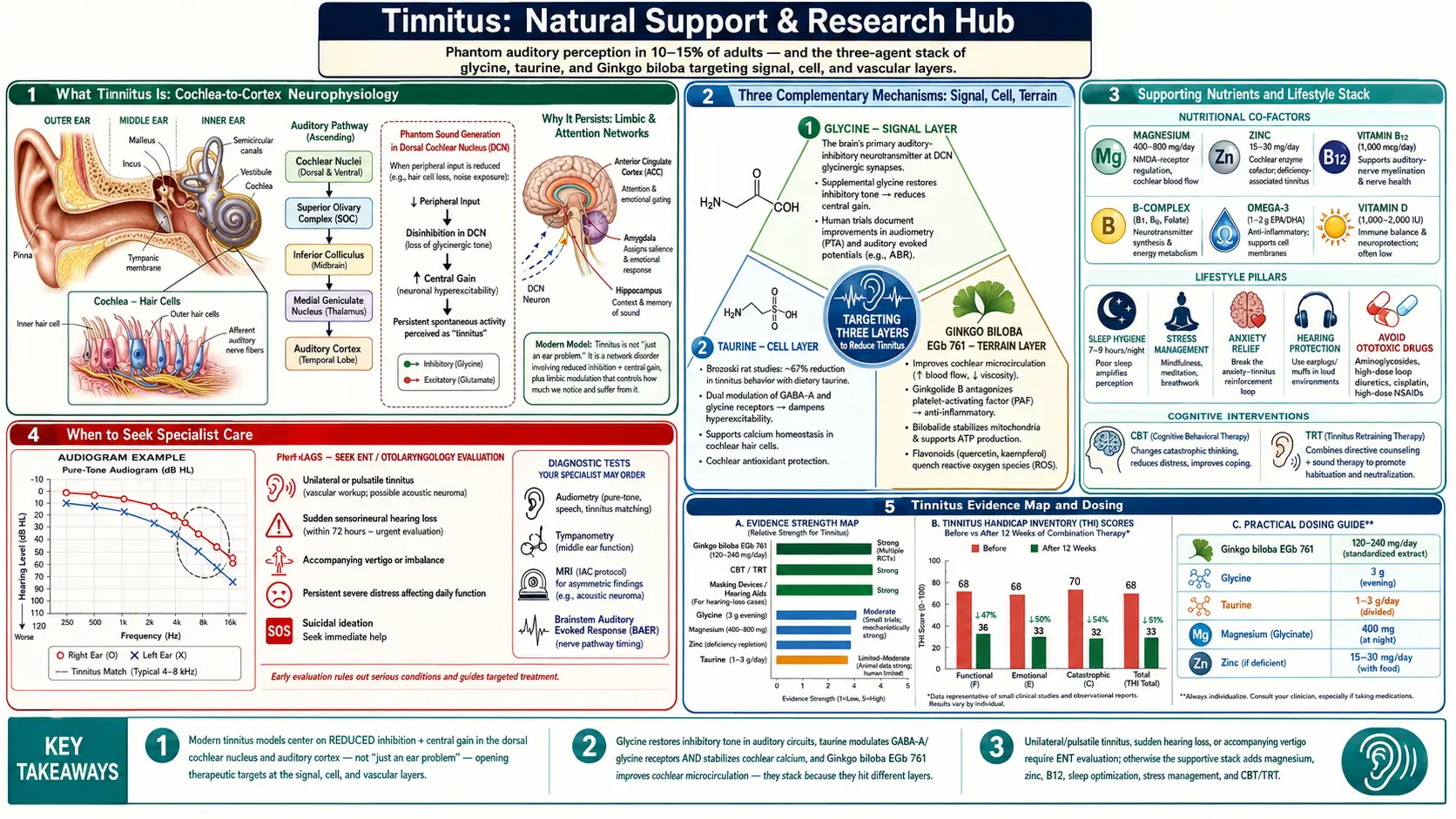
⚠ Evidence warning: Clinical trials or other evidence do not support the claim that positive trial data at 120–240 mg a day make ginkgo a cornerstone of herbal tinnitus support. This page keeps it as a report of what people, websites or other media say.
Tinnitus: Natural Support & Research Hub

Tinnitus — the perception of ringing, buzzing, hissing, or humming sounds in the ears without an external source — affects an estimated 10–15% of adults worldwide, with roughly 50 million people in the United States alone experiencing some form of it. For many, tinnitus is intermittent and mild; for others, it is a persistent presence that affects sleep, concentration, mood, and quality of life. The modern scientific understanding of tinnitus has moved far beyond the old notion of a simple "ear problem." It is now recognized as a complex neurophysiological phenomenon rooted in the interaction between the cochlea, the auditory brainstem, and higher brain regions — and this expanded model has opened the door to a rich landscape of nutritional, herbal, and lifestyle strategies that support the ear-brain axis.
Some kinds of tinnitus point to a cause that needs checking. The 2014 tinnitus guideline of the American Academy of Otolaryngology–Head and Neck Surgery Foundation (Tunkel 2014) singles out tinnitus that is heard in one ear only, tinnitus that beats in time with the pulse (pulsatile tinnitus), and tinnitus that comes with signs of nerve trouble (focal neurologic abnormalities) or with hearing loss that is worse in one ear, as the kinds that call for a scan of the head and neck. The same guideline calls for a prompt, full hearing test (audiologic examination) when tinnitus is in one ear, has lasted 6 months or more, or comes with trouble hearing. The U.S. National Institute on Deafness and Other Communication Disorders describes sudden hearing loss (sudden deafness — hearing lost all at once or over a few days, often in one ear, sometimes with ringing, ear fullness or dizziness) as a medical emergency: about half of people recover some or all of their hearing on their own, but delaying diagnosis and treatment can make treatment less effective.
This hub collects in-depth, research-driven articles on three of the most promising, well-studied natural agents for tinnitus support: glycine, taurine, and Ginkgo biloba. Each targets a different slice of the tinnitus puzzle — glycine restores inhibitory signaling in auditory circuits, taurine stabilizes calcium balance and modulates gamma-aminobutyric acid (GABA)/glycine receptors in cochlear and brainstem neurons, and Ginkgo biloba (as a standardized leaf extract) improves microcirculation and protects inner-ear and neural tissue from oxidative stress. These three are proposed to work through different mechanisms, which is the reason practitioners give for combining them in tinnitus-support protocols.
Research Topics
Glycine Benefits for Tinnitus
Glycine is one of the brain's primary inhibitory neurotransmitters, and it is especially active in the auditory pathways. Contemporary tinnitus research has converged on a model in which the phantom sound arises from reduced inhibition — too much neural noise in hearing circuits. Because glycine provides much of that inhibition (particularly in the dorsal cochlear nucleus), boosting glycinergic signaling is now one of the most actively researched therapeutic avenues. One small, non-randomised human study, which was not about tinnitus, gave glycine to 28 people with type 2 diabetes and nerve damage in the hearing pathway (auditory neuropathy) at 20 g a day for 6 months, and hearing at some low frequencies and some auditory evoked-potential waves improved (Muñoz-Carlin 2010). In a rat study, rats with tinnitus showed changes in their glycine receptors (GlyR), which the authors wrote "could provide a unique receptor target for tinnitus pharmacotherapy" (Wang 2009).
- Glycine as the auditory system's main "calming" molecule
- One small human study (diabetic auditory neuropathy, not tinnitus): improvements in some audiometry and auditory evoked-potential results
- Dorsal cochlear nucleus (DCN) plasticity and glycinergic synapses
- Glycine's contribution to glutathione synthesis and inner-ear antioxidant defense
- Dietary sources, supplementation doses, and evening-dose/sleep benefits
Taurine Benefits for Tinnitus
Taurine is one of the most abundant free amino acids in the brain, heart, and inner ear, where it plays a central role in calcium homeostasis, membrane stability, osmoregulation, and antioxidant defense. A 2010 rat study from Brozoski and colleagues found that a high dose of taurine in the drinking water significantly reduced tinnitus-related behaviour in rats with sound-induced tinnitus, which returned to near pre-treatment levels after the taurine was stopped; taurine also improved sound discrimination in rats without tinnitus. Taurine modulates both gamma-aminobutyric acid-A and glycine receptors in the auditory brainstem and inferior colliculus, helping restore the inhibition/excitation balance that goes awry in tinnitus.
- Brozoski et al. rat study: dietary taurine reduced tinnitus behaviour
- Dual gamma-aminobutyric acid-A and glycine receptor modulation in auditory brainstem neurons
- Calcium homeostasis in cochlear hair cells and synaptic ribbon function
- Antioxidant protection of the cochlea against noise and oxidative stress
- Dietary sources (seafood, shellfish, organ meats) and supplementation ranges
Ginkgo Biloba Benefits for Tinnitus
Ginkgo biloba is the single most studied herbal therapy for tinnitus. A standardized ginkgo leaf extract (the one used in the trials) — containing 24% flavone glycosides and 6% terpene lactones (ginkgolides A/B/C and bilobalide) — has been used in European clinical practice for decades; a 2022 Cochrane review found 12 randomised trials of ginkgo for tinnitus, with 1,915 people in total. Its mechanisms are multi-layered: ginkgolide B antagonizes platelet-activating factor (PAF), flavonoids provide potent antioxidant protection, bilobalide stabilizes mitochondria, and the extract as a whole improves microcirculation in the cochlea and brain. Positive trial data at doses of 120–240 mg/day of the standardized extract make Ginkgo a cornerstone of herbal tinnitus support. The research reads both ways. A 2011 systematic review (von Boetticher) concluded that the standardized extract, at the 120–240 mg a day used in those trials, is "an evidence-based treatment option" for tinnitus, based on three trials in people whose main complaint was tinnitus and five trials in people with age-related memory decline or dementia who also had tinnitus. The 2022 Cochrane review (Sereda) found that ginkgo may have little to no effect on tinnitus severity compared with placebo, with very low certainty of evidence, and concluded that there is uncertainty about its benefits and harms. The 2014 guideline of the American Academy of Otolaryngology–Head and Neck Surgery Foundation recommends against ginkgo, melatonin, zinc or other dietary supplements for persistent, bothersome tinnitus.
- The standardized ginkgo leaf extract used in the trials
- Flavonoids, ginkgolides, and bilobalide — what each constituent does
- Improved cochlear and cerebral microcirculation
- Platelet-activating factor (PAF) antagonism by ginkgolide B
- Clinical trials: Morgenstern & Biermann, Spiegel, von Boetticher systematic review
How These Three Are Thought to Work Together
Glycine, taurine, and Ginkgo biloba are proposed to act on different layers of the tinnitus picture, which is the reason practitioners give for combining them.
- Glycine restores inhibitory neurotransmission in central auditory circuits, quieting the overactive firing that the brain interprets as phantom sound.
- Taurine stabilizes cellular calcium and membrane function in both hair cells and auditory neurons, while simultaneously modulating gamma-aminobutyric acid-A and glycine receptors.
- Ginkgo biloba addresses the vascular and oxidative layer — improving blood flow to the cochlea and auditory nerve, scavenging free radicals, and protecting mitochondria.
Put differently: glycine and taurine work primarily on the signal (how auditory neurons fire and communicate), while Ginkgo works on the terrain (the blood supply, oxygenation, and oxidative state of the tissue those neurons live in). Many tinnitus-support protocols combine all three, often alongside magnesium, zinc, B-complex vitamins, and sleep/stress interventions.
Supporting Nutrients & Lifestyle Factors
Alongside the three primary agents in this hub, these factors are commonly addressed in comprehensive tinnitus-support protocols:
- Magnesium — supports N-methyl-D-aspartate-receptor regulation and cochlear blood flow
- Zinc — essential cofactor for cochlear enzymes; deficiency is associated with tinnitus in some populations
- Vitamin B12 — supports myelination of the auditory nerve
- Sleep hygiene — poor sleep amplifies tinnitus perception; restoring sleep reduces distress
- Stress management — the limbic system gates how much attention the brain gives to the phantom sound
- Natural anxiety relief — anxiety and tinnitus reinforce each other; calming the nervous system helps break the loop
Connections
Featured Videos