Vagal Tone and HRV — Resonance Breathing and Autonomic Balance
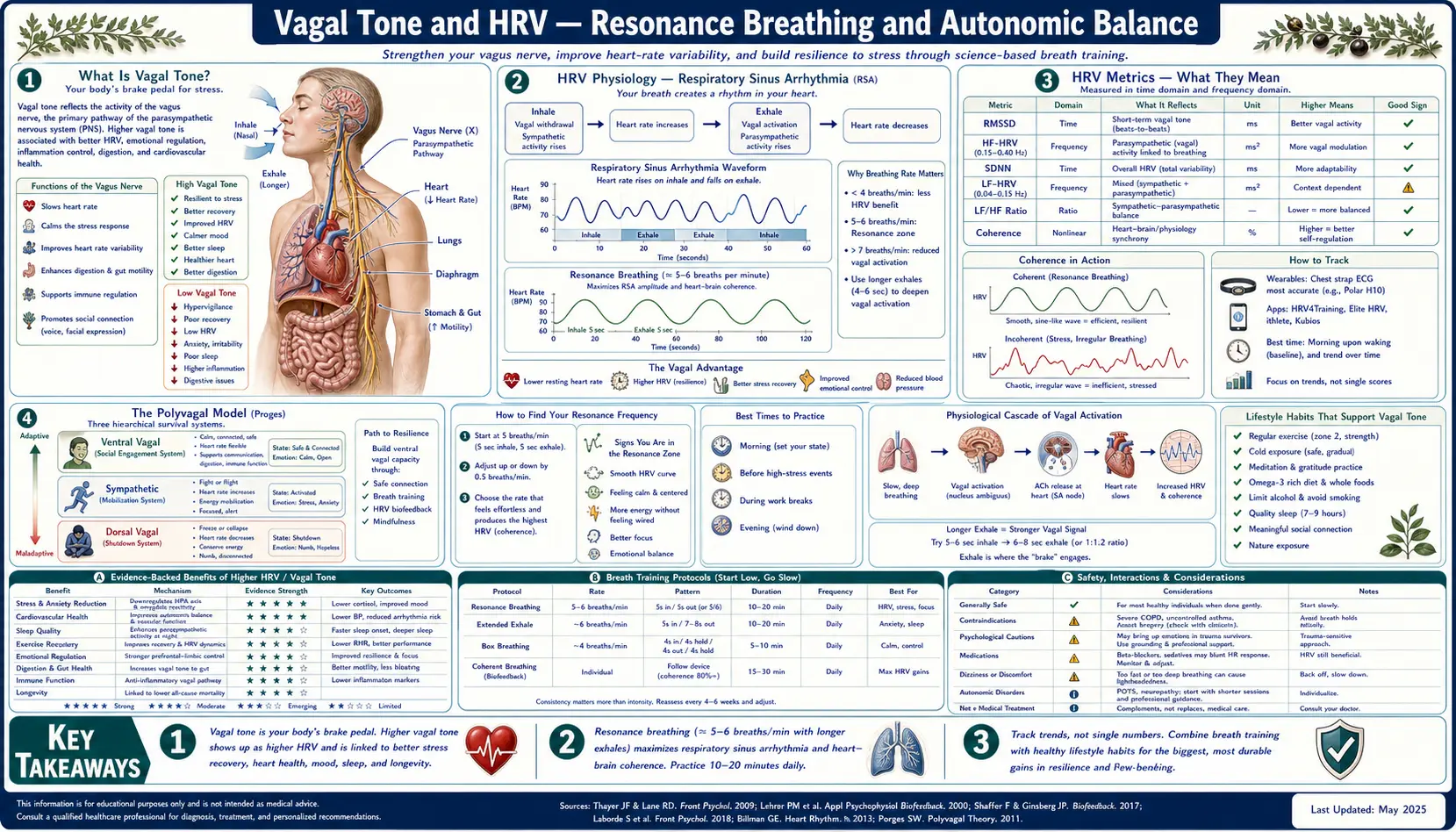
Heart-rate variability (HRV) is the change in the time intervals between consecutive heartbeats; as one review puts it, a healthy heart is not a metronome. Researchers use HRV as a non-invasive index of cardiac vagal tone — the contribution of the parasympathetic nervous system to the control of the heart. Low HRV predicted higher mortality after a heart attack in a 1987 study of 808 patients, and predicted new cardiac events and all-cause mortality in Framingham Heart Study analyses. Breathing at about six breaths a minute, the "resonance frequency" most studies identify, produces the largest heart-rate oscillations, and HRV biofeedback is built on it. Meta-analyses report that slow breathing raises vagally mediated HRV and that HRV biofeedback reduces self-reported stress and anxiety. This page covers what the research reports on vagal tone, HRV measurement, the polyvagal model and the debate around it, resonance breathing, HRV biofeedback, and the clinical evidence.
Table of Contents
- What Is Vagal Tone
- HRV Physiology — Respiratory Sinus Arrhythmia
- HRV Metrics — RMSSD, HF, LF, SDNN, and pNN50
- The Polyvagal Model (Porges) and Its Critics
- Resonance Frequency — Around Six Breaths per Minute
- HRV Biofeedback — How the Training Is Structured in Studies
- How HRV Is Measured (Devices and Methods)
- Clinical Evidence — Anxiety, Hypertension, Performance, Longevity
- What Affects Vagal Tone Beyond Breathing
- Cautions and Interpretation Pitfalls
- Key Research Papers
- Connections
- Featured Videos
What Is Vagal Tone
The vagus nerve is the main nerve of the parasympathetic nervous system, and in HRV research "vagal tone" usually means cardiac vagal tone: the contribution of the parasympathetic system to regulating the heart, as estimated from HRV (Laborde 2017). The same review notes that HRV findings are easy to misinterpret unless they are measured and analysed with care.
Lower HRV has been linked in studies to:
- All-cause mortality — in 736 elderly Framingham Heart Study participants followed for 4 years, lower HRV measures were associated with higher all-cause mortality after adjustment for other risk factors; a one-standard-deviation lower low-frequency power carried 1.70 times the hazard (Tsuji 1994).
- New cardiac events — in 2,501 Framingham participants free of coronary heart disease and heart failure, followed for a mean 3.5 years, all HRV measures except the LF/HF ratio were associated with new angina, heart attack, coronary death or heart failure (Tsuji 1996).
- Mortality after myocardial infarction — in 808 heart-attack survivors, 24-hour SDNN had the strongest univariate correlation with mortality of any Holter variable; the relative risk of death was 5.3 times higher with SDNN below 50 ms than above 100 ms (Kleiger 1987).
- Diabetes — the Kleiger paper notes that HRV can be reduced by diabetic neuropathy, and a study summarized by Shaffer and Ginsberg (2017) found global autonomic regulation lower in people with diabetes.
- Depression — a meta-analysis of 18 studies found lower HRV in major depression without heart disease, falling further with greater severity; tricyclic antidepressants lowered HRV, while serotonin reuptake inhibitors, mirtazapine and nefazodone had no significant effect on it despite symptom response (Kemp 2010).
- Anxiety disorders — a meta-analysis of 36 studies (2,086 patients, 2,294 controls) found lower HRV, a small-to-moderate effect; panic disorder, PTSD, generalized anxiety and social anxiety showed lower high-frequency HRV, obsessive-compulsive disorder did not (Chalmers 2014).
- Thinking and emotion — Thayer and Lane's neurovisceral integration model links prefrontal brain pathways to the heart and reviews the role of vagally mediated HRV in regulating physiological, emotional and cognitive processes, describing low HRV as a risk factor for physical and psychological disorders (Thayer 2009).
- Inflammation — a meta-analysis of 51 studies found HRV indices generally negatively associated with inflammatory markers, most strongly for SDNN and high-frequency HRV, although some individual studies had found the opposite (Williams 2019).
Tracey's 2002 Nature review described the "inflammatory reflex": cholinergic nerve signalling inhibits acute inflammation, and the nervous system regulates the inflammatory response in real time, as it controls heart rate (Tracey 2002). A later review summarizes the animal evidence behind it: vagus-nerve stimulation suppressed proinflammatory cytokines in rodents with endotoxaemia; acetylcholine inhibited TNF release from stimulated macrophages through the alpha-7 nicotinic acetylcholine receptor, with suppression of NF-κB; and in the spleen a subset of T cells, not neurons, supplies the acetylcholine (Pavlov and Tracey 2012).
HRV Physiology — Respiratory Sinus Arrhythmia
Respiratory sinus arrhythmia (RSA) is the breathing-driven speeding and slowing of the heart through the vagus nerve: heart rate speeds up during inhalation and slows during exhalation, and the baroreflex makes this possible (Shaffer and Ginsberg 2017). The baroreflex is driven by blood-pressure sensors in the aorta and carotid artery; when blood pressure rises, it lowers heart rate at once (Lehrer and Gevirtz 2014).
- Gas exchange — in seven anaesthetized dogs, artificially produced RSA lowered the ratio of dead space to tidal volume by 10% and the intrapulmonary shunt fraction by 51% compared with steady stimulation, while reversed RSA worsened both. The authors concluded that RSA benefits pulmonary gas exchange and may "save heartbeats" (Hayano 1996). This was an animal experiment.
- RSA is not the same as vagal tone — Shaffer and Ginsberg point out that slow, deep breathing can increase RSA and that changes in breathing rate can shift RSA a great deal without changing vagal tone. A critic of polyvagal theory likewise calls treating RSA as equivalent to vagal tone a "category mistake" (Grossman 2023).
RSA size depends on breathing rate. The high-frequency HRV band (0.15–0.40 Hz) reflects breathing at 9 to 24 breaths a minute, and the low-frequency band (0.04–0.15 Hz) is affected by breathing at about 3 to 9 breaths a minute; breathing at 4.5 to 7.5 breaths a minute concentrates heart-rate oscillations around 0.1 Hz (Shaffer and Ginsberg 2017). RSA is more pronounced during slow-paced breathing at 0.1 Hz and below (Vickhoff 2013), and a systematic review of 15 studies of slow breathing (under 10 breaths a minute) in healthy people found increased HRV and RSA (Zaccaro 2018).
Lehrer and Gevirtz (2014) explain these large oscillations through the phase relationships between heart rate, breathing and blood pressure, the baroreflex, and the resonance properties of the cardiovascular system; at about 0.1 Hz (six breaths a minute), heart rate oscillates exactly in phase with breathing.
HRV Metrics — RMSSD, HF, LF, SDNN, and pNN50
HRV is described with time-domain, frequency-domain and non-linear measures, over 24 hours, short-term (about 5 minutes) or ultra-short-term (under 5 minutes) recordings, and these are not interchangeable (Shaffer and Ginsberg 2017):
- RMSSD (root mean square of successive differences) — reflects vagal tone, is highly correlated with high-frequency HRV, and is relatively free of breathing influences (Laborde 2017). A table of short-term norms from Nunan and colleagues, reproduced in Shaffer and Ginsberg, lists a mean RMSSD of 42 ms (SD 15, range 19–75 ms across 15 studies).
- HF power (0.15–0.40 Hz) — the respiratory band. Shaffer and Ginsberg caution that HF power and RSA do not directly represent vagal tone, because breathing rate changes them.
- LF power (0.04–0.15 Hz) and the LF/HF ratio — the LF/HF ratio rests on the assumption that LF power comes from the sympathetic system and HF power from the parasympathetic system, and it may estimate their balance only under controlled conditions (Shaffer and Ginsberg 2017). In the Framingham cardiac-events analysis it was the one HRV measure not associated with risk (Tsuji 1996).
- SDNN (standard deviation of normal-to-normal intervals) — both sympathetic and parasympathetic activity contribute to it, and it predicts both illness and mortality (Shaffer and Ginsberg 2017); Kleiger 1987 used 24-hour SDNN.
- pNN50 — the percentage of adjacent intervals differing by more than 50 ms; closely correlated with parasympathetic activity, though RMSSD usually assesses RSA better, especially in older people, and most researchers prefer it (Shaffer and Ginsberg 2017).
- During resonance-frequency biofeedback — Shaffer and Ginsberg write that LF power or peak frequency are the relevant metrics, because breathing at 4.5–7.5 breaths a minute concentrates heart-rate oscillations around 0.1 Hz in the LF band.
The Shaffer and Ginsberg 2017 overview (Frontiers in Public Health) surveys these metrics and published norms and stresses that recording length, age and sex shape baseline values.
The Polyvagal Model (Porges) and Its Critics
Stephen Porges's polyvagal theory (stated in his 2007 Biological Psychology paper) relates autonomic function to behaviour, identifies neural circuits regulating autonomic state, and interprets autonomic reactions in light of the evolution of the vertebrate autonomic nervous system, with emphasis on the neural regulation of "the two vagal systems" (Porges 2007). Among the theory's premises, as summarized by a critic (Grossman 2023):
- Brainstem ventral and dorsal vagal regions in mammals each have their own effects on heart-rate control.
- These ventral and dorsal differences are linked to behaviour — social affiliative behaviour on the ventral side, defensive immobilization on the dorsal side — and to trends in the evolution of the vagus nerve.
- RSA, used as the index of vagal control, is a mammalian phenomenon.
Grossman (2023, Biological Psychology) argues that each of the theory's five basic premises is untenable or highly implausible on the available scientific literature, and that treating RSA as equivalent to vagal tone confuses an approximate index with the process itself. The theory's claims are therefore contested in the research literature.
Studies have measured vagal responses to some practices often discussed in this context: cold-water face immersion increased high-frequency HRV, with the slowing of the heart attributed mainly to cardiac vagal activity (Kinoshita 2006), and humming and singing linked heart rate to song structure and breathing (Vickhoff 2013). These are covered in the section on what affects vagal tone.
Resonance Frequency — Around Six Breaths per Minute
The Vaschillo 2006 paper (PubMed PMID: 16838124) describes the resonance properties of the cardiovascular system behind HRV biofeedback. Paced breathing at each person's natural resonant frequency produces large oscillations in heart rate, blood pressure, vascular tone and pulse amplitude. In data from 32 adults with asthma and 24 healthy adults:
- Resonant frequency was lower in taller people and lower in men than in women.
- It was not related to age, weight, or having asthma.
- It stayed constant across 10 sessions of biofeedback training.
- It appears to be related to blood volume.
Lehrer and Gevirtz (2014) report that resonance frequency varies from person to person but lies around 0.1 Hz, and that most studies find the largest effects at about six breaths per minute.
What studies have used:
- The Steffen 2017 study (PubMed PMID: 28890890) compared 15 minutes of breathing at each person's resonance frequency, breathing one breath a minute faster, and sitting quietly. Afterwards the resonance group reported more positive mood than both other groups and had a higher LF/HF ratio than controls; during a stress task and recovery, its systolic blood pressure was lower than in controls. The faster-breathing group did not differ significantly from either.
- Laborde and colleagues' 2022 meta-analysis of 223 studies found increases in vagally mediated HRV during voluntary slow breathing, immediately after a single session, and after multi-session programmes. The authors describe slow breathing as low-tech and low-cost, with few adverse effects expected.
HRV Biofeedback — How the Training Is Structured in Studies
HRV biofeedback (HRVB), also called RSA biofeedback or resonance frequency feedback, is a form of cardiorespiratory feedback training built on resonance-frequency breathing (Lehrer and Gevirtz 2014). The research group of Lehrer and Vaschillo describes a procedure for finding each person's resonant frequency first, then training at it (Vaschillo 2006):
- The Lehrer 2003 Psychosomatic Medicine study (PubMed PMID: 14508023) compared 10 biofeedback sessions with an uninstructed control in 54 healthy adults. During biofeedback, low-frequency and total HRV and vagal baroreflex gain rose; baseline baroreflex gain rose across sessions; peak expiratory flow increased; and biofeedback had fewer adverse relaxation side effects than the control condition.
- Lehrer and Gevirtz (2014) report that twice-daily home practice over about 3 months also raised resting baroreflex gain.
Meta-analyses:
- Goessl 2017 (PubMed PMID: 28478782) — 24 studies, 484 participants; HRVB was associated with a large reduction in self-reported stress and anxiety (between-group Hedges' g 0.83), and the authors note that more well-controlled studies are needed.
- Lehrer 2020 (PubMed PMID: 32385728) — 58 randomized controlled studies; a significant small-to-moderate effect favouring HRVB that did not differ from other effective treatments. With few studies for each outcome, effects were largest for anxiety, depression, anger and athletic or artistic performance, and smallest for PTSD, sleep and quality of life; effects were larger against inactive than active controls.
- Pagaduan 2020 (PubMed PMID: 32774542) — a systematic review of 6 randomized trials in 187 athletes; the findings support HRVB as a potential way to improve fine and gross motor function.
How HRV Is Measured (Devices and Methods)
Ways HRV is measured, and what studies report about their accuracy:
- Electrocardiogram (ECG) — R-R intervals from an ECG are the gold-standard source for HRV (Schäfer 2013).
- Photoplethysmography (PPG) and other pulse-wave sensors — optical sensors, such as those in pulse oximeters, measure pulse intervals ("pulse rate variability") instead. A review found sufficient accuracy at rest, although short-term variability was often somewhat overestimated, while physical activity and some mental stressors impaired agreement with ECG, often to an unacceptable extent (Schäfer 2013). Shaffer and Ginsberg cite one study in which ECG and PPG differed by less than 6% for most HRV measures but by 29.9% for pNN50.
Measurement conditions described in research guidance (Laborde 2017):
- Measurements on different days are taken at the same time of day.
- The participant is in the chosen posture for at least 5 minutes before the baseline recording; some authors recommend a supine recording first thing in the morning as least influenced by outside factors.
- Transient influences are controlled: a normal sleep routine the night before, no intense training the day before, no meal and no coffee or other caffeinated drinks in the 2 hours before.
- Stable influences are recorded: age, sex, smoking, habitual alcohol intake, weight and height, and heart-active medication.
- Breathing is controlled or recorded, because breathing rate shifts HRV readings (Laborde 2017; Shaffer and Ginsberg 2017).
Clinical Evidence — Anxiety, Hypertension, Performance, Longevity
The clinical evidence for HRV biofeedback and slow breathing covers several areas:
- Anxiety and stress — the Goessl 2017 meta-analysis of 24 studies (484 participants) found a large reduction in self-reported stress and anxiety.
- Prehypertension — the Lin 2012 study (PubMed PMID: 22339103) assigned 43 young adults with prehypertension to HRV biofeedback, slow abdominal breathing, or a control group, with 10 sessions over 5 weeks. In the biofeedback group, blood pressure fell from 131.7/79.3 to 118.9/71.9 mm Hg and baroreflex sensitivity and HRV rose; these effects were more marked than with slow breathing alone and lasted at least 3 months. The authors conclude that HRV biofeedback could enhance baroreflex sensitivity and cardiac autonomic tone in prehypertension.
- Sport performance — the Pagaduan 2020 systematic review (PubMed PMID: 32774542) of 6 randomized trials in 187 athletes found support for HRVB as a potential way to improve fine and gross motor function; the Lehrer 2020 meta-analysis found among its largest effects for athletic and artistic performance, from a small number of studies.
- Depression — the Karavidas 2007 open-label study gave 11 people with major depression 10 weekly sessions of HRVB; depression scores (HAM-D and BDI-II) improved significantly by session 4 and the improvement persisted at follow-up. All participants received the treatment, with no control group, and the authors called for a randomized controlled trial. The Lehrer 2020 meta-analysis also found among its largest effects for depression, from a small number of studies.
- Mortality after myocardial infarction — in 808 survivors, low 24-hour HRV remained a significant predictor of mortality after adjustment for clinical, demographic and other Holter findings and ejection fraction (Kleiger 1987).
- Asthma — in Lehrer 2004 (Chest), 94 adults with asthma were randomized to HRV biofeedback with pursed-lip abdominal breathing, HRV biofeedback alone, placebo EEG biofeedback, or a waiting list. Both HRV biofeedback groups were prescribed less medication than the control groups, with improvements averaging one full level of asthma severity; a placebo effect improved symptoms but not lung function, and groups did not differ in severe flares.
- Brain-heart connection — Thayer and Lane's 2009 Neuroscience & Biobehavioral Reviews paper (PubMed PMID: 18771686) describes the "neurovisceral integration" model linking prefrontal brain pathways to heart-rate regulation and reviews the role of vagally mediated HRV in regulating emotional and cognitive processes.
- Longevity — in elderly Framingham participants, lower HRV predicted all-cause mortality over 4 years beyond traditional risk factors (Tsuji 1994). These are associations in observational data, not evidence that raising HRV extends life.
What Affects Vagal Tone Beyond Breathing
Other factors studied for their effect on HRV:
- Aerobic exercise training — a meta-analysis found that exercise training increases RR interval (d = 0.75, 12 studies) and high-frequency power (d = 0.48, 13 studies), with smaller responses in older people; the authors concluded that factors besides increased vagal modulation also contribute to the slower resting heart rate of training (Sandercock 2005).
- Alcohol — in 4,098 Finnish employees, comparing each person's days with and without alcohol, alcohol was associated, dose-dependently, with more sympathetic and less parasympathetic regulation in the first 3 hours of sleep. An HRV-derived recovery index fell on average by 9.3, 24.0 and 39.2 percentage units with low, moderate and high intake; regular physical activity and young age did not protect against the effect (Pietiälä 2018).
- Cold-water face immersion — in 8 healthy volunteers, cold-water face immersion increased high-frequency HRV, and the slowing of the heart was attributed mainly to cardiac vagal activity, independent of bending over or breath-holding (Kinoshita 2006).
- Meditation and relaxation practices — a systematic review notes that the effects of most meditative and relaxing practices rely on voluntarily slowing the breath, and links slow breathing to increased HRV (Zaccaro 2018).
- Singing and humming — in healthy 18-year-olds who hummed, sang a hymn, and sang a slow mantra, song structure, breathing and heart rate were connected; singing regular song structures in unison made singers' hearts speed up and slow down together (Vickhoff 2013).
- Sauna — acute and short-term studies of heat and sauna have reported HRV improvements, but in an 8-week randomized trial of 38 sedentary adults with at least one cardiovascular risk factor, adding a 15-minute sauna after exercise gave no extra HRV benefit over exercise alone (Lee 2025).
- Day-to-day factors — research guidance treats the previous night's sleep, intense training the day before, recent meals and caffeine as transient influences on HRV (Laborde 2017).
For more on related interventions, see Cold Therapy, Meditation, and Sauna.
Cautions and Interpretation Pitfalls
- HRV is sensitive to method — HRV findings are easily misinterpreted, and methodological differences such as body position make comparison between studies difficult (Laborde 2017). Short-term, ultra-short-term and 24-hour values are not interchangeable (Shaffer and Ginsberg 2017).
- Comparing individuals — baseline HRV depends on measurement context, recording length, age and sex, so the choice of normative values matters (Shaffer and Ginsberg 2017).
- Pulse-based sensors — agreement between pulse-based and ECG-based HRV is sufficient at rest but worsens with physical activity and some mental stressors (Schäfer 2013).
- Irregular rhythms — ectopic beats and atrial fibrillation are treated as artefacts in HRV analysis (Laborde 2017), and the Framingham mortality analysis excluded people with non-sinus rhythm (Tsuji 1994). When conduction abnormalities raise HRV readings, this is strongly linked to higher mortality, particularly in the elderly (Shaffer and Ginsberg 2017).
- Medications — heart-active medications, including antidepressants, antipsychotics and antihypertensives, are recorded in HRV research; among psychotropic drugs, one systematic review found only tricyclic antidepressants and clozapine significantly changed HRV (Laborde 2017), and a depression meta-analysis found tricyclics lowered HRV (Kemp 2010).
- Biofeedback versus plain slow breathing — in the Lin 2012 prehypertension study, biofeedback effects were more marked than those of slow abdominal breathing alone, while the Laborde 2022 meta-analysis found that voluntary slow breathing alone raises vagally mediated HRV.
- Strength of the evidence — the meta-analyses note small study numbers for many outcomes and larger effects against inactive than active controls (Lehrer 2020), and the need for more well-controlled studies (Goessl 2017).
Key Research Papers
- Lehrer PM, Gevirtz R (2014). Heart rate variability biofeedback: how and why does it work? Frontiers in Psychology, 5:756. — PubMed PMID: 25101026
- Vaschillo EG, Vaschillo B, Lehrer PM (2006). Characteristics of resonance in heart rate variability stimulated by biofeedback. Applied Psychophysiology and Biofeedback, 31(2):129-42. — PubMed PMID: 16838124
- Porges SW (2007). The polyvagal perspective. Biological Psychology, 74(2):116-43. — PubMed PMID: 17049418
- Thayer JF, Lane RD (2009). Claude Bernard and the heart-brain connection: further elaboration of a model of neurovisceral integration. Neuroscience & Biobehavioral Reviews, 33(2):81-8. — PubMed PMID: 18771686
- Shaffer F, Ginsberg JP (2017). An overview of heart rate variability metrics and norms. Frontiers in Public Health, 5:258. — PubMed PMID: 29034226
- Lehrer PM, Vaschillo E, Vaschillo B, Lu SE, Eckberg DL, Edelberg R, Shih WJ, Lin Y, Kuusela TA, Tahvanainen KU, Hamer RM (2003). Heart rate variability biofeedback increases baroreflex gain and peak expiratory flow. Psychosomatic Medicine, 65(5):796-805. — PubMed PMID: 14508023
- Steffen PR, Austin T, DeBarros A, Brown T (2017). The Impact of Resonance Frequency Breathing on Measures of Heart Rate Variability, Blood Pressure, and Mood. Frontiers in Public Health, 5:222. — PubMed PMID: 28890890
- Goessl VC, Curtiss JE, Hofmann SG (2017). The effect of heart rate variability biofeedback training on stress and anxiety: a meta-analysis. Psychological Medicine, 47(15):2578-2586. — PubMed PMID: 28478782
- Pagaduan JC, Chen YS, Fell JW, Wu SSX (2020). Can Heart Rate Variability Biofeedback Improve Athletic Performance? A Systematic Review. Journal of Human Kinetics, 73:103-114. — PubMed PMID: 32774542
- Lin G, Xiang Q, Fu X, Wang S, Wang S, Chen S, Shao L, Zhao Y, Wang T (2012). Heart rate variability biofeedback decreases blood pressure in prehypertensive subjects by improving autonomic function and baroreflex. Journal of Alternative and Complementary Medicine, 18(2):143-52. — PubMed PMID: 22339103
- Tracey KJ (2002). The inflammatory reflex. Nature, 420(6917):853-9. — PubMed PMID: 12490958
- Pavlov VA, Tracey KJ (2012). The vagus nerve and the inflammatory reflex — linking immunity and metabolism. Nature Reviews Endocrinology, 8(12):743-54. — PubMed PMID: 23169440
- Lehrer P, Kaur K, Sharma A, Shah K, Huseby R, Bhavsar J, et al. (2020). Heart Rate Variability Biofeedback Improves Emotional and Physical Health and Performance: A Systematic Review and Meta Analysis. Applied Psychophysiology and Biofeedback, 45(3):109-129. — PubMed PMID: 32385728
- Laborde S, Mosley E, Thayer JF (2017). Heart Rate Variability and Cardiac Vagal Tone in Psychophysiological Research — Recommendations for Experiment Planning, Data Analysis, and Data Reporting. Frontiers in Psychology, 8:213. — PubMed PMID: 28265249
- Laborde S, Allen MS, Borges U, Dosseville F, Hosang TJ, Iskra M, et al. (2022). Effects of voluntary slow breathing on heart rate and heart rate variability: A systematic review and a meta-analysis. Neuroscience & Biobehavioral Reviews, 138:104711. — PubMed PMID: 35623448
- Zaccaro A, Piarulli A, Laurino M, Garbella E, Menicucci D, Neri B, et al. (2018). How Breath-Control Can Change Your Life: A Systematic Review on Psycho-Physiological Correlates of Slow Breathing. Frontiers in Human Neuroscience, 12:353. — PubMed PMID: 30245619
- Karavidas MK, Lehrer PM, Vaschillo E, Vaschillo B, Marin H, Buyske S, et al. (2007). Preliminary results of an open label study of heart rate variability biofeedback for the treatment of major depression. Applied Psychophysiology and Biofeedback, 32(1):19-30. — PubMed PMID: 17333315
- Lehrer PM, Vaschillo E, Vaschillo B, Lu SE, Scardella A, Siddique M, et al. (2004). Biofeedback treatment for asthma. Chest, 126(2):352-61. — PubMed PMID: 15302717
- Kleiger RE, Miller JP, Bigger JT, Moss AJ (1987). Decreased heart rate variability and its association with increased mortality after acute myocardial infarction. American Journal of Cardiology, 59(4):256-62. — PubMed PMID: 3812275
- Tsuji H, Venditti FJ, Manders ES, Evans JC, Larson MG, Feldman CL, et al. (1994). Reduced heart rate variability and mortality risk in an elderly cohort. The Framingham Heart Study. Circulation, 90(2):878-83. — PubMed PMID: 8044959
- Tsuji H, Larson MG, Venditti FJ, Manders ES, Evans JC, Feldman CL, et al. (1996). Impact of reduced heart rate variability on risk for cardiac events. The Framingham Heart Study. Circulation, 94(11):2850-5. — PubMed PMID: 8941112
- Williams DP, Koenig J, Carnevali L, Sgoifo A, Jarczok MN, Sternberg EM, et al. (2019). Heart rate variability and inflammation: A meta-analysis of human studies. Brain, Behavior, and Immunity, 80:219-226. — PubMed PMID: 30872091
- Kemp AH, Quintana DS, Gray MA, Felmingham KL, Brown K, Gatt JM (2010). Impact of depression and antidepressant treatment on heart rate variability: a review and meta-analysis. Biological Psychiatry, 67(11):1067-74. — PubMed PMID: 20138254
- Chalmers JA, Quintana DS, Abbott MJ, Kemp AH (2014). Anxiety Disorders are Associated with Reduced Heart Rate Variability: A Meta-Analysis. Frontiers in Psychiatry, 5:80. — PubMed PMID: 25071612
- Hayano J, Yasuma F, Okada A, Mukai S, Fujinami T (1996). Respiratory sinus arrhythmia. A phenomenon improving pulmonary gas exchange and circulatory efficiency. Circulation, 94(4):842-7. — PubMed PMID: 8772709
- Schäfer A, Vagedes J (2013). How accurate is pulse rate variability as an estimate of heart rate variability? A review on studies comparing photoplethysmographic technology with an electrocardiogram. International Journal of Cardiology, 166(1):15-29. — PubMed PMID: 22809539
- Sandercock GR, Bromley PD, Brodie DA (2005). Effects of exercise on heart rate variability: inferences from meta-analysis. Medicine and Science in Sports and Exercise, 37(3):433-9. — PubMed PMID: 15741842
- Pietiälä J, Helander E, Korhonen I, Myllymäki T, Kujala UM, Lindholm H (2018). Acute Effect of Alcohol Intake on Cardiovascular Autonomic Regulation During the First Hours of Sleep in a Large Real-World Sample of Finnish Employees: Observational Study. JMIR Mental Health, 5(1):e23. — PubMed PMID: 29549064
- Kinoshita T, Nagata S, Baba R, Kohmoto T, Iwagaki S (2006). Cold-water face immersion per se elicits cardiac parasympathetic activity. Circulation Journal, 70(6):773-6. — PubMed PMID: 16723802
- Vickhoff B, Malmgren H, Åström R, Nyberg G, Ekström SR, Engwall M, et al. (2013). Music structure determines heart rate variability of singers. Frontiers in Psychology, 4:334. — PubMed PMID: 23847555
- Grossman P (2023). Fundamental challenges and likely refutations of the five basic premises of the polyvagal theory. Biological Psychology, 180:108589. — PubMed PMID: 37230290
- Lee E, Ketelhut S, Wiklund P, Kostensalo J, Kolunsarka I, Hägglund H, et al. (2025). Regular postexercise sauna bathing does not improve heart rate variability: A multi-arm randomized controlled trial. Physiological Reports, 13(13):e70449. — PubMed PMID: 40611569