Breathwork — Benefits Deep Dive
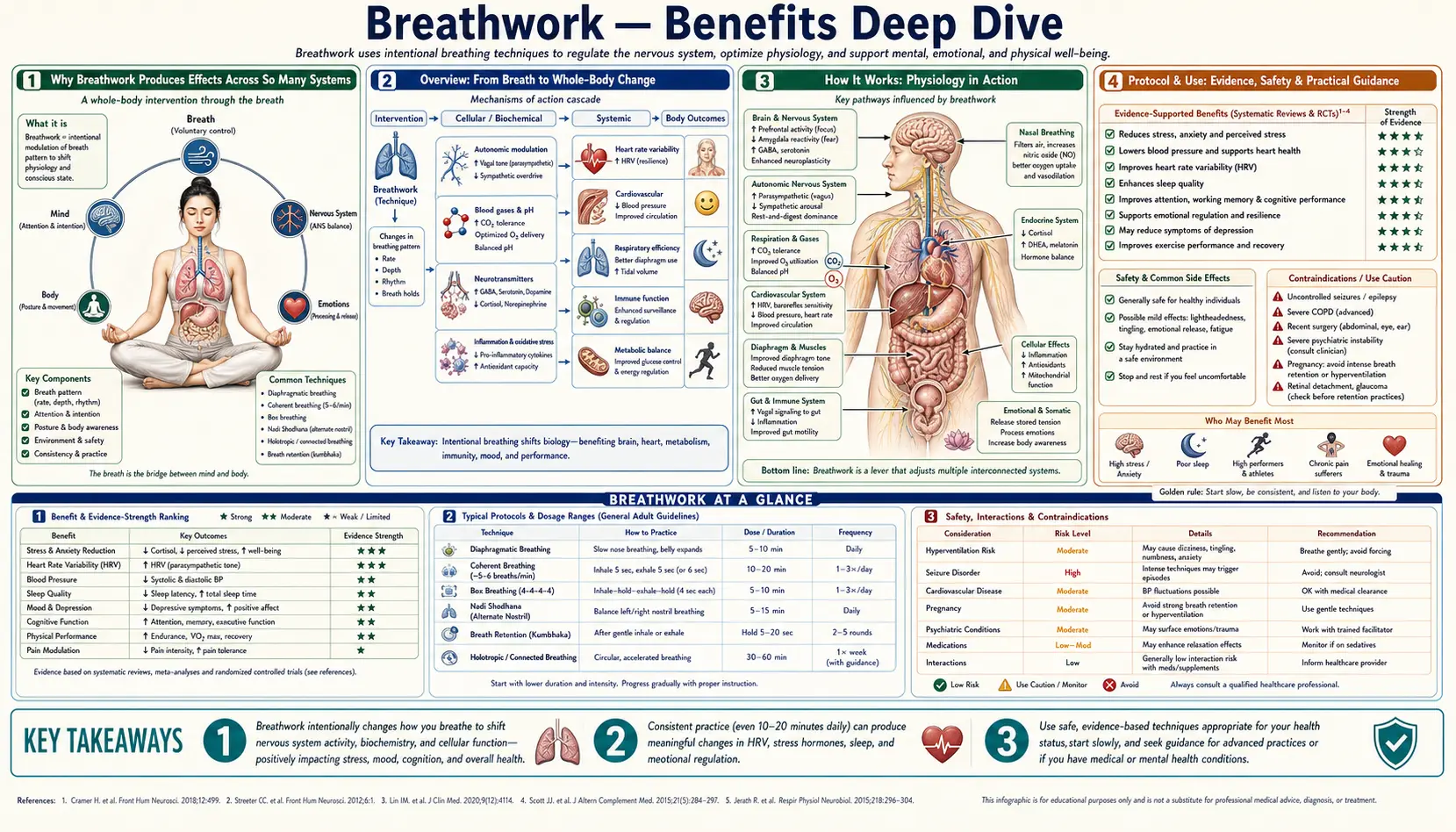
Breathwork is the deliberate, structured control of breathing rate, depth and pattern. Reviews of the research describe effects of slow breathing on the respiratory, cardiovascular and autonomic nervous systems, including heart-rate variability, baroreflex and chemoreflex sensitivity and sympathovagal balance, while noting a need for further research (Russo 2017); in trials of the Wim Hof breathing technique, rapid breathing lowered exhaled carbon dioxide to levels indicating respiratory alkalosis, a rise in blood pH (Kox 2014; Citherlet 2021). The four deep-dive pages below report the research on the most studied practices: the Wim Hof Method's cyclic hyperventilation, breath retention and cold exposure, tested in an endotoxin-challenge trial of the innate immune response; box breathing, an equal-phase paced-breathing pattern; the yogic breathing practices known as pranayama; and slow resonance breathing, with vagal tone measured through heart-rate variability (HRV).
Deep-Dive Articles
Wim Hof Method
Cyclic hyperventilation followed by breath retention, combined with cold exposure and meditation. The Kox 2014 PNAS trial, in which trained volunteers showed intermittent respiratory alkalosis, sharply raised epinephrine and a smaller inflammatory response to injected endotoxin; the follow-up trials; an imaging case study that found brown fat activation unremarkable; and the documented drowning risk of hyperventilation before breath-holding in water.
Read the deep dive →Box Breathing and Resilience
Equal phases of inhaling, holding, exhaling and holding (commonly 4 seconds each). Studies of tactical breathing in military and police settings, the baroreceptor reflex arc, how box breathing differs from resonance breathing at about six breaths a minute (which raised heart-rate variability more in a direct comparison), and what randomized trials report on stress, anxiety and performance, including where the evidence is limited.
Read the deep dive →Pranayama Traditions
Yogic breath regulation (pranayama): Nadi Shodhana (alternate-nostril breathing), Bhastrika (bellows breath), Kapalabhati (skull-shining breath), Ujjayi (ocean breath) and Sitali, which the texts call cooling although a 2020 study measured a rise in body temperature during it. What laboratory studies and small clinical trials report in high blood pressure, asthma and anxiety, including results that contradict traditional descriptions.
Read the deep dive →Vagal Tone and HRV
Heart-rate variability as a non-invasive research index of cardiac vagal tone. Resonance-frequency breathing at about six breaths per minute, the polyvagal model (Porges) and the debate around it, RMSSD and HF-HRV measurement, HRV biofeedback, and the research linking HRV with inflammation, emotion and cognition, and mortality.
Read the deep dive →Table of Contents
- Deep-Dive Articles
- Why Breathwork Produces Effects Across So Many Systems
- Research Papers: Wim Hof Method
- Research Papers: Box Breathing & Tactical Stress Regulation
- Research Papers: Pranayama and Yogic Breathing
- Research Papers: Vagal Tone, HRV, and Resonance Breathing
- Research Papers: Cross-Cutting (Mechanism, Safety, Clinical)
- External Authoritative Resources
- Connections
- Featured Videos
Why Breathwork Produces Effects Across So Many Systems
Research on breathing practices describes several physiological routes through which they act, and different practices emphasize different routes. Three are described below.
- Autonomic effects via the vagus nerve and baroreceptor reflex — a meta-analysis of 223 studies found that voluntary slow breathing increases vagally mediated heart-rate variability during a session, immediately after one session and after multi-session programs (Laborde 2022). A review of studies in healthy people reports effects of slow breathing on baroreflex and chemoreflex sensitivity, heart-rate variability, respiratory sinus arrhythmia and sympathovagal balance (Russo 2017). This is the route studied in box breathing and resonance-frequency HRV training.
- Blood gas chemistry (carbon dioxide and respiratory alkalosis) — in a crossover study of the Wim Hof breathing technique, end-tidal carbon dioxide fell to 19 ± 3 mmHg after the last round of hyperventilation, which the authors described as indicating respiratory alkalosis, and finger oxygen saturation dropped to 60 ± 12% at the end of the breath holds (Citherlet 2021). In the Kox 2014 trial, practicing cyclic hyperventilation followed by breath retention produced intermittent respiratory alkalosis and low blood oxygen (hypoxia), followed by sharply raised plasma epinephrine. This route is central to the Wim Hof Method; the forceful yogic practices are described on the Pranayama practices page.
- Brain activity and attention to the breath — in direct intracranial recordings in humans, neuronal activity tracked the breathing cycle across widespread cortical and limbic areas; deliberately paced breathing increased this coupling in a frontotemporal-insular network, and attending to the breath increased it in the anterior cingulate, premotor, insular and hippocampal cortices (Herrero 2018). In a similar recording study, natural nasal breathing synchronized activity in the olfactory cortex, amygdala and hippocampus, an effect that faded when breathing was switched to the mouth (Zelano 2016). A systematic review of slow-breathing studies reported increased EEG alpha and decreased theta power alongside reports of greater relaxation and lower anxiety (Zaccaro 2018). Attention to the breath is also part of meditation and of yogic Pranayama.
The same breathing can carry very different risks depending on where it is done. A health-department case review, published in the CDC's weekly report, of fatal and nonfatal drownings in New York State from 1988 to 2011 was prompted by the deaths of two healthy young men who became unconscious underwater after intentional hyperventilation before submersion — a phenomenon described as hypoxic blackout. The review identified 16 cases involving what it called dangerous underwater breath-holding behaviors, and practicing more than one of them increased the risk of death (Boyd 2015). The Wim Hof Method page reports this hazard, and the risk while driving, in detail.
The four deep-dive pages report the evidence for each practice, the conditions in which it has been tested, how the studies carried it out, and the adverse events and hazards that have been reported. Decisions about using breathing practices alongside medical care belong with a clinician.
Research Papers: Wim Hof Method
- Kox M, van Eijk LT, Zwaag J, van den Wildenberg J, Sweep FC, van der Hoeven JG, Pickkers P (2014). Voluntary activation of the sympathetic nervous system and attenuation of the innate immune response in humans. PNAS, 111(20):7379-84. — PubMed PMID: 24799686
- Kox M, Stoffels M, Smeekens SP, van Alfen N, Gomes M, Eijsvogels TM, et al. (2012). The influence of concentration/meditation on autonomic nervous system activity and the innate immune response: a case study. Psychosomatic Medicine, 74(5):489-94. — PubMed PMID: 22685240
- Muzik O, Reilly KT, Diwadkar VA (2018). "Brain over body" — A study on the willful regulation of autonomic function during cold exposure. NeuroImage, 172:632-641. — PubMed PMID: 29438845
- Buijze GA, Hopman MT (2014). Controlled hyperventilation after training may accelerate altitude acclimatization. Wilderness & Environmental Medicine, 25(4):484-6. — PubMed PMID: 25443751
- Almahayni O, Hammond L (2024). Does the Wim Hof Method have a beneficial impact on physiological and psychological outcomes in healthy and non-healthy participants? A systematic review. PLOS ONE, 19(3):e0286933. — PubMed PMID: 38478473
- Citherlet T, Crettaz von Roten F, Kayser B, Guex K (2021). Acute Effects of the Wim Hof Breathing Method on Repeated Sprint Ability: A Pilot Study. Frontiers in Sports and Active Living, 3:700757. — PubMed PMID: 34514386
- Petraskova Touskova T, Bob P, Bares Z, Vanickova Z, Nyvlt D, Raboch J (2022). A novel Wim Hof psychophysiological training program to reduce stress responses during an Antarctic expedition. Journal of International Medical Research, 50(4):3000605221089883. — PubMed PMID: 35437052
- Zwaag J, Naaktgeboren R, van Herwaarden AE, Pickkers P, Kox M (2022). The Effects of Cold Exposure Training and a Breathing Exercise on the Inflammatory Response in Humans: A Pilot Study. Psychosomatic Medicine, 84(4):457-467. — PubMed PMID: 35213875
- Søberg S, Löfgren J, Philipsen FE, Jensen M, Hansen AE, Ahrens E, et al. (2021). Altered brown fat thermoregulation and enhanced cold-induced thermogenesis in young, healthy, winter-swimming men. Cell Reports Medicine, 2(10):100408. — PubMed PMID: 34755128
- Marko D, Bahenský P, Bunc V, Grosicki GJ, Vondrasek JD (2022). Does Wim Hof Method Improve Breathing Economy during Exercise? Journal of Clinical Medicine, 11(8):2218. — PubMed PMID: 35456308
Research Papers: Box Breathing & Tactical Stress Regulation
- Mauro M, Zulian E, Bestiaco N, Polano M, Larese Filon F (2024). Slow-Paced Breathing Intervention in Healthcare Workers Affected by Long COVID: Effects on Systemic and Dysfunctional Breathing Symptoms, Manual Dexterity and HRV. Biomedicines, 12(10):2254. — PubMed PMID: 39457567
- Magnon V, Dutheil F, Vallet GT (2021). Benefits from one session of deep and slow breathing on vagal tone and anxiety in young and older adults. Scientific Reports, 11(1):19267. — PubMed PMID: 34588511
- Balban MY, Neri E, Kogon MM, Weed L, Nouriani B, Jo B, et al. (2023). Brief structured respiration practices enhance mood and reduce physiological arousal. Cell Reports Medicine, 4(1):100895. — PubMed PMID: 36630953
- Russo MA, Santarelli DM, O'Rourke D (2017). The physiological effects of slow breathing in the healthy human. Breathe (Sheffield), 13(4):298-309. — PubMed PMID: 29209423
- Zaccaro A, Piarulli A, Laurino M, Garbella E, Menicucci D, Neri B, Gemignani A (2018). How Breath-Control Can Change Your Life: A Systematic Review on Psycho-Physiological Correlates of Slow Breathing. Frontiers in Human Neuroscience, 12:353. — PubMed PMID: 30245619
- Brown RP, Gerbarg PL (2005). Sudarshan Kriya Yogic breathing in the treatment of stress, anxiety, and depression. Part II—clinical applications and guidelines. Journal of Alternative and Complementary Medicine, 11(4):711-7. — PubMed PMID: 16131297
- Yackle K, Schwarz LA, Kam K, Sorokin JM, Huguenard JR, Feldman JL, et al. (2017). Breathing control center neurons that promote arousal in mice. Science, 355(6332):1411-1415. — PubMed PMID: 28360327
- Sarang P, Telles S (2006). Effects of two yoga based relaxation techniques on heart rate variability (HRV). International Journal of Stress Management, 13(4):460-475. — doi:10.1037/1072-5245.13.4.460
- Hopper SI, Murray SL, Ferrara LR, Singleton JK (2019). Effectiveness of diaphragmatic breathing for reducing physiological and psychological stress in adults: a quantitative systematic review. JBI Database of Systematic Reviews and Implementation Reports, 17(9):1855-1876. — PubMed PMID: 31436595
- Ma X, Yue ZQ, Gong ZQ, Zhang H, Duan NY, Shi YT, et al. (2017). The Effect of Diaphragmatic Breathing on Attention, Negative Affect and Stress in Healthy Adults. Frontiers in Psychology, 8:874. — PubMed PMID: 28626434
- Marchant J, Khazan I, Cressman M, Steffen P (2025). Comparing the Effects of Square, 4-7-8, and 6 Breaths-per-Minute Breathing Conditions on Heart Rate Variability, CO2 Levels, and Mood. Applied Psychophysiology and Biofeedback, 50(2):261-276. — PubMed PMID: 39864026
Research Papers: Pranayama and Yogic Breathing
- Telles S, Nagarathna R, Nagendra HR (1994). Breathing through a particular nostril can alter metabolism and autonomic activities. Indian Journal of Physiology and Pharmacology, 38(2):133-7. — PubMed PMID: 8063359
- Sharma VK, Trakroo M, Subramaniam V, Rajajeyakumar M, Bhavanani AB, Sahai A (2013). Effect of fast and slow pranayama on perceived stress and cardiovascular parameters in young health-care students. International Journal of Yoga, 6(2):104-10. — PubMed PMID: 23930028
- Pramanik T, Sharma HO, Mishra S, Mishra A, Prajapati R, Singh S (2009). Immediate effect of slow pace bhastrika pranayama on blood pressure and heart rate. Journal of Alternative and Complementary Medicine, 15(3):293-5. — PubMed PMID: 19249921
- Cooper S, Oborne J, Newton S, Harrison V, Thompson Coon J, Lewis S, Tattersfield A (2003). Effect of two breathing exercises (Buteyko and pranayama) in asthma: a randomised controlled trial. Thorax, 58(8):674-9. — PubMed PMID: 12885982
- Telles S, Singh N, Balkrishna A (2011). Heart rate variability changes during high frequency yoga breathing and breath awareness. BioPsychoSocial Medicine, 5:4. — PubMed PMID: 21486495
- Bhavanani AB, Ramanathan M, Balaji R, Pushpa D (2014). Comparative immediate effect of different yoga asanas on heart rate and blood pressure in healthy young volunteers. International Journal of Yoga, 7(2):89-95. — PubMed PMID: 25035617
- Saoji AA, Raghavendra BR, Manjunath NK (2019). Effects of yogic breath regulation: A narrative review of scientific evidence. Journal of Ayurveda and Integrative Medicine, 10(1):50-58. — PubMed PMID: 29395894
- Streeter CC, Whitfield TH, Owen L, Rein T, Karri SK, Yakhkind A, et al. (2010). Effects of yoga versus walking on mood, anxiety, and brain GABA levels: a randomized controlled MRS study. Journal of Alternative and Complementary Medicine, 16(11):1145-52. — PubMed PMID: 20722471
- Brown RP, Gerbarg PL (2005). Sudarshan Kriya Yogic breathing in the treatment of stress, anxiety, and depression. Part II—clinical applications and guidelines. Journal of Alternative and Complementary Medicine, 11(4):711-7. — PubMed PMID: 16131297
- Jerath R, Edry JW, Barnes VA, Jerath V (2006). Physiology of long pranayamic breathing: neural respiratory elements may provide a mechanism that explains how slow deep breathing shifts the autonomic nervous system. Medical Hypotheses, 67(3):566-71. — PubMed PMID: 16624497
- Telles S, Gandharva K, Sharma SK, Gupta RK, Balkrishna A (2020). Body Temperature and Energy Expenditure During and After Yoga Breathing Practices Traditionally Described as Cooling. Medical Science Monitor Basic Research, 26:e920107. — PubMed PMID: 31907342
Research Papers: Vagal Tone, HRV, and Resonance Breathing
- Lehrer PM, Gevirtz R (2014). Heart rate variability biofeedback: how and why does it work? Frontiers in Psychology, 5:756. — PubMed PMID: 25101026
- Vaschillo EG, Vaschillo B, Lehrer PM (2006). Characteristics of resonance in heart rate variability stimulated by biofeedback. Applied Psychophysiology and Biofeedback, 31(2):129-42. — PubMed PMID: 16838124
- Porges SW (2007). The polyvagal perspective. Biological Psychology, 74(2):116-43. — PubMed PMID: 17049418
- Thayer JF, Lane RD (2009). Claude Bernard and the heart-brain connection: further elaboration of a model of neurovisceral integration. Neuroscience & Biobehavioral Reviews, 33(2):81-8. — PubMed PMID: 18771686
- Shaffer F, Ginsberg JP (2017). An Overview of Heart Rate Variability Metrics and Norms. Frontiers in Public Health, 5:258. — PubMed PMID: 29034226
- Lehrer PM, Vaschillo E, Vaschillo B, Lu SE, Eckberg DL, Edelberg R, et al. (2003). Heart rate variability biofeedback increases baroreflex gain and peak expiratory flow. Psychosomatic Medicine, 65(5):796-805. — PubMed PMID: 14508023
- Steffen PR, Austin T, DeBarros A, Brown T (2017). The Impact of Resonance Frequency Breathing on Measures of Heart Rate Variability, Blood Pressure, and Mood. Frontiers in Public Health, 5:222. — PubMed PMID: 28890890
- Goessl VC, Curtiss JE, Hofmann SG (2017). The effect of heart rate variability biofeedback training on stress and anxiety: a meta-analysis. Psychological Medicine, 47(15):2578-2586. — PubMed PMID: 28478782
- Pagaduan JC, Chen YS, Fell JW, Wu SSX (2020). Can Heart Rate Variability Biofeedback Improve Athletic Performance? A Systematic Review. Journal of Human Kinetics, 73:103-114. — PubMed PMID: 32774542
- Lin G, Xiang Q, Fu X, Wang S, Wang S, Chen S, et al. (2012). Heart rate variability biofeedback decreases blood pressure in prehypertensive subjects by improving autonomic function and baroreflex. Journal of Alternative and Complementary Medicine, 18(2):143-52. — PubMed PMID: 22339103
- Laborde S, Allen MS, Borges U, Dosseville F, Hosang TJ, Iskra M, et al. (2022). Effects of voluntary slow breathing on heart rate and heart rate variability: A systematic review and a meta-analysis. Neuroscience & Biobehavioral Reviews, 138:104711. — PubMed PMID: 35623448
Research Papers: Cross-Cutting (Mechanism, Safety, Clinical)
- Bordoni B, Purgol S, Bizzarri A, Modica M, Morabito B (2018). The Influence of Breathing on the Central Nervous System. Cureus, 10(6):e2724. — PubMed PMID: 30083485
- Herrero JL, Khuvis S, Yeagle E, Cerf M, Mehta AD (2018). Breathing above the brain stem: volitional control and attentional modulation in humans. Journal of Neurophysiology, 119(1):145-159. — PubMed PMID: 28954895
- Zelano C, Jiang H, Zhou G, Arora N, Schuele S, Rosenow J, Gottfried JA (2016). Nasal Respiration Entrains Human Limbic Oscillations and Modulates Cognitive Function. Journal of Neuroscience, 36(49):12448-12467. — PubMed PMID: 27927961
- Noble DJ, Hochman S (2019). Hypothesis: Pulmonary Afferent Activity Patterns During Slow, Deep Breathing Contribute to the Neural Induction of Physiological Relaxation. Frontiers in Physiology, 10:1176. — PubMed PMID: 31572221
- Critchley HD, Nicotra A, Chiesa PA, Nagai Y, Gray MA, Minati L, Bernardi L (2015). Slow breathing and hypoxic challenge: cardiorespiratory consequences and their central neural substrates. PLOS ONE, 10(5):e0127082. — PubMed PMID: 25973923
- Pal GK, Agarwal A, Karthik S, Pal P, Nanda N (2014). Slow yogic breathing through right and left nostril influences sympathovagal balance, heart rate variability, and cardiovascular risks in young adults. North American Journal of Medical Sciences, 6(3):145-51. — PubMed PMID: 24741554
- Tracey KJ (2002). The inflammatory reflex. Nature, 420(6917):853-9. — PubMed PMID: 12490958
- Pavlov VA, Tracey KJ (2012). The vagus nerve and the inflammatory reflex — linking immunity and metabolism. Nature Reviews Endocrinology, 8(12):743-54. — PubMed PMID: 23169440
- Salim S (2014). Oxidative stress and psychological disorders. Current Neuropharmacology, 12(2):140-7. — PubMed PMID: 24669208
- Russo MA, Santarelli DM, O'Rourke D (2017). The physiological effects of slow breathing in the healthy human. Breathe (Sheffield), 13(4):298-309. — PubMed PMID: 29209423
- Boyd C, Levy A, McProud T, Huang L, Raneses E, Olson C (2015). Fatal and nonfatal drowning outcomes related to dangerous underwater breath-holding behaviors - New York State, 1988-2011. MMWR Morbidity and Mortality Weekly Report, 64(19):518-21. — PubMed PMID: 25996093
External Authoritative Resources
- Wim Hof Method organization site — the method's own description of its practice and the research it cites
- NCCIH (NIH) — Yoga: Effectiveness and Safety
- PubMed — All research on breathwork / HRV