Box Breathing and Resilience — Tactical Stress Regulation
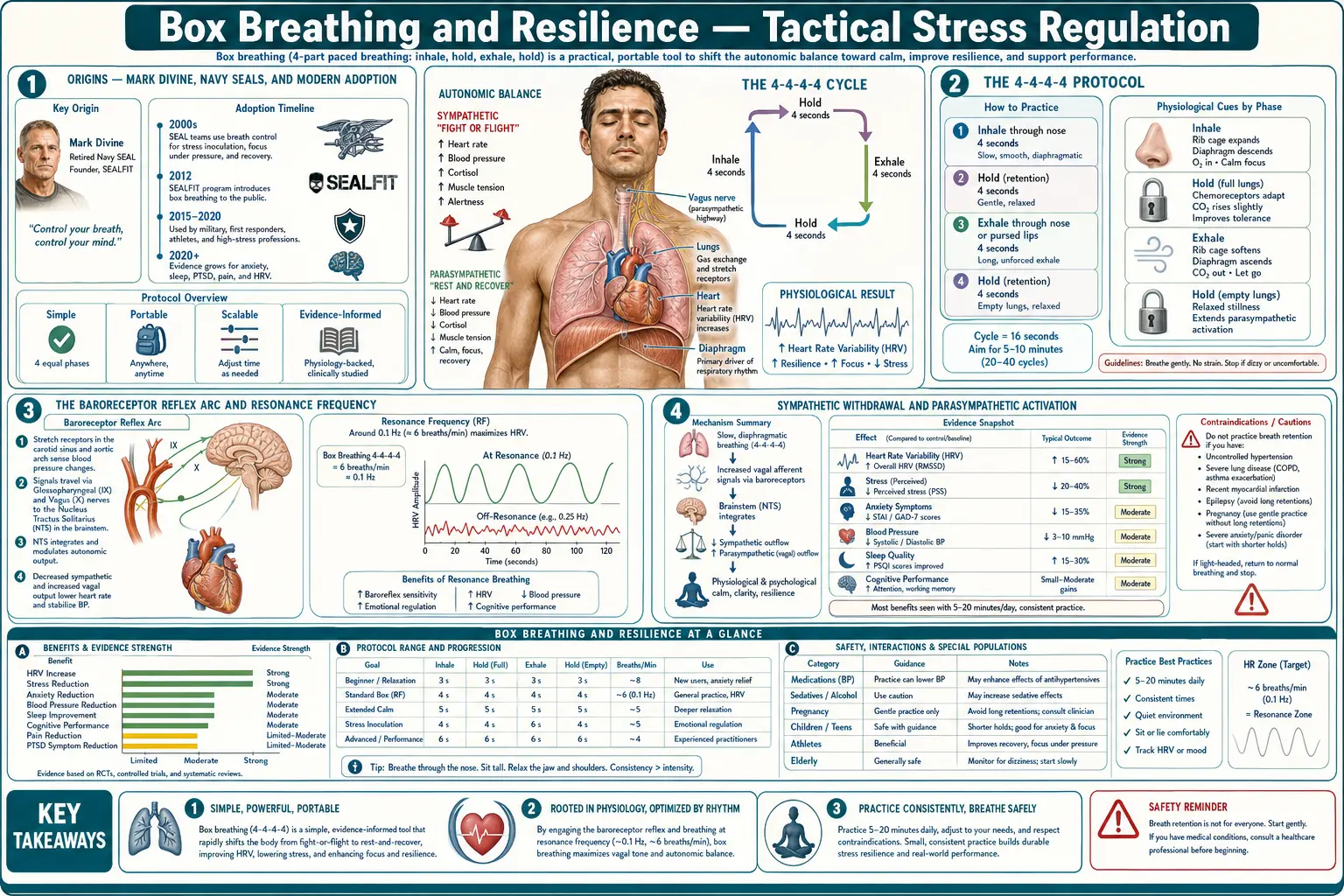
Box breathing — also called square or four-square breathing — consists of equal phases of inhaling, holding the breath, exhaling and holding again (Dujawara 2026); the common form uses 4 seconds for each phase (4-4-4-4). Variations of it are popularized as "tactical" or "combat" breathing among first responders, and it has been used by members of the military for stress regulation (McAllister 2026; Balban 2023). A 2026 systematic review identified eight randomized trials that specifically tested box breathing: several reported short-term benefits on perceived stress, anxiety and mood, physiological effects were inconsistent, and the authors described the evidence as limited (Dujawara 2026). Box breathing is often discussed alongside resonance breathing at about six breaths a minute (approximately 0.1 Hz), but the two are different practices, and in a direct comparison breathing at six breaths a minute raised heart rate variability more than square breathing did (Lehrer 2000; Marchant 2025). This page reports the practice as the studies used it, the proposed mechanisms, the trial results and their limits.
Table of Contents
- Origins — Military and Police Use, and Older Traditions
- The 4-4-4-4 Pattern as Studies Used It
- The Baroreceptor Reflex Arc and Resonance Frequency
- Sympathetic and Parasympathetic Measures
- Breathing and the Brain — What Has Been Measured
- Clinical Evidence in Anxiety, PTSD, and Performance
- Variants — 4-7-8, Longer Boxes, and Triangle Breathing
- Settings Where It Has Been Studied
- How the Trials Taught It
- Cautions and Limitations
- Key Research Papers
- Connections
- Featured Videos
Origins — Military and Police Use, and Older Traditions
Box breathing is widely described in popular accounts as a technique taught in US Navy SEAL training. No published trial of box breathing in SEAL training was found in PubMed for this page. The report of the Balban 2023 trial describes "box breathing" or "tactical breathing" as having been used by members of the military for stress regulation and performance improvement, and a 2021 study from the German Armed Forces describes tactical breathing as used by military and law-enforcement personnel to reduce stress and maintain performance in dangerous situations, while noting that empirical evidence on its effectiveness is limited (Röttger 2021).
Equal-ratio breathing patterns are also described in yoga traditions, where an equal-count breath is known as sama vritti pranayama. Yogic breathing practices more broadly have been reviewed as an adjunct in stress, anxiety and depression (Brown 2005).
Studies of breathing-based training in military and police settings have tested:
- Student soldiers — in a randomized study of 100 student soldiers in a shooting simulator, the group taught tactical breathing scored an average of 1.9 points better on the first, more difficult shot; the total hit score showed a ceiling effect (Ibrahim 2024).
- A laboratory stress task — in 30 healthy participants doing a timed Stroop task under noise, tactical breathing and prolonged exhalation did not differ on self-reported stress; physiological arousal was lower with tactical breathing, while performance was better with prolonged exhalation (Röttger 2021).
- Special forces police — in a feasibility study of 18 SWAT officers, a 5-day resilience program of psychoeducation plus controlled breathing and imagery, practised while listening to recorded critical-incident scenarios, was followed by lower average heart rate and better controlled breathing during the simulated incidents; the authors note that real-world effects were not tested (Andersen 2015).
- Front-line police — in a within-subjects study of 57 urban officers, heart rate variability biofeedback applied during stressful lethal-force decision training was followed by fewer lethal-force errors and less autonomic arousal, maintained across 12 months; at 18 months results began returning toward pre-intervention levels. This was a biofeedback program, not box breathing (Andersen 2018).
The 4-4-4-4 Pattern as Studies Used It
Box breathing has four equal phases: inhale, hold with the lungs full, exhale, and hold with the lungs empty (Dujawara 2026). The schedules used in trials:
- McAllister 2026 — a 4-second inhale, 4-second hold, 4-second exhale and 4-second hold, repeated for 5 minutes immediately before a stress test and for 1 minute during it.
- Balban 2023 — participants first timed how long a slow, full exhale took (a "CO2 tolerance test"), and the length of every phase was set from that time: 3–4 seconds for an exhale of 0–20 seconds, 5–6 seconds for 25–45 seconds, and 8–10 seconds for 50–75 seconds or more. The practice lasted 5 minutes a day for one month.
- Riedl 2026 — one minute of box breathing during real-life moments of acute anxiety.
None of these trials compared different phase lengths of box breathing with each other.
The Baroreceptor Reflex Arc and Resonance Frequency
Baroreceptors in the carotid sinus and aortic arch detect changes in arterial pressure; this information travels via cranial nerves IX and X (glossopharyngeal and vagus) to the nucleus tractus solitarius in the medulla, which feeds the centers that adjust heart rate and vascular tone.
Breathing changes heart rate on every cycle — heart rate rises on the in-breath and falls on the out-breath (respiratory sinus arrhythmia) — and slow breathing enlarges these oscillations (Russo 2017; Lehrer 2000).
The reason six breaths a minute keeps appearing comes from heart rate variability biofeedback. Lehrer and colleagues report that biofeedback training to increase respiratory sinus arrhythmia maximally increases heart rate oscillations only at approximately 0.1 Hz; breathing at this rate produces resonance between breathing-driven heart rate oscillations and oscillations that occur naturally at this rate, probably triggered partly by baroreflex activity, and the authors hypothesize that this exercises the baroreflexes (Lehrer 2000). The exact resonant frequency differs between people — in one study it was lower in men than in women and in taller people — and it stayed constant across 10 biofeedback sessions (Vaschillo 2006). A later review names strengthening of baroreflex homeostasis as the best-supported mechanism of HRV biofeedback (Lehrer 2014). In a laboratory study, 15 minutes of breathing at each person's resonance frequency was followed by higher positive mood and lower systolic blood pressure during a stressful arithmetic task than in a control group that sat quietly (Steffen 2017).
Box breathing is a different practice from resonance-frequency breathing. In a study of 84 college students, breathing at 6 breaths per minute increased HRV measures more than square or 4-7-8 breathing, with small to medium effects; none of the breathing conditions meaningfully changed blood pressure or mood, and breathing at 6 breaths per minute led to mild over-breathing (Marchant 2025).
Sympathetic and Parasympathetic Measures
Reviews of slow breathing (under 10 breaths per minute) in healthy people report:
- Higher heart rate variability, with larger respiratory sinus arrhythmia (Zaccaro 2018; Russo 2017)
- Changes in baroreflex and chemoreflex sensitivity and in sympathovagal balance (Russo 2017)
- Fewer self-reported symptoms of arousal, anxiety, depression, anger and confusion, and more comfort, relaxation and alertness (Zaccaro 2018)
Findings for box breathing itself are mixed:
- In a randomized trial of 66 adults, 5 minutes of box breathing or of prolonged exhalation before a virtual social stress test blunted the rise in heart rate, state anxiety and salivary alpha-amylase compared with normal breathing; heart rate variability, cortisol and cognitive performance did not differ between the groups, and cortisol showed no stress response in any group (McAllister 2026).
- The 2026 systematic review reports that recent trials found box breathing reduced some acute stress responses — heart rate, state anxiety and salivary alpha-amylase — but not HRV or cortisol (Dujawara 2026).
- In the Balban 2023 trial, none of the breathing groups differed from mindfulness meditation in changes in resting heart rate or heart rate variability.
Related slow-breathing studies that did not use breath holds: a single 5-minute session of deep and slow breathing (4 seconds in and 4 out, gradually lengthening to 4 in and 6 out) increased high-frequency HRV power and reduced state anxiety in 22 older and 25 younger adults, with a larger HRV increase in the older group; RMSSD did not increase (Magnon 2021). In 40 healthy adults, 20 sessions of diaphragmatic breathing training over 8 weeks, at an average of 4 breaths per minute with a feedback device, were followed by lower salivary cortisol, less negative affect and better sustained attention, while a control group showed no cortisol change (Ma 2017).
Breathing and the Brain — What Has Been Measured
Recordings from electrodes implanted in the brains of patients with epilepsy showed that natural nasal breathing synchronizes electrical activity in the piriform (olfactory) cortex, the amygdala and the hippocampus; the oscillations peaked during inspiration and faded when breathing was switched from the nose to the mouth. In parallel behavioral experiments in healthy people, the phase of breathing influenced fear discrimination and memory retrieval (Zelano 2016).
The 2018 systematic review of slow breathing found one available fMRI study, which showed increased activity in cortical areas (prefrontal, motor and parietal) and in subcortical structures including the pons, thalamus, periaqueductal gray and hypothalamus; EEG studies showed more alpha and less theta power (Zaccaro 2018). An effect of HRV biofeedback on the vagal afferent pathway to frontal cortical areas has been proposed as one possible mechanism (Lehrer 2014).
None of the studies cited here measured brain activity during box breathing specifically, or tested whether box breathing changes amygdala activity.
Clinical Evidence in Anxiety, PTSD, and Performance
Trials of box breathing itself are few; much of the wider slow-breathing evidence comes from heart rate variability biofeedback, a related but different practice.
- Box breathing overall — the 2026 systematic review found eight eligible randomized trials, in healthy adults and in clinical groups such as postpartum women and women recovering from surgery. Several reported short-term benefits on perceived stress, anxiety and mood, though not uniformly; clinical results included less postpartum pain and better scores on some lactation-related outcomes. No trial measured lung function or maximal aerobic capacity, and the authors judged the evidence limited by small numbers, variable protocols and populations, and little long-term follow-up (Dujawara 2026).
- Mood — a one-month remote randomized trial at Stanford of 108 adults (Balban 2023) compared 5 minutes a day of cyclic sighing, box breathing or cyclic hyperventilation with retention against mindfulness meditation. Breathwork, especially the exhale-focused cyclic sighing, produced greater improvement in mood and a greater fall in respiratory rate than mindfulness meditation. The box breathing group's increase in positive affect was also higher than meditation's, but that difference was not significant. State anxiety fell after each session in both the breathwork and the mindfulness groups.
- Acute laboratory stress — box breathing and prolonged exhalation each blunted the rise in heart rate, state anxiety and salivary alpha-amylase during a virtual social stress test, compared with normal breathing (McAllister 2026).
- Anxious moments in daily life — in a pilot study of 47 university students, one minute of box breathing or of cyclic sighing during real-life threat situations was associated with greater reductions in state anxiety than a passive control; students made fewer inhibition errors after box breathing, and reaction times were longer after both exercises (Riedl 2026).
- Stress and anxiety with HRV biofeedback — a meta-analysis of 24 studies with 484 participants found HRV biofeedback associated with a large reduction in self-reported stress and anxiety (between-groups Hedges' g = 0.83); the effect was not moderated by study year, risk of bias, number of sessions or the presence of an anxiety disorder, and the authors called for more well-controlled studies (Goessl 2017).
- PTSD — the 2026 review did not describe any box-breathing trial in PTSD, and no trial of box breathing in PTSD was found for this page.
- Sport performance — a systematic review of six randomized studies with 187 athletes concluded that HRV biofeedback is a potential intervention to improve fine and gross motor function in athletes (Pagaduan 2020).
- Blood pressure — in 43 young adults with prehypertension, a 10-session HRV biofeedback program over 5 weeks lowered blood pressure from 131.7/79.3 to 118.9/71.9 mmHg and increased baroreflex sensitivity; these effects were larger than in a slow abdominal breathing group and lasted at least 3 months (Lin 2012). In the single-session Marchant 2025 study, square breathing did not meaningfully change blood pressure.
- Diaphragmatic breathing — a systematic review found three eligible studies, each reporting reduced stress on one measure (respiratory rate and salivary cortisol, blood pressure, or a stress questionnaire score); pooling was not possible (Hopper 2019).
Variants — 4-7-8, Longer Boxes, and Triangle Breathing
Several related patterns are described:
- 4-7-8 breathing — a 4-second inhale, 7-second hold and 8-second exhale, with no second hold. The authors of a 2025 comparison describe square and 4-7-8 breathing as popularly promoted by psychotherapists but with little empirical support; in their study both raised HRV less than breathing at 6 breaths per minute (Marchant 2025).
- Longer boxes — in the Balban 2023 trial, people whose timed exhale was longer were assigned 5–6 or 8–10 seconds per phase instead of 3–4.
- Triangle breathing — a three-phase version (inhale, hold, exhale, without the empty-lung hold) described in popular sources; no trial of it was found for this page.
- Resonance or coherent breathing — smooth breathing at about six breaths a minute, or at a person's measured resonant frequency, with no holds, as used in HRV biofeedback (Lehrer 2000; Vaschillo 2006; Steffen 2017).
- Prolonged exhalation — an out-breath longer than the in-breath; it was compared with box or tactical breathing in two studies (Röttger 2021; McAllister 2026).
- Cyclic sighing — a double inhale (a second inhale stacked on the first) followed by a prolonged exhale; the exhale-focused practice showed the clearest mood benefit in the Balban 2023 trial.
Settings Where It Has Been Studied
- Immediately before a stressor — 5 minutes before a virtual social stress test, plus 1 minute during it (McAllister 2026).
- In the moment — one minute during real-life situations that students experienced as threatening (Riedl 2026).
- Daily practice — 5 minutes a day for one month, done remotely (Balban 2023).
- Training for high-stress work — tactical breathing in a military shooting simulator (Ibrahim 2024) and under time pressure and noise (Röttger 2021); controlled breathing within police resilience training (Andersen 2015).
Apart from the small Riedl 2026 pilot, the studies cited here tested box breathing in laboratory or training settings, not during real emergencies, and none tested whether a practice learned at rest helps during an acute panic attack.
How the Trials Taught It
- Balban 2023 — participants sat in a chair or lay down, set a timer for 5 minutes, and inhaled, held, exhaled and held for the phase length assigned from their timed exhale, repeating the pattern for the whole 5 minutes; the study was run remotely.
- McAllister 2026 — participants received instructions and a visual demonstration lasting under a minute immediately before the 5-minute breathing task.
- Andersen 2015 — officers practised controlled breathing and imagery while listening to audio-recorded critical-incident scenarios over 5 days of training.
Cautions and Limitations
- Not everyone finds breathing exercises comfortable — in the optional end-of-study questionnaire of the Balban 2023 trial, 90% of participants reported positive experiences during the exercises and 10% reported negative experiences related to them.
- Over-breathing — in the Marchant 2025 study, breathing at 6 breaths per minute led to mild over-breathing; the effects of different techniques on carbon dioxide levels were named as a question for future studies.
- Panic disorder — hyperventilation produces light-headedness, tingling and breathlessness that overlap with panic symptoms, and some people with panic disorder are highly sensitive to breathing sensations.
- Lung disease and pregnancy — the trials cited here enrolled healthy adults, students, police and soldiers, and clinical groups such as postpartum women and women recovering from surgery; none tested breath-hold practices in severe COPD, pulmonary fibrosis, severe asthma or pregnancy.
- Limits of the evidence — the box-breathing trials are few and small, used different protocols and populations, and followed participants for a short time (Dujawara 2026).
- Scope — the trials tested box breathing as a short-term self-regulation exercise, not as a replacement for medical or psychological treatment. Decisions about treatment belong with a clinician.
Key Research Papers
- Lehrer PM, Gevirtz R (2014). Heart rate variability biofeedback: how and why does it work? Frontiers in Psychology, 5:756. — PubMed PMID: 25101026
- Balban MY, Neri E, Kogon MM, Weed L, Nouriani B, Jo B, Holl G, Zeitzer JM, Spiegel D, Huberman AD (2023). Brief structured respiration practices enhance mood and reduce physiological arousal. Cell Reports Medicine, 4(1):100895. — PubMed PMID: 36630953 · Search PubMed
- Magnon V, Dutheil F, Vallet GT (2021). Benefits from one session of deep and slow breathing on vagal tone and anxiety in young and older adults. Scientific Reports, 11(1):19267. — PubMed PMID: 34588511 · Search PubMed
- Russo MA, Santarelli DM, O'Rourke D (2017). The physiological effects of slow breathing in the healthy human. Breathe, 13(4):298-309. — PubMed PMID: 29209423
- Zaccaro A, Piarulli A, Laurino M, Garbella E, Menicucci D, Neri B, Gemignani A (2018). How Breath-Control Can Change Your Life: A Systematic Review on Psycho-Physiological Correlates of Slow Breathing. Frontiers in Human Neuroscience, 12:353. — PubMed PMID: 30245619
- Goessl VC, Curtiss JE, Hofmann SG (2017). The effect of heart rate variability biofeedback training on stress and anxiety: a meta-analysis. Psychological Medicine, 47(15):2578-2586. — PubMed PMID: 28478782
- Pagaduan JC, Chen YS, Fell JW, Wu SSX (2020). Can Heart Rate Variability Biofeedback Improve Athletic Performance? A Systematic Review. Journal of Human Kinetics, 73:103-114. — PubMed PMID: 32774542
- Hopper SI, Murray SL, Ferrara LR, Singleton JK (2019). Effectiveness of diaphragmatic breathing for reducing physiological and psychological stress in adults: a quantitative systematic review. JBI Database Syst Rev Implement Rep, 17(9):1855-1876. — PubMed PMID: 31436595
- Ma X, Yue ZQ, Gong ZQ, Zhang H, Duan NY, Shi YT, Wei GX, Li YF (2017). The Effect of Diaphragmatic Breathing on Attention, Negative Affect and Stress in Healthy Adults. Frontiers in Psychology, 8:874. — PubMed PMID: 28626434
- McAllister MJ, Martaindale MH, Sutton N, Andersen JP (2026). Box breathing and prolonged exhalation reduces markers of physiological stress reactivity in response to a virtual trier social stress test. Comprehensive Psychoneuroendocrinology, 27:100360. — PubMed PMID: 42388906
- Brown RP, Gerbarg PL (2005). Sudarshan Kriya yogic breathing in the treatment of stress, anxiety, and depression. Part II—clinical applications and guidelines. Journal of Alternative and Complementary Medicine, 11(4):711-7. — PubMed PMID: 16131297
- Steffen PR, Austin T, DeBarros A, Brown T (2017). The Impact of Resonance Frequency Breathing on Measures of Heart Rate Variability, Blood Pressure, and Mood. Frontiers in Public Health, 5:222. — PubMed PMID: 28890890
- Dujawara A, Ali K, Kumari S (2026). Systematic Review of Randomised Controlled Trials Evaluating Box Breathing for Stress, Autonomic, and Clinical Outcomes. Applied Psychophysiology and Biofeedback, online ahead of print. — PubMed PMID: 42768274
- Marchant J, Khazan I, Cressman M, Steffen P (2025). Comparing the Effects of Square, 4-7-8, and 6 Breaths-per-Minute Breathing Conditions on Heart Rate Variability, CO2 Levels, and Mood. Applied Psychophysiology and Biofeedback, 50(2):261-276. — PubMed PMID: 39864026
- Riedl EM, Bracklo T, Wimmer K, Perzl J, Gdynia HJ, Thomas J, Surzykiewicz J (2026). Simply breathing anxiety away? A pilot, just-in-time ecological momentary intervention study of one-minute cyclic sighing versus box breathing as tools for acute anxiety reduction and attention promotion in real life. Anxiety, Stress, and Coping, 39(5):608-622. — PubMed PMID: 42002307
- Röttger S, Theobald DA, Abendroth J, Jacobsen T (2021). The Effectiveness of Combat Tactical Breathing as Compared with Prolonged Exhalation. Applied Psychophysiology and Biofeedback, 46(1):19-28. — PubMed PMID: 32757097
- Ibrahim F, Schumacher J, Schwandt L, Herzberg PY (2024). The first shot counts the most: Tactical breathing as an intervention to increase marksmanship accuracy in student officers. Military Psychology, 36(6):689-700. — PubMed PMID: 37733483
- Andersen JP, Papazoglou K, Koskelainen M, Nyman M, Gustafsberg H, Arnetz BB (2015). Applying Resilience Promotion Training Among Special Forces Police Officers. SAGE Open, 5(2). — PubMed PMID: 26137394
- Andersen JP, Di Nota PM, Beston B, Boychuk EC, Gustafsberg H, Poplawski S, Arpaia J (2018). Reducing Lethal Force Errors by Modulating Police Physiology. Journal of Occupational and Environmental Medicine, 60(10):867-874. — PubMed PMID: 30020222
- Lehrer PM, Vaschillo E, Vaschillo B (2000). Resonant frequency biofeedback training to increase cardiac variability: rationale and manual for training. Applied Psychophysiology and Biofeedback, 25(3):177-191. — PubMed PMID: 10999236
- Vaschillo EG, Vaschillo B, Lehrer PM (2006). Characteristics of resonance in heart rate variability stimulated by biofeedback. Applied Psychophysiology and Biofeedback, 31(2):129-142. — PubMed PMID: 16838124
- Zelano C, Jiang H, Zhou G, Arora N, Schuele S, Rosenow J, Gottfried JA (2016). Nasal Respiration Entrains Human Limbic Oscillations and Modulates Cognitive Function. Journal of Neuroscience, 36(49):12448-12467. — PubMed PMID: 27927961
- Lin G, Xiang Q, Fu X, Wang S, Wang S, Chen S, Shao L, Zhao Y, Wang T (2012). Heart rate variability biofeedback decreases blood pressure in prehypertensive subjects by improving autonomic function and baroreflex. Journal of Alternative and Complementary Medicine, 18(2):143-152. — PubMed PMID: 22339103