Wim Hof Method — Breathwork, Cold, and the Immune System
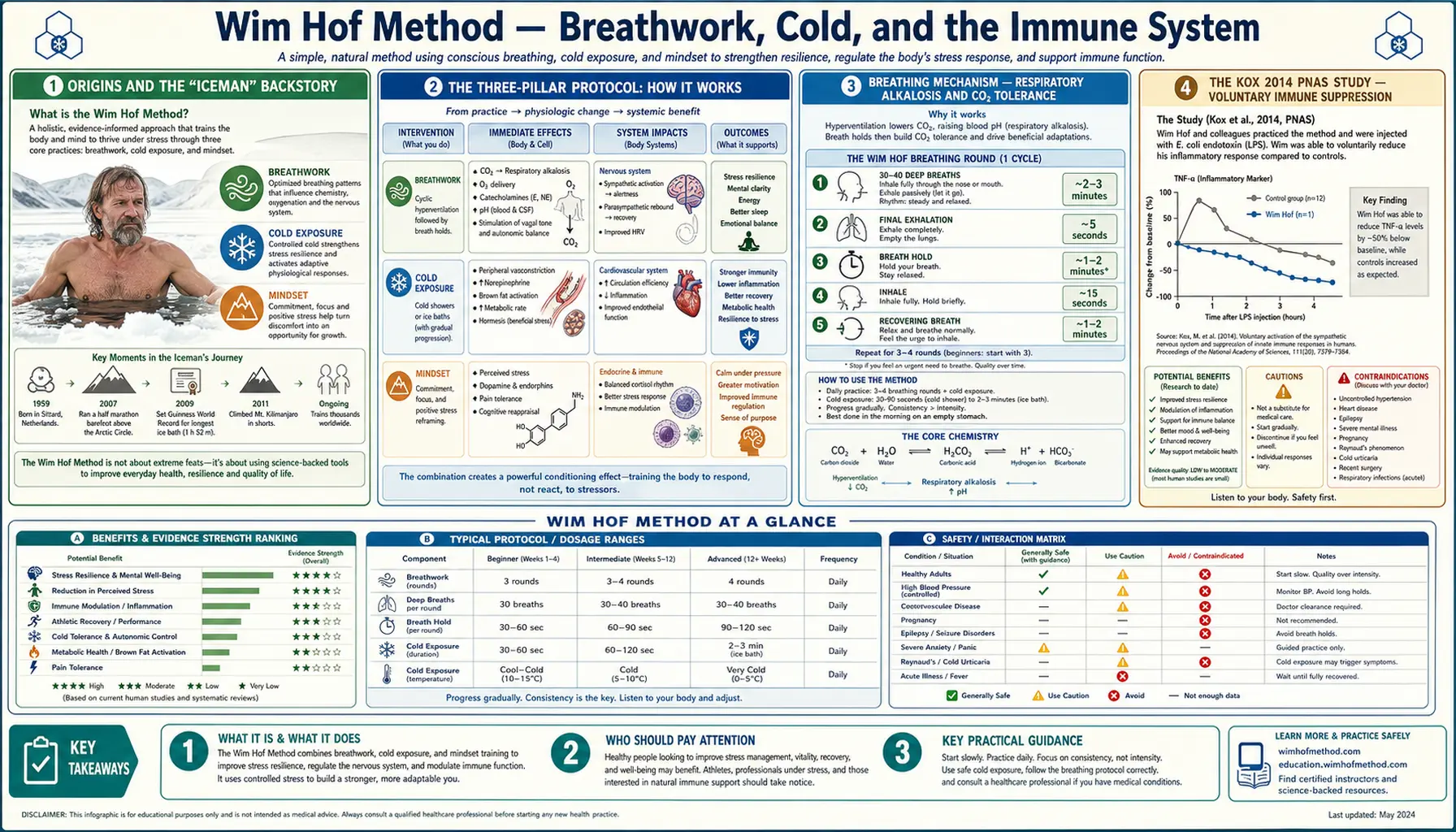
The Wim Hof Method is a practice developed by the Dutch cold-exposure athlete Wim Hof that combines cyclic hyperventilation with breath retention, cold exposure and meditation. It has been tested in randomized laboratory trials. In the 2014 Kox study in PNAS, men trained in the method showed sharply raised plasma epinephrine and a smaller inflammatory response to injected bacterial endotoxin than untrained men — a result the authors set against the long-held view that the autonomic and innate immune systems cannot be voluntarily influenced. A 2018 imaging case study at Wayne State University examined Hof himself during cold exposure. Other trials of the breathing technique found no effect on sprint performance, breathing economy, blood pressure or heart-rate variability. This page reports the trial protocols, the proposed mechanisms, the published results and the documented hazards — above all that hyperventilation before breath-holding in water is a recognized cause of drowning.
Table of Contents
- Origins and the "Iceman" Backstory
- The Three Pillars as Described
- Breathing Mechanism — Respiratory Alkalosis and CO2
- The Kox 2014 PNAS Study — Voluntary Immune Suppression
- Brain Imaging Evidence (Muzik 2018 "Brain Over Body")
- Cold Exposure Mechanism — Norepinephrine, Brown Fat, Habituation
- Clinical and Performance Trials
- The Breathing Protocol as Used in the Trials
- Safety — Why Hyperventilation Kills in Water
- Who the Research Raises Concerns For
- Key Research Papers
- Connections
- Featured Videos
Origins and the "Iceman" Backstory
Wim Hof is a Dutch athlete known as "the Iceman", who holds several world records for tolerating extreme cold (Kox 2012). He describes his method as having grown out of his own long self-experimentation with cold-water immersion. Practitioners often compare its breathing to the Tibetan inner-heat practice tummo and to yogic forceful-breathing techniques; researchers treat these as related but separate practices (the 2024 systematic review excluded tummo studies for that reason).
Laboratory research began with a case study at Radboud University Medical Center in Nijmegen, Netherlands (Kox 2012, Psychosomatic Medicine). Hof was given intravenous E. coli endotoxin (2 ng/kg) while practicing his technique. His catecholamine levels rose, his plasma cortisol was higher than in any of 112 earlier participants in the institution's endotoxin studies, and his cytokine response and flu-like symptoms were "remarkably low" compared with that historical group. A single individual could simply be an unusual responder, so the case study could not show that the effect was teachable.
The 2014 Kox PNAS trial tested that question. Twelve healthy male volunteers were trained for 10 days by Hof and three instructors he had trained; then they and 12 untrained controls were given the same endotoxin challenge. The results are set out below.
The Three Pillars as Described
Hof describes the method as three pillars meant to be practiced together. The trials have studied them both together and apart.
- Breathing — rounds of deep, rapid breathing (cyclic hyperventilation) followed by holding the breath after exhaling, at low lung volume (Kox 2014; Citherlet 2021). One trial described its regimen as three sets of controlled hyperventilation, each followed by a maximal breath hold, for about 20 minutes a day (Marko 2022).
- Cold exposure — in the Kox trial this included immersion in ice-cold water, standing barefoot in snow and hiking up a snowy mountain bare-chested. In a separate large trial of cold showers alone, volunteers ended a hot shower with 30, 60 or 90 seconds of cold water daily for 30 days (Buijze 2016).
- Commitment / mindset — the third pillar as Hof describes it, consistent practice and focused concentration. The Kox trial taught a "third eye" meditation as part of training.
On whether the pillars matter separately, a 2022 Radboud follow-up trial (Zwaag 2022) found that the breathing exercise on its own enhanced anti-inflammatory and lowered pro-inflammatory cytokine levels after endotoxin, cold-exposure training on its own did not meaningfully change the inflammatory response, and the combination of both had the strongest effect.
Breathing Mechanism — Respiratory Alkalosis and CO2
Rapid deep breathing lowers carbon dioxide in the blood (hypocapnia) and raises blood pH (respiratory alkalosis). In the Kox 2014 trial, arterial pH reached up to 7.75 in individual trained subjects (normal is about 7.40), and during the breath holds oxygen saturation typically fell to around 50% for about 10 seconds. Citherlet 2021 recorded finger oxygen saturation of 60 ± 12% at the end of breath holds and estimated an arterial pH rise of about 0.17 after the last hyperventilation.
Recognized physiological consequences of respiratory alkalosis include:
- Narrowing of brain blood vessels — carbon dioxide dilates cerebral arteries, so lowering it reduces blood flow to the brain. This is the standard explanation for the light-headedness, tingling of the hands and face (paresthesia) and visual changes that hyperventilation produces.
- Bohr effect — lower CO2 shifts the oxygen-hemoglobin curve to the left, so hemoglobin holds oxygen more tightly. With little CO2 left to drive the urge to breathe, a breath hold after hyperventilation can last much longer than usual.
- Calcium shifts and tetany — alkalosis increases the binding of ionized calcium to albumin, which can cause muscle cramping and stiffening of the hands and feet (carpopedal spasm or tetany), a recognized effect of hyperventilation.
- Sympathetic activation — in the Kox 2014 trial, epinephrine in trained subjects rose higher than the levels reported in an earlier study of first-time bungee jumpers, where that stress also suppressed cytokine production.
Practitioners describe their breath holds getting longer with practice. The abstracts of the trials cited on this page do not report a measured long-term change in carbon dioxide sensitivity.
The Kox 2014 PNAS Study — Voluntary Immune Suppression
The Kox 2014 study (PubMed PMID: 24799686) is the most-cited laboratory trial of the method. Design and results as reported:
- Design — 24 healthy male volunteers were randomized to 10 days of training (n = 12) or no training (n = 12). The first four, most intensive days took place in Poland and included cold-water immersion, time barefoot in snow and a bare-chested mountain hike; the training also covered meditation and the breathing technique. Afterwards all 24 were given intravenous E. coli endotoxin (2 ng/kg) at Radboud University Medical Center.
- During the challenge — the trained group practiced the techniques from half an hour before the endotoxin injection until 2.5 hours after it. Subjects were monitored from 1 hour before the injection until discharge 8 hours after it.
- Pro-inflammatory cytokines — TNF-alpha, IL-6 and IL-8 were 53%, 57% and 51% lower, respectively, in the trained group.
- Anti-inflammatory IL-10 — IL-10 rose more rapidly after endotoxin and was 194% higher in the trained group; IL-10 levels correlated strongly with the epinephrine levels that preceded them.
- Symptoms — peak flu-like symptoms were 56% lower in the trained group.
- Epinephrine — practicing the techniques produced intermittent respiratory alkalosis and low blood oxygen and "profoundly increased" plasma epinephrine, higher than levels reported in a study of bungee jumping.
The authors concluded that voluntary activation of the sympathetic nervous system leads to epinephrine release and subsequent suppression of the innate immune response, and that this could matter for conditions involving excessive or persistent inflammation, such as autoimmune diseases. They framed the result against the prevailing view that both the autonomic nervous system and the innate immune system "cannot be voluntarily influenced". The trial measured a single short-term challenge in healthy young men.
Zwaag 2022 (Psychosomatic Medicine, same group) extended the work. In 40 healthy men, both breathing variants raised plasma epinephrine regardless of training length or of whether Hof or an independent trainer taught them. In a second trial of 48 men given endotoxin, the breathing exercise reduced the inflammatory response, cold training alone did not, and cold training enhanced the breathing exercise's effect. The authors wrote that the effects could be reproduced in a standardized manner, opening the way to clinical trials.
The 2024 PLOS ONE systematic review (Almahayni & Hammond, PubMed PMID: 38478473) included nine papers covering eight separate trials. It found that the method may reduce inflammation by raising epinephrine, which increases IL-10 and lowers pro-inflammatory cytokines, and that effects on exercise performance and on breathing measures during exercise were mixed. Its authors called the inflammation findings promising and called for studies in people with inflammatory disorders.
Brain Imaging Evidence (Muzik 2018 "Brain Over Body")
The 2018 Muzik et al. NeuroImage study (PubMed PMID: 29438845) at Wayne State University was a case study of Hof, then 57, compared with a group of typical controls. Mild cooling was delivered during fMRI, and Hof also had whole-body PET/CT scans in warm and cold conditions. As reported in the abstract:
- Practicing the method activated the periaqueductal gray (PAG), a brainstem area that controls descending pain and cold signals. The authors suggested this might trigger a stress-induced analgesic response.
- It also engaged higher cortical areas (the left anterior and right middle insula), which the authors linked to self-reflection and to sustained internal focus despite unpleasant cold.
- Activation of brown adipose tissue was "unremarkable".
- The forceful breathing increased sympathetic activity and glucose use in the intercostal (rib-cage) muscles. The authors proposed that the heat this produced warms blood passing through the lungs.
The authors read the results as evidence that the brain, rather than peripheral mechanisms, mainly drives Hof's cold responses. Because it is a single-subject case study, the results may not apply to other practitioners.
Cold Exposure Mechanism — Norepinephrine, Brown Fat, Habituation
Research on cold-water exposure in general (not specifically on the Wim Hof Method) describes three relevant responses:
- Norepinephrine — in young men immersed head-out for 1 hour in 14°C water, plasma noradrenaline (norepinephrine) rose by 530% and dopamine by 250%, while adrenaline did not change and metabolic rate rose by 350% (Šrámek 2000). Immersion at 32°C did not raise noradrenaline.
- Brown adipose tissue (BAT) — brown fat makes heat by uncoupling its mitochondria through uncoupling protein 1 (UCP1). In experienced winter-swimming men who combine cold dips with sauna two to three times a week, Søberg 2021 found a lower core temperature, no BAT activity at comfortable temperatures, and a larger rise in cold-induced heat production than in controls, while BAT glucose uptake during cold rose similarly in both groups. In the Muzik case study, BAT activation in Hof himself was unremarkable.
- Habituation of the cold shock response — Hof calls the adaptation "hardening". A 2024 meta-analysis found that repeated cold-water immersion reduces the cold shock response (the gasp, hyperventilation and racing heart on entering cold water), with habituation appearing after about four immersions; the authors noted this could reduce drowning risk (Barwood 2024).
In the largest randomized trial of cold exposure, 3,018 Dutch adults with no habit of cold showering were assigned to end a daily hot shower with 30, 60 or 90 seconds of cold water for 30 days, or to a control group (Buijze 2016). The cold-shower groups had 29% less self-reported sickness absence from work (incidence rate ratio 0.71), but no difference in the number of illness days, and no related serious adverse events were reported. Of the intervention groups, 79% completed the 30-day protocol.
Cold showers, ice baths and contrast hydrotherapy on their own are covered on the Cold Therapy page.
Clinical and Performance Trials
Published trials of the Wim Hof Method, or of its breathing component, include:
- Axial spondyloarthritis — an open-label, randomized proof-of-concept trial in 24 patients with moderately active disease added 8 weeks of training in breathing exercises, cold exposure and meditation (Buijze 2019). Its primary endpoint, safety, was met with no safety signals. ESR (an inflammation marker) and the ASDAS-CRP disease-activity score fell in the intervention group, serum calprotectin showed a trend, and hs-CRP did not change. The authors called for full-scale randomized trials. Other inflammatory conditions, such as rheumatoid arthritis and inflammatory bowel disease, have not been tested in the trials cited here.
- Mood and stress — a one-month remote randomized trial at Stanford (Balban 2023) compared three daily 5-minute breathing practices, one of them cyclic hyperventilation with retention, against mindfulness meditation. Breathwork overall, and the exhale-focused cyclic sighing practice in particular, improved mood and lowered breathing rate more than meditation. In an Antarctic expedition, six members who did 8 weeks of training had fewer depressive symptoms than seven who did not, with a non-significant fall in cortisol (Petraskova Touskova 2022, a small observational study).
- Cardiovascular and psychological measures — in a randomized trial of 42 participants, 15 days of daily practice did not change heart rate, heart-rate variability, blood pressure, arterial stiffness, perceived stress, mood or vitality, at rest or during a cold pressor test (Ketelhut 2023).
- Exercise performance — in 15 amateur runners, a single breathing session before repeated sprints had large physiological effects but did not improve peak power, average power or fatigue index (Citherlet 2021). In 19 adolescent runners, 4 weeks of the breathing method did not change breathing economy during exercise (Marko 2022).
- Chronic fatigue and autonomic disorders — the trials cited on this page did not include people with ME/CFS, POTS or other autonomic disorders.
The Breathing Protocol as Used in the Trials
The published trials describe the breathing technique in broadly the same terms:
- Structure — cycles of hyperventilation, each followed by a voluntary breath hold at low lung volume after exhaling (Kox 2014; Citherlet 2021). In Marko 2022 this meant three sets of controlled hyperventilation, each followed by a maximal breath hold, about 20 minutes a day for 4 weeks.
- Setting — in the laboratory trials, people practiced lying or sitting under supervision, with blood gases, oxygen saturation or catecholamines measured (Kox 2014; Zwaag 2022; Citherlet 2021).
- Training length — trial training periods ranged from a single session (Citherlet 2021) and 10 days (Kox 2014) to 15 days (Ketelhut 2023), 4 weeks (Marko 2022) and 8 weeks (Buijze 2019; Petraskova Touskova 2022). In Zwaag 2022, the epinephrine rise did not depend on whether training was short or extensive.
- Measured effects during a session — arterial pH up to 7.75 and oxygen saturation down to around 50% for about 10 seconds in trained subjects (Kox 2014).
The trials taught the technique through supervised training; apart from Marko 2022's three sets, the published abstracts give no exact breath counts or hold times. Decisions about taking up breathwork or cold exposure belong with a clinician.
Safety — Why Hyperventilation Kills in Water
The best-documented hazard of this kind of breathing is drowning when hyperventilation is followed by breath-holding in water. The mechanism below is why the breathing is dangerous in water and while driving.
Hyperventilation lowers arterial CO2, and the urge to breathe is driven mainly by rising CO2 rather than falling O2. After hyperventilating, a person holding their breath can let oxygen fall low enough to lose consciousness before CO2 rises far enough to force a breath. Consciousness can be lost with no warning. This is called hypoxic blackout or "shallow water blackout". A CDC review of New York State drownings from 1988 to 2011 (Boyd 2015, MMWR) was prompted by the deaths of two healthy young men who had practiced intentional hyperventilation before going underwater. The review identified 16 cases involving what it called "dangerous underwater breath-holding behaviors" and found that combining more than one such behavior increased the risk of death. Hypoxic-blackout drowning deaths have also been tallied in Australia (Franklin 2018, Medical Journal of Australia).
The same physiology applies to the breath holds of this method: the Kox trial recorded oxygen saturation around 50% during retention. A loss of consciousness that would be harmless lying on a floor can be fatal in a pool, bath, hot tub or open water.
Driving carries a similar risk, because reduced blood flow to the brain and light-headedness at peak hyperventilation impair alertness.
Other hazards described in the research:
- Hyperventilation tetany — tingling, muscle cramps and stiffening of the hands and feet caused by alkalosis-driven calcium shifts (see the mechanism above).
- Cold shock — sudden immersion in cold water triggers the cold shock response: a gasp reflex, hyperventilation and a rise in heart rate. This response is life-threatening, increases cardiac arrhythmias and raises drowning risk by impairing safety behavior (Barwood 2024). Reviews treat cold-water immersion as a precursor to drowning, cardiac arrest and hypothermia (Tipton 2017).
- Sedatives and alcohol — alcohol and other central nervous system depressants add their own effect on consciousness to the blackout risk of breath-holding.
Who the Research Raises Concerns For
- Anyone in or near water — hyperventilation before breath-holding underwater is linked to fatal and nonfatal drownings, including among healthy, capable swimmers (Boyd 2015).
- Epilepsy or seizure history — voluntary hyperventilation is used as a standard EEG provocation test because it can trigger seizure activity in susceptible people.
- Heart disease — both the catecholamine surge of the breathing and the cold shock response (rapid heart rate, arrhythmias) put stress on the heart. Cold-water immersion is a recognized trigger of cardiac arrest (Tipton 2017).
- Pregnancy — the trials cited here did not include pregnant women; there is no safety data on the method in pregnancy.
- Raynaud's phenomenon, cryoglobulinemia, cold urticaria — in these conditions cold exposure itself provokes symptoms.
- Lung disease with CO2 retention — the trials cited here did not include people with severe asthma or COPD.
- Mental health conditions — people with psychosis, severe panic disorder or acute trauma were not studied, and hyperventilation itself produces sensations (light-headedness, tingling, breathlessness on breath-holding) that overlap with panic symptoms.
- Children — the 2024 systematic review excluded studies of children under 14; the youngest participants in the trials cited here were adolescent runners (Marko 2022).
Decisions about medicines, supplements and practices like this one belong with a clinician.
Key Research Papers
- Kox M, van Eijk LT, Zwaag J, van den Wildenberg J, Sweep FC, van der Hoeven JG, Pickkers P (2014). Voluntary activation of the sympathetic nervous system and attenuation of the innate immune response in humans. Proceedings of the National Academy of Sciences, 111(20):7379-7384. — PubMed PMID: 24799686
- Kox M, Stoffels M, Smeekens SP, van Alfen N, Gomes M, Eijsvogels TM, Hopman MT, van der Hoeven JG, Netea MG, Pickkers P (2012). The influence of concentration/meditation on autonomic nervous system activity and the innate immune response: a case study. Psychosomatic Medicine, 74(5):489-94. — PubMed PMID: 22685240 · Search PubMed
- Muzik O, Reilly KT, Diwadkar VA (2018). "Brain over body" — A study on the willful regulation of autonomic function during cold exposure. NeuroImage, 172:632-641. — PubMed PMID: 29438845
- Almahayni O, Hammond L (2024). Does the Wim Hof Method have a beneficial impact on physiological and psychological outcomes in healthy and non-healthy participants? A systematic review. PLOS ONE, 19(3):e0286933. — PubMed PMID: 38478473 · Search PubMed
- Citherlet T, Crettaz von Roten F, Kayser B, Guex K (2021). Acute Effects of the Wim Hof Breathing Method on Repeated Sprint Ability: A Pilot Study. Frontiers in Sports and Active Living, 3:700757. — PubMed PMID: 34514386 · Search PubMed
- Petraskova Touskova T, Bob P, Bares Z, Vanickova Z, Nyvlt D, Raboch J (2022). A novel Wim Hof psychophysiological training program to reduce stress responses during an Antarctic expedition. Journal of International Medical Research, 50(4):3000605221089883. — PubMed PMID: 35437052 · Search PubMed
- Zwaag J, Naaktgeboren R, van Herwaarden AE, Pickkers P, Kox M (2022). The Effects of Cold Exposure Training and a Breathing Exercise on the Inflammatory Response in Humans: A Pilot Study. Psychosomatic Medicine, 84(4):457-467. — PubMed PMID: 35213875 · Search PubMed
- Buijze GA, Hopman MT (2014). Controlled hyperventilation after training may accelerate altitude acclimatization. Wilderness & Environmental Medicine, 25(4):484-486. — PubMed PMID: 25443751 · Search PubMed
- Marko D, Bahenský P, Bunc V, Grosicki GJ, Vondrasek JD (2022). Does Wim Hof Method Improve Breathing Economy during Exercise? Journal of Clinical Medicine, 11(8):2218. — PubMed PMID: 35456308
- Buijze GA, De Jong HMY, Kox M, et al. (2019). An add-on training program involving breathing exercises, cold exposure, and meditation attenuates inflammation and disease activity in axial spondyloarthritis — A proof of concept trial. PLOS ONE, 14(12):e0225749. — PubMed PMID: 31790484 · Search PubMed
- Buijze GA, Sierevelt IN, van der Heijden BC, Dijkgraaf MG, Frings-Dresen MH (2016). The Effect of Cold Showering on Health and Work: A Randomized Controlled Trial. PLOS ONE, 11(9):e0161749. — PubMed PMID: 27631616
- Ketelhut S, Querciagrossa D, Bisang X, Metry X, Borter E, Nigg CR (2023). The effectiveness of the Wim Hof method on cardiac autonomic function, blood pressure, arterial compliance, and different psychological parameters. Scientific Reports, 13(1):17517. — PubMed PMID: 37845341
- Balban MY, Neri E, Kogon MM, Weed L, Nouriani B, Jo B, Holl G, Zeitzer JM, Spiegel D, Huberman AD (2023). Brief structured respiration practices enhance mood and reduce physiological arousal. Cell Reports Medicine, 4(1):100895. — PubMed PMID: 36630953
- Šrámek P, Šimečková M, Janský L, Šavlíková J, Vybíral S (2000). Human physiological responses to immersion into water of different temperatures. European Journal of Applied Physiology, 81(5):436-442. — PubMed PMID: 10751106
- Søberg S, Löfgren J, Philipsen FE, et al. (2021). Altered brown fat thermoregulation and enhanced cold-induced thermogenesis in young, healthy, winter-swimming men. Cell Reports Medicine, 2(10):100408. — PubMed PMID: 34755128
- Barwood MJ, Eglin C, Hills SP, Johnston N, Massey H, McMorris T, Tipton MJ, Wakabayashi H, Webster L (2024). Habituation of the cold shock response: A systematic review and meta-analysis. Journal of Thermal Biology, 119:103775. — PubMed PMID: 38211547
- Tipton MJ, Collier N, Massey H, Corbett J, Harper M (2017). Cold water immersion: kill or cure? Experimental Physiology, 102(11):1335-1355. — PubMed PMID: 28833689
- Boyd C, Levy A, McProud T, Huang L, Raneses E, Olson C (2015). Fatal and nonfatal drowning outcomes related to dangerous underwater breath-holding behaviors — New York State, 1988-2011. MMWR Morbidity and Mortality Weekly Report, 64(19):518-521. — PubMed PMID: 25996093
- Franklin RC, Peden AE, Pearn JH (2018). Drowning deaths in Australia caused by hypoxic blackout, 2002-2015. Medical Journal of Australia, 208(6):271. — PubMed PMID: 29614942