⚠ Evidence warning: Clinical trials or other evidence do not support the claims that berberine is the only natural molecule to match metformin, that it matches statins, that dihydroberberine is absorbed 5-fold better, and that one master switch explains its effects. This page keeps it as a report of what people, websites or other media say.
Berberine — Benefits Deep Dive
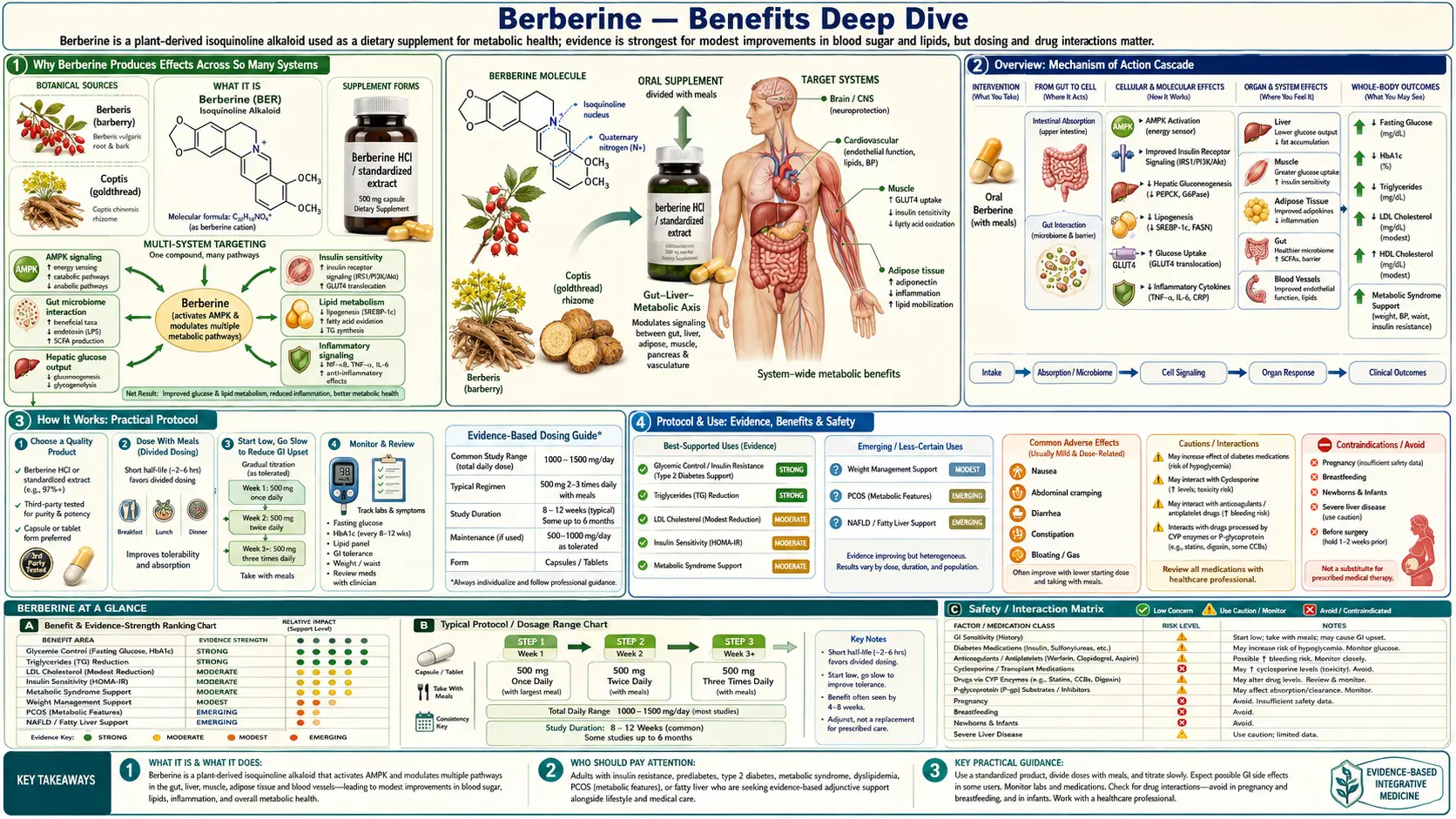
Berberine is one of the most extensively studied plant-derived isoquinoline alkaloids in modern pharmacology, described as having more than four decades of clinical trial data, though meta-analyses rate the quality of those trials as generally low. It is often described as the only naturally occurring molecule that produces a metformin-comparable reduction in fasting glucose and hemoglobin A1c (HbA1c) in randomized head-to-head trials; one such trial is a pilot study of 36 adults over 3 months (Yin 2008). It is also reported to lower low-density lipoprotein (LDL) cholesterol, triglycerides, and apolipoprotein B (ApoB) through a low-density lipoprotein-receptor-stabilizing mechanism distinct from statins. Its action through AMP-activated protein kinase (AMPK), the master cellular energy sensor, plus parallel effects on gut microbiome composition, intestinal dipeptidyl peptidase-4 (DPP-4) activity, and proprotein convertase subtilisin/kexin type 9 (PCSK9) expression, is proposed to explain why berberine produces benefits across glucose, lipids, and the gut barrier from a single molecule. The four deep-dive pages below explore the principal clinical applications — type 2 diabetes and insulin resistance, dyslipidemia and cardiovascular risk, gut microbiome modulation, and the practical questions of dosing form, dihydroberberine versus standard berberine, and the cautions that matter (pregnancy, jaundiced neonates, and drug interactions through cytochrome P450 2D6 (CYP2D6), cytochrome P450 2C9 (CYP2C9) and cytochrome P450 3A4 (CYP3A4)).
Deep-Dive Articles
Blood Sugar & Insulin Sensitivity
The Yin 2008 pilot trial against metformin (Metabolism; 36 adults, 3 months), AMP-activated protein kinase activation as the proposed master mechanism (shown in animals and cell lines), glucose transporter type 4 (GLUT4) translocation independent of insulin, hepatic gluconeogenesis suppression, intestinal alpha-glucosidase inhibition, the hemoglobin A1c reduction in pooled meta-analyses (0.63% in a 2022 analysis of 37 trials; 0.7-1.0% is also quoted), and the rationale for combining berberine with metformin for additive effect in difficult-to-control type 2 diabetes.
Read the deep dive →Cholesterol & Cardiovascular
The Kong 2004 Nature Medicine paper establishing berberine as a low-density lipoprotein-receptor stabilizer (distinct from statin HMG-CoA reductase inhibition), the 25% low-density lipoprotein cholesterol (LDL-C) reduction in that paper's 32 patients over 3 months (20-25% is also quoted), PCSK9 suppression, triglyceride lowering through sterol regulatory element-binding protein 1c (SREBP-1c) modulation, the Italian evidence on a combination of berberine, monacolin K and policosanol, and what trials report for berberine-containing products in people who cannot tolerate statins or as an add-on for residual risk.
Read the deep dive →Gut Microbiome
Why berberine's low oral bioavailability (0.36% and 0.68% measured in rats; 1-5% is also quoted) is described as a feature rather than a bug — much of an oral dose stays in the gut, where it is reported to remodel the microbiome, suppress opportunistic Enterobacteriaceae and lipopolysaccharide-producing taxa, expand short-chain-fatty-acid producers (Akkermansia, Faecalibacterium), reduce metabolic endotoxemia, and the proposed gut-mediated mechanism behind glucose and lipid effects.
Read the deep dive →Dosing, Forms & Cautions
The standard 500 mg three-times-daily protocol (1,500 mg/day total), dihydroberberine, used at 200 mg twice daily on a quoted 5-fold higher oral bioavailability (rodent work and a five-man pilot trial show better absorption, with no glucose or insulin difference in that pilot), berberine phytosome and silymarin-paired formulations, gastrointestinal (GI) tolerance and titration strategy, the pregnancy and newborn caution (test-tube and adult-rat work on bilirubin displacement, a reported kernicterus risk in newborns given the herb, and a 1993 paper's statement that such herbs are best avoided in jaundiced newborns and pregnant women), and the CYP2D6, CYP2C9 and CYP3A4 inhibition behind interactions with cyclosporine and many psychiatric medications, with transporter effects relevant to metformin, which is excreted unchanged rather than cleared by these enzymes.
Read the deep dive →Table of Contents
- Deep-Dive Articles
- Why Berberine Produces Effects Across So Many Systems
- Research Papers: Blood Sugar & Insulin Sensitivity
- Research Papers: Cholesterol & Cardiovascular
- Research Papers: Gut Microbiome
- Research Papers: Pharmacokinetics, Forms, and Cautions
- Research Papers: Cross-Cutting (AMP-Activated Protein Kinase, Mechanism, Safety)
- External Authoritative Resources
- Connections
- Featured Videos
Why Berberine Produces Effects Across So Many Systems
Most plant alkaloids act on a narrow pharmacological target — morphine on opioid receptors, caffeine on adenosine receptors, nicotine on cholinergic receptors. Berberine is described as unusual because it acts on a single master regulator (AMP-activated protein kinase (AMPK)) plus the gut microbiome, and AMP-activated protein kinase in turn coordinates hundreds of downstream metabolic processes. The breadth of berberine's clinical effect — glucose, lipids, gut barrier, weight, inflammation, non-alcoholic fatty liver disease (NAFLD) — is described by supporters not as polypharmacology in the traditional sense but as the result of pulling a single master lever that controls everything downstream. A 2026 review instead describes several interacting pathways.
- AMP-activated protein kinase activation (the master metabolic switch) — in two animal models and in cell lines, berberine raised AMP-activated protein kinase activity (Lee 2006), and supporters describe this as happening at concentrations achievable with oral dosing. Blood levels in people are very low: low ng/mL in a 2026 review, and a peak of 0.4 ng/mL after 500 mg in a pilot trial of five men (Moon 2021). AMP-activated protein kinase is the cell's low-energy sensor: when adenosine triphosphate (ATP) runs low and AMP accumulates, AMP-activated protein kinase turns on, which shuts down anabolic processes (fatty acid synthesis, cholesterol synthesis, gluconeogenesis) and turns up catabolic processes (fatty acid oxidation, glucose uptake, mitochondrial biogenesis). Metformin works through the same final pathway. Berberine reaches AMP-activated protein kinase by a slightly different route (inhibition of complex I of the mitochondrial electron transport chain at higher concentrations, and a more direct route at lower concentrations), but the downstream effects on glucose disposal, hepatic gluconeogenesis, and insulin sensitivity overlap substantially.
- Low-density lipoprotein-receptor stabilization (a non-statin lipid mechanism) — the Kong 2004 Nature Medicine paper reported that, in human liver-derived cells, berberine stabilizes low-density lipoprotein-receptor mRNA through a process that depends on activation of the extracellular signal-regulated kinase pathway. More low-density lipoprotein-receptors on hepatocytes means more low-density lipoprotein particles cleared from circulation, lowering serum low-density lipoprotein cholesterol. This is mechanistically distinct from statin HMG-CoA reductase inhibition, which is why berberine and statins are additive when combined and why berberine is described as working for many patients with statin intolerance. A trial cited for this tested a combination pill rather than berberine alone: low-density lipoprotein cholesterol fell 31.7% against 25.4% on ezetimibe in 228 people who could not tolerate or refused statins (Pisciotta 2012).
- Gut microbiome remodeling (the unabsorbed-fraction mechanism) — very little of an oral berberine dose reaches the bloodstream. A figure of 1-5% is often quoted; measured absolute oral bioavailability in rats was 0.36% (Liu 2010) and 0.68% (cited in a 2026 review). In those rats about half of the dose ran intact through the gastrointestinal tract and the other half was disposed of by the small intestine. The part that stays in the gut is described as acting locally on the gut microbiome, suppressing lipopolysaccharide-producing taxa (Enterobacteriaceae, certain Bacteroides species) and expanding short-chain-fatty-acid producers (Akkermansia muciniphila, Faecalibacterium prausnitzii). This microbiome remodeling reduces metabolic endotoxemia (circulating lipopolysaccharide, LPS) and produces secondary improvements in systemic insulin sensitivity through the gut-liver-adipose axis — explaining why some of berberine's metabolic benefit appears even though tissue concentrations of the parent molecule are very low.
The clinical claim is that berberine produces dose-dependent, head-to-head metformin-comparable benefits on glucose (a hemoglobin A1c reduction of 0.7-1.0% is often quoted) and statin-comparable benefits on lipids (a low-density lipoprotein cholesterol reduction of 20-25% is often quoted) from a single molecule taken at 1,500 mg/day in three divided doses. What the trials report: a 2022 meta-analysis of 37 trials and 3,048 patients put the hemoglobin A1c reduction at 0.63% (95% confidence interval 0.53-0.72). Two earlier meta-analyses found no significant difference between berberine and oral diabetes drugs, and the 2015 one found none against oral lipid-lowering drugs, not specifically statins, on total or low-density lipoprotein cholesterol (Dong 2012, Lan 2015). The 25% low-density lipoprotein fall comes from 32 patients over 3 months (Kong 2004). The fourth deep-dive page covers the practical questions: how standard berberine compares with dihydroberberine, for which a 5-fold higher bioavailability is quoted, how people titrate the dose to reduce the initial gastrointestinal symptoms, the pregnancy and newborn caution, and the cytochrome P450 (CYP450) interactions that matter most.
A large trial of the gut idea in people. In the PREMOTE trial (409 newly diagnosed patients in China, 12 weeks), hemoglobin A1c fell 0.99% on berberine, 1.04% on berberine plus probiotics, 0.59% on placebo and 0.53% on probiotics alone, so the raw fall on berberine overstates the difference from placebo. Berberine caused more stomach and bowel side effects. The authors traced the effect to reduced conversion of deoxycholic acid, a bile acid, by the gut bacterium Ruminococcus bromii, a species other than those named above (Zhang 2020).
Cholesterol and hormones in women and men. A 2026 report from two placebo-controlled trials in Hong Kong (100 women, 84 men; 500 mg twice daily for 12 weeks) found that berberine lowered apolipoprotein B, low-density lipoprotein cholesterol, triglycerides and lipoprotein(a), with greater falls in women than men for most of these. It lowered total testosterone in women and raised it in men (Zhao 2026).
How berberine interacts with medicines. A 2026 review lists berberine as blocking CYP3A4, CYP2D6 and CYP2C9, acting on P-glycoprotein and the transporters OCT1/OCT2 and MATE1, and adding to the effects of drugs that lower blood sugar or blood pressure or prolong the QT heart interval (Dumitru 2026). Human enzyme testing found lower CYP2D6, CYP2C9 and CYP3A4 activity after 2 weeks of 300 mg three times a day (Guo 2012). The firmest human case is cyclosporine, whose exposure rose 34.5% in kidney-transplant patients. Metformin is a different case: it is excreted unchanged in urine, and its absorption, liver uptake and kidney excretion run largely through organic cation transporters (Graham 2011).
What is not known. A 2026 review describes the clinical benefits as modest and names formulation variability, differing trial designs and limited long-term outcome data as important barriers (Xie 2026). A 2012 meta-analysis called for careful interpretation because of low methodological quality, small sample size and a limited number of trials (Dong 2012).
Research Papers: Blood Sugar & Insulin Sensitivity
- Yin J, Xing H, Ye J (2008). Efficacy of berberine in patients with type 2 diabetes mellitus. Metabolism;57(5):712-717. — PubMed PMID: 18442638
- Lan J, Zhao Y, Dong F, et al. (2015). Meta-analysis of the effect and safety of berberine in the treatment of type 2 diabetes mellitus, hyperlipemia and hypertension. Journal of Ethnopharmacology;161:69-81. — PubMed PMID: 25498346
- Dong H, Wang N, Zhao L, Lu F (2012). Berberine in the treatment of type 2 diabetes mellitus: a systemic review and meta-analysis. Evidence-Based Complementary and Alternative Medicine;2012:591654. — PubMed PMID: 23118793
- Lee YS, Kim WS, Kim KH, et al. (2006). Berberine, a natural plant product, activates AMP-activated protein kinase with beneficial metabolic effects in diabetic and insulin-resistant states. Diabetes;55(8):2256-2264. — PubMed PMID: 16873688
- Berberine and GLUT4 translocation in muscle — PubMed: GLUT4 translocation
- Berberine suppresses hepatic gluconeogenesis — PubMed: Hepatic gluconeogenesis
- Berberine and intestinal alpha-glucosidase inhibition — PubMed: Alpha-glucosidase
- Berberine and DPP-4 inhibition (incretin effect) — PubMed: DPP-4 inhibition
- Berberine for polycystic ovary syndrome (PCOS) insulin resistance — PubMed: PCOS
- Zhang Y, Li X, Zou D, et al. (2008). Treatment of type 2 diabetes and dyslipidemia with the natural plant alkaloid berberine. The Journal of Clinical Endocrinology & Metabolism;93(7):2559-2565. — PubMed PMID: 18397984
- Xie W, Su F, Wang G, et al. (2022). Glucose-lowering effect of berberine on type 2 diabetes: a systematic review and meta-analysis. Frontiers in Pharmacology;13:1015045. — PubMed PMID: 36467075
- Zhang Y, Gu Y, Ren H, et al. (2020). Gut microbiome-related effects of berberine and probiotics on type 2 diabetes (the PREMOTE study). Nature Communications;11(1):5015. — PubMed PMID: 33024120
Research Papers: Cholesterol & Cardiovascular
- Kong W, Wei J, Abidi P, et al. (2004). Berberine is a novel cholesterol-lowering drug working through a unique mechanism distinct from statins. Nature Medicine;10(12):1344-1351. — PubMed PMID: 15531889
- Berberine LDL-receptor stabilization mechanism (ERK pathway) — PubMed: LDLR stabilization
- Berberine and proprotein convertase subtilisin/kexin type 9 (PCSK9) suppression — PubMed: PCSK9 suppression
- Combination of berberine, monacolin K and policosanol for dyslipidemia — PubMed: Berberine, monacolin K and policosanol
- Berberine and triglyceride reduction via SREBP-1c — PubMed: SREBP-1c
- Pisciotta L, Bellocchio A, Bertolini S (2012). Nutraceutical pill containing berberine versus ezetimibe on plasma lipid pattern in hypercholesterolemic subjects and its additive effect in patients with familial hypercholesterolemia on stable cholesterol-lowering treatment. Lipids in Health and Disease;11:123. — PubMed PMID: 22998978
- Berberine for nonalcoholic fatty liver disease (NAFLD) — PubMed: NAFLD
- Berberine in hypertension and endothelial function — PubMed: Hypertension
- Berberine and atherosclerosis in animal models — PubMed: Atherosclerosis
- Berberine and cardiac arrhythmia (historical use in China) — PubMed: Arrhythmia
- Zhao JV, Chen B, Chan YH, et al. (2026). Sex-specific lipid, apolipoprotein B, and lipoprotein(a) responses to berberine based on 2 randomized placebo-controlled trials. JACC: Asia;6(10 Pt 1):2204-2216. — PubMed PMID: 42470424
Research Papers: Gut Microbiome
- Berberine and gut microbiome remodeling in metabolic syndrome — PubMed: Microbiome remodeling
- Berberine expands Akkermansia muciniphila — PubMed: Akkermansia
- Berberine and short-chain-fatty-acid production (butyrate, propionate) — PubMed: SCFA production
- Berberine suppresses Enterobacteriaceae and metabolic endotoxemia — PubMed: Metabolic endotoxemia
- Berberine bioavailability and gut conversion to dihydroberberine — PubMed: Gut conversion
- Berberine historical use as antidiarrheal — PubMed: Antidiarrheal
- Berberine and small intestinal bacterial overgrowth (SIBO) — PubMed: SIBO
- Berberine antimicrobial activity (mechanism: nucleic acid binding, FtsZ inhibition) — PubMed: Antimicrobial mechanism
- Berberine and intestinal tight junction / barrier integrity — PubMed: Tight junction integrity
- Berberine and bile acid metabolism via the farnesoid X receptor (FXR) — PubMed: FXR bile acid
Research Papers: Pharmacokinetics, Forms, and Cautions
- Liu YT, Hao HP, Xie HG, et al. (2010). Extensive intestinal first-pass elimination and predominant hepatic distribution of berberine explain its low plasma levels in rats. Drug Metabolism and Disposition;38(10):1779-1784. — PubMed PMID: 20634337
- Turner N, Li JY, Gosby A, et al. (2008). Berberine and its more biologically available derivative, dihydroberberine, inhibit mitochondrial respiratory complex I: a mechanism for the action of berberine to activate AMP-activated protein kinase and improve insulin action. Diabetes;57(5):1414-1418. — PubMed PMID: 18285556
- Moon JM, Ratliff KM, Hagele AM, et al. (2021). Absorption kinetics of berberine and dihydroberberine and their impact on glycemia: a randomized, controlled, crossover pilot trial. Nutrients;14(1):124. — PubMed PMID: 35010998
- Berberine phytosome (phospholipid delivery) formulation — PubMed: Phytosome
- Chan E (1993). Displacement of bilirubin from albumin by berberine. Biology of the Neonate;63(4):201-208. — PubMed PMID: 8513024
- Guo Y, Chen Y, Tan ZR, et al. (2012). Repeated administration of berberine inhibits cytochromes P450 in humans. European Journal of Clinical Pharmacology;68(2):213-217. — PubMed PMID: 21870106
- Berberine and CYP3A4 inhibition — PubMed: CYP3A4
- Berberine and cyclosporine interaction (transplant patients) — PubMed: Cyclosporine interaction
- Berberine and metformin combination pharmacology — PubMed: Metformin combination
- Berberine GI tolerability and titration strategy — PubMed: GI tolerability
- Berberine safety in long-term human use — PubMed: Long-term safety
- Dumitru CN, Marcu T, Dumitru AO, et al. (2026). Berberine-drug interactions: mechanisms, clinical relevance and risk stratification: a narrative review. Pharmaceuticals;19(8):1313. — PubMed PMID: 42653808
- Graham GG, Punt J, Arora M, et al. (2011). Clinical pharmacokinetics of metformin. Clinical Pharmacokinetics;50(2):81-98. — PubMed PMID: 21241070
Research Papers: Cross-Cutting (AMP-Activated Protein Kinase, Mechanism, Safety)
- AMPK as the master cellular energy sensor (Hardie review) — PubMed: AMPK master sensor
- Berberine inhibits mitochondrial complex I (mechanism of AMPK activation) — PubMed: Complex I inhibition
- Berberine and weight loss meta-analysis — PubMed: Weight loss meta-analysis
- Berberine and inflammation (NF-kB suppression) — PubMed: NF-kB suppression
- Berberine anticancer activity (preclinical) — PubMed: Anticancer preclinical
- Berberine sources: Berberis vulgaris, Coptis chinensis, Hydrastis canadensis — PubMed: Botanical sources
- Berberine in traditional Chinese medicine (Huang Lian) — PubMed: TCM Huang Lian
- Berberine and Alzheimer's disease (preclinical AMPK and amyloid effects) — PubMed: Alzheimer preclinical
- Berberine and acne (oral, anti-inflammatory mechanism) — PubMed: Acne treatment
- Berberine antimicrobial resistance modulator activity — PubMed: Antimicrobial resistance
- Xie J, Cao J, Zhang S, et al. (2026). Berberine as a multitarget modulator of metabolic inflammation: molecular mechanisms, circadian regulation, and translational perspectives. Frontiers in Pharmacology;17:1935151. — PubMed PMID: 42774343
External Authoritative Resources
- LiverTox (U.S. National Institutes of Health, NIH) — Berberine — the standard clinical reference summary on berberine mechanism, dosing, and safety
- Mount Sinai — Berberine Supplement Monograph
- PubMed — All research on berberine (~7,000+ papers)
Connections
- All Remedies
- Berberine Benefits Deep Dive (Herbs) — a parallel benefits hub for the same compound in the Herbs tree, with its own four sub-articles on blood sugar, cholesterol, gut health and small intestinal bacterial overgrowth (SIBO), and AMP-activated protein kinase and metabolic syndrome.
- Berberine (Main Page)
- Berberine for Blood Sugar & Insulin Sensitivity
- Berberine for Cholesterol & Cardiovascular
- Berberine for Gut Microbiome
- Berberine Dosing, Forms & Cautions
- Berberine and Iron Overload
- Type 2 Diabetes
- Insulin Resistance
- Metabolic Syndrome
- Dyslipidemia
- Small Intestinal Bacterial Overgrowth
- Non-Alcoholic Fatty Liver Disease
- Polycystic Ovary Syndrome
- Goldenseal (Hydrastis canadensis)