Berberine Dosing, Forms, and Cautions
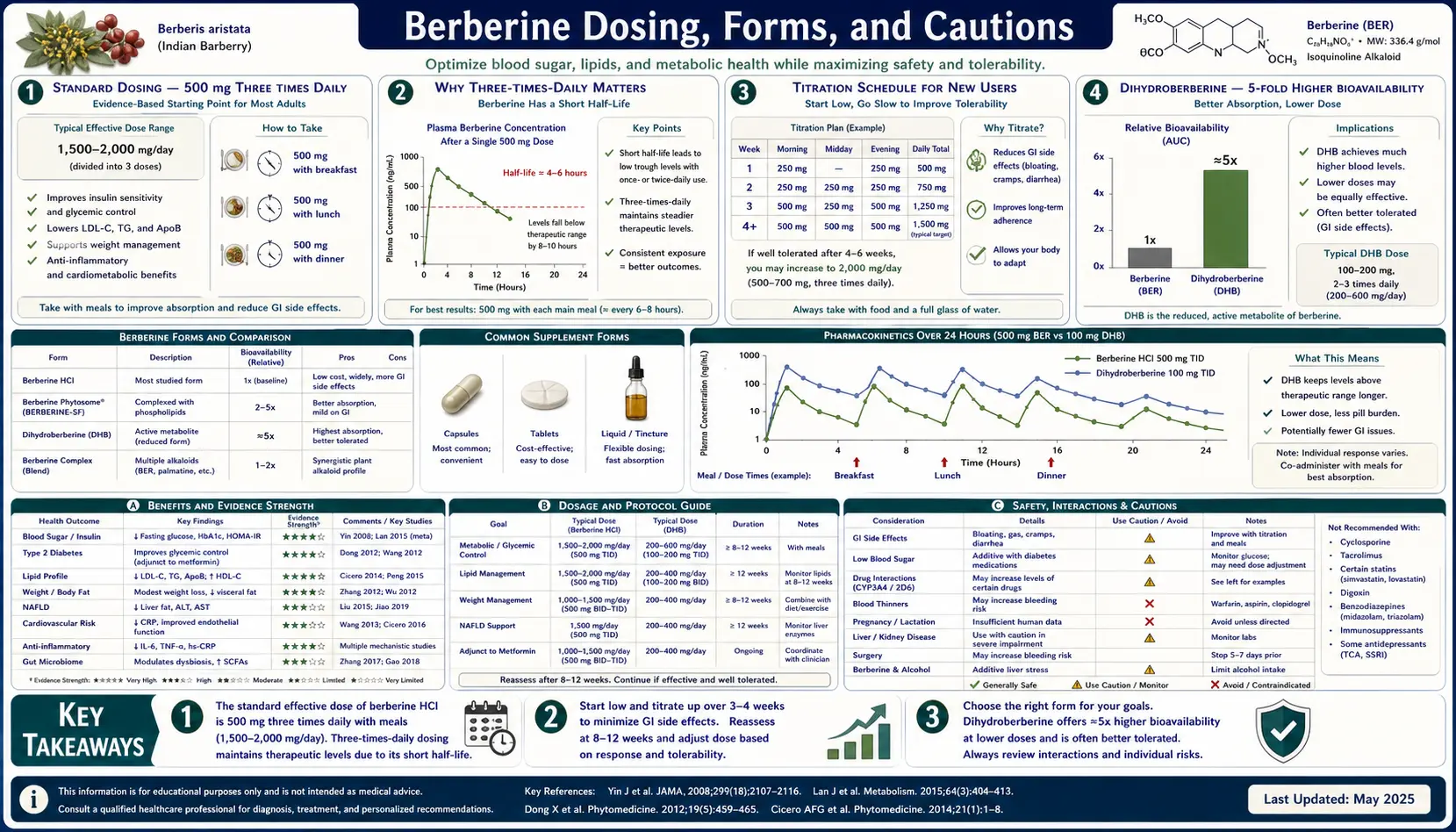
A common berberine regimen in clinical trials is 500 mg three times daily, taken with meals, for a total of 1,500 mg/day (the Yin 2008 diabetes trial); other trials used about 1,000 mg/day (the Zhang 2008 trial used 1.0 g a day). Practitioners hold that once-daily dosing produces approximately half the clinical effect because of berberine's short (about 4-hour) half-life. Within this standard regimen, however, a number of practical questions matter: which berberine salt or formulation is preferable, when dihydroberberine's reported higher bioavailability is worth the price premium, how people titrate to reduce gastrointestinal symptoms, and most importantly the groups for whom the research raises concerns. The absolute contraindications are pregnancy (kernicterus risk in neonates from bilirubin displacement at the albumin binding site), breastfeeding (same mechanism, transferred via breast milk), and jaundiced infants of any age. The relative contraindications driven by cytochrome P450 2D6 (CYP2D6) and cytochrome P450 3A4 (CYP3A4) inhibition are numerous but manageable with proper drug-interaction review. This page walks through dosing, formulations, titration strategy, drug interactions, and the specific patient populations for whom the research raises concerns or doses are changed.
Table of Contents
- Standard Dosing: 500 mg Three Times Daily
- Why Three-Times-Daily Matters
- Titration Schedule for New Users
- Dihydroberberine: Higher Reported Bioavailability
- Berberine Phytosome and Silymarin-Paired Formulations
- Berberine Hydrochloride vs Sulfate vs Citrate
- Gastrointestinal Tolerance and Side Effects
- The Pregnancy Contraindication (Kernicterus Risk)
- Cytochrome P450 2D6 and Cytochrome P450 3A4 Drug Interactions
- Special Populations: Chronic Kidney Disease, Elderly, Liver Disease
- Duration of Therapy and Monitoring
- Key Research Papers
- Connections
- Featured Videos
Standard Dosing: 500 mg Three Times Daily
A common trial regimen is 500 mg of berberine hydrochloride three times daily, with meals, for a total of 1,500 mg/day. The key trials and their doses:
- The Yin 2008 metformin-comparison diabetes trial — 0.5 g three times a day for 3 months in 36 adults with newly diagnosed type 2 diabetes; hemoglobin A1c fell from 9.5% to 7.5%, a glucose-lowering effect similar to metformin's
- The Kong 2004 Nature Medicine paper's clinical arm — 32 people with high cholesterol treated for 3 months; total cholesterol fell 29%, triglycerides 35% and low-density lipoprotein (LDL) cholesterol 25% (its dose is given below)
- The Zhang 2008 trial in 116 people with type 2 diabetes and abnormal blood fats (published in The Journal of Clinical Endocrinology and Metabolism) — 1.0 g a day for 3 months; hemoglobin A1c fell from 7.5% to 6.6% and LDL cholesterol from 3.23 to 2.55 mmol/L, both differing significantly from placebo
- Later trials, which have used a range of doses
Trials have found benefit at both 1,000 mg/day (Zhang 2008) and 1,500 mg/day (Yin 2008); no trial cited on this page compares doses directly. Practitioners report that doses above 2,000 mg/day total produce more gastrointestinal side effects without commensurate additional benefit.
Timing with meals matters for two reasons: (1) reduces the gastrointestinal symptoms of fasting-state berberine administration, and (2) maximizes the postprandial alpha-glucosidase and dipeptidyl peptidase-4 (DPP-4) inhibition effects covered on the Blood Sugar page. People who eat fewer than three meals per day commonly take berberine alongside any food (even a small snack) rather than on an empty stomach.
For patients taking berberine primarily for cholesterol (not glucose) effects, a slightly modified regimen of 500 mg twice daily is sometimes used — this is the Kong 2004 trial dose, which lowered LDL cholesterol by 25% over 3 months. No trial cited on this page compares it directly with the three-times-daily regimen.
Why Three-Times-Daily Matters
The pharmacokinetic basis for three-times-daily dosing is berberine's short plasma half-life. The terminal half-life of berberine in healthy human subjects is approximately 4 hours (some sources report 3-6 hours depending on assay method). With a 4-hour half-life:
- Once daily (1,500 mg single dose) — peak concentration is high but the molecule clears within ~16 hours, leaving 8 hours per day with sub-therapeutic concentration. Effective steady-state is poor.
- Twice daily (750 mg per dose) — produces better steady-state coverage but still has 12-hour gaps with declining concentration.
- Three times daily (500 mg per dose) — with 8-hour dose intervals, the concentration troughs are at approximately 25% of peak, and steady-state coverage is maintained throughout the day. This matches the experimental conditions of the positive trials.
- Four times daily (375 mg per dose) — slightly better steady-state coverage but the marginal benefit is small and compliance suffers.
The compliance challenge of three-times-daily dosing is real — many patients struggle to remember the noon dose. Strategies people use:
- Pill organizer with morning, noon, and evening compartments
- Phone alarm specifically for the noon dose
- Linking the noon dose to a daily ritual (immediately after lunch, before afternoon coffee)
- Some people who cannot manage three doses per day use dihydroberberine twice daily instead (covered below); no human trial cited on this page compares the two
Titration Schedule for New Users
In the Yin 2008 trial, 20 patients (34.5%) had transient gastrointestinal side effects, and in the Zhang 2008 trial mild to moderate constipation occurred in five people on berberine. The symptoms are primarily diarrhea, cramping, bloating, and occasionally constipation (some patients oscillate between the two as the gut microbiome remodels). These symptoms typically self-resolve within 2-4 weeks as the microbiome reaches a new equilibrium, but the initial intolerance is the principal reason new users discontinue.
People commonly use a graduated titration to reduce dropout:
- Week 1 — 500 mg once daily with dinner, while gastrointestinal tolerance is assessed.
- Week 2 — 500 mg twice daily (breakfast and dinner).
- Week 3 onward — 500 mg three times daily (breakfast, lunch, dinner). This is the steady-state regimen for ongoing use.
A slower schedule used by unusually sensitive people:
- Week 1-2 — 250 mg once daily with dinner
- Week 3-4 — 500 mg once daily
- Week 5-6 — 500 mg twice daily
- Week 7 onward — 500 mg three times daily
250 mg capsules are commercially available; alternatively, opening a 500 mg capsule and splitting the contents (berberine is a yellow powder, not unstable, no special handling) accomplishes the same. The taste is intensely bitter, so consumption as a powder is unpleasant, which is why it is usually taken as capsules.
Some people who still cannot tolerate berberine at full dose switch to dihydroberberine at 100-200 mg twice daily (covered below); its tolerability and effect have not been compared with standard berberine in a human trial cited on this page.
Dihydroberberine: Higher Reported Bioavailability
Dihydroberberine is the reduced form of berberine — with an additional hydrogen across the C7-C8 bond, converting the quaternary ammonium of berberine into the tertiary amine of dihydroberberine. Critically, this single chemical change dramatically improves oral absorption.
The Turner 2008 paper in Diabetes tested dihydroberberine in rodents fed a high-fat diet. In these animals, dihydroberberine:
- Showed improved efficacy in counteracting increased body fat, fat build-up in tissues, and insulin resistance
- Did so, the authors wrote, likely because of better absorption by mouth (oral bioavailability); the paper's abstract reports no blood-level comparison and no human data
In practice, dihydroberberine 100-200 mg twice daily is described as producing roughly the same systemic effect as berberine 500 mg three times daily, with fewer gastrointestinal side effects and a more convenient dosing schedule; no human trial testing that equivalence is cited on this page. The trade-offs people weigh:
- Cost — dihydroberberine is typically 2-3x the price per dose of standard berberine
- Less gut-microbiome effect — because more drug is absorbed, less remains in the lumen to remodel the microbiome. For patients whose principal indication is systemic (glucose, lipids), this is a non-issue. People using berberine for small intestinal bacterial overgrowth or other gut conditions generally use standard berberine, since the gut-luminal action is the one in question.
- Less long-term safety data — dihydroberberine has fewer human trials and a shorter track record than standard berberine
In practice, standard berberine 500 mg three times daily is the usual starting form. Dihydroberberine 200 mg twice daily is used by people who (a) cannot tolerate the gastrointestinal effects of standard berberine even after careful titration, or (b) cannot adhere to a three-times-daily schedule, or (c) have a strong preference for higher systemic exposure.
Berberine Phytosome and Silymarin-Paired Formulations
Two formulation strategies seek to improve berberine's oral absorption without the chemistry change to dihydroberberine:
- Berberine phytosome — berberine complexed with phospholipids (typically phosphatidylcholine from soy or sunflower lecithin). The phospholipid carrier improves berberine's passage across the intestinal epithelium by enhancing membrane interaction. A healthy-volunteer study of one such formulation, run by the manufacturer's researchers (Petrangolini 2021), reported about 10 times higher total blood exposure (area under the curve, on a molar basis) than free berberine.
- Berberine plus silymarin (milk thistle extract) — silymarin inhibits intestinal P-glycoprotein, the efflux pump that pumps absorbed berberine back into the gut lumen. Co-administration of silymarin 100-200 mg with berberine doses produces approximately 2-3x higher berberine plasma concentrations. A combination tablet tested in Italian trials contains 588 mg of Berberis aristata extract and 105 mg of Silybum marianum (milk thistle) extract.
Practitioners describe the standard berberine 500 mg three-times-daily regimen as sufficient for most people. The enhanced-bioavailability formulations are used mainly by people who have shown suboptimal response to standard berberine (poor hemoglobin A1c (HbA1c) or lipid response despite full compliance), or patients with documented malabsorption (post-bariatric surgery, advanced Crohn's) where conventional oral absorption is impaired.
In the Derosa 2015 trial, 137 people with high blood fats who could not tolerate high-dose statins went back on half their previous statin dose and added either a placebo or the Berberis aristata/Silybum marianum 588/105 mg tablet twice daily (at lunch and dinner) for six months. On the combination, fasting glucose fell by 9 mg/dl and blood fats stayed stable; on placebo they worsened, with total cholesterol 23.4 mg/dl, LDL cholesterol 19.6 mg/dl and triglycerides 23.1 mg/dl higher than with the combination. The trial did not compare the combination with free berberine.
A 2024 meta-analysis of 41 randomized trials (4,838 patients, 8–18 weeks of treatment) found that berberine-containing products lowered total cholesterol by about 17 mg/dL, LDL cholesterol by about 15 mg/dL and triglycerides by about 19 mg/dL, and raised HDL cholesterol by about 2 mg/dL, compared with control. Products with berberine alone had weaker effects on total and LDL cholesterol (the LDL change was not statistically certain), while berberine combined with Silybum marianum lowered LDL cholesterol by about 31 mg/dL (Hernandez 2024).
Berberine Hydrochloride vs Sulfate vs Citrate
Berberine in supplements is sold as one of several salt forms. The active berberine cation is the same; only the counter-ion differs. The salt form affects solubility, taste, and to a small extent absorption kinetics, but does not affect overall clinical efficacy.
- Berberine hydrochloride (BBR HCl) — the most common form, used in essentially all clinical trials. Yellow crystalline solid, modest water solubility, intensely bitter taste. The HCl salt is what is meant by "berberine 500 mg" on a supplement label unless specified otherwise.
- Berberine sulfate — older form, less commonly available now
- Berberine citrate — somewhat better water solubility than the HCl form, marketed in some products for purported faster onset
Berberine hydrochloride is the form most people use, because the clinical trial evidence is built on it. The other salts are not problematic; the dose adjustment for equivalent berberine content can be calculated from the molecular weights (BBR HCl molecular weight 371.8; berberine free base 336.4; so 500 mg BBR HCl = 452 mg berberine free base).
Labeling practice varies by manufacturer. Some labels report the berberine HCl content (which is what was in the trials), some report the berberine free base equivalent. For trial-equivalent dosing, the 1,500 mg/day trial amount refers to berberine HCl, which is approximately 1,355 mg/day of berberine free base.
Gastrointestinal Tolerance and Side Effects
The principal side effects of berberine, in roughly decreasing frequency (the percentages below are estimates with no trial cited for them; in the Yin 2008 trial, 34.5% of patients had transient gastrointestinal side effects):
- Diarrhea (10-20% in first 2 weeks, < 5% long-term) — mechanism: gut microbiome remodeling and direct intestinal motility effect. Typically transient and self-resolving.
- Abdominal cramping (5-10%) — mechanism: intestinal smooth muscle effect of high luminal berberine concentration
- Constipation (3-5%) — some patients experience this paradoxical effect, particularly during the microbiome transition period
- Bloating and flatulence (5-10%) — gas production by the remodeled microbiome
- Nausea (2-3%) — usually responds to taking with food
- Headache (1-2%) — uncommon, mechanism uncertain
- Hypoglycemia in patients also taking sulfonylureas or insulin — additive glucose-lowering effect; doses of those agents may need to be reduced when berberine is added
Serious adverse events are very rare. Long-term safety (years of continuous use) has not been formally studied in large cohorts, but a berberine-containing combination product sold in Italy has been used widely in primary care for over 15 years without alarming signals, and traditional Chinese use of berberine-containing plants (Huang Lian) over centuries has not produced documented chronic toxicity at culinary or therapeutic doses.
Drug-induced hepatotoxicity from berberine is rare but has been reported. Practitioners commonly check liver enzymes in people on long-term berberine, particularly when combined with other hepatically-cleared agents (red yeast rice, statins).
A 2025 meta-analysis of randomized placebo-controlled trials in metabolic syndrome found that berberine lowered triglycerides (by 0.367 mmol/L), fasting blood glucose (by 0.515 mmol/L), waist size (by 3.27 cm) and LDL cholesterol (by 0.495 mmol/L), had no significant effect on HDL cholesterol or blood pressure, and showed no significant difference in side effects between berberine and placebo (Liu 2025).
The Pregnancy Contraindication (Kernicterus Risk)
The single most important safety issue with berberine is the absolute contraindication in pregnancy and in breastfeeding. The mechanism is bilirubin displacement from serum albumin.
Background: bilirubin is a yellow breakdown product of heme that is bound to serum albumin during transport from the reticuloendothelial system to the liver for conjugation. In adults, the liver can handle conjugation easily. In newborns, particularly premature newborns, hepatic uridine diphosphate glucuronosyltransferase 1A1 (UGT1A1, the enzyme that conjugates bilirubin) is immature and not yet at full capacity. Unconjugated bilirubin can cross the blood-brain barrier and deposit in the basal ganglia, producing the neurological syndrome called kernicterus — a permanent, devastating injury producing cerebral palsy, deafness, and cognitive impairment.
Several drugs displace bilirubin from albumin binding, freeing it to cross the blood-brain barrier. Sulfonamide antibiotics are the classic example (the classic evidence is a 1956 trial in premature infants given two different preventive antibiotic regimens, which differed in deaths and in kernicterus). Berberine also has this property — it competes with bilirubin for the same albumin binding site.
The teratogenic and neonatal risks:
- Berberine taken during pregnancy can cross the placenta and reach the fetal circulation, where the immature fetal liver and blood-brain barrier create kernicterus risk
- Berberine taken during breastfeeding is transferred in breast milk and reaches the newborn, who is the highest-risk individual for kernicterus
- Jaundiced infants — the 1993 study that measured berberine's bilirubin displacement concluded that berberine-rich herbs are best avoided in jaundiced newborns and pregnant women; precautionary practice extends this to any jaundiced infant and to all infants under one year
Standard practice treats this contraindication as absolute: people of reproductive age are counseled to stop berberine if pregnancy is planned or detected, and not to use it while breastfeeding. Women with polycystic ovary syndrome who use berberine while trying to conceive typically stop it at a positive pregnancy test.
Cytochrome P450 2D6 and Cytochrome P450 3A4 Drug Interactions
Berberine inhibits several cytochrome P450 enzymes. In a 2012 study in healthy men given berberine 300 mg three times daily for 2 weeks (Guo 2012), cytochrome P450 2D6 activity fell sharply (the urine ratio of dextromethorphan to its breakdown product dextrorphan rose ninefold), cytochrome P450 2C9 activity fell (the losartan-to-E-3174 ratio doubled), and cytochrome P450 3A4 activity fell moderately (midazolam's total exposure rose 40% and its peak level 38%). The three enzymes:
- Cytochrome P450 2D6 — metabolizes approximately 25% of commonly used drugs, including many antidepressants, antipsychotics, opioids, and beta-blockers
- Cytochrome P450 3A4 — metabolizes approximately 50% of commonly used drugs, including statins, calcium channel blockers, immunosuppressants, many antibiotics, and many antivirals
- Cytochrome P450 2C9 — metabolizes losartan (the probe drug in the Guo 2012 study) and the more active form of warfarin, among others
Drugs with potentially clinically meaningful interactions with berberine include:
- Cyclosporine (transplant immunosuppressant) — in a randomized trial in kidney-transplant recipients (Wu 2005), cyclosporine trough levels rose 88.9% from baseline in 52 patients given berberine 0.2 g three times daily, against 64.5% in 52 patients not given it, ending 29.3% higher than in the group without berberine; in a 6-patient pharmacokinetic study, cyclosporine's total exposure rose 34.5%. No significant effects on liver or kidney function were seen, and the authors noted the combination may allow a lower cyclosporine dose.
- Tacrolimus, sirolimus (other immunosuppressants) — same cytochrome P450 3A4 mechanism, same caution
- Statins metabolized by cytochrome P450 3A4 (atorvastatin, simvastatin, lovastatin) — berberine may modestly increase statin concentrations, potentially increasing rhabdomyolysis risk. The combination is widely used, and practitioners check liver enzymes and creatine kinase (a muscle-damage marker) periodically.
- Calcium channel blockers (amlodipine, felodipine, verapamil) — potential for increased hypotensive effect
- Antidepressants metabolized by cytochrome P450 2D6 (paroxetine, fluoxetine, venlafaxine, duloxetine) — potential for increased plasma concentrations and side effects
- Antipsychotics (risperidone, haloperidol, olanzapine) — same mechanism, same caution
- Beta-blockers (metoprolol, propranolol, carvedilol) — potential for increased plasma concentrations
- Opioids (codeine, tramadol — both cytochrome P450 2D6-activated prodrugs) — berberine may reduce conversion to active metabolites, potentially reducing analgesic effect
- Warfarin — berberine may increase warfarin effect; a 2026 review grades this as laboratory and mechanism evidence only, with no human study of the pair, and places warfarin in its high-risk tier, with international normalized ratio (INR) monitoring if the two are combined (Dumitru 2026)
- Metformin — berberine slows metformin absorption and reduces its peak plasma concentration, though steady-state remains adequate. The two are widely used together; the practical impact is modest.
The same 2026 review states that berberine use belongs in every medication review. Its high-risk tier covers narrow-margin drugs such as cyclosporine, tacrolimus and warfarin in vulnerable patients: it discourages the combination or, if unavoidable, describes supervision, monitoring and dose adjustment of the other drug. Its moderate tier, active monitoring, covers drugs without a critical margin that use the CYP2D6 or CYP3A4 pathways, a group that includes many psychiatric medicines (Dumitru 2026).
Special Populations: Chronic Kidney Disease, Elderly, Liver Disease
Chronic kidney disease — berberine is primarily metabolized in the liver and gut, not renally cleared, so it does not accumulate in chronic kidney disease (CKD). The estimated glomerular filtration rate (eGFR) >30 restriction that limits metformin does not apply to berberine. However, the chronic kidney disease population is also typically polypharmacy and the CYP450 interaction risk is elevated; medication reconciliation is essential.
Elderly patients (>75 years) — berberine is generally well tolerated, but the higher prevalence of polypharmacy creates more drug interaction risk. Practitioners commonly start lower (250 mg once daily for the first week) and titrate more slowly.
Liver disease — berberine has been studied in non-alcoholic fatty liver disease (NAFLD) with mixed results on liver fat and liver enzymes (see Berberine and Fatty Liver Disease). In advanced cirrhosis (Child-Pugh B or C), the limited hepatic reserve makes CYP450 interactions more clinically meaningful, and the principle of starting low and titrating slowly applies. Bilirubin displacement in jaundiced patients is theoretically a concern though has not been documented in adults; conservative practice is to avoid berberine in patients with significantly elevated bilirubin.
Cardiac arrhythmias — berberine has historically been used in China for cardiac arrhythmias (ventricular tachycardia) at higher doses. At standard 1,500 mg/day doses, no clinically meaningful effect on QT interval or other arrhythmia markers has been documented, but the molecule is a class III antiarrhythmic at high doses. For patients on QT-prolonging medications (azithromycin, fluconazole, quetiapine), the combination is reasonable but warrants attention.
Bariatric surgery — absorption is typically impaired after gastric bypass and duodenal switch. Standard berberine doses may produce reduced systemic effect; some practitioners use dihydroberberine or higher doses with monitoring.
Duration of Therapy and Monitoring
Berberine is used long term by people with chronic indications (type 2 diabetes, dyslipidemia, metabolic syndrome, non-alcoholic fatty liver disease, recurrent small intestinal bacterial overgrowth). Unlike antibiotics, there is no concern about driving resistance with chronic use, and the metabolic mechanisms continue to provide benefit indefinitely.
A monitoring schedule commonly used by practitioners:
- Baseline — lipid panel, hemoglobin A1c, comprehensive metabolic panel (including liver enzymes and creatinine), thyroid-stimulating hormone (TSH) if reasonable, medication reconciliation
- 3 months — lipid panel, hemoglobin A1c, liver enzymes, with the dose adjusted if needed.
- 6 months — same panel
- Annually thereafter — lipid panel, hemoglobin A1c, liver enzymes, complete blood count
If the principal indication is small intestinal bacterial overgrowth, a course of 4-8 weeks is typical, followed by prokinetic maintenance therapy to prevent relapse. Long-term berberine for small intestinal bacterial overgrowth maintenance is reasonable but the metabolic-target population is the more typical long-term user.
The most common reason for discontinuation is intolerable gastrointestinal symptoms in the first month, which is largely preventable with careful titration. The second most common reason is loss of clinical benefit, which typically indicates either non-adherence or a need to switch to dihydroberberine for better systemic exposure.
Key Research Papers
- Turner N, Li JY, Gosby A et al. (2008). Berberine and its more biologically available derivative, dihydroberberine, inhibit mitochondrial respiratory complex I: a mechanism for the action of berberine. Diabetes, 57(5):1414-1418. — PubMed PMID: 18285556
- Liu YT, Hao HP, Xie HG et al. (2010). Extensive intestinal first-pass elimination and predominant hepatic distribution of berberine explain its low plasma levels in rats. Drug Metabolism and Disposition, 38(10):1779-1784. — PubMed PMID: 20634337
- Chan E (1993). Displacement of bilirubin from albumin by berberine. Biology of the Neonate, 63(4):201-208. — PubMed PMID: 8513024
- Guo Y, Chen Y, Tan ZR et al. (2012). Repeated administration of berberine inhibits cytochromes P450 in humans. European Journal of Clinical Pharmacology, 68(2):213-217. — PubMed PMID: 21870106
- Wu X, Li Q, Xin H et al. (2005). Effects of berberine on the blood concentration of cyclosporin A in renal transplanted recipients: clinical and pharmacokinetic study. European Journal of Clinical Pharmacology, 61(8):567-572. — PubMed PMID: 16133554
- Hua W, Ding L, Chen Y et al. (2007). Determination of berberine in human plasma by liquid chromatography-electrospray ionization-mass spectrometry. Journal of Pharmaceutical and Biomedical Analysis, 44(4):931-937. — PubMed PMID: 17531424
- Derosa G, Romano D, D'Angelo A, Maffioli P (2015). Berberis aristata combined with Silybum marianum on lipid profile in patients not tolerating statins at high doses. Atherosclerosis, 239(1):87-92. — PubMed PMID: 25577665
- Petrangolini G, Corti F, Ronchi M et al. (2021). Development of an innovative berberine food-grade formulation with an ameliorated absorption: in vitro evidence confirmed by healthy human volunteers pharmacokinetic study. Evidence-Based Complementary and Alternative Medicine, 2021:7563889. — PubMed PMID: 34904017
- Pan GY, Wang GJ, Liu XD et al. (2002). The involvement of P-glycoprotein in berberine absorption. Pharmacology and Toxicology, 91(4):193-197. — PubMed PMID: 12530470
- Imenshahidi M, Hosseinzadeh H (2019). Berberine and barberry (Berberis vulgaris): a clinical review. Phytotherapy Research, 33(3):504-523. — PubMed PMID: 30637820
- Habtemariam S (2016). Berberine and inflammatory bowel disease: a concise review. Pharmacological Research, 113(Pt A):592-599. — PubMed PMID: 27697643
- Dumitru CN, Marcu T, Dumitru AO, Tudor SS, Ferțu ID, Elisei AM, Goroftei L (2026). Berberine-Drug Interactions: Mechanisms, Clinical Relevance and Risk Stratification-A Narrative Review. Pharmaceuticals (Basel), 19(8):1313. — PubMed PMID: 42653808
- Kong W, Wei J, Abidi P et al. (2004). Berberine is a novel cholesterol-lowering drug working through a unique mechanism distinct from statins. Nature Medicine, 10(12):1344-1351. — PubMed PMID: 15531889
- Yin J, Xing H, Ye J (2008). Efficacy of berberine in patients with type 2 diabetes mellitus. Metabolism: Clinical and Experimental, 57(5):712-717. — PubMed PMID: 18442638
- Zhang Y, Li X, Zou D et al. (2008). Treatment of type 2 diabetes and dyslipidemia with the natural plant alkaloid berberine. The Journal of Clinical Endocrinology and Metabolism, 93(7):2559-2565. — PubMed PMID: 18397984
- Andersen DH, Blanc WA, Crozier DN, Silverman WA (1956). A difference in mortality rate and incidence of kernicterus among premature infants allotted to two prophylactic antibacterial regimens. Pediatrics, 18(4):614-625. — PubMed PMID: 13370229
- Hernandez AV, Hwang J, Nasreen I et al. (2024). Impact of berberine or berberine combination products on lipoprotein, triglyceride and biological safety marker concentrations in patients with hyperlipidemia: a systematic review and meta-analysis. Journal of Dietary Supplements, 21(2):242-259. — PubMed PMID: 37183391
- Liu D, Zhao H, Zhang Y, Hu J, Xu H (2025). Efficacy and safety of berberine on the components of metabolic syndrome: a systematic review and meta-analysis of randomized placebo-controlled trials. Frontiers in Pharmacology, 16:1572197. — PubMed PMID: 40740996
PubMed Topic Searches
Connections
- All Remedies
- Berberine Overview
- Berberine Benefits Hub
- Berberine for Blood Sugar
- Berberine for Cholesterol
- Berberine for Gut Microbiome
- Berberine and Iron Overload
- Milk Thistle (Silymarin)
- Goldenseal (Hydrastis canadensis)
- Red Yeast Rice (Monacolin K)
- Type 2 Diabetes
- Dyslipidemia
- Small Intestinal Bacterial Overgrowth
- Non-Alcoholic Fatty Liver Disease
- Hemoglobin A1c Lab Test
- Lipid Panel Lab Test