⚠ Evidence warning: Clinical trials or other evidence do not support the claim that 5R gut protocols, vagal-tone training (cold exposure, slow breathing, gargling) and leaky-gut repair rebuild a dysregulated gut-brain axis and help depression, autism and Parkinson's disease. This page keeps it as a report of what people, websites or other media say.
Gut-Brain Axis — Benefits Deep Dive
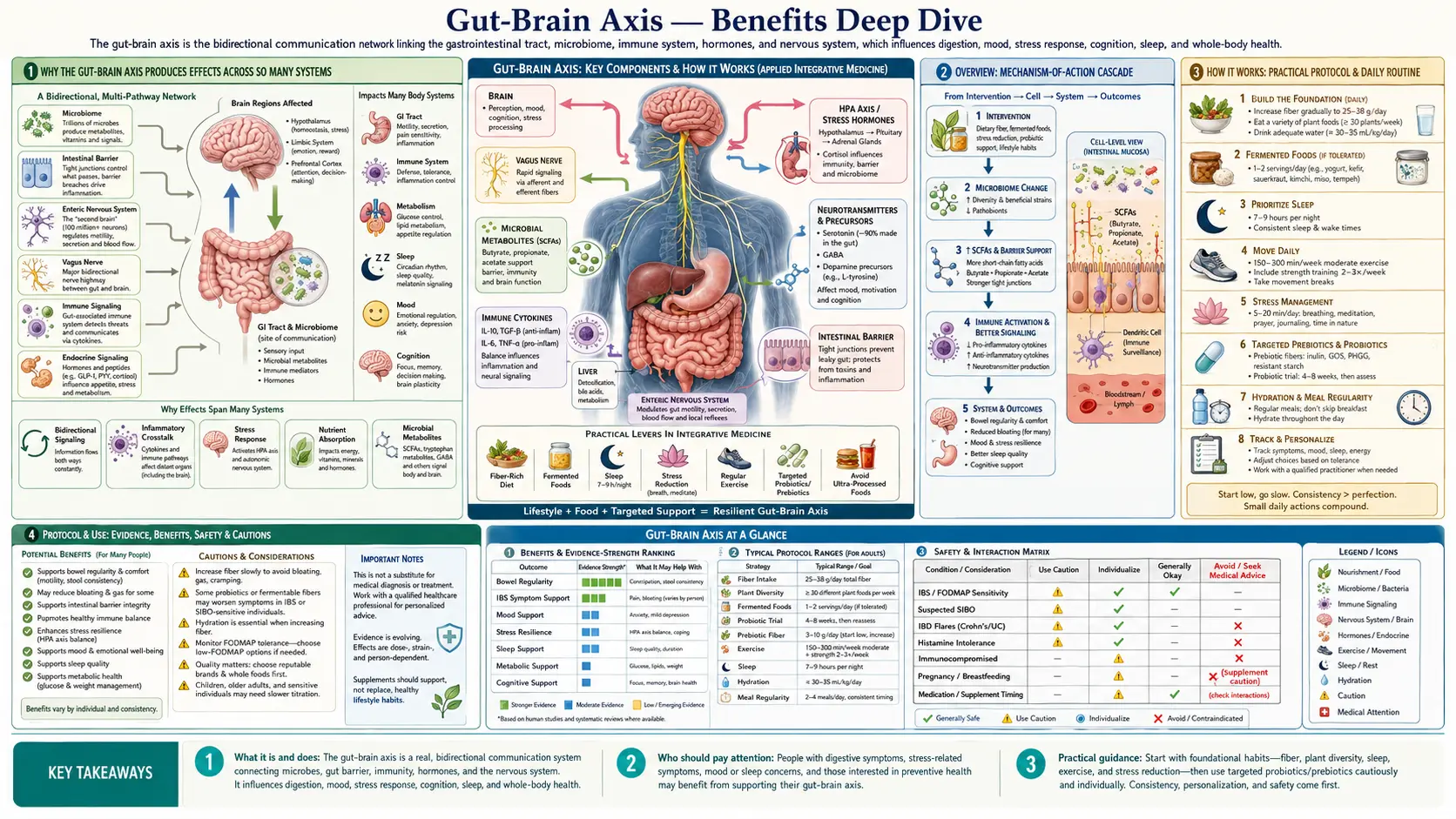
The gut-brain axis is a bidirectional communication network linking the central nervous system to the enteric nervous system through neural, endocrine, immune, and metabolic pathways. It is the only physiological circuit in which a peripheral organ — the gastrointestinal tract — can fundamentally reshape mood, cognition, stress reactivity, and even neurodegenerative disease trajectory through its resident microbial community. Four benefit pages below explore the four mechanistic pillars where this axis produces the largest clinical effect — the vagal nerve as the physical wire connecting gut to brain, microbial production of neurotransmitter precursors that modulate mood, the stress-permeability feedback loop that drives "leaky gut" pathology, and the practical restoration protocols (diet, probiotics, lifestyle) that rebuild a dysregulated axis.
Deep-Dive Articles
Vagal Nerve Signaling
The vagus nerve as the longest cranial nerve and the dominant parasympathetic conduit between gut and brain — 80% afferent (gut to brain), 20% efferent. How vagal afferents detect microbial metabolites (short-chain fatty acids, lipopolysaccharide), mechanical distension, and gut peptides (glucagon-like peptide-1 (GLP-1), cholecystokinin (CCK), ghrelin), and how implanted vagus nerve stimulation is approved by the U.S. Food and Drug Administration (FDA) for epilepsy and treatment-resistant depression, a non-invasive vagus nerve stimulation device is FDA-cleared for migraine and cluster-type headaches (trigeminal autonomic cephalalgias), and stimulation through the ear (transcutaneous auricular vagus nerve stimulation) is still being studied.
Read the deep dive →Serotonin & Mood
Why 90-95% of body serotonin is produced in enterochromaffin cells of the gut, not the brain. Tryptophan as the limiting precursor, the role of Bifidobacterium and Lactobacillus in tryptophan metabolism, the kynurenine pathway diversion under inflammation, the gut-derived "psychobiotics" producing gamma-aminobutyric acid (GABA) and dopamine precursors, and what this means for major depressive disorder, anxiety, and the selective serotonin reuptake inhibitor (SSRI) gut side-effect profile.
Read the deep dive →Stress & Intestinal Permeability
The hypothalamic-pituitary-adrenal (HPA) axis, corticotropin-releasing hormone (CRH)-induced mast cell degranulation, zonulin-mediated tight junction disassembly, and the bidirectional feedback loop in which chronic stress causes "leaky gut" and lipopolysaccharide translocation, which in turn drives neuroinflammation, microglial activation, and further hypothalamic-pituitary-adrenal hyperactivation. The Alessio Fasano zonulin discovery, the role of gliadin and dysbiosis, and links to depression, autism, and Parkinson's disease.
Read the deep dive →Restoration Protocols
Protocols used to rebuild a dysregulated gut-brain axis: the practitioner-built 5R framework (Remove, Replace, Reinoculate, Repair, Rebalance), Mediterranean and low-FODMAP (fermentable oligosaccharides, disaccharides, monosaccharides and polyols) diets, fermented foods vs. probiotic capsules, the Bifidobacterium longum 1714 and Lactobacillus rhamnosus JB-1 strain-specific psychobiotic evidence, vagal tone training (cold exposure, slow breathing, gargling), and adjuncts including L-glutamine, zinc carnosine, and butyrate.
Read the deep dive →Table of Contents
- Deep-Dive Articles
- Why the Gut-Brain Axis Produces Effects Across So Many Systems
- Research Papers: Vagal Nerve Signaling
- Research Papers: Serotonin and Mood
- Research Papers: Stress and Permeability
- Research Papers: Restoration Protocols and Psychobiotics
- Research Papers: Cross-Cutting (Mechanism, Microbiome, Disease Associations)
- External Authoritative Resources
- Connections
- Featured Videos
Why the Gut-Brain Axis Produces Effects Across So Many Systems
Unlike a single hormone or neurotransmitter, the gut-brain axis is a multi-channel communication system. Four parallel pathways link gut to brain, each with its own anatomy, kinetics, and clinical signature. Almost every condition that maps onto this axis — from irritable bowel syndrome to major depression to Parkinson's disease — engages two or more of these channels simultaneously, which is why isolated single-target interventions (a single probiotic strain, a selective serotonin reuptake inhibitor alone, a fiber supplement) often disappoint when chronic gut-brain dysregulation is the underlying problem.
- Neural pathway (vagus nerve) — the vagus nerve is the physical wire connecting gut to brainstem. Vagal afferents detect microbial metabolites, mechanical distension, and gut peptides; vagal efferents modulate gut motility, secretion, and mucosal immunity. This is the mechanism behind implanted vagus nerve stimulation, approved by the U.S. Food and Drug Administration for treatment-resistant depression in 2005, and why cutting the vagus nerve in mice blocked the anxiety- and depression-related effects of one probiotic strain (Bravo 2011). A 2018 review (Bonaz and colleagues) describes the vagus nerve as about 80% afferent (gut-to-brain) and 20% efferent (brain-to-gut) fibers, states that stress inhibits the vagus nerve, and reports that low vagal tone has been described in people with irritable bowel syndrome and inflammatory bowel disease, which the review says favors inflammation in the body outside the brain.
- Endocrine pathway (gut peptides and hypothalamic-pituitary-adrenal axis) — enteroendocrine cells secrete glucagon-like peptide-1, peptide YY, cholecystokinin, and ghrelin in response to nutrient sensing. These peptides cross the blood-brain barrier (or signal via vagal afferents) and modulate satiety, mood, and stress reactivity. Stress in turn drives corticotropin-releasing hormone (CRH) release, which directly increases intestinal permeability — the bidirectional loop discussed on the Stress and Permeability page.
- Immune pathway (cytokines and lipopolysaccharide) — the gut is the largest immune organ in the body, with 70% of immune cells residing in gut-associated lymphoid tissue (GALT). Intestinal barrier breakdown allows bacterial lipopolysaccharide (LPS) translocation into circulation, triggering systemic and central nervous system inflammation. Microglial activation by elevated lipopolysaccharide and inflammatory cytokines (interleukin-6 (IL-6), tumor necrosis factor-alpha) is now implicated in the pathophysiology of depression, anxiety, and neurodegenerative disease.
- Metabolic pathway (microbial metabolites) — the gut microbiome produces short-chain fatty acids (butyrate, propionate, acetate) from fiber fermentation, neurotransmitter precursors (tryptophan, tyrosine, glutamate, gamma-aminobutyric acid), and signaling molecules (bile acid derivatives, indoles). Many of these metabolites cross the blood-brain barrier or modulate vagal afferent signaling. The 90-95% of body serotonin produced in the gut is the most famous example, but butyrate's direct neuroprotective effects and the gamma-aminobutyric acid-producing capacity of certain Lactobacillus strains are equally important.
The therapeutic implication is that effective restoration protocols target multiple pathways simultaneously — dietary fiber to feed butyrate-producing bacteria, fermented foods to provide live psychobiotic strains, vagal tone training (cold exposure, slow breathing) to normalize parasympathetic signaling, and stress reduction to break the hypothalamic-pituitary-adrenal-permeability feedback loop. No single intervention addresses all four pathways, which is why "gut healing" in clinical practice is multi-modal and time-consuming.
Research Papers: Vagal Nerve Signaling
- Bravo JA et al. (2011). Ingestion of Lactobacillus strain regulates emotional behavior and central GABA receptor expression in a mouse via the vagus nerve. PNAS. — PubMed PMID: 21876150
- Bonaz B, Bazin T, Pellissier S (2018). The vagus nerve at the interface of the microbiota-gut-brain axis. Frontiers in Neuroscience. — PubMed PMID: 29467611
- FDA approval of implanted vagus nerve stimulation for treatment-resistant depression (2005): Austelle CW, O'Leary GH, Thompson S, Gruber E, Kahn A, Manett AJ, Short B, Badran BW (2022). A comprehensive review of vagus nerve stimulation for depression. Neuromodulation. — PubMed PMID: 35396067
- Vagal afferent sensing of microbial short-chain fatty acids — PubMed: Vagal short-chain fatty acid sensing
- Cholinergic anti-inflammatory pathway (Tracey, Nature 2002) — PubMed: Tracey cholinergic pathway
- Heart rate variability as biomarker of vagal tone — PubMed: Heart rate variability and vagal tone
- Vagus nerve stimulation for refractory epilepsy — PubMed: Vagus nerve stimulation for epilepsy
- Polyvagal theory and ventral vagal complex (Porges) — PubMed: Polyvagal theory
- GLP-1 vagal afferent signaling and food reward — PubMed: GLP-1 vagal signaling
- Vagotomy and protection from Parkinson's disease (Svensson 2015) — PubMed: Vagotomy and Parkinson's
Research Papers: Serotonin and Mood
- Yano JM et al. (2015). Indigenous bacteria from the gut microbiota regulate host serotonin biosynthesis. Cell. — PubMed: Yano serotonin
- O'Mahony SM et al. Serotonin, tryptophan metabolism and the brain-gut-microbiome axis. Behavioural Brain Research. — PubMed: O'Mahony tryptophan
- Enterochromaffin cells as primary source of body serotonin — PubMed: Enterochromaffin cells
- Kynurenine pathway diversion of tryptophan under inflammation — PubMed: Kynurenine pathway
- Psychobiotic Lactobacillus rhamnosus JB-1 (Bravo) anxiety reduction — PubMed: L. rhamnosus JB-1
- Bifidobacterium longum 1714 and stress in humans (Allen 2016) — PubMed: B. longum 1714
- GABA production by Lactobacillus and Bifidobacterium strains — PubMed: GABA-producing probiotics
- SSRI gut side effects and 5-HT3 receptors in enterochromaffin cells — PubMed: SSRI gut side effects
- Tryptophan depletion studies and mood — PubMed: Tryptophan depletion
- Fecal microbiota transplantation for depression — PubMed: Fecal microbiota transplantation for depression
- Kelly JR, Allen AP, Temko A, Hutch W, Kennedy PJ, Farid N, Murphy E, Boylan G, Bienenstock J, Cryan JF, Clarke G, Dinan TG (2017). Lost in translation? The potential psychobiotic Lactobacillus rhamnosus (JB-1) fails to modulate stress or cognitive performance in healthy male subjects. Brain, Behavior, and Immunity. — PubMed PMID: 27865949
The mouse findings for Lactobacillus rhamnosus JB-1 did not carry over to healthy people: in an 8-week randomized, placebo-controlled crossover trial in 29 healthy men, the strain did not change mood, anxiety, stress or sleep quality, the stress-hormone response to a cold-water stress test, inflammation markers, or memory and attention compared with placebo (Kelly 2017). The authors write that people with stress-related disorders still need to be studied.
Research Papers: Stress and Permeability
- Fasano A. Zonulin and its regulation of intestinal barrier function. Physiological Reviews. — PubMed: Fasano zonulin
- Soderholm JD, Perdue MH. Stress and gastrointestinal tract. II. Stress and intestinal barrier function. American Journal of Physiology – Gastrointestinal and Liver Physiology. — PubMed: Soderholm stress
- CRH-mast cell axis and intestinal permeability — PubMed: CRH mast cells
- Lipopolysaccharide translocation, leaky gut, and depression — PubMed: LPS translocation depression
- Maes M, Kubera M, Leunis JC (2008). The gut-brain barrier in major depression: intestinal mucosal dysfunction with an increased translocation of LPS from gram negative enterobacteria (leaky gut) plays a role in the inflammatory pathophysiology of depression. Neuro Endocrinol Lett. — PubMed PMID: 18283240
- Microglial activation and systemic inflammation — PubMed: Microglial activation
- Tight junction proteins (claudin, occludin, ZO-1) and gut permeability — PubMed: Tight junctions
- HPA axis dysregulation in irritable bowel syndrome — PubMed: HPA axis in irritable bowel syndrome
- Gliadin, zonulin, and non-celiac gluten sensitivity — PubMed: Gliadin and zonulin
- Early-life stress, dysbiosis, and adult mental health — PubMed: Early-life stress
- Wallon C, Yang PC, Keita AV, Ericson AC, McKay DM, Sherman PM, Perdue MH, Söderholm JD (2008). Corticotropin-releasing hormone (CRH) regulates macromolecular permeability via mast cells in normal human colonic biopsies in vitro. Gut. — PubMed PMID: 17525093
The stress hormone and gut leakiness in human tissue: in a laboratory study of colon tissue samples (biopsies) from 39 volunteers, corticotropin-releasing hormone raised the passage of a large protein (horseradish peroxidase) through the gut lining to 2.8 pmol/cm²/h, compared with 1.5 pmol/cm²/h without it, and a mast-cell stabilizer (lodoxamide) blocked the effect (Wallon 2008). This was tissue tested in the laboratory, not a study in living people.
Research Papers: Restoration Protocols and Psychobiotics
- Sarkar A et al. Psychobiotics and the manipulation of bacteria-gut-brain signals. Trends in Neurosciences. — PubMed: Sarkar psychobiotics
- Mediterranean diet, microbiome diversity, and mood — PubMed: Mediterranean diet
- SMILES trial: dietary intervention for major depression (Jacka 2017) — PubMed: SMILES trial
- Fermented foods and microbiome diversity (Wastyk 2021): Wastyk HC, Fragiadakis GK, Perelman D, Dahan D, Merrill BD, Yu FB, Topf M, Gonzalez CG, Van Treuren W, Han S, Robinson JL, Elias JE, Sonnenburg ED, Gardner CD, Sonnenburg JL. Gut-microbiota-targeted diets modulate human immune status. Cell. — PubMed PMID: 34256014
- Butyrate, histone deacetylase (HDAC) inhibition, and neuroprotection — PubMed: Butyrate neuroprotection
- L-glutamine and intestinal barrier repair — PubMed: L-glutamine barrier
- Zinc carnosine and gut mucosa repair — PubMed: Zinc carnosine
- Cold exposure, breathing, and vagal tone training — PubMed: Vagal tone training
- 5R framework (Functional Medicine gut healing protocol) — PubMed: 5R framework
- Low-FODMAP diet and irritable bowel syndrome symptom reduction — PubMed: Low-FODMAP for irritable bowel syndrome
Fermented foods and gut-microbe diversity: in a 17-week randomized study in healthy adults (18 people per group), a diet high in fermented foods steadily increased the diversity of gut microbes and lowered inflammatory markers, while a high-fiber diet left microbial diversity unchanged (Wastyk 2021).
Research Papers: Cross-Cutting (Mechanism, Microbiome, Disease Associations)
- Cryan JF, Dinan TG. Mind-altering microorganisms: the impact of the gut microbiota on brain and behaviour. Nature Reviews Neuroscience. — PubMed: Cryan Dinan review
- Cryan JF et al. (2019). The microbiota-gut-brain axis. Physiological Reviews. — PubMed: Cryan 2019 review
- Mayer EA et al. Gut-brain axis and the microbiota. Journal of Clinical Investigation. — PubMed: Mayer JCI
- Germ-free mice and altered HPA stress response (Sudo 2004) — PubMed: Sudo germ-free
- Parkinson's disease and gut microbiome (alpha-synuclein) — PubMed: Parkinson's microbiome
- Autism spectrum disorder and gut microbiome dysbiosis — PubMed: Autism and microbiome
- Alzheimer's disease, neuroinflammation, and gut barrier — PubMed: Alzheimer's and gut
- Vagus nerve as conduit for alpha-synuclein spread — PubMed: Vagal alpha-synuclein
- Multiple sclerosis and gut microbiome — PubMed: Multiple sclerosis and microbiome
- Anxiety, depression and the microbiome: human cohort evidence (Valles-Colomer 2019) — PubMed: Valles-Colomer cohort
External Authoritative Resources
- PubMed — All gut-brain axis research (~30,000+ papers)
- APC Microbiome Ireland (Alimentary Pharmabiotic Centre; Cryan / Dinan group at University College Cork) — the leading academic center for microbiota-gut-brain axis research
- University of California, Los Angeles (UCLA) Integrative Digestive Health (Mayer group)
- National Institutes of Health (NIH), National Institute of Diabetes and Digestive and Kidney Diseases (NIDDK) — Digestive Diseases
- Gastroenterology journal (flagship journal of the American Gastroenterological Association (AGA); gut-brain axis is a regular feature topic)