⚠ Evidence warning: Clinical trials or other evidence do not support the claims that calcium and magnesium taken with meals block fluoride absorption and ease fluoride-related joint pain, cramps and tooth sensitivity. This page keeps it as a report of what people, websites or other media say.
Calcium and Magnesium for Fluoride
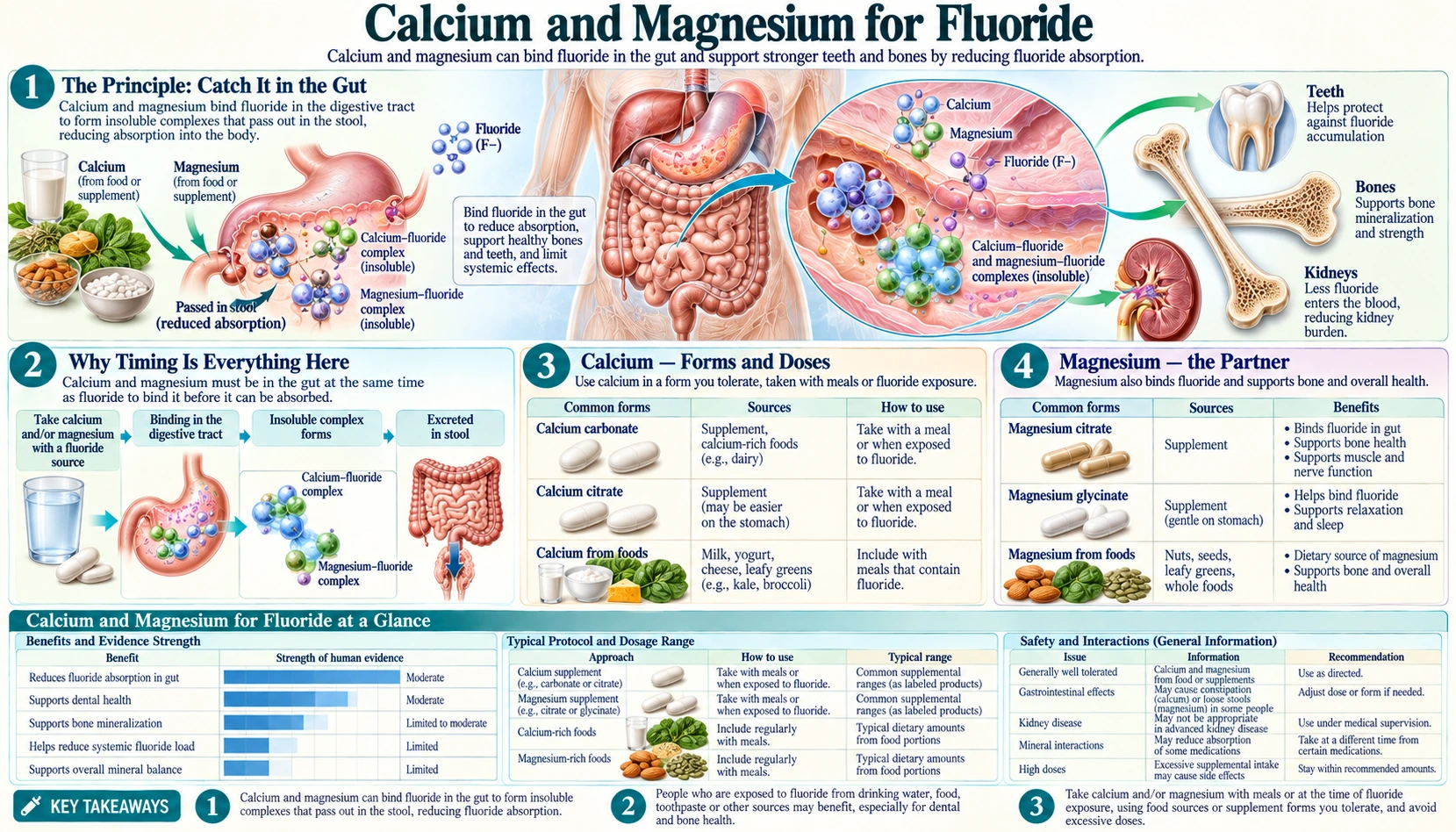
People describe this as the oldest approach in the fluoride toolkit and the least argued over. In the villages of India and China where fluorosis has been a fact of life for generations, the traditional answer was never exotic — it was get more calcium into people. The reasoning given is the simplest principle available: fluoride you never absorb is fluoride you never have to remove.
Table of Contents
The Principle: Catch It in the Gut
Fluoride and calcium find each other. Put them in the same place and they form calcium fluoride, which is poorly soluble — meaning it does not dissolve well, does not cross the gut wall well, and largely carries straight through and out.
That is the whole idea as people explain it: not chasing fluoride around the body, but meeting it at the door with something it would rather bind to than the bones. People credit magnesium with much the same effect. Aluminium-containing antacids do lower fluoride absorption, a 1980 study in people reported; the same report notes that those antacids can cause calcium loss through phosphorus depletion, which may contribute to bone thinning (Spencer 1980).
People call it the least glamorous item in the toolkit and rate it among the most dependable.
What is not known: no study read for this page measured whether long-term calcium or magnesium lowers the fluoride in the bodies of people drinking fluoridated water at ordinary levels.
Why Timing Is Everything Here
People who use this approach call timing the piece most often gotten wrong, and the difference, as they see it, between the mineral working and sitting there doing nothing.
The reasoning people give: calcium taken with fluoride-containing food and drink blocks absorption, and calcium taken hours away from it does nothing for fluoride at all — it is just a calcium supplement at that point.
So the practice is deliberately the opposite of the usual supplement advice. People take calcium and magnesium with meals, and specifically with the meal most likely to carry fluoride — anything cooked in tap water, and above all with tea.
The tea point is worth its own line. The tea plant concentrates fluoride, and a heavy tea drinker is often getting more fluoride from the pot than from the tap. People point out that taking tea with milk is, whether anyone intended it or not, a calcium-binding intervention that has been standard practice in Britain and India for centuries.
Calcium — Forms and Doses
| Form | Notes people give |
|---|---|
| Calcium carbonate | Cheap, high in elemental calcium, needs stomach acid to break down — so it is taken with food, which is exactly what people want here anyway. The most common choice for this purpose. |
| Calcium citrate | Gentler, absorbs without much stomach acid. Preferred by older people and anyone on acid-reducing medication. |
| Bone meal / eggshell powder | The traditional home version. Eggshell ground fine is the folk staple — it is almost pure calcium carbonate. People source bone meal carefully, since bone is where contaminants concentrate. |
| Coral or algae calcium | Popular in detox circles because it brings trace minerals along with it. |
Amounts people use: typically 500–1,000 mg of elemental calcium per day, split across meals rather than taken in one dose — both because absorption is better in smaller amounts and because the point is to have calcium present whenever fluoride arrives.
Magnesium — the Partner
Nobody in this world takes calcium without magnesium, for three reasons: magnesium binds fluoride in the gut in its own right; calcium taken alone is widely felt to make magnesium status worse; and magnesium is the mineral people credit with the muscle and joint relief.
| Form | Why people pick it |
|---|---|
| Magnesium glycinate | The most recommended. Gentle on the gut, calming, good for sleep. The default choice. |
| Magnesium citrate | Well absorbed, loosens the bowels — which some people want and some do not. |
| Magnesium malate | Favoured by people whose main complaint is muscle pain and fatigue. |
| Magnesium chloride / Epsom salt baths | The transdermal route. Popular with people who cannot tolerate oral magnesium, and it pairs naturally with the sauna and sweating side of the protocol. |
| Magnesium oxide | Cheap and poorly absorbed; generally passed over except as a laxative. |
Amounts people use: commonly 300–400 mg of elemental magnesium per day, often split with some at bedtime. People describe their own bowels as the practical ceiling and cut back when stools turn loose. The Institute of Medicine upper limit for magnesium from supplements is 350 mg a day for adults, on top of the magnesium in food, and the effect listed for going over it is diarrhea; the top of the range people use sits above that limit.
The Food-First Version
Plenty of people skip supplements entirely and simply build the minerals into meals. The list that circulates:
- Sardines and tinned salmon with the bones in — the single best whole food for this, calcium and magnesium together with the fats that go with them.
- Full-fat dairy — yoghurt, kefir and hard cheese. The traditional pairing with tea.
- Dark leafy greens — kale and collards especially. Spinach and chard are high in oxalate, which ties up their own calcium, so people rotate rather than rely on them.
- Sesame seeds and tahini — extremely calcium-dense.
- Almonds — calcium and magnesium in one, and boron alongside.
- Bone broth — the classic. Made with clean water, not tap.
- Pumpkin seeds, dark chocolate, black beans — the magnesium end.
One thing worth knowing: making broth or cooking beans in fluoridated tap water concentrates fluoride as the water boils off. People running this properly cook with filtered water too.
The Traditional Village Protocol
In endemic fluorosis regions the folk answer has always been a combination rather than a single mineral, and the same three things appear everywhere:
- Calcium — from dairy, from ground eggshell, or from whatever local source there is.
- Vitamin C — from fresh fruit, amla above all, which is the traditional Indian source and extraordinarily rich in it.
- Vitamin D — from sunlight, so the calcium is actually used rather than just passing through.
Add tamarind, which is the other half of the Indian approach, and you have essentially the whole traditional remedy. It is notable how much overlap there is between what villages worked out by observation and what modern detox protocols arrived at independently.
This combination has one small published trial behind it. In an area with 4.5 parts per million of fluoride in the water, 25 children aged 6 to 12 took part in a double-blind trial of calcium, vitamin C and vitamin D3 with lactose as the placebo. The authors report significant improvement in dental, clinical and skeletal fluorosis (Gupta 1996). The trial was small and old, and no repeat of it was found in the papers read for this page.
What People Report
- Joint and bone aching easing — the most common report, usually attributed to the magnesium.
- Muscle cramps and twitching stopping — often the first thing to change, within days.
- Better sleep, from evening magnesium.
- Less tooth sensitivity, generally alongside a switch to hydroxyapatite toothpaste.
- A gentler ride on other protocols. People consistently say boron and iodine are easier to tolerate once calcium and magnesium are already in place. This is the reason most protocols put these two first.
Cautions
Safety limits. Everything on this page is what people do and report. Some of it is centuries old, some of it is community practice from the last twenty years. Where a substance has a real dose ceiling — boron and iodine above all — the number is given, because the people who get hurt are the ones who assume natural means unlimited. Pregnancy, dialysis, kidney disease, thyroid disease and prescription medication are the situations in which these protocols raise the most concern, because blood minerals and drug absorption can change.
- Calcium binds medication too. Thyroid hormone, antibiotics and iron all bind to calcium in the gut. People commonly keep them four hours clear of calcium — this one catches a lot of people, particularly anyone on levothyroxine. The drug labels give different gaps. The levothyroxine label lists calcium carbonate and ferrous sulfate among products that bind it and gives at least 4 hours apart. The ciprofloxacin label gives at least 2 hours before or 6 hours after products containing calcium, so a four-hour gap after calcium falls short of it. The doxycycline label says antacids containing calcium or magnesium, and iron preparations, impair the absorption of that drug family.
- Calcium has an upper limit. More is not better; very high supplemental calcium has its own problems. The Institute of Medicine upper limit is 2,500 mg a day at ages 19 to 50 and 2,000 mg a day from age 51. The usual advice people pass on is to get most of it from food and use supplements to fill the gap.
- Calcium supplements and kidney stones. In the Women's Health Initiative, 36,282 postmenopausal women took 1,000 mg of calcium with 400 IU of vitamin D3 a day or a placebo, followed for 7 years on average. Kidney stones rose in the supplement group (hazard ratio 1.17, 95 percent confidence interval 1.02 to 1.34). That calcium dose is the top of the range people use on this page.
- Vitamin K2 alongside vitamin D is the standard pairing people use, on the reasoning that it directs calcium to bone rather than to arteries.
- Kidney disease and a history of calcium kidney stones both change this picture: they are the conditions in which high calcium intake raises concern.
Key Research Papers
- Spencer H, Kramer L, Osis D, Wiatrowski E, Norris C, Lender M. Effect of calcium, phosphorus, magnesium, and aluminum on fluoride metabolism in man. Annals of the New York Academy of Sciences. 1980;355:181-194. — PubMed PMID: 6940475
- Trautner K, Einwag J. Influence of milk and food on fluoride bioavailability from NaF and Na2FPO3 in man. Journal of Dental Research. 1989;68(1):72-77. — PubMed PMID: 2910959
- Gupta SK, Gupta RC, Seth AK, Gupta A. Reversal of fluorosis in children. Acta Paediatrica Japonica. 1996;38(5):513-519. — PubMed PMID: 8942013
- Jackson RD, LaCroix AZ, Gass M, et al. Calcium plus vitamin D supplementation and the risk of fractures. New England Journal of Medicine. 2006;354(7):669-683. — PubMed PMID: 16481635
- Gröber U, Werner T, Vormann J, Kisters K. Myth or Reality-Transdermal Magnesium? Nutrients. 2017;9(8):813. — PubMed PMID: 28788060
- Ross AC, Manson JE, Abrams SA, et al. The 2011 report on dietary reference intakes for calcium and vitamin D from the Institute of Medicine: what clinicians need to know. Journal of Clinical Endocrinology & Metabolism. 2011;96(1):53-58. — PubMed PMID: 21118827
Official Limits and Drug Labels
Connections
- Fluoride Chelation — the full toolkit
- Boron and Borax — magnesium is required alongside it
- Herbs — tamarind and amla complete the traditional protocol
- Calcium
- Magnesium
- Skeletal Fluorosis
- Dental Fluorosis
- Fluoride Toxicity
- Fluoride in Water