Gratitude Practice
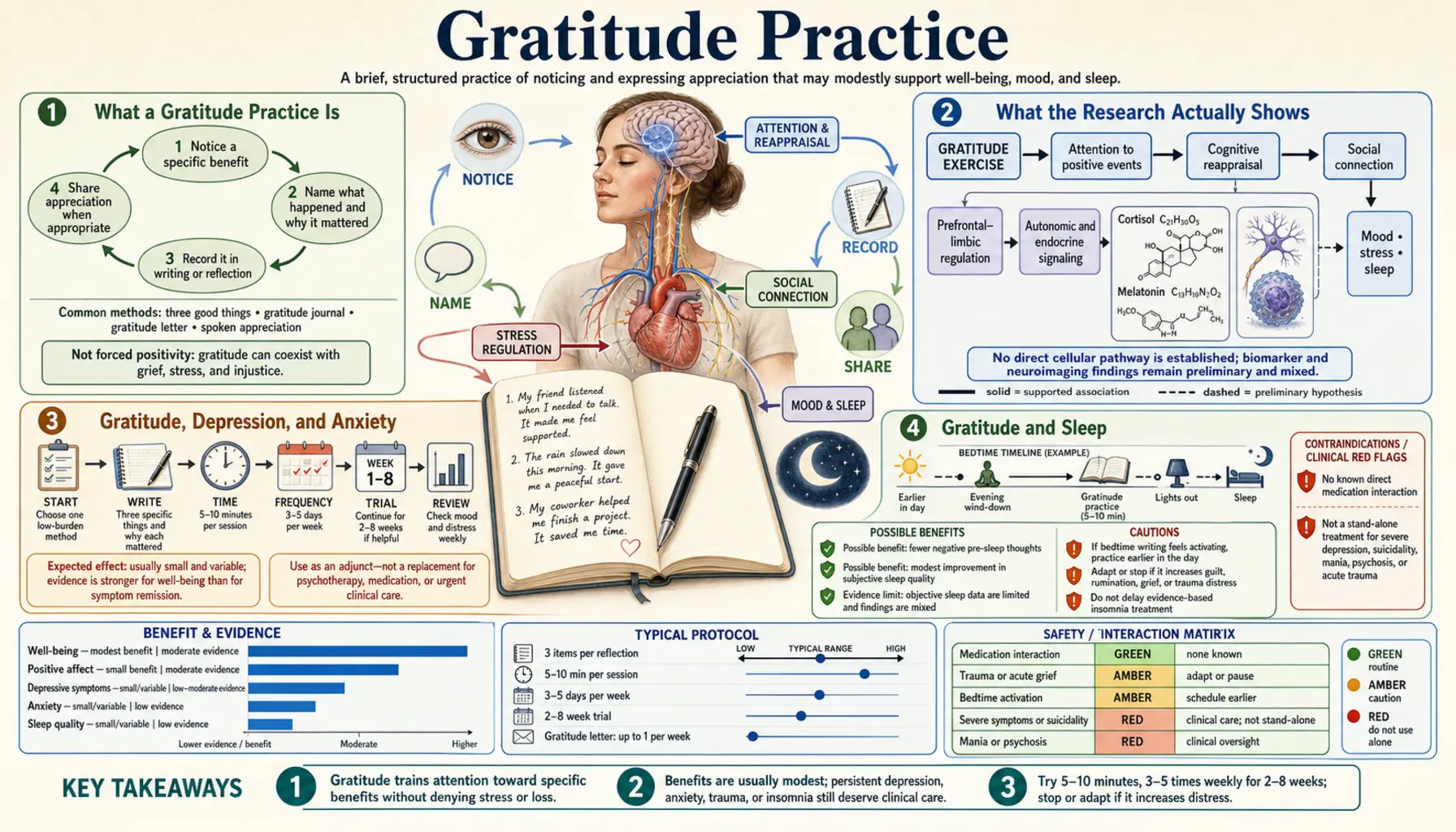
A gratitude practice is simply the deliberate habit of noticing and appreciating the good things in your life — and, importantly, doing it on purpose rather than waiting for the feeling to arrive on its own. In practical terms that usually means keeping a short gratitude journal, jotting down "three good things" that went well at the end of the day, or writing a heartfelt letter to someone who helped you. It sounds almost too plain to matter, yet gratitude is one of the more genuinely well-studied tools in positive psychology, with controlled trials behind it rather than just inspirational quotes.
This page lays out what the research actually shows — the encouraging parts and the honest limits. Early studies were striking, and gratitude reliably nudges mood, life satisfaction, and sometimes sleep in a good direction. But newer meta-analyses have tempered the early enthusiasm: the average effects are small to moderate, and gratitude is a helpful adjunct, not a cure for clinical depression. It is also not the same thing as forced cheerfulness or "toxic positivity," and it should never be used to paper over real pain or grief. What it is, at its best, is a free, low-risk, evidence-supported practice that modestly lifts wellbeing for many people when done as a sincere habit.
Table of Contents
- What a Gratitude Practice Is
- What the Research Actually Shows
- Gratitude, Depression, and Anxiety
- Gratitude and Sleep
- Relationships and Physical Health
- How Gratitude May Work
- The Practices, Step by Step
- Honest Caveats: Not Toxic Positivity
- The Honest Bottom Line
- Research Papers
- Connections
- Featured Videos
What a Gratitude Practice Is
Gratitude, in the psychological sense, is the felt sense of thankfulness that comes from recognizing something good in your life and, often, seeing that it came in part from outside yourself — another person, luck, nature, or circumstance. A gratitude practice turns that occasional feeling into a deliberate routine. Instead of hoping to feel grateful, you schedule a few minutes to look for what is going right.
Most practices fall into one of three families:
- Gratitude journaling / "three good things." At a set time — usually before bed — you write down a few specific things that went well and, ideally, why. The point is specificity: "my sister called and we laughed for an hour" beats a generic "my family."
- Gratitude letters and visits. You write a detailed letter of thanks to someone who helped you and never got a proper thank-you. Delivering it in person — a "gratitude visit" — produces one of the largest short-term boosts in wellbeing of any single exercise studied.
- Reflective gratitude. A quieter version: mentally reviewing the day, savoring a good moment, or offering thanks in prayer or meditation without necessarily writing anything down.
None of this requires money, equipment, a therapist, or a particular belief system. That accessibility is part of why researchers keep studying it and why clinicians sometimes suggest it as a low-cost first step.
What the Research Actually Shows
Gratitude earned its place in psychology through actual experiments, not just enthusiasm. Two studies are usually cited as the foundation.
In 2003, Robert Emmons and Michael McCullough ran a set of "counting blessings versus burdens" experiments. People randomly assigned to list things they were grateful for each week — rather than hassles or neutral events — reported better mood, more optimism about the coming week, and in one study even exercised more and had fewer physical complaints. It was a clean, randomized demonstration that directing attention toward the good could shift how people felt.
In 2005, Martin Seligman and colleagues tested several positive-psychology exercises in a randomized, placebo-controlled online study. Two gratitude-based ones stood out. The "three good things" exercise — writing down three things that went well each night for a week, with their causes — increased happiness and decreased depressive symptoms, with benefits that were still measurable six months later. The gratitude visit produced the single largest immediate jump in happiness of any exercise tested, though that particular spike faded faster.
Since then, dozens of trials have followed. When they are pooled in meta-analyses, the honest summary is this: gratitude practices reliably produce small-to-moderate improvements in wellbeing, positive mood, and life satisfaction compared with doing nothing. The effects are real and repeatable — but they are modest, not miraculous, and they shrink when gratitude is compared against another active, pleasant activity rather than against a blank control. In other words, part of the benefit is simply spending a few minutes deliberately focusing on something good, which many enjoyable habits can do.
Gratitude, Depression, and Anxiety
This is where honesty matters most, because it is where hopes run highest. Some studies — including Seligman's — found that gratitude exercises lowered depressive symptoms, and gratitude writing has been tested even in people already in psychotherapy, where it added a small edge to mental-health outcomes over therapy alone.
But the most careful recent work tempers the early optimism. A 2021 meta-analysis by Cregg and Cheavens, focused specifically on gratitude interventions as self-help for depression and anxiety symptoms, found only a small effect — and importantly, gratitude did not clearly outperform active comparison activities. Their measured conclusion was that gratitude can be a reasonable, low-cost adjunct, but it is not a stand-alone treatment and should not be oversold.
The practical takeaway is balanced, not dismissive:
- For everyday low mood, stress, or a wish to feel a bit more content, a gratitude habit is a sensible, safe thing to try.
- As a complement to therapy or other care, it may add a modest benefit and costs nothing.
- For clinical depression or an anxiety disorder, it is not a substitute for evidence-based treatment such as psychotherapy or, when appropriate, medication. If you are struggling, gratitude journaling is fine to keep doing — but please also reach out to a professional.
Gratitude and Sleep
One of the more intriguing threads is sleep. The idea is intuitive: if you end the day cataloguing good things instead of replaying worries, you may fall asleep in a calmer frame of mind. Some evidence supports this. Earlier research linked more grateful dispositions to better sleep quality, partly because grateful people reported more positive and fewer negative thoughts at bedtime.
A 2016 randomized study by Jackowska and colleagues had women spend two weeks on a brief nightly gratitude practice. Compared with control conditions, the gratitude group reported improved subjective wellbeing and better sleep, alongside some favorable shifts in blood-pressure measures. As with the mood findings, the sleep effects across the literature are encouraging but generally modest, and not every study finds them. Still, given that the "intervention" is writing a few lines before bed, it is a reasonable, no-cost thing to try if racing thoughts keep you awake — and it pairs naturally with the basics of good sleep hygiene.
Relationships and Physical Health
Gratitude is inherently social — much of what we are thankful for involves other people — and this shows up in relationship research. Expressing appreciation to a partner, friend, or colleague tends to strengthen the bond, making the other person feel valued and making us feel more connected. Trials of gratitude and appreciation exercises have found improvements in relationship satisfaction and in feeling supported.
The physical health story is more tentative and should be read carefully. A handful of small studies have measured biological markers: a pilot trial by Redwine and colleagues in patients with early-stage heart failure found that gratitude journaling was associated with better heart-rate-variability and some inflammatory markers, and a few studies report modest blood-pressure or wellbeing changes. But a 2020 systematic review by Boggiss and colleagues concluded that the evidence for gratitude improving physical health and health behaviors is still limited and mixed — promising in places, but far from established. It is fair to say gratitude may nudge health-related habits and stress physiology in a helpful direction; it is not fair to claim it treats disease.
How Gratitude May Work
No one mechanism explains gratitude's effects, but several plausible ones probably work together:
- Attention shift. The mind has a well-documented negativity bias — problems grab the spotlight. Deliberately searching for good things redirects attention, so you spend more of the day noticing what is working.
- Savoring. Writing something down makes you dwell on it a little longer, stretching a pleasant moment and letting it register more fully instead of slipping past.
- Reframing. Over time, the habit can gently reshape how you interpret events, building a more balanced, less catastrophizing default outlook.
- Social connection. Gratitude points outward, toward the people and forces that helped you. Acting on it — thanking someone — deepens relationships, which are among the strongest predictors of long-term wellbeing.
- Reduced rumination and calmer arousal. Ending the day on appreciation rather than worry may quiet the mental churn that fuels stress and disrupts sleep.
These overlap with why practices like meditation and broader stress management help: much of the benefit comes from where you place your attention.
The Practices, Step by Step
Here is how to actually do the three best-supported versions. Pick one and keep it small — consistency matters more than length.
Three Good Things
- Once a day, ideally at night, write down three things that went well that day. They can be tiny (a good cup of coffee) or large (a friend's kindness during a hard week).
- For each one, add a short note on why it happened or what role you or others played. This "why" step is part of what made it effective in the original studies.
- Keep it brief — a few sentences is plenty. Aim for most days rather than perfection.
Gratitude Journal
- Keep a notebook or note on your phone and list several things you are grateful for.
- On cadence: interestingly, some research suggests journaling once or twice a week can work as well as, or better than, every single day — doing it daily can make it feel routine and lose its punch. Experiment and keep whatever stays meaningful.
- Favor specificity and variety. "The way the rain sounded this morning" beats repeating "my health" every night. Novel, concrete entries keep the practice fresh.
Gratitude Letter and Visit
- Think of someone who did something meaningful for you whom you never properly thanked — a teacher, relative, mentor, or friend.
- Write them a specific, detailed letter: what they did, and how it affected you.
- If you can, read it to them in person or by phone — this is the "gratitude visit," which produced the largest single-session mood boost in the research. If that is not possible, sending it (or even just writing it) still helps.
Whichever you choose, the spirit is the same: sincerity over performance. Rushing through a list you do not feel does little. A few genuine lines does a lot.
Honest Caveats: Not Toxic Positivity
Gratitude gets oversold, so a few honest cautions are worth stating plainly.
- It is not toxic positivity. A healthy gratitude practice sits alongside real problems; it does not deny them. Telling yourself — or being told — to "just be grateful" in order to dismiss pain, injustice, or loss is not gratitude. It is invalidation, and it can make things worse.
- It does not replace grief. When you are mourning or in acute distress, forcing thankfulness can feel hollow or even shaming. Grief deserves room. Gratitude, if it comes, arrives gently and on its own schedule — not as an assignment to override sadness.
- The effects are modest. Meta-analyses put the average benefit in the small-to-moderate range, and gratitude often does not beat other pleasant activities in head-to-head tests. Expect a gentle lift, not a transformation.
- It is not a treatment for clinical illness. For diagnosable depression or anxiety, gratitude is an adjunct at best. It is not a stand-in for therapy, medication, or professional support.
- It may feel forced — or fall flat — for some. Not everyone responds, and for a minority, comparing their gratitude to their difficulties can briefly feel worse. If it consistently feels fake or discouraging, it is fine to stop and try something else, such as exercise or breath-based practices.
Framed honestly, gratitude is a gentle, optional tool — not a moral obligation and not a demand to feel a certain way.
The Honest Bottom Line
A gratitude practice is a rare thing in wellbeing advice: free, essentially risk-free, easy to try, and backed by real randomized studies. The evidence says it can modestly improve mood, life satisfaction, and sometimes sleep for many people, and that it strengthens relationships when you express it outward. The evidence also says the effects are small-to-moderate, that newer meta-analyses have rightly cooled the early hype, and that it is a companion to good care — never a replacement for treating serious depression or anxiety.
Used well — as a genuine, low-key habit rather than a performance, and with room left for real problems and real grief — noticing what is good is a small, sustainable way to feel a little more at home in your own life. That is a worthwhile thing, even if it is not a cure-all. Start with three good things tonight, keep it honest, and let it be what it is.
Research Papers
- Emmons RA, McCullough ME. Counting blessings versus burdens: an experimental investigation of gratitude and subjective well-being in daily life. Journal of Personality and Social Psychology. 2003;84(2):377–389. doi:10.1037/0022-3514.84.2.377 — the foundational randomized "counting blessings" experiments showing gratitude lists improved mood and optimism.
- Seligman MEP, Steen TA, Park N, Peterson C. Positive psychology progress: empirical validation of interventions. American Psychologist. 2005;60(5):410–421. doi:10.1037/0003-066X.60.5.410 — the RCT introducing "three good things" (lasting benefits) and the gratitude visit (largest immediate boost).
- Sheldon KM, Lyubomirsky S. How to increase and sustain positive emotion: the effects of expressing gratitude and visualizing best possible selves. The Journal of Positive Psychology. 2006;1(2):73–82. doi:10.1080/17439760500510676 — found expressing gratitude reliably raised positive emotion.
- Wood AM, Froh JJ, Geraghty AWA. Gratitude and well-being: a review and theoretical integration. Clinical Psychology Review. 2010;30(7):890–905. doi:10.1016/j.cpr.2010.03.005 — a comprehensive review tying gratitude to wellbeing and proposing how it works.
- Emmons RA, Stern R. Gratitude as a psychotherapeutic intervention. Journal of Clinical Psychology. 2013;69(8):846–855. doi:10.1002/jclp.22020 — reviews the case, and the limits, of using gratitude in clinical practice.
- Kerr SL, O'Donovan A, Pepping CA. Can gratitude and kindness interventions enhance well-being in a clinical sample? Journal of Happiness Studies. 2015;16(1):17–36. doi:10.1007/s10902-013-9492-1 — gratitude and kindness practices improved wellbeing and reduced anxiety in help-seeking participants.
- Jackowska M, Brown J, Ronaldson A, Steptoe A. The impact of a brief gratitude intervention on subjective well-being, biology and sleep. Journal of Health Psychology. 2016;21(10):2207–2217. doi:10.1177/1359105315572455 — a two-week practice improved wellbeing and sleep with some favorable blood-pressure changes.
- Davis DE, Choe E, Meyers J, et al. Thankful for the little things: a meta-analysis of gratitude interventions. Journal of Counseling Psychology. 2016;63(1):20–31. doi:10.1037/cou0000107 — pooled trials show real but modest gains, smaller against active control conditions.
- Redwine LS, Henry BL, Pung MA, et al. Pilot randomized study of a gratitude journaling intervention on heart rate variability and inflammatory biomarkers in patients with stage B heart failure. Psychosomatic Medicine. 2016;78(6):667–676. doi:10.1097/PSY.0000000000000316 — a small trial linking gratitude journaling to better heart-rate variability and inflammatory markers.
- Wong YJ, Owen J, Gabana NT, et al. Does gratitude writing improve the mental health of psychotherapy clients? Effects of a randomized controlled trial. Psychotherapy Research. 2018;28(2):192–202. doi:10.1080/10503307.2016.1169332 — gratitude letters added a small mental-health benefit over psychotherapy alone.
- Boggiss AL, Consedine NS, Brenton-Peters JM, Hofman PL, Serlachius AS. A systematic review of gratitude interventions: effects on physical health and health behaviors. Journal of Psychosomatic Research. 2020;135:110165. doi:10.1016/j.jpsychores.2020.110165 — concludes the physical-health evidence is limited and mixed, urging caution.
- Cregg DR, Cheavens JS. Gratitude interventions: effective self-help? A meta-analysis of the impact on symptoms of depression and anxiety. Journal of Happiness Studies. 2021;22(1):413–445. doi:10.1007/s10902-020-00236-6 — the honest tempering meta-analysis: only a small effect on depression and anxiety, no clear edge over active comparisons.
Connections
- All Remedies
- Meditation
- Stress Management
- Sleep Hygiene
- Natural Anxiety Relief
- Breathwork
- Exercise
- Yoga
- Qigong
- Psychiatry
- Depression
- Anxiety